The Films Busan Keeps Bringing Back
From Shin Na-ri’s final documentary to films returning decades later, Busan’s independent cinema lives through filmmakers, critics, theaters and the people who gather there.

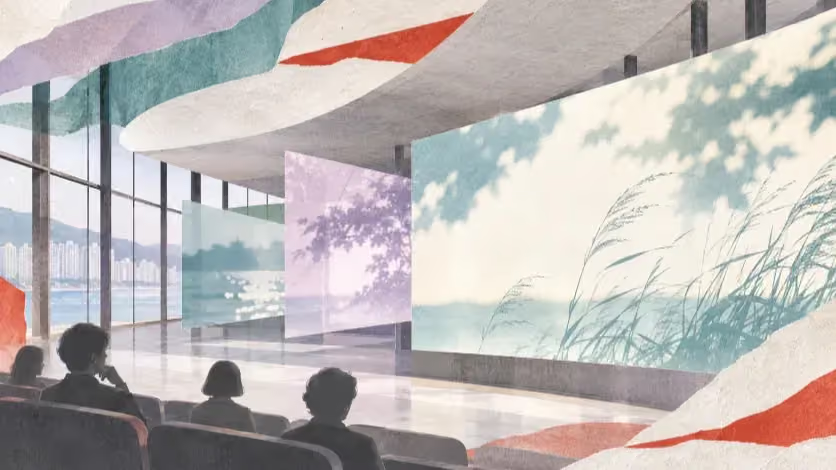
A filmmaker's final documentary, films returning after decades, and the people who keep screening them trace a history of Busan's independent cinema that extends far beyond festival week.
Four years of work lie behind the 64 minutes of Doban, the documentary chosen to open the 28th Independent Film Festival Busan on November 19. Its subject, according to the festival's program, is the relationship between Kim Young-gil, a master of traditional Korean pottery, and his apprentice, the artist Park Sung-jun. The craft they practice is learned through prolonged attention to another person's work. The film's own journey toward completion demanded a different kind of persistence.
Director Shin Na-ri died in 2025. Producer Lee Jin-seung told Yonhap News Agency that her prolonged illness had made the four-year production difficult to complete, and that support from the Ulju Mountain Film Festival's UMFF Summit initiative helped the team finish the work. Ulju identifies Doban as a 2024 supported project and screened it in September 2026. When Busan selected the documentary for its November opening, it was adding another occasion for the finished film to meet an audience. Behind that choice lay a production sustained by collaborators and support from outside the city, followed by separate decisions to place the work in front of viewers.
Another film follows a longer passage of time. Kim Ji-gon's documentary Forget the Ocean, When We Look at the Ocean—Mangyangjungbok in Korean—was included in the festival's 2025 Spectrum Busan program. Critic Lee Woo-bin described footage accumulated over roughly fifteen years around Mangyang Road, where new buildings had increasingly obscured the hillside's view of the sea. The documentary subsequently entered the 2026 Local Pick, Bright Time calendar, presented by the Busan Cinema Center and the Busan Independent Film Association. So did Kim Jong-han's short fiction film snowy spring day, which had appeared in the 2025 Spectrum program. The later listings place these works within a continuing repertoire, where programmers and cinemas must choose which films deserve another evening on the screen.
The institutions that make such encounters possible have their own histories. Long before Busan became internationally identified with film festivals, residents were arguing about what cinema should show, learning how to make it and organizing places where others could watch. The different traditions did not always agree about the purpose of a film, but their points of contact shaped the city's independent-film culture.
The People Who Made a Film Culture
In the 1950s and 1960s, Chang Kap-sang was writing about cinema in Busan's newspapers. A professor of English literature at Pusan National University, he helped establish a local tradition of public film criticism while participating in societies and institutions devoted to cinema. His 1970 collection Film and Criticism gathered essays and reviews; a 2025 study by Lee Seon-ju identifies 268 short assessments of individual films in the volume. The reviews belong to a history in which watching cinema led to sustained argument about it. What the theater presented for an evening could continue to circulate through the newspaper, the film society and the conversation that followed.
Others wanted the means of production in their own hands. The Busan Small-Gauge Film Club, established in 1970, brought residents together around 8mm and 16mm filmmaking. Film historian Lee Seok-chang links this amateur movement to the development of the Korean Short Film Festival in 1980, the forerunner of today's Busan International Short Film Festival. Lee's research also traces the movement's decline in the early 1980s as video and television altered viewing practices. The short-film festival endured, while the club that helped lay its groundwork lost momentum—a reminder that an institution can outlast the particular community and technology from which it emerged.
The establishment of a film department in 1983 at the institution that became Kyungsung University gave this landscape a further dimension. Its records describe student screenings in the middle of the decade, evidence that filmmaking was becoming part of a formal course of study while small-gauge enthusiasts and independent screening circles continued to develop their own practices. Those paths offered different kinds of equipment, instruction and collaboration, and they later intersected in the lives of local filmmakers.
During the 1980s, Busan's French Cultural Center became a gathering place for people drawn to films absent from ordinary commercial theaters. The Busan Cine Club took shape there in 1984. Former participants later helped establish Cinematheque 1/24 in 1993, extending screenings, discussions and film study beyond a single cultural center. In interviews published years afterward, organizers recalled preparing Korean subtitles and building a collection of videos to give local audiences access to unfamiliar films. The labor of cinema had expanded to include selecting, translating and presenting works that viewers might otherwise never encounter.
Another network approached the camera as an instrument of social testimony. The collective Kkotdarim, formed in 1988 amid student and cultural activism, made and circulated films concerning political protest, labor and the lives of people neglected by mainstream media. In 1994, Jo Sung-bong founded Hani Video, which drew on relationships with people involved in the city's cinephile circles. Historical reporting identifies individuals who moved between those groups, among them Heo Hyeon-suk and collaborators on Jo's later documentary Red-Hunt. The cinephiles concerned with access to world cinema and the filmmakers recording political conflict pursued different aims; their personal and professional connections nevertheless helped shape a broader local filmmaking community. Its history runs through particular collaborations rather than an unbroken succession of institutions.
The Busan International Film Festival began in 1996. According to the independent association's chronology, the first Made in Busan Independent Film Festival followed on May 15–17, 1999, and the association was formally founded that October. It subsequently organized workshops and exchanges with filmmakers in other cities, published criticism and developed projects concerned with the history of local cinema. The organization did not create Busan's earlier film cultures; it brought some of their interests in production, exhibition and criticism into a more durable common framework.
The disagreements that animated those earlier communities have contemporary counterparts. A 2023 qualitative study by researchers at Pusan National University drew on interviews and discussions with local filmmakers who described independent cinema variously as socially engaged work, personal documentation, preparation for commercial filmmaking and a category shaped by public support programs. Such different ambitions help explain why the films now grouped under a regional festival's name need not share a subject, method or aspiration.
The same interviews describe the practical difficulty of sustaining those ambitions. One participant spoke of being unable to find enough collaborators for local productions; another linked the movement of film workers toward the Seoul metropolitan area to the scarcity of work that could support a livelihood in Busan. A further concern was that funding and distribution systems might reward familiar subjects and narrow filmmakers' choices. These are testimonies from a qualitative study rather than a representative employment survey. They nevertheless complicate any easy equation between a full festival schedule and secure conditions for producing the next film.
A City's Films, Made in Different Ways
Before Doban was selected as the 2026 opening film, Shin Na-ri's earlier shorts had already been brought together in a separate Busan theater. In January, the Seobusan Media Center and the Busan Independent Film Association announced a program at the new Modu Theater spanning four works she had made between 2018 and 2024. The program brought successive parts of her career into view before the November festival chose to feature her final completed documentary. One selection looked across earlier work; the other concentrated attention on a project completed under exceptionally difficult circumstances. The filmmaker's legacy was taking shape through curatorial decisions at distinct venues.
Kim Ji-gon's practice follows another timetable. The 2025 festival's program notes trace four Halmae films, made between 2011 and 2015, before the documentary set around Mangyang Road. In the programmers' account, the films sustain attention to older residents and the places they inhabit. The hillside and its altered view of the sea give Mangyangjungbok a distinctly Busan subject, but the film's public itinerary is not confined to Busan. It appeared on the 2025 DMZ International Documentary Film Festival's Korean Competition selection list; the Busan Film Commission has identified it as a recipient of 2022 production assistance and included it in a separate November 2025 showcase. The local independent festival and the following year's cinema series offered further engagements. This is the record of a film moving through a national documentary competition, a regional production organization and local exhibitors, each with a different role in its life.
Kim Jong-han's work has moved at a different pace. His 22-minute fiction film snowy spring day entered the 2025 Spectrum program after receiving postproduction assistance through the association's Project Indie Busan initiative, according to its programmers. The following edition selected another of his shorts, Forget, while the earlier film had appeared on the June 2026 Local Pick calendar. These overlapping dates offer a glimpse of a working filmmaker's successive projects and the different programs willing to present them. They reveal a continuing practice, though the record of one booking says nothing about how the next production was financed.
Other projects begin with friends, collaboration or travel. A festival programmer described Kwon Yong-jin's 2025 short Free Photo as a work developed with friends around a pedestrian overpass; a year later, Kwon shared directing credit with Shin Eun-ju on Dancing Out Loud. The records point to different working arrangements without establishing a complete account of their production resources. Lee Si-o's Homecoming took the question of place further: made through a Busan Inter-City residency in Quezon City, the Philippines, it entered the 2025 Spectrum selection as a work by a filmmaker connected to Busan but produced abroad. Local artistic identity and filming location had ceased to be the same question.
This range of practices gives the festival's regional competition a more precise meaning. The 2026 Made in Busan rules qualify directors through at least a year of actual residence in Busan or production companies through a local address and recent production record, with additional provisions for co-directors. The rules concern the people or production organizations responsible for a work, rather than requiring its story to contain a Busan landmark. They also distinguish competition from curated sections: the inclusion of Homecoming in Spectrum, for instance, says nothing about whether it was entered in Made in Busan.
The competition received 95 submissions for 2026—90 shorts and five features—and selected 16 works. The detailed listings identify 13 shorts and three features, with 12 fiction titles and four documentaries. Submissions had numbered 72 in 2024 and 79 in 2025, when eligibility was widened beyond filmmakers' first features. The rising totals therefore describe the festival's changing entry pool rather than a measured expansion of the city's entire production sector. The selection nevertheless contains revealing individual journeys. Moon Won-su's Moolmangol, named after a Busan neighborhood, drew on an unusual combination of film training and experience in public administration, according to accounts published around its selection. Yu So-young's feature documentary Water Deer had appeared in the Jeonju International Film Festival's Korean Competition and received a prize before its Busan selection. The first work brings a particular local place and an individual route into filmmaking to the screen; the second arrives with a national festival history already attached. Regional affiliation leaves room for both.
Beyond the competition, geography opens in the other direction. The 2026 Local-to-Local program lists eight features and seven shorts from elsewhere in Korea. Its films include Jang Yun-mi's Miari Texas, whose curatorial description follows histories of a place in Seoul, and Each and Every World, made by Jang and Lee Su-yu and concerned with the lives of farmed animals. Gam Jeong-won's Stars and Sand offers a particularly clear route between regional programs: earlier in 2026, Jeonju International Film Festival selected it for a showcase associated with Daegu and North Gyeongsang, while Busan placed it in its November lineup. The selections show how a film associated with one region can enter another city's program without an exclusive claim of ownership by either festival.
Other festivals have built their own routes for regional cinema. The 2026 Seoul Independent Film Festival selected work for a Local Cinema section, while Jeonju's regional showcase involved independent-film associations from eight areas. Busan International Short Film Festival has also proposed touring programs of award-winning shorts with provisions for rights-holder agreements and screening fees. Within that wider network, Busan's combination of sections has a particular coherence. Made in Busan defines a place-based competition; Local-to-Local brings the work of other regions to the city; Spectrum allows recent films to be considered alongside earlier ones. Busan becomes at once a working base for filmmakers, a host for visiting work and a place where its own cinematic history can be reconsidered.
The Calendar Beyond November
The calendar beyond festival week offers a different way to follow a filmmaker's work. In April 2022, a Busan Cinema Center program co-presented with the independent-film association included Kim Ji-gon's Monthly Halmae. Four years later, the continuing Local Pick, Bright Time series listed Mangyangjungbok in its annual repertoire. Between those dates lies a succession of programming decisions rather than an uninterrupted theatrical run. The association and the cinema returned to Kim's work at different points in its development, sustaining a place for it on a screen outside the annual festival.
The 2026 calendar announced 25 film titles distributed among themed screenings through December. Several had appeared at the independent festival the previous November. The Form of Matter, Lee Seong-uk's 2025 top-prize winner, was listed in January. Just One More Time, that year's opening film, followed in April. A June program grouped Self Tape, The Hill, snowy spring day and Lee Ha-ram's Bugs; Indieground's nationwide independent-theater bulletin independently carried the June screening notice. The roster spans scheduled engagements through December; its 25 titles describe the program's breadth, while admission and financial results remain outside the published evidence.
Lim Ji-hun's Haunt makes the involvement of spectators particularly tangible. At the 2025 festival, the film received both a special jury prize and the audience-jury award. The audience jury published an assessment engaging with the work's treatment of particular Busan places and the problem of people whose residence is unregistered. The film was subsequently listed for a March 27, 2026 Local Pick program with Simon and another short. The jury's published judgment and the later cinema listing belong to separate moments in the film's public life. One records how a group of viewers interpreted the work; the other shows programmers choosing to present it again, without establishing that the earlier award determined the later booking.
The venue has a history of its own. IndiePlus at the Busan Cinema Center marked its tenth anniversary in 2026 with independent-film screenings, repertory selections and filmmaker discussions. A permanent theater brings continuity that an annual selection committee, working alone, could never provide: a projection space, recurring dates, staff and a program that must be renewed throughout the year. The association's role in choosing films operates alongside the cinema's responsibility for presenting them.
In Busan's smaller theaters, another kind of cultural work comes into view. The association's Indiecritic in Mousai has linked films discussed in its periodical Indiecritique with screenings at Mousai Theater; the published archive records programs in 2024 and 2025. Criticism here is not confined to a written judgment circulated after the fact. It can become a reason to gather in a theater and examine a film again. The public schedule documents this relationship in 2024 and 2025, showing a form of film culture in which published criticism and theatrical programming reinforced one another.
The city's smaller theaters have also begun working with one another. In November 2026, Modu Theater at the Seobusan Media Center, Corner Theater and Mousai Theater announced MomoMu, a joint program of 22 films, readings and audience activities. Its selection includes international and older commercial movies as well as independent work. Organized by the three venues rather than the annual festival, the event offers a parallel view of local film culture: the people who keep a place for watching cinema alive are not limited to those who produce films about the city.
The association reported 54 films and 26 filmmaker-audience conversations at its 2025 festival, and thanked 1,140 audience members in a separate statement. It has not supplied a definition establishing whether that last figure counts individual people or visits to separate screenings. The count is best read as the organizer's report on one edition, while the jury's written response to Haunt reveals something numbers alone cannot convey: spectators were invited to become interpreters and judges of films made around them. A new audience jury was preparing for the November 2026 competition, carrying that practice into the festival's next edition.
When a Film Returns After Decades
The longer history of screening is not always one of uninterrupted access. Jo Sung-bong's documentary Red-Hunt, chosen for the 2026 Spectrum Rewind program, was presented in the Wide Angle section of the Busan International Film Festival in 1997. The film deals with testimony concerning the killings and repression surrounding Jeju April 3. Soon afterward, police prevented planned screenings in Jeju and Gwangju, citing allegations about the documentary's politics and the absence of required screening approval. Gwangju organizers challenged the contradiction of a film shown at Busan's international festival being refused at their own event. The film's earliest circulation thus depended as much on the places where it could be shown as on the restrictions encountered elsewhere.
Later screenings form a more complicated record than a simple story of disappearance and recovery. The Korean Film Archive lists Red-Hunt in a June 24, 2009 program in Seoul. In 2018, it was shown again alongside its sequel during events marking the seventieth anniversary of Jeju April 3, followed by a discussion involving the director. The 2026 Rewind selection placed it on another announced program, nearly three decades after its first Busan festival appearance. Each occasion belonged to its own historical moment. Audiences in the late 1990s, in 2009 and at anniversary screenings years later were not necessarily gathering to ask identical questions of the same documentary.
The records also expose a difficulty familiar to anyone trying to revisit an older film. The Busan festival's 1997 archive lists Red-Hunt at 83 minutes on Beta, while a contemporary newspaper account from the same year describes a 67-minute documentary; the Korean Film Archive's 2009 entry likewise gives 67 minutes, on DVD. The entries do not establish whether different versions circulated or whether one or more catalogues recorded the running time incorrectly. They identify occasions on which the film was presented and advertised, while leaving the history of the surviving elements and their condition to be established separately.
Cho Eun-sung's Uju Kkotsaseum, another 2026 Rewind selection, offers a different history of return. The film appears in the Seoul Independent Film Festival's 2001 archive as a 16mm fiction short; the filmmaker's accompanying statement describes a story concerned with the difficult emotional life of two people around a barbershop. In 2006, the eighth Made in Busan Independent Film Festival included it in a program titled Made in Busan Revisited, alongside other works from the turn of the millennium. Its 2026 inclusion therefore follows an earlier act of recollection. What appears in the present as a retrospective has its own past as a film that was already worth showing again.
Screening histories / 1997–2026
Two Films, Several Returns
Two different works, two sets of public records. Each entry marks a documented listing, a reported restriction or a later return—not an unbroken run of screenings.
01 / Documentary
Red-Hunt (1997)
Festival archive
Busan International Film Festival · Wide Angle
Contemporary news report
Police prevented planned screenings in Jeju and Gwangju.
Archive cinema program
Cinematheque KOFA · June 24 listing, Seoul
Reported screening and discussion
Jeju April 3 anniversary event · with Red-Hunt 2
Scheduled · as of Nov. 18
Independent Film Festival Busan · Spectrum Rewind
02 / Fiction short
Uju Kkotsaseum (2001)
Festival archive
Seoul Independent Film Festival · 16mm fiction short
Contemporary festival program
8th Made in Busan · Made in Busan Revisited
Scheduled · as of Nov. 18
Independent Film Festival Busan · Spectrum Rewind
A screening record is not a preservation record.
These entries identify individual public programs and reports. They do not establish continuous availability, the condition of original film elements, restoration or rights clearance.
The association has taken steps to record this history beyond individual programs. Its published chronology refers to an independent-film archive-building project begun in 2010, volumes of Indiecritique devoted to local filmmakers, and later 16mm screenings of historical work. A film-personnel database was established in 2016. These records show sustained attention to memory, criticism and filmography, although a database of people is not the same thing as a collection of original film materials. Archival custody requires identifiable elements, appropriate storage, a record of rights and a means for future use. Without a current holdings inventory, the 2010 initiative cannot serve as proof that every important Busan film has been preserved or remains accessible.
The two Rewind titles therefore bring different histories into the present. Red-Hunt carries a record of political restriction and renewed public discussion; Uju Kkotsaseum returns to a festival that had already revisited it twenty years earlier. Their subjects and circumstances are scarcely comparable, yet each depends on the existence of a viewable copy, permission to present it and a curator willing to make room for it. The festival's choice begins a new occasion for viewing, while the material and legal work that makes such a choice possible extends well beyond the screening itself.
As the festival prepares to open on November 19, Doban arrives with four years of work behind it and the loss of its director woven into its production history. The same program is set to bring Red-Hunt and Uju Kkotsaseum, films first shown decades earlier, before the city's viewers once more. Elsewhere, a recurring cinema series continues to give more recent titles another date. Between these encounters are the people who learned to make films, wrote about them, argued over where they could be screened and cared enough to bring them back. Busan's independent cinema has taken shape through that accumulated work, one film and one showing at a time.
Continue this reporting
Reporting on the same issue
Related coverage selected from the article's desk, topics and newsroom relationships.
 NewsJun 17, 2026
Netflix’s Teach You a Lesson Reopens Korea’s Teacher-Protection Debate
Overseas, Netflix’s Teach You a Lesson looks like an anti-bullying revenge dr...
 NewsApr 8, 2026
Who Makes a BTS Site in Busan?
As BTS’ return drives global attention back to Busan, some fan landmarks were...
 NewsAug 9, 2025
Korean Jjimjilbangs: Global Fame, Local Decline
On screen, Korea’s bathhouses glow with warmth and color. In reality, many ar...
More from the author
More from this byline
Stay with the same line of reporting through more work from this byline.
 NewsOct 16, 2026
What Is Still Worth Going to See?
Reader Signal
Community readWhat did this report leave you with?
Choose the signal that best reflects your reading. Select it again to remove it.
One response per article
No response selected
A moderated conversation about the reporting.
One-level replies and newsroom moderation keep the conversation anchored to this article.
Discussion Status
Open
Please sign in to join the discussion.
Newsletter
Weekly reporting and context from Busan and Korea.