What the Trump–Lee Summit Reveals About Power, Peace, and Policy
Economic deals, defense costs, and diplomacy converged as the Trump–Lee summit recast the U.S.–Korea alliance in an era of rivalry and change.

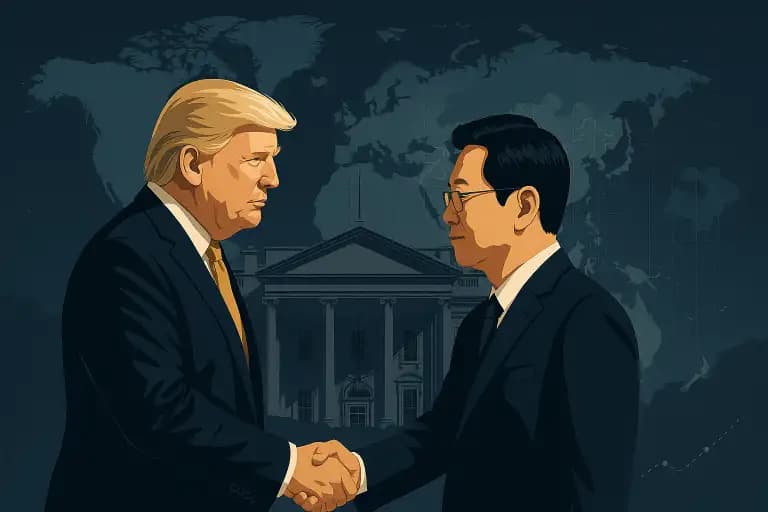
Washington delivered the images it wanted: smiles in the Oval Office, warm handshakes, and a brief invitation to meet again at APEC. Yet the path to that stage was anything but orderly. Hours earlier, Donald Trump had jolted Seoul with a social-media post claiming South Korea faced a “Purge or Revolution,” tying domestic investigations to U.S. military bases in language as dramatic as it was misleading. The remark set off a storm in conservative media and risked overshadowing the summit before it even began.
Inside the White House, the tone shifted quickly. President Lee responded with humor and calm explanations, recasting the meeting in the language of cooperation. He labeled Trump the peacemaker and put Seoul in the role of pacemaker—a rhetorical turn that signaled a new balance: U.S. leadership would remain, but South Korea would seek to shape timing and diplomacy rather than passively absorb decisions.
Economics soon threaded into security. South Korean companies announced billions in U.S. investments while Washington pressed for greater defense contributions, presenting trade incentives and alliance costs as two sides of the same negotiation. And on the margins of policy talk, a new stage appeared: the Wonsan–Kalma resort on North Korea’s east coast, newly opened and already floated—half jokingly—as a venue for high-profile diplomacy.
Media coverage split along predictable lines. State outlets in Seoul stressed continuity and opportunity; conservative dailies dissected Trump’s remarks for signs of tension; foreign correspondents widened the lens to cost-sharing, China strategy, and the possibility of renewed nuclear talks. The day revealed an alliance juggling rhetoric and reality, domestic politics and regional strategy, with symbols like APEC and Wonsan carrying weight beyond ceremony.
Pre-Summit Messaging and Reality Check
Hours before the summit, Trump posted on Truth Social that South Korea looked as if it were going through a “Purge or Revolution.” He cited reports of church raids and even suggested U.S. bases were involved. The remarks landed with force in Seoul, where conservative outlets quickly picked them up, linking the phrase to long-running concerns about political investigations at home. For a few hours, the narrative threatened to overshadow the summit itself.
When Trump and President Lee finally met in the Oval Office, the tone shifted almost immediately. Lee began with light humor and open compliments, remarking on the Oval Office’s new décor and even joking about building a “Trump Tower” in North Korea. He explained that the investigations Trump had referenced were lawful proceedings carried out under existing statutes, not signs of political upheaval. The conversation moved on, with both leaders signaling that the alliance, not domestic disputes, would define the day’s agenda.
As prosecutors in Seoul later clarified the facts, some of the conservative commentary softened. What had briefly served as a talking point for critics of the administration came to look more like a misunderstanding amplified by distance and timing. International coverage noted the arc: a provocative social-media post, domestic political reverberations, and finally a reset inside the White House where diplomacy, rather than confrontation, took center stage.
Diverging Media Frames
Coverage of the summit split along clear lines. In Seoul, the presidential office and state broadcasters led with President Lee’s invitation for Donald Trump to attend the APEC summit in Gyeongju this October, the handshake scenes in the Oval Office, and Lee’s call to reopen talks with Pyongyang. Their reports emphasized continuity, diplomacy, and the optics of alliance stability rather than the frictions surrounding Trump’s earlier remarks.
Conservative dailies chose a different focus. Chosun Biz highlighted Trump’s claim about “owning” U.S. base land, pulling the Status of Forces Agreement into view and linking it to the cost-sharing negotiations expected later this year. Editorials also raised the discrepancy between Trump’s “over 40,000” troop figure and the Pentagon’s 28,500, pressing for clarity before talks resume.
Foreign outlets widened the lens further. Reuters paired the Oval Office images with Trump’s comment about meeting Kim Jong-un this year and Lee’s speech at CSIS. The Financial Times tied cost-sharing to Washington’s shifting approach toward Beijing. Al Jazeera and The Guardian noted the contrast between Trump’s combative pre-summit posts and the measured tone inside the White House, while the Times of India flagged his unexpected reference to World War II “comfort women,” a reminder that historical disputes can surface without warning.
Across these narratives, the same facts produced distinct interpretations. Domestic state media cast the summit as opportunity, conservative papers as a moment requiring scrutiny, and foreign correspondents as part of a wider strategic map. The divergence reflected not contradiction but calibration—each outlet writing to its audience, its politics, and the diplomatic calendar ahead.
Korea’s Rhetorical Pivot in Alliance Politics
The summit in Washington did more than produce headlines. By presenting Trump as the “peacemaker” and South Korea as the “pacemaker,” Seoul recast the alliance in terms that reached beyond traditional security language. The message was clear enough: the United States would take the lead on major decisions, but South Korea intended to shape the pace and structure of whatever diplomacy followed.
This was not the way the alliance used to speak. For decades, terms like deterrence and defense carried the weight of policy debates. They reflected a history built around military readiness and the risks posed by North Korea. What emerged this time was different. Peace and dialogue moved to the center, signaling that alliance modernization now touches politics and economics as much as it does troop levels or missile defenses.
Washington has its own reasons for widening the scope. Its version of modernization draws allies into trade policy, technology supply chains, and Indo-Pacific strategy. Seoul, by contrast, used the language of peace to mark out a space for itself—an attempt to show that joining U.S. strategy does not mean giving up the ability to set diplomatic rhythms or to manage regional optics.
Here the contrast with the Moon administration stands out. Under Moon, peace language was tied closely to inter-Korean talks and the idea of a formal end to the Korean War. The current government places the same language inside alliance diplomacy itself. It treats peace not only as a goal for the peninsula but as a frame through which to build a more balanced partnership with Washington.
That choice serves several purposes. It lowers the political costs of deeper security ties, leaves open the possibility of renewed talks with Pyongyang, and offers a softer edge to alliance modernization at a time when U.S.–China rivalry shapes nearly every regional decision. By giving peace a central place while recognizing U.S. leadership, Seoul aims to keep both flexibility and credibility as the alliance enters a more complicated phase.
Wonsan–Kalma and the Trump Tower Idea
The Wonsan–Kalma coastal resort has moved quickly from a showcase of North Korea’s domestic ambitions to a stage for international signaling. In June, Pyongyang declared the complex officially open, boasting a capacity of twenty thousand visitors and an expanded airport capable of handling long-haul aircraft. Within weeks, Russian foreign minister Sergey Lavrov used the resort—not Pyongyang—for high-level talks, a choice that hinted at the site’s emerging role as a venue for diplomacy as well as tourism.
Foreign access, however, has remained uneven. Russian charter flights and a direct rail line from Moscow reopened over the summer, bringing small tour groups to the resort, only for Pyongyang to suspend outside visitors again weeks later. This stop-and-go pattern mirrors the broader unpredictability that has long limited foreign investment in North Korea, despite repeated attempts to court Russian and Chinese tourists.
It was in this setting that President Lee joked about building a “Trump Tower” on the Kalma peninsula, a remark Trump greeted with his trademark smile. For a leader drawn to spectacle and unexpected breakthroughs, the image of a U.S.–North Korea summit at a luxury resort bearing his name would carry obvious appeal. It would offer cameras the kind of headline moment he has favored before: a deal signed in a place no one expected, with architecture and drama sharing the frame.
Yet the practical barriers remain high. United Nations Security Council resolutions prohibit joint ventures with North Korea, while U.S. Treasury regulations ban nearly all new investment, services, and financial transactions without specific licenses. American passports cannot be used for travel to North Korea except under rare validations renewed annually by the State Department. Any real estate or branding project would therefore require a cascade of legal and diplomatic shifts—from sanctions relief to domestic political approval in Washington—before ground could be broken.
For now, the resort’s most realistic diplomatic role lies in hosting symbolic meetings rather than construction projects. Its airport, hotels, and controlled access points offer the infrastructure for high-level summits, much as Singapore and Panmunjom once did. Whether Washington would accept the political risk of a North Korea–based venue remains uncertain, but the idea itself reflects Pyongyang’s bid to recast Wonsan–Kalma as more than a tourism venture: a physical stage for diplomacy, open to leaders eager for spectacle as well as substance.
Policy and Strategic Implications
Trump’s remarks did not land in a vacuum. They came at a time when the U.S.–Korea alliance is already negotiating its financial and political balance. The Special Measures Agreement, which governs Seoul’s payments for the 28,500 American troops stationed on the peninsula, comes up for renewal later this year. South Korea has increased its contribution under the current deal—by over eight percent, according to defense ministry figures—but even the suggestion of additional demands from Washington could fuel political backlash in Seoul. Lawmakers have long treated cost-sharing as a matter of sovereignty as much as budgets, forcing every round of talks into public view.
The offhand comment about “owning” U.S. base land cut closer still. The Status of Forces Agreement has since 1967 kept ownership firmly in South Korean hands while granting the U.S. rights of use. Any move to alter that principle would invite legal scrutiny first, and fierce political debate immediately after. Senior officials in Seoul, speaking to local media after the summit, made clear that neither party has tabled such a proposal; but they also acknowledged that even casual remarks from Washington can trigger domestic unease when alliance sovereignty lines are involved.
Yet the meeting was not defined by friction alone. President Lee’s invitation for Trump to attend the APEC summit in Gyeongju this October opens a potential diplomatic track that could include North Korea if conditions shift. Trump said he was open to meeting Kim Jong-un before year’s end—a brief comment with outsized implications, given that U.S.–DPRK talks have been stalled since 2019. Analysts in Seoul and Washington noted that APEC could offer the first high-level setting for such contact in years, even if details remain hypothetical.
Economic and security threads ran together through the summit’s aftermath. South Korean firms pledged roughly $150 billion in U.S. investments across shipbuilding, semiconductors, nuclear energy, and advanced manufacturing—part of a broader effort to deepen industrial ties. Trump, for his part, paired those commitments with talk of tariff relief and repeated calls for allies to shoulder more defense costs. The approach points to a regional strategy where trade, technology, and military burden-sharing advance in parallel, leaving Seoul with both an opportunity and a dilemma: how to lock in economic gains while bracing for sharper demands on security policy in the months ahead.
Alliances Under Pressure, Asia in Flux
The Trump–Lee summit produced no treaties or sweeping agreements, yet its impact reached beyond the images from the Oval Office. In a single day, the alliance absorbed social-media provocations, disputes over troop levels and base sovereignty, and a burst of political commentary in Seoul. What remained was a partnership intact but increasingly shaped by economic strategy, regional competition, and domestic sensitivities rather than the old logic of deterrence alone.
South Korea’s domestic reaction showed how quickly sovereignty concerns can flare when alliance management collides with local politics. Trump’s offhand remark about “owning” U.S. base land energized critics before officials clarified the facts, a reminder that cost-sharing talks carry risks well beyond budgets.
Economic and security agendas also moved together. South Korean firms pledged $150 billion in U.S. investments across shipbuilding, semiconductors, and energy, while Washington linked those commitments to tariff relief and calls for larger defense contributions. This dual track leaves Seoul weighing economic opportunity against the tighter strategic alignment Washington seeks as its rivalry with China deepens.
North Korea hovered at the margins. Trump’s comment about a possible meeting with Kim Jong-un under the APEC umbrella lacked detail but revived speculation about diplomacy returning to the peninsula.
Beneath these threads ran a rhetorical shift. By casting the United States as the peacemaker and South Korea as the pacemaker, Seoul sought to modernize the alliance in the language of peace as well as power, expanding its diplomatic room while limiting domestic costs.
Whether these signals translate into concrete policy will depend on cost-sharing negotiations, the APEC calendar, and a regional environment where symbolism, strategy, and public politics increasingly intersect.
The Weekly Breeze
Keep pace with Busan's deep narratives.
Delivered every Monday morning.