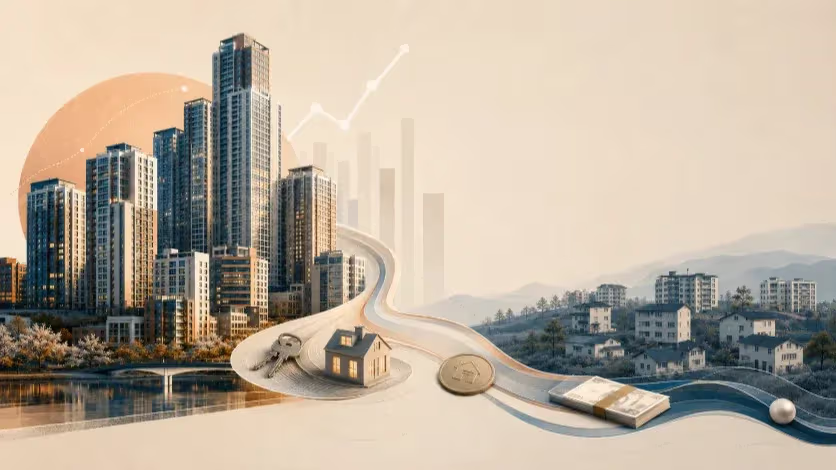
Evergrande's Economic Quake: China's Property Crisis Spills Over Borders
In a dramatic turn of events, China's property titan, Evergrande Group, once hailed as the country's second-largest developer, lodged a bankruptcy petition in New York on Thursday. This move traces back to the severe debt crisis the company faced in 2021, which has since rippled across China's property sector and potentially even its broader economy. Borrowing, Defaulting, and Bankruptcy Evergrande's financial debacle began when it heavily borrowed and subsequently failed to service its debt.


In a dramatic turn of events, China's property titan, Evergrande Group, once hailed as the country's second-largest developer, lodged a bankruptcy petition in New York on Thursday. This move traces back to the severe debt crisis the company faced in 2021, which has since rippled across China's property sector and potentially even its broader economy.
Borrowing, Defaulting, and Bankruptcy
Evergrande's financial debacle began when it heavily borrowed and subsequently failed to service its debt. The repercussions were immediate and widespread: homeowners felt betrayed, and the country's financial ecosystem trembled. Beijing's decision to curtail excessive borrowing by developers to regulate skyrocketing property prices only added fuel to the fire.
In light of its financial turmoil, Evergrande turned to Chapter 15 bankruptcy protection, a tool designed to foster collaboration between US courts and their counterparts in cross-border bankruptcy situations. As of yet, the company has not provided a comment on this matter, despite media outlets such as CNN reaching out.
Ripple Effect Across China’s Property Market
Once a cornerstone of China’s robust economic expansion, the real estate sector contributed nearly 30% to its GDP. Evergrande's debacle has been a sharp wakeup call for the entire industry. Following its decline, major players such as Kasia, Fantasia, and Shimao Group also succumbed to debt defaults. Even giants like Country Garden are raising eyebrows with talk of potential debt restructuring.
Can Evergrande Bounce Back?
With its influence spanning over 1,300 real estate ventures across 280 cities, Evergrande is no small player. Beyond property, its interests span from electric vehicles to healthcare and even theme parks. Yet, its accumulated debt stands at an astonishing 2.437 trillion yuan ($340 billion)—roughly 2% of China’s total GDP.
Despite these staggering numbers, there's a glimmer of hope. Evergrande recently disclosed its ambitious debt restructuring scheme, marking it as China's largest. They have also been negotiating “binding agreements” with international bondholders, signifying progress. Additionally, Evergrande plans a comeback within three years, although this requires a colossal investment ranging from $36.4 billion to $43.7 billion. Encouragingly, Dubai-based automaker NWTN has already pledged $500 million in exchange for a significant stake in Evergrande’s EV business.
The Bigger Picture: China’s Housing Policy and its Global Impact
The Chinese government’s housing policy has been instrumental in shaping the real estate market's trajectory. The leader, Xi Jinping, emphasized homes as essentials for living, not assets for speculation. This pivot, combined with efforts to stymie excessive borrowing in 2020, paved the way for a series of property company defaults.
Evergrande’s situation illustrates a deeper, systemic issue with China’s real estate sector. As housing once acted as a means for the Chinese to amass wealth, the shift in policy has left many with vast debts and unfinished homes.
The real estate slowdown is also reverberating globally. Major banks, such as JP Morgan Chase, have trimmed their growth forecasts for China, citing real estate risks. Consequently, countries with close economic ties to China, like South Korea, are bracing for potential economic aftershocks.
In conclusion, as Evergrande’s saga unfolds, its impact on China's property market and the global economy remains a looming concern. Stakeholders worldwide will be watching closely to discern the final fallout and the potential recovery of China's real estate titan.
Editorial Context
"Independent journalism relies on radical transparency. View our full log of editorial notes, corrections, and project dispatches in the Newsroom Transparency Log."
Reader Pulse
The report's impact signal
Be the first to provide a reading pulse. These collective signals help our newsroom understand the impact of our reporting.
Join the discussion
A more thoughtful conversation, anchored to the story
Atlantic-style discussion for this article. One-level replies, editor prompts, and moderation-first participation are now powered directly by Prisma.
Discussion Status
Open
Please sign in to join the discussion.
The Weekly Breeze
Independent reporting and analysis on Busan,
Korea, and the broader regional economy.