Leeno’s Labor Dispute Tests the Model Behind a 47.5% Margin
Leeno Industrial’s union dispute over an 800% regular bonus and 15% profit sharing is testing the Busan semiconductor supplier’s high-margin production model and factory expansion.


A newly organized workforce at the Busan semiconductor supplier is challenging the bonus-heavy pay and working-time arrangements that accompanied record profits, rapid deliveries and plans for a much larger factory.
Leeno Industrial was already becoming more selective about new orders when its labor dispute crossed the legal threshold for a strike.
Strong demand had pressed against the production capacity of the Busan semiconductor-component supplier, prompting management to screen new business and concentrate on orders it had already accepted. The company entered an emergency-management system in the second week of July as negotiations with its newly formed union approached another failed mediation session. Production continued, but the union’s acquisition of the legal right to strike made an existing capacity constraint more difficult to manage: Leeno could no longer plan its order queue on the assumption that the working hours and uninterrupted process flow available in recent years would remain unchanged.
About 350 union members gathered outside Leeno’s headquarters in western Busan on July 14, one day after the Busan Regional Labor Relations Commission ended mediation without proposing a settlement. The company and the Korean Metal Workers’ Union branch had held eight bargaining sessions since the union was formed in March, but they remained divided over the structure of employee compensation. The labor commission’s decision allows lawful industrial action, although union officials said they would return to negotiations before deciding whether to strike, when to begin or what form the action might take. No production stoppage or walkout timetable had been announced as of July 16.
The confrontation has emerged during the most profitable period in Leeno’s history. Revenue reached 372.5 billion won in 2025, while operating profit rose to approximately 177 billion won, producing an operating margin of 47.5%. Employee compensation increased sharply alongside those results: aggregate employee pay climbed 36.6% to 78.26 billion won, and the company reported average annual compensation of 117 million won among 677 employees at year-end.
Those figures make Leeno an unusual setting for an industrial dispute. Employees were not excluded from the record year, and management says the performance award associated with the result approached 2,000%. The disagreement concerns the terms under which such rewards are determined. The union wants part of the annually differentiated award converted into an 800% regular bonus and is separately seeking a performance pool equal to 15% of operating profit. Management argues that placing a large portion of performance compensation into regular wages would create a cost that remains after the semiconductor cycle turns, and estimates that the proposed structure could take annual labor costs to about 130 billion won.
The two demands would change compensation in different ways. A 15% pool would allow employee rewards to rise and fall with published earnings, converting a management decision made after the year closes into a formula agreed before the work begins. The 800% regular bonus would establish a larger recurring payment and could also alter the wage base used to calculate overtime, night and holiday premiums. Leeno has offered an average 6% increase in base pay, a new holiday bonus, an additional fixed increase and advance payment of part of the performance award, but its proposal preserves more management control over the largest boom-year payment.
Working time matters because Leeno does not manufacture a standardized commodity that can be produced, stored and redirected freely among customers. It builds customized test sockets and spring contact probes that connect semiconductors to testing equipment, moving customer requirements through design, precision machining, plating, assembly and inspection within its own production system. The integration shortens delivery times and supports an operating margin rarely seen in physical manufacturing, but it also means that available skilled hours and coordination between processes are embedded in the service customers are buying.
The dispute has therefore reached beyond the size of one bonus. Leeno is preparing to consolidate its production in a new Eco Delta City complex, install additional equipment and add about 200 jobs, while founder and chief executive Lee Chae-yoon has reduced his stake from 34.66% to 25.48% through the sale of 7 million shares. The company is entering its largest physical expansion with ownership less concentrated, a union representing more than 400 of roughly 670 employees and no agreement on the compensation and working-time rules that will apply as its workforce grows.
Leeno’s first major collective-bargaining dispute is consequently testing the system behind its success. The company built an export business around customer-specific products, rapid response and large variable rewards decided after results were known. The question is whether those arrangements can govern a larger production base once employees have organized to negotiate the conditions in advance.
The Business Behind Leeno’s Strike Leverage
Leeno earns its margin in the narrow physical connection between a semiconductor and the equipment used to test it. A spring contact probe carries electrical signals into a packaged device, while an IC test socket holds the chip and creates the contact required for testing. The components are small, but errors in their alignment, resistance, durability or signal transmission can compromise the test before the semiconductor reaches a finished product.
Test sockets generated 243.9 billion won in 2025, accounting for 65.48% of Leeno’s revenue, while spring contact probes sold under the LEENO Pin brand contributed another 23.38%. The two product groups produced almost 89% of company sales. Overseas customers accounted for 93.78% of socket revenue and 76.31% of probe sales, tying the work performed in western Busan to semiconductor development and manufacturing schedules beyond South Korea.
The economics differ from those of a conventional parts manufacturer running a limited catalogue through long, identical production batches. Leeno says it produces approximately 30,000 product types to order. An established item can generally be delivered within 10 days after an order is received, while a specially designed product takes two to four weeks. The company treats each customer purchase order as its order backlog because production begins in response to the specification and delivery requirement attached to it.
A customer is therefore purchasing more than a socket or probe. A change in chip packaging, contact density, signal frequency, heat generation or power requirement can require a different interface, and the commercial value lies partly in converting that change into functioning test hardware before the customer’s development or production schedule moves on. Leeno’s own marketing emphasizes customized solutions, rapid delivery and complete in-house manufacturing rather than a price advantage based on volume alone.
The products also create recurring demand. Probes and sockets wear through repeated contact and must be replaced during ongoing testing programs, while new processors and packaging formats require additional designs. Leeno can earn revenue from components used in established chip production and from research and qualification work tied to devices that have not yet entered mass manufacture. The combination reduces dependence on a single product launch and allows the company to participate in technological changes without fabricating the semiconductor itself.
Much of the response remains inside the company. Mechanical, electrical and thermal design feed into machining, barrel and spring production, plating, molding, assembly, inspection and reliability testing. Leeno says ownership of its plating facility shortens lead time and gives it direct control over quality, while in-house molding tools help it respond more quickly when socket volumes increase. Assembly of intricate products is performed by a specialized and extensively trained workforce.
Bringing these stages together reduces external handoffs. Engineers can revise a design, machining teams can produce the structure, and plating, assembly and inspection can proceed within the same manufacturing organization rather than through a chain of independent contractors. The advantage becomes more valuable when a customer changes a specification late in development or needs a limited quantity before committing to a larger program. Leeno’s margin reflects accumulated design data, precision equipment and product replacement demand, but also the organizational ability to move a customized order through several linked processes without losing time.
That same organization determines the limits of production. Leeno’s filings explain that capacity cannot be expressed as one fixed number because each order requires a different combination of micro-assembly, precision machining and plating. Output changes with product complexity, the employees assigned to each operation and the number and type of machines available. Adding equipment at one point does not remove every bottleneck: more machined parts create no finished sockets if plating or assembly cannot absorb them, while completed assemblies cannot be shipped until electrical inspection and reliability testing are finished.
Industrial action would apply pressure through those connections. Lost hours in a standardized plant mainly reduce the count of identical units completed. At Leeno, reduced time in machining, plating or assembly can delay an order built for a particular customer specification, and the unfinished work then affects the next operation. Management can change priorities and direct available labor toward its most important commitments, but a socket cannot bypass a process required by its design.
The company’s broad product range also limits the protection provided by finished inventory. A socket produced for one package cannot ordinarily be redirected to an unrelated chip, so stock of other specifications does little to meet the delayed order. The commercial damage would begin with longer lead times, fewer accepted orders and slower responses to design changes, even if most employees remained at work and shipments continued to leave the plant.
Leeno does not need to halt semiconductor production around the world for labor action to weaken its competitive position. Its customers pay partly for a reliable delivery window, and the company’s technical capability becomes valuable only when skilled processes are coordinated quickly enough to meet it. The union’s industrial leverage lies at that point, where hours worked inside the factory become a promise made to a customer outside it.
From Boom-Year Bonuses to a Written Wage Formula
South Korea’s AI-chip boom has changed the terms of the argument over performance pay. Workers at the country’s largest semiconductor companies have moved beyond bargaining only over the generosity of an award announced after an exceptional year. They have sought formulas linking employee compensation to operating profit, shifting part of the decision from management judgment after the books close to an agreement that determines the pool in advance.
SK Hynix set the most influential benchmark in September 2025. The company and its union agreed to allocate 10% of annual operating profit to employee performance bonuses, remove the previous cap of 1,000% of base pay and retain the framework for 10 years. Eighty percent of the pool is paid in the relevant year, with the remaining portion deferred over the following two years. The arrangement still contains rules governing payment and distribution, but it establishes the size of the pool through a financial result rather than a discretionary ceiling.
The scale of SK Hynix’s AI-related earnings intensified pressure at Samsung Electronics, where unions sought the removal of a bonus cap and demanded 15% of semiconductor operating profit. An 18-day strike involving about 48,000 workers was suspended after a government-mediated agreement in May. Under the deal, Samsung’s chip employees receive a regular cash bonus equal to 50% of annual salary, while 10.5% of semiconductor operating profit is reserved for special stock-based awards subject to profit conditions and differentiated distribution among businesses. The settlement showed that even a written percentage leaves room for management and unions to negotiate the accounting base, payment medium, eligibility and timing.
Leeno’s union has brought the same basic demand into a company with fewer than 700 employees and an operating margin comparable to the strongest semiconductor producers. Its proposal to allocate 15% of company-wide operating profit uses the headline percentage initially sought by Samsung’s unions, although the companies are not directly comparable. Leeno does not operate capital-intensive chip fabrication plants or divide its earnings among multiple consumer-electronics and semiconductor businesses; the pool would be calculated against the results of a much smaller specialist supplier.
Applied to Leeno’s 2025 operating profit of approximately 176.997 billion won, 15% would produce about 26.55 billion won. Divided equally among the 677 employees reported at year-end, that would amount to roughly 39.2 million won per person, although the union’s publicly described position does not establish equal distribution. The more useful comparison is with the company’s reported employee-pay total: the proposed pool would equal almost 34% of the 78.26 billion won paid in 2025.
Employees entered the negotiations after receiving a substantial increase in annual compensation. Aggregate pay rose from 57.30 billion won in 2024 to 78.26 billion won in 2025, while headcount increased from 636 to 677. Average compensation climbed from approximately 90 million won to 117 million won, and management says the performance award associated with the year approached 2,000%. The payroll grew much faster than employment, demonstrating that Leeno did share a significant part of the record result with its workforce.
The scale of the award also reveals the arrangement now being challenged. Leeno could pay employees far more than their regular salaries when sales and margins rose, but management retained authority over the largest variable component until the company knew the year’s earnings, investment requirements and financial position. Union representatives say performance pay accounts for an excessive share of annual income and makes household earnings difficult to predict when the semiconductor market weakens.
The proposed 15% pool would preserve exposure to company performance while reducing uncertainty over how the reward is calculated. A strong year would increase the pool and a downturn would reduce it, but the percentage would be known before management announced the award. Employees would accept the cycle while gaining a contractual claim on the profit generated within it.
The 800% regular bonus addresses a different concern. Local reporting describes the proposal as converting part of the differentiated annual performance award into fixed compensation, giving employees a larger income floor throughout the year. If the change were implemented as described by the union, the remaining variable award could continue to reward stronger results, while a smaller share of total compensation would depend on a decision made after the work had already been performed.
Leeno’s offer moves in the same direction, but by a shorter distance. The company has cited an average 6% increase in base pay, a new holiday bonus, an additional fixed increase and advance payment of part of the performance award. It also says it responded to workplace demands by appointing a factory manager and reorganizing production under four divisions. These proposals would improve regular and earlier compensation while preserving the annual award as the main channel through which an exceptional year produces exceptional income.
The gap between the two approaches is therefore not captured by comparing 2,000% with 800%. Management wants a modestly higher fixed floor and a large variable reward it can adjust to demand, earnings and investment. The union wants a larger portion of compensation secured in advance, with additional upside determined through a published profit formula rather than the company’s final judgment.
Other bargaining demands extend the same struggle over managerial discretion. The union has raised working hours, leave, workplace organization and the wage-peak system, arguing that older employees experience reduced pay without an equivalent reduction in workload. More than 400 employees joined within months of the union’s formation, and 92.6% of participating members supported industrial action in the strike vote. The speed of organization suggests that workers understood the dispute as one involving the terms of employment across the factory, rather than merely an attempt to increase the payout from 2025.
High average pay does not resolve that argument. A bonus-heavy system can produce very high annual income in a record year while leaving employees uncertain about the portion that will survive the next downturn. Leeno’s profits gave management the ability to grant a large award; the agreements at SK Hynix and Samsung gave its workers a different benchmark for deciding who should determine the reward and when.
Where Industrial Action Would Bite
Leeno’s union would not need to stop every machine to put economic pressure on the company. Employees remain at work and union leaders have said that renewed bargaining is their immediate objective, but management has already narrowed order intake and focused production on commitments in its existing queue. The restrictions began as strong demand strained the current facilities and cannot be attributed solely to the threat of a strike. Industrial action would intensify the underlying problem by reducing the working time or process stability available to clear the backlog and accept additional business.
The scale of recent production growth helps explain why labor availability has become important. Leeno manufactured 191,102 test sockets in 2025, an increase of 46.2% from the previous year, while LEENO Pin output rose 19.8% to 65 million units. Employment increased 6.4% over the same period. The comparison does not establish a labor-productivity figure because equipment, automation, outsourcing and product mix can all alter output, but it shows how much more work the existing production organization absorbed before the Eco Delta City expansion became available.
The union has made working time part of its case, alleging that the company used special overtime, weekend schedules and staffing practices that placed excessive burdens on employees. Management has emphasized the need for stable production and warned that weakening the compensation flexibility available in a cyclical industry could ultimately affect employment. The dispute brings those positions together: hours beyond the ordinary schedule may help Leeno respond to order surges, but workers are seeking greater authority over when those hours are provided and how they are compensated.
An overtime refusal would create the narrowest form of pressure. Regular shifts could continue, machinery would remain in operation and shipments could leave the site, while the company lost the hours used to recover delayed work, complete urgent orders or absorb a short-term rise in demand. The backlog could grow gradually, forcing management to quote longer lead times or decline more orders before any visible shutdown occurred.
A partial or rotating strike could have a different effect because Leeno’s production processes do not contribute equally at every moment. A stoppage affecting precision machining, plating, micro-assembly or inspection could restrict the work reaching the next stage while much of the factory remained active. Management could reorder jobs and direct available employees toward selected customers, but it could not complete a customized socket until every required operation had been performed.
The product range makes those bottlenecks commercially significant. Leeno’s approximately 30,000 specifications are produced in response to customer orders, and one finished product cannot simply replace another designed for a different package. A delay at one operation may leave equipment and employees elsewhere available but unable to advance the affected order. The integrated production chain gives Leeno control and speed when work moves normally; during a labor action, the same chain can carry a bottleneck from one specialist process through the rest of the schedule.
A full walkout would create the clearest disruption by stopping production across the linked processes and complicating preparations for the new factory. It would also impose the largest immediate cost on employees, which helps explain why the union has left its timetable and tactics open while pursuing renewed talks. The July 14 event was presented as a strike-launch rally, but the phrase did not signify that an indefinite or full-scale stoppage had begun.
Order intake will offer an earlier measure of pressure than the factory gate. A shutdown is obvious, while a gradual loss of effective capacity appears first in the amount of new business accepted, the time needed to work through the queue and the delivery periods offered to customers. Quarterly revenue would reveal the financial effect only after delayed or declined orders moved through the reporting cycle.
Leeno’s leverage in bargaining comes from its profitability, its investment plans and its demonstrated ability to grant large annual awards. The union’s leverage comes from the coordinated skilled time required to convert those assets into products delivered on schedule. The company can determine which customers and orders receive priority; employees can affect whether the additional hours and uninterrupted process flow behind short delivery promises remain available on management’s existing terms.
The first material consequence of industrial action may therefore be a factory that appears to be operating normally. Machines could remain active, regular shifts could continue and current orders could be shipped while management became increasingly cautious about future commitments. For a company whose premium depends partly on rapid responses to changing semiconductor designs, that narrowing of capacity would reach its commercial position before an outright stoppage did.
The 800% Question
Management’s estimate of a 130 billion won annual labor bill is the largest number in the dispute, but it does not mean the union’s demands would add that amount on top of everything Leeno already pays. The company has described the figure as the cost of operating under the proposed wage structure, amounting to close to one-third of annual revenue. Assessing that claim requires separating compensation already contained in the payroll from the new or reclassified obligations created by the union proposal.
Leeno reported 78.26 billion won in employee pay for 2025. Adding a pool equal to 15% of the year’s 176.997 billion won operating profit produces a combined amount of approximately 104.81 billion won, leaving about 25.19 billion won between that calculation and management’s 130 billion won estimate. The comparison establishes the scale but does not reproduce the company’s model because the annual filing and management statement may cover different categories.
The filing reports compensation attributed to employees, while total labor cost can include employer social-insurance contributions, retirement obligations and statutory premiums. Management has not published the monthly wage base, eligibility rules or assumptions it used for the 800% calculation, making that component the principal unknown in the estimate.
An 800% bonus is calculated against a defined monthly wage rather than against the company’s total payroll. Its cost depends on which salary components form that base, whether every employee qualifies and how the payment interacts with the performance award Leeno already distributes. The most important issue is therefore whether the regular bonus replaces part of existing compensation or is added to it.
Under a conversion, Leeno would move part of the annual differentiated award into regular pay and reduce the remaining discretionary bonus accordingly. The company paid a performance award approaching 2,000% for 2025, so transferring 800 percentage points into a regular category would not necessarily create an entirely new cash payment in another highly profitable year. Employees could receive a similar total through a different structure, with more paid predictably and less left to the year-end decision.
The longer-term obligation would still increase. Management can cut a discretionary award if profit falls, orders weaken or the company needs to preserve cash for investment. A regular bonus written into a wage agreement is more difficult to remove and would be incurred before the year’s earnings were known. The cost would become less sensitive to the semiconductor cycle even if the first-year cash increase remained modest.
A different outcome follows if the proposed payment is additional. Leeno could then be required to fund the 800% regular bonus, a 15% operating-profit pool and a separate management-set performance award. Employer contributions and other labor costs associated with the recurring payment would sit on top of those three layers. Management’s 130 billion won estimate becomes more understandable under that interpretation, while the union’s description of a conversion suggests that it is not the structure workers say they are seeking.
The legal treatment of the new payment could affect the economics of overtime. In December 2024, South Korea’s Supreme Court removed “fixedness” as an independent requirement for determining ordinary wage, focusing instead on whether compensation is paid regularly and uniformly in return for prescribed work. The title “regular bonus” would not settle the issue by itself; the final payment conditions, eligibility and relationship to ordinary duties would determine whether it formed part of the base used to calculate statutory premiums.
If the 800% payment qualified as ordinary wage, each hour of overtime, night work or holiday work could become more expensive. The effect connects the compensation dispute directly to the production system. Leeno has used short delivery times as a commercial advantage, and additional hours can be one way to protect those schedules when demand exceeds ordinary capacity. Raising the hourly base would force management to decide whether overtime remained the most economical response or whether it needed more employees, equipment or longer customer lead times.
The 15% pool is easier to calculate because it follows a published profit figure. The cost of the 800% demand depends on where the payment sits within the wage structure: what portion of the existing award it replaces, what remains under management discretion and which statutory costs are recalculated from the new base. The same headline percentages can describe very different compensation systems until those terms are written into an agreement.
A credible settlement will consequently require more than bargaining the numbers downward. Leeno and the union must define the wage base, the portion of current performance pay being converted and the status of any remaining annual award. Without those details, the company can calculate a permanent addition while the union describes a reallocation of compensation that Leeno already pays.
A Company Expanding Under New Constraints
The unresolved wage structure will soon extend beyond the workforce that produced Leeno’s 2025 results. The company is preparing the largest physical expansion in its history, consolidating facilities and installing new production capacity in Busan’s Eco Delta City. It expects to add about 200 employees, which would increase headcount by almost 30% from the 677 reported at the end of last year before accounting for departures or transfers elsewhere.
Leeno approaches that transition after a substantial change in its ownership structure. Lee Chae-yoon sold 7 million shares through an off-market block transaction on June 12, reducing his stake from 34.66% to 25.48%. The shares represented 9.18% of the company and were sold at 90,000 won each for a reported total of approximately 731.5 billion won. Lee remained Leeno’s largest shareholder and chief executive.
The proceeds went to Lee because the transaction involved his existing shares; they did not increase the company’s factory, research or wage budgets. The sale also did not transfer control. It nevertheless reduced the concentration of ownership and generated speculation over the future of a company that has been led by its founder since its establishment in 1978.
Leeno has denied that a formal sale of the company is under way, and the completed block transaction should not be treated as evidence that control will change. The institutional question for employees is more immediate. A large annual award based mainly on management judgment remains closely associated with the people controlling the company at that time, while a regular bonus and profit-sharing formula written into a collective agreement would continue to apply if ownership or leadership changed later.
The Eco Delta City project gives that issue a practical deadline. Busan’s updated materials describe an investment of 208 billion won, including 74.5 billion won for land and 133.5 billion won for facilities and equipment. The site covers 72,519 square meters, with 69,525 square meters of floor space across six buildings, and completion is targeted for the second half of 2026.
The factory will do more than add floor space. Leeno plans to consolidate production now distributed around the Mieum Industrial Complex, install machinery and expand the number of orders it can handle. Existing customer deliveries must continue while equipment is installed, lines are moved and production is validated at the new site. Experienced employees will be needed to maintain current output and support the transfer at the same time.
The planned hires cannot replace that experience immediately. Customized sockets and probes pass through processes in which accuracy, sequence and coordination affect whether the final product meets the required specification. New employees must learn the equipment and quality standards, while established teams absorb training responsibilities alongside their normal work. A labor dispute during the transition would draw on the same technical and managerial resources required to stabilize the new plant.
The compensation agreement will determine the cost structure applied to those recruits. An 800% regular bonus could become part of recurring pay for a workforce approaching 900, while a 15% profit pool would expand if the new capacity generated the sales and margins expected from the project. Any increase in the ordinary-wage base could also affect overtime during a period when Leeno is balancing current production, employee training and equipment transfers.
Expansion may relieve some of the working-time pressure identified by the union. More machinery, additional employees and consolidated processes could reduce the need to respond to order surges through extended schedules. The outcome will depend on how quickly staffing and training grow relative to sales. If Leeno uses the plant primarily to accept substantially more business, production targets could rise as quickly as physical capacity and reproduce the same dispute over hours on a larger scale.
Busan has a direct interest in the transition. The city supported the project after Leeno struggled to secure a sufficiently large industrial site and considered expansion outside the region. Municipal authorities could provide land, coordinate infrastructure and retain an export-oriented precision manufacturer, but public industrial policy cannot determine the wage structure inside the plant or the amount of production that will depend on overtime.
The project was presented through investment, construction and employment targets. Its success will also depend on whether skilled employees remain, whether new workers can be trained without disrupting deliveries and whether management and the union establish rules that both sides can carry into the expanded operation. A building can increase potential capacity; it cannot by itself produce the coordination required for Leeno’s short lead times.
Lee’s continued leadership and investment in Eco Delta City are evidence that the company is planning for growth in Busan. Employees are seeking continuity of a different kind: compensation and working-time terms that remain clear across semiconductor cycles, workforce expansion and any future changes in ownership. Those two claims are now converging in the same factory project.
Before the New Factory Opens
Leeno still has room to resolve the dispute before industrial action interrupts production. Employees remain at work, union leaders have announced no strike timetable and management is filling the orders it has already accepted. Yet the company has little operational reason to let the conflict drift. Existing capacity is already restricting new business, and preparation for Eco Delta City will soon require experienced workers to support current deliveries, line transfers and training simultaneously.
A settlement concerned only with the next performance award would postpone the central decision. Leeno must determine how much annual income remains under management discretion, how a profit-linked pool will be calculated and whether moving part of the award into regular wages changes the economics of the additional hours used to protect delivery schedules.
Those rules will not apply only to the employees who shared in the record results of 2025. They will shape the terms offered to roughly 200 recruits and the production routines established as the new factory begins operating. The company could enter that expansion with an agreement defining how profit, wages and working time fit together, or carry the same uncertainty into a larger and more demanding transition.
Leeno built its profitability by responding quickly when customers altered their semiconductor designs. The change now confronting the company is internal and cannot be solved by faster machining or additional equipment alone. Before the new factory opens, management and the union must decide which part of a boom-year reward becomes a continuing wage—and how much future production can depend on working hours employees are no longer prepared to leave solely to management.
Continue this reporting
Reporting on the same issue
Related coverage selected from the article's desk, topics and newsroom relationships.
 NewsOct 21, 2026
What a Small Mackerel Is Worth
Busan’s catch is dominated by small mackerel even as some buyers need larger...
 NewsSep 21, 2026
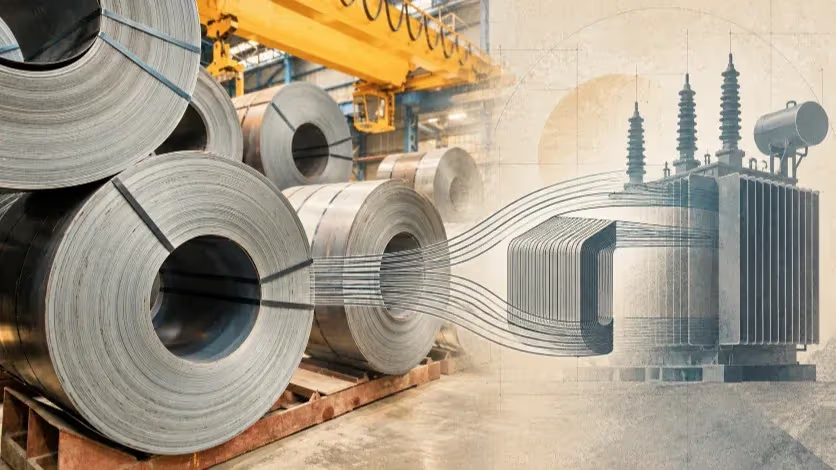
Europe’s Electrical-Steel Safeguard Now Reaches Inside the Transformer
A new EU safeguard follows electrical steel into certain finished transformer...
 NewsSep 14, 2026
Foreign Tourist Spending Is Reshaping Busan’s Nampo District
Foreign spending is making long-empty commercial space valuable again in Namp...
More from the author
More from this byline
Stay with the same line of reporting through more work from this byline.
 NewsOct 22, 2026
Busan Port’s LNG and Methanol Plan: Who Pays to Keep Fuel Ready?
 NewsOct 12, 2026
Bukangi, the Shark That Stayed in Busan’s North Port
Reader Signal
Community readWhat did this report leave you with?
Choose the signal that best reflects your reading. Select it again to remove it.
One response per article
No response selected
A moderated conversation about the reporting.
One-level replies and newsroom moderation keep the conversation anchored to this article.
Discussion Status
Open
Please sign in to join the discussion.
Newsletter
Weekly reporting and context from Busan and Korea.