Busan Speeds Up Redevelopment as the Market Becomes More Selective
Busan has spent years shortening planning procedures and expanding incentives, but construction costs, financing, contractor risk and uneven housing demand are increasingly deciding which projects can actually move forward.


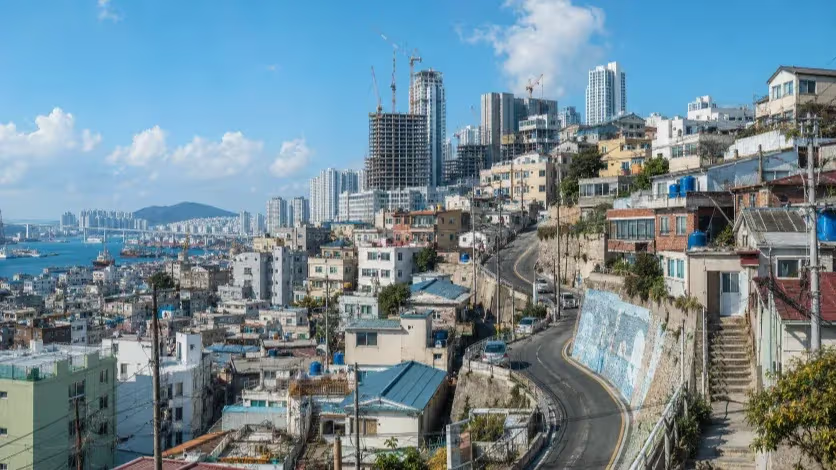
Busan has spent years removing planning barriers and adding incentives to revive aging neighborhoods. The city can shorten the route into redevelopment, but construction costs, financing, contractor appetite, uneven housing demand and a changing household structure increasingly determine what happens farther down the line.
On July 7, a redevelopment association in Busan’s Dongnae district moved to end its relationship with the builder it had selected more than a decade earlier. GS E&C had been chosen to build the Boksan 1 redevelopment project in 2015, when the plan envisioned 6,494 apartments and a construction contract worth roughly 1.4 trillion won. By 2025, after years of revisions involving cultural heritage, school relocation and changes to the physical plan, the project that received implementation approval had been reduced to about 4,300 apartments in 74 buildings. The following year, the association began moving toward a separation from the contractor, with the project expected to continue under a new construction arrangement.
A day after the Boksan 1 decision, Busan Metropolitan City changed the way new redevelopment projects enter the planning system. The city abolished its preliminary feasibility review and introduced a Master Planner advisory process involving specialists in planning, architecture, landscape, transport and design. City officials said overlapping reviews had lengthened the early process and increased costs for residents; the revised system also offers an FAR incentive of up to 5 percent for projects using the city’s redevelopment plan-request mechanism.
The proximity of the two developments was coincidental, but the distance between the problems they represented was revealing. City Hall was revising the beginning of redevelopment, where procedural delay, duplicated review and uncertain planning requirements can consume time before construction becomes a realistic prospect. Boksan 1 was confronting conditions much farther ahead, after more than a decade had changed the physical project, construction economics and the market assumptions beneath the original partnership.
Busan’s redevelopment problem increasingly lies in that distance. Years of policy changes have reduced some of the friction at the beginning of the process, but a faster route into redevelopment cannot remove the tests that follow. Contractors decide which projects justify capital and construction risk. Associations and builders must renegotiate terms as projects age. Financing expenses accumulate when time extends, while the final price of new housing remains constrained by what buyers in a particular location can absorb.
Those pressures are becoming harder to separate from Busan’s uneven housing geography. The parts of the city with the oldest housing and strongest need for physical intervention are not necessarily the places where new apartments can command the prices required to finance comprehensive redevelopment. At the same time, strong residential locations do not guarantee competition among builders on the terms expected by associations. Busan recorded 8,292 unsold homes in May 2026, including 2,945 that remained unsold after completion, even as housing permits during the first five months of the year fell 59.1 percent from the same period a year earlier.
The question facing Busan is therefore larger than how quickly a redevelopment zone can be designated. The city must consider which projects can remain viable through contracting, financing, construction and sale; whether the housing eventually delivered will match a market and household structure changing during the long development period; and what happens to neighborhoods where urban repair is urgent but comprehensive private redevelopment cannot carry its own cost.
The Bottleneck Moves Downstream
Busan entered the current redevelopment cycle with a familiar problem: projects were taking too long to move through a system that residents, builders and the city itself regarded as cumbersome. In 2021, the city expanded development incentives and tried to improve feasibility in older areas where redevelopment activity had lagged behind stronger housing markets. Later that year, Busan announced an additional 10-percentage-point increase in base FAR for redevelopment and reconstruction in six shrinking districts—Jung-gu, Dong-gu, Seo-gu, Yeongdo-gu, Saha-gu and Sasang-gu. At the time, the city cited 79 redevelopment and reconstruction projects in eastern Busan compared with 46 in the old downtown and western districts covered by the additional measure.
Density served as more than a planning variable. Additional floor space could increase potential saleable area, spread some fixed costs across a larger project and make redevelopment more financially attractive where difficult site conditions or weaker land values had limited private investment. Faster procedures could reduce years of uncertainty before a project reached the stages where builders and lenders became fully committed. Busan’s policy direction was built around a reasonable premise: unnecessary time carries a cost, and a city with a rapidly aging housing stock cannot afford to leave viable renewal projects trapped indefinitely in early procedure.
The planning question gradually expanded beyond speed. Busan’s district-based planning initiatives sought earlier coordination where several redevelopment areas could otherwise advance as separate projects without adequate attention to roads, pedestrian connections and surrounding infrastructure. The revised 2030 Urban and Residential Environment Improvement Master Plan later broadened the city’s planning approach across different physical environments, including hillside districts, waterfront areas and station zones, reflecting the fact that redevelopment takes place in a city whose terrain and existing urban form differ sharply from one district to another.
The 2026 reform changed the institutional form again. The city removed the preliminary feasibility review but retained the argument that coordination should happen early, replacing the previous process with Master Planner advice intended to address relationships with adjacent areas, infrastructure placement and public contributions before a proposal hardens. The revision is better understood as another attempt to reconcile objectives that can conflict: residents want a shorter and less costly route into redevelopment, planners want infrastructure and public space considered before redesign becomes expensive, and builders eventually need a project whose density, schedule and expected revenue justify the risks of construction.
Five years of reform have therefore concentrated heavily on the front of the process. The city has tried to reduce uncertainty before designation, compress administrative time and use development rights to improve project feasibility. Those measures can remove avoidable delay, but the limits become clear once a project enters contractor selection and detailed financial negotiation, where the variables are no longer controlled primarily by a municipal review calendar.
The pressures are visible even in districts normally expected to attract major builders. In Suyeong-gu, the Gwang-an 5 redevelopment project held two contractor tenders in early 2026 and failed to create a competitive bid in either round because GS E&C was the sole participant. The association later negotiated with the company, and GS E&C was selected as contractor in April for a project expected to produce about 2,090 apartments.
The outcome was not evidence that builders had lost interest in Gwangalli. A major contractor remained committed enough to continue through the process and win the project. The more revealing signal was the lack of competition on the original tender terms. A project can attract a builder while failing to generate a field of contractors willing to submit binding offers and compete aggressively over price, financing support, design commitments and other conditions. For associations that expect location and scale to produce bargaining leverage, the distinction matters.
A more complicated version of the same market discipline appeared in Haeundae. U-dong 1, the reconstruction of the Samho Garden apartment complex, had initially selected DL E&C, but a prolonged disagreement followed. Reporting on the dispute described a construction price of 6.09 million won per 3.3 square meters proposed in 2021 and a later request for 8.48 million won by 2024. After the relationship ended, the first contractor tender in 2026 attracted no bidder. Four companies attended the briefing for a second process, but the project ultimately moved toward direct negotiation, with Daewoo E&C later expressing interest.
U-dong 1 did not disappear from the redevelopment market. Its route to a new contract changed. Interest expressed at a project briefing was different from submitting a binding tender, and willingness to negotiate directly was different from competing under conditions set earlier by the association. The project illustrates a market in which major contractors remain active but assess price, contract structure and exposure to future cost changes with greater selectivity.
Construction costs are part of that calculation, although they are often treated as a complete explanation. The Korea Institute of Civil Engineering and Building Technology reported that its residential-building construction cost index stood at 130.76 in December 2025, with 2020 set at 100. The institute cautioned that the index measures average changes in construction inputs and cannot by itself explain the actual cost or sale price of an individual development, pointing to land prices, demand, financing costs, project structure and policy conditions as additional variables.
For redevelopment projects, higher construction expenses reduce the margin available to absorb mistakes and delays. Financing costs raise the price of time. A weak presale market narrows the range of sale prices a project can realistically assume, while existing owners may resist increases in contributions needed to cover a more expensive contract. Contractors have their own constraints: a project that looks attractive in broad terms may still fail internal investment criteria if the expected return does not justify years of capital exposure and uncertain market conditions.
The calculations made by an association, a contractor and future buyers do not automatically converge. An association may expect a high general-sale price because redevelopment will produce new housing in an established district. A contractor underwriting risk may discount that expectation because completion remains years away and unsold-unit exposure is possible. Owners may object to a construction-price increase because it raises their financial burden, even when the underlying cost environment has already changed. A project can therefore remain desirable in principle while the parties fail to agree on the narrow range of numbers required to keep it moving.
Time intensifies those differences. Financing expenses accumulate during delay, material and labor costs can move before construction begins, and tender assumptions become outdated. A contractor deciding whether to bid today evaluates a project under current capital costs and current risk controls, even when the association’s expectations were formed through negotiations conducted years earlier. The land remains the same, but the economic project changes.
Boksan 1 shows the consequences when that process extends across more than a decade. The area had already spent years in redevelopment procedure before GS E&C won the construction contract in 2015. The company entered a project then described as 6,494 apartments and roughly 1.4 trillion won in construction value. The physical plan later contracted substantially as cultural heritage constraints and other planning issues reshaped the site, and project implementation approval granted in March 2025 covered about 4,300 apartments across 74 buildings on a site of roughly 400,000 square meters.
The site sits within the historic core of Dongnae, where redevelopment has had to contend with cultural properties and the relationship between new high-rise housing and the surrounding historic landscape. The project also faced disputes involving Naeseong Elementary School and the proposed relocation of the school. Those were specific planning and institutional conflicts rather than direct products of the housing market, but the years spent addressing them gave the market time to change underneath the project.
By the time implementation approval arrived, the project had advanced formally while moving further from the conditions under which the original construction partnership had been formed. In July 2026, the association moved to end the relationship with GS E&C and seek a new contractor. Reporting on the separation described a project with more than 1 trillion won in costs and noted long-running cultural heritage and school issues alongside revisions to density and the number of homes.
Reducing the episode to construction inflation would miss the larger risk. Redevelopment contracts are written against an uncertain future. A contractor prices labor, materials, construction duration, financing exposure and risk. An association estimates future housing values, general-sale revenue and owner contributions. When more than a decade separates contractor selection from construction, those estimates can cease to describe the same economic reality.
Boksan 1 illustrates a form of contract obsolescence. The project may remain valuable, redevelopment may remain necessary and another contractor may eventually take the work, but the assumptions holding the earlier partnership together have aged. During a long development period, construction prices change, lending conditions change, housing preferences shift, association members become older and public expectations surrounding heritage, open space and infrastructure evolve. The redevelopment boundary can stay in place while the economic and social project inside it is repeatedly rewritten.
Municipal reform can reduce part of that exposure. Earlier coordination can identify major conflicts before they consume years of redesign, and clearer planning rules can reduce uncertainty. Shorter administrative procedures can lower carrying costs. None of those measures can freeze market conditions for a decade, preserve an old construction price or guarantee that the presale assumptions of one housing cycle will remain credible in the next.
The distinction between approval speed and progress through the entire process is therefore central to Busan’s next phase of redevelopment. A city can designate zones more efficiently while projects later accumulate around contractor negotiation, financing, owner contributions or changes in market demand. Faster procedure matters, but the more difficult question is whether projects continue to move after each formal approval.
Three Maps That Do Not Fully Overlap
The pressures exposed by individual projects become clearer when redevelopment is viewed across Busan as a whole. The city does not have one housing market moving through one renewal cycle. Neighborhoods that urgently need physical intervention can have weak capacity to support the price of comprehensive redevelopment, while strong residential markets can still produce difficult contractor negotiations. Projects close to one another geographically can be separated by many years in the development process and by completely different levels of financial exposure.
The first geography is the map of need. KOSIS-based figures show that the number of homes in Busan at least 30 years old increased from 363,944 in 2022 to 432,913 in 2024. Their share of the city’s housing stock rose from 27.8 percent to 32.1 percent over the same period. The distribution was highly uneven: in 2024, the share of housing at least 30 years old reached 57.8 percent in Yeongdo-gu, 48.8 percent in Sasang-gu, 46.6 percent in Dong-gu, 46 percent in Jung-gu and 43.5 percent in Saha-gu.
Building age alone does not establish that every house should be demolished, and a 30-year threshold is an imperfect measure of physical condition. The figures nevertheless show why urban renewal cannot be reduced to a speculative property cycle. A large share of Busan’s built environment is entering an age when maintenance, accessibility, energy performance and safety require greater attention, while some of the highest concentrations are in districts where private redevelopment has historically been more difficult.
The physical problems also differ by location. Hillside neighborhoods can contain steep pedestrian routes, retaining structures, narrow streets and fragmented plots assembled through decades of incremental construction. Older apartment districts present a different challenge: large populations living in buildings approaching major renovation or reconstruction decisions, often in places where roads and public facilities were designed for an earlier phase of urban growth. Industrial-residential edges add questions of freight traffic, noise, environmental buffering and pedestrian safety that cannot be solved merely by replacing old housing with newer towers.
Busan’s 2021 incentive package for six shrinking districts reflected an official recognition that the geography of need and the geography of redevelopment activity were already diverging. Higher allowable density was intended to improve project economics where population decline and weaker market conditions had reduced private momentum.
The policy identified a durable problem: deterioration does not create purchasing power. An aging building can generate urgent need for intervention without producing the sale prices required to assemble land, relocate households, finance construction and provide new infrastructure. A narrow street can need widening while offering no revenue stream of its own. Once those obligations are placed inside a private redevelopment balance sheet, the ability to repair an old neighborhood depends increasingly on the future value of the housing that will replace it.
FAR incentives attempt to bridge part of the gap. Additional density can increase saleable floor space and improve the financial model where buyer demand is deep enough to absorb the resulting housing. The mechanism works differently in weaker markets. Before additional floor area becomes revenue, it creates more building volume that must be financed and constructed and a larger number of homes that eventually need buyers. The planning incentive exists in both places, but its economic value is determined partly by the market waiting at the end.
Busan’s current housing data shows how segmented that market has become. The city had 8,292 unsold homes in May 2026, including 2,945 remaining after completion. Housing permits for January through May totaled 3,968, down 59.1 percent year on year. The figures describe different points in the housing cycle and should not be collapsed into a simple prediction that oversupply today will automatically become shortage tomorrow. They reveal a sequencing problem: weak absorption in parts of the current market is occurring while the front of the future supply pipeline has contracted sharply.
Housing units are not interchangeable across Busan. An apartment that remains unsold in one district does not eliminate demand for replacement housing near established schools, employment, transport or family networks elsewhere. Price ranges, unit sizes and timing also divide the market. A citywide stock of unsold homes can coexist with intense demand in selected locations and limited effective demand in others.
The difference makes redevelopment unusually difficult to assess because its supply calendar is long. A project entering planning in 2026 is unlikely to compete with the same housing stock visible in today’s unsold inventory. Its future competitors may be projects that have not yet started construction, existing homes in another district or housing products aimed at a household structure that changes before completion. Associations must still make decisions about density, unit mix and construction economics years before that market becomes visible.
The old east-west division of Busan offers only a partial explanation. Haeundae and Suyeong contain some of the city’s most recognizable residential markets, yet U-dong 1 and Gwang-an 5 have shown that location does not guarantee competitive bidding under any contract structure. Western Busan is internally diverse as well. Gangseo’s housing pressures are linked partly to expansion, new development areas and infrastructure growth. Saha combines older industrial and residential fabric in which renewal often means repairing an existing city rather than extending it. Sasang sits at the intersection of transport accessibility, industrial restructuring and a more difficult housing market. Yeongdo’s terrain and unusually high share of old housing create another set of constraints.
A citywide regulation can alter the development rights available in all of those places. It cannot make an additional square meter equally valuable across them.
The third geography is deliverability: not where redevelopment has been proposed, but where projects can keep moving. Busan’s public redevelopment system records projects across formal stages from planning and association organization through project implementation approval, management and disposition, construction and completion. A list of all projects can suggest an enormous volume of future housing, but schemes classified together as “under redevelopment” can be separated by a decade of unresolved work and by entirely different risks.
A project at the beginning may demonstrate strong resident interest while remaining years away from proving that its economics work. Project implementation approval can resolve a major planning hurdle while opening a more demanding period of cost allocation and contractor negotiation. Management and disposition planning determines how rights, units and financial burdens are distributed, but a project approaching construction is then directly exposed to contract prices, borrowing conditions and the market into which future homes will be sold.
Progress can therefore change the form of risk rather than eliminate it. Boksan 1 reached implementation approval only to confront the collapse of an old contractor relationship. U-dong 1 remained commercially relevant while moving through failed tenders and a new negotiation route. Gwang-an 5 secured a major builder but without the competitive tender the association had originally sought. The examples belong to different stages and histories, yet each shows why formal advancement does not make later viability automatic.
The most useful measure is therefore movement through the full sequence. Approval velocity asks how quickly a project clears a particular administrative step. Overall progress requires asking how long projects remain between major stages, where repeated contractor tenders fail, which schemes are carrying contracts created under older cost conditions and how much proposed housing remains separated from construction by unresolved approvals or financial negotiations.
Large proposed unit counts are particularly easy to misread. A planned apartment does not become housing supply when a redevelopment boundary is drawn. Delivery remains contingent on later consent, agreements, financing, relocation, demolition and construction. For a city planning schools, transport and other infrastructure, projects five or ten years apart in realistic completion time cannot be treated as equivalent additions to supply.
Time also changes the demand side of the calculation. Statistics Korea’s regional household projections show Busan approaching its household peak around the early 2030s. The five-year projections place the city at about 1.442 million households in 2022 and 1.473 million in 2032 before decline to 1.422 million in 2042 and 1.268 million in 2052. Average household size is projected to fall from 2.20 people in 2022 to 1.79 by 2052, while the share of single-person households rises from 34.9 percent to 41.7 percent.
The significance for redevelopment lies less in the exact year of the household peak than in the mismatch between demographic time and project time. A scheme entering planning now can spend years organizing ownership, securing approvals, selecting a builder, relocating households and constructing the new complex. Housing planned before the household peak may arrive after it, while projects delayed into the 2040s may enter a city whose total number of households and internal composition have moved substantially away from conditions visible at the start.
Demographic decline should not be turned into a mechanical argument against housing construction. Population and household numbers move differently, and demand remains strongly affected by location, housing quality, household wealth, schools, transport and replacement needs. A shrinking city can still have intense demand for new housing in specific districts. A rising household count does not guarantee viability for every project.
The larger risk is that long-duration projects make major decisions early. Unit mix, broad design, construction specifications and expected general-sale revenue are shaped long before buyers enter the market. A development can eventually offer housing designed around assumptions formed many years earlier. In a city where average household size is falling and older households will represent a much larger share of demand, the surrounding neighborhood can become as important as the apartment itself: accessible streets, safe crossings, proximity to healthcare and everyday services, and public spaces usable by people with different levels of mobility.
Time also changes the social coalition inside a redevelopment association. Owners who support a project at the beginning can be in a different stage of life when relocation and additional contributions become immediate. Income, health and family circumstances change over a decade. In an aging city, a project can remain attractive in projected capital value while becoming increasingly difficult for some members to finance or wait for.
Busan’s three redevelopment maps are therefore unstable. The map of need shows where housing and infrastructure require intervention. The map of demand shows where the market can support replacement housing at the scale and price required. The map of deliverability shows whether the institutional and financial process connecting those two can continue long enough to produce a finished neighborhood. The demographic clock changes all three before many projects reach completion.
What Redevelopment Is Supposed to Repair
The mismatch does not lead to a simple conclusion that Busan should build less or abandon large redevelopment. Comprehensive redevelopment remains one of the few mechanisms capable of replacing substantial concentrations of aging housing, assembling fragmented land and financing major changes to roads and infrastructure. In parts of the city where demand is deep enough to support the cost, the model can solve problems that piecemeal repair cannot.
The difficulty begins when comprehensive redevelopment becomes the default answer to forms of urban decline that the redevelopment market is poorly equipped to finance. Busan contains neighborhoods where deteriorating housing is only one part of the problem. Narrow roads limit emergency access, vacant properties interrupt occupied streets, steep terrain makes everyday movement difficult for older residents, and small plots make assembly expensive. Commercial decline can weaken basic services while the remaining housing continues to age.
A large apartment project may be physically capable of replacing the buildings, but its financial model still depends on a future market strong enough to pay for land assembly, relocation, infrastructure and construction. Where that demand is insufficient, the neighborhood can become trapped between two kinds of waiting: residents wait for redevelopment to become viable, while the project waits for prices, density or financing conditions capable of supporting a scheme larger than the local market can absorb.
Private infeasibility does not remove public need. A neighborhood that cannot support a conventional redevelopment project still needs safe streets, drainage, accessible open space, building maintenance and responses to vacancy. That gap explains the importance of smaller housing renewal, vacant-home management and infrastructure-led intervention alongside the city’s major redevelopment pipeline.
Scale changes both the financial model and the urban consequences. A comprehensive redevelopment project can reorganize an entire district and finance large improvements when land and housing values are sufficient. The same scale requires a large coalition of owners, long procedural exposure and substantial construction and market risk. Smaller forms of renewal can replace clusters of deteriorating buildings without waiting for an entire district to assemble, but fragmented projects can also fail to address wider roads, parking, pedestrian circulation and public space unless public planning coordinates them.
The relevant question is therefore whether the scale of intervention matches the scale of the problem. A deteriorated apartment complex with clear ownership and durable replacement demand presents one type of case. A hillside neighborhood with separately owned buildings, stairs, retaining walls and narrow roads presents another. An industrial-residential edge may need freight management and environmental protection alongside housing renewal. A street losing population may require vacant-property management and selective land reuse before large-scale new housing makes economic sense.
Calling all of them aging neighborhoods describes their visible condition without identifying the intervention each one needs.
The distinction also changes the meaning of success. Large redevelopment is easy to see: old structures disappear, towers rise and thousands of households occupy new apartments. Smaller urban interventions produce less dramatic evidence. A dangerous vacant building is removed, emergency access improves, a group of deteriorated homes is renewed without erasing the surrounding district, or a public facility closes a gap in daily services. The value of each action depends on whether it addresses the constraint preventing the neighborhood from functioning.
The same standard should apply to major redevelopment. A project that replaces old housing but leaves surrounding pedestrians dependent on dangerous crossings has repaired buildings while preserving an urban barrier. Landscaped open space that is difficult for neighboring residents to access delivers amenity inside a project without improving connection to the wider district. Thousands of additional households can increase pressure on schools, roads and transit if those systems are treated as later adjustments rather than part of the project.
Busan’s recent planning reforms increasingly acknowledge those relationships. The city’s public-led Planning Proposal Request System is intended to involve public authorities from the initial planning stage rather than waiting for a resident-led proposal to mature. In June 2026, Busan selected a service provider to establish the basic planning direction for Sinpyeong 2 in Saha-gu, an area of about 52,000 square meters. The city said land use, housing plans, roads, parks and social infrastructure would be reviewed together, with the stated objective of balancing project feasibility and public value.
Sinpyeong 2 is useful because the project sits in a part of Busan where apartment planning cannot be separated easily from the city around it. Saha contains established residential areas requiring renewal, industrial activity that shapes surrounding roads and land use, and major infrastructure that can make destinations appearing close on a map difficult to reach on foot. Earlier planning can identify those relationships, but the success of the experiment will depend on whether they are translated into obligations durable enough to survive later financial pressure.
Pedestrian connection offers the clearest example. New towers, landscaped courtyards and internal paths can substantially improve conditions for residents inside a redevelopment boundary while doing little for movement across the surrounding district. A credible plan must consider where routes lead, the roads people need to cross, the gradients they encounter and whether the route remains continuous beyond the project boundary. A line connecting two points on a planning diagram has little public value when the actual journey ends at a wide road without a safe crossing.
The relationship with the Nakdong River raises a similar distinction. Waterfront proximity can increase residential value through views and marketing, but visual proximity and public access are separate urban assets. A redevelopment project can capture the river as a private amenity for upper-floor residents while leaving the wider neighborhood with the same difficult route to the waterfront. Meaningful connection requires attention to crossings, lighting, slope, traffic and continuity rather than a conceptual arrow toward the river.
Access inside the project needs the same scrutiny. Plans can show pedestrian passages, plazas and publicly accessible open space, while ownership and management rules after completion determine how public those spaces remain in practice. Gates, card-controlled entrances, ambiguous signage or pressure from residents can make a legally open route function as a private one. A public route that matters to the surrounding district therefore needs a clear legal status, management responsibility and operating structure capable of surviving the transition from planning to private residential management.
The industrial edge demands more than decorative buffering. A planted strip cannot resolve every conflict generated by freight traffic, loading, roadside parking, noise, odor or air quality. Planning needs to begin with how nearby industrial activity actually operates at different hours and how trucks and service vehicles intersect with residential entrances, school routes and pedestrian movement. The boundary between housing and industry must be treated as urban infrastructure involving circulation, enforcement and environmental conditions, rather than as a setback line on a site plan.
The hardest questions appear when those objectives acquire a price. Safe crossings require construction and maintenance. A public route uses land and creates management obligations. Effective industrial buffering can reduce land available for development. Infrastructure outside the project boundary can require coordination between the city, the district, utilities and private actors. Early planning has value because it can identify those costs before the economic structure hardens, but identification alone does not determine who will pay.
Busan’s effort to intervene earlier will therefore be judged less by the quality of the first concept plan than by what remains when the project becomes expensive. Construction costs may rise, financing conditions may tighten and future contractor negotiations may place pressure on the association to reduce expenditure that does not contribute directly to saleable housing. The most revealing stage will be when the project has to decide which public elements are indispensable and which can be redesigned or removed to protect feasibility.
The distinction between advice and obligation is critical. A planning expert can recommend a public route, a better crossing or a stronger industrial buffer, but an advisory concept does not have the same durability as a requirement embedded in an approved plan or a formal agreement assigning cost and responsibility. Following Sinpyeong 2 will therefore require attention not only to what planners propose, but to how each important public element is translated into a form capable of surviving later revision.
Governance after completion deserves equal attention. Redevelopment is usually evaluated when construction finishes, although many public claims depend on how spaces operate years later. A plaza can be built and remain effectively private. A route can lose accessibility through security measures. A landscaped connection can deteriorate when maintenance responsibility is unclear. The institutional arrangements governing everyday use receive less attention than architectural renderings but often determine whether a promised connection continues to function.
No conclusion can yet be drawn about Sinpyeong 2, and that is precisely why it is a useful test. The city has created an opportunity to address relationships that conventional project-by-project redevelopment often confronts too late. The result will emerge through the sequence that follows: whether pedestrian connections become specific enough to build, whether industrial conflicts are treated operationally, whether public access has durable rules, whether maintenance responsibility is assigned and whether those commitments survive cost pressure.
The experiment also clarifies the limits of public planning. Earlier intervention can reduce the risk that a project reaches an advanced stage before discovering inadequate roads, disconnected public space or unresolved conflict with surrounding land uses. It can make obligations visible before private negotiations narrow attention toward construction price and saleable floor area. It cannot remove the economic pressures already visible elsewhere in Busan or guarantee that every desirable public improvement can be financed through a private redevelopment balance sheet.
That limit makes prioritization more important. A serious urban plan must distinguish between decorative improvements and the infrastructure required for a neighborhood to function. Losing an ornamental landscape feature does not have the same consequence as removing a safe crossing, a continuous pedestrian route or an effective response to freight traffic. Earlier planning matters when it makes those priorities explicit before feasibility negotiations begin.
Busan’s redevelopment reforms have addressed a genuine weakness. Time lost to duplicated review, unclear planning demands and late coordination imposes costs that eventually return through financing, renegotiation and delayed supply. A city where 32.1 percent of housing had already passed 30 years of age by 2024 cannot treat administrative delay as harmless.
The market evidence, however, shows why acceleration alone cannot be the final policy objective. Strong locations can attract builders without producing competitive tenders. Old contracts can cease to fit projects changed by years of planning and market movement. Additional density can improve feasibility where demand is deep while increasing sales exposure where it is weak. Neighborhoods with the greatest need for physical intervention may remain the least capable of financing comprehensive renewal through future apartment values.
Demographic change adds another constraint. Projects entering the system now will reach housing markets shaped by smaller households and a larger share of older residents. The relevant question is not whether population decline eliminates the need for new housing; replacement demand, household formation and housing preference remain highly uneven across the city. The risk lies in long-duration projects becoming increasingly dependent on assumptions about buyers and household needs formed years before completion.
Busan has spent much of the past five years improving the entrance to redevelopment. Abandoning that effort would not solve the problems appearing later. The next challenge is more difficult because no single procedural reform can address it. The city must distinguish avoidable administrative delay from projects constrained by weak economics, and places capable of supporting comprehensive redevelopment from neighborhoods where waiting for that model leaves urgent problems unresolved.
The geography of redevelopment will therefore matter more than the headline number of projects moving through the system. The places where physical renewal is most urgent, the districts where housing demand is deepest and the projects capable of surviving construction and financing risk are not distributed in the same pattern. Time changes each of those maps while projects move between them.
For Busan, the next measure of redevelopment speed should be taken at the other end of the process. A faster start has value when projects can continue through contracting, financing, construction and sale without becoming dependent on assumptions the market can no longer support. Completion, in turn, deserves a broader measure than the number of apartments delivered. The harder test is whether the neighborhood that emerges is safer, better connected and more capable of serving the city around it than the one redevelopment was supposed to replace.
Continue this reporting
Reporting on the same issue
Related coverage selected from the article's desk, topics and newsroom relationships.
 NewsOct 16, 2026
What Is Still Worth Going to See?
Busan’s biennale faces questions of artistic judgment and institutional care....
 NewsOct 14, 2026
What Became of Busan’s University Streets?
From 2015 to 2023, registered businesses grew near Pusan National University...
 NewsOct 12, 2026
Bukangi, the Shark That Stayed in Busan’s North Port
A rescue net guided Bukangi toward the sea, but the dusky shark returned to B...
More from the author
More from this byline
Stay with the same line of reporting through more work from this byline.
- NewsOct 12, 2026
Bukangi, the Shark That Stayed in Busan’s North Port
 NewsOct 6, 2026
Busan’s Water System Is Entering a Harder Era of Renewal
Reader Signal
Community readWhat did this report leave you with?
Choose the signal that best reflects your reading. Select it again to remove it.
One response per article
No response selected
A moderated conversation about the reporting.
One-level replies and newsroom moderation keep the conversation anchored to this article.
Discussion Status
Open
Please sign in to join the discussion.
Newsletter
Weekly reporting and context from Busan and Korea.