Can Busan Speed Up Gadeokdo Airport? The Ground Will Decide
Busan’s mayor-elect wants to pull the airport forward by two to three years. After failed bids and a revised 106-month construction schedule, the real test now lies in soft ground, settlement data, design choices and the cost of acceleration.

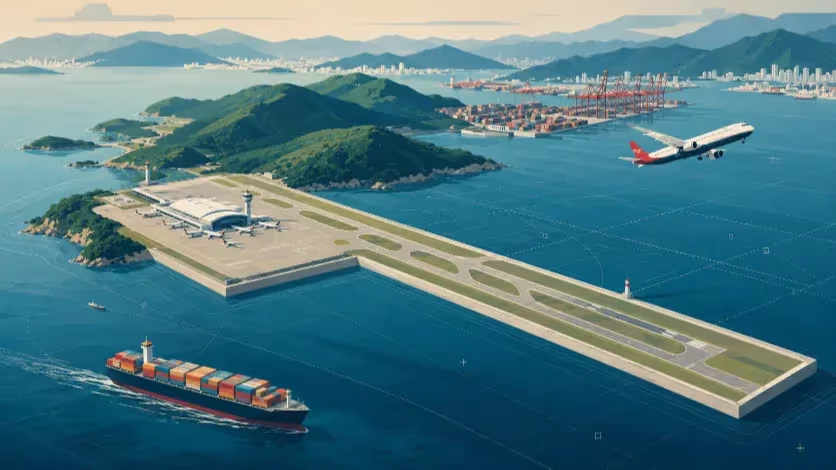
Busan’s airport debate has returned to speed. The harder evidence will come from soil, cost and design.
Gadeokdo New Airport has entered the politics of acceleration before it has cleared the engineering test of acceleration. Busan Mayor-elect Jeon Jae-soo says the city’s long-awaited airport could open two to three years earlier than its current 2035 target if risks tied to soft ground and offshore structures are reduced. The pledge arrives at a delicate moment. After repeated bid failures, a withdrawn negotiation and a rewritten construction schedule, the project has only just moved into the basic design stage that will determine how much of the new timetable is engineering necessity and how much is recoverable margin.
Busan has waited decades for an airport that can operate around the clock, connect the southern coast to international routes and support a logistics strategy built around ports, railways and air cargo. Gimhae International Airport remains the working gateway, yet its role has become increasingly transitional: too important to ignore, too constrained to carry the region’s long-term ambitions alone. Gadeokdo became the answer to that mismatch.
The harder question now belongs below the runway. South Korea’s current schedule gives the site preparation work 106 months, a number that carries more weight than any campaign sentence. The figure reflects marine soft ground, differential settlement risk, offshore equipment constraints and the sequencing of seawalls, reclamation and runway works. A mayor can compress a political message into a promise. A contractor has to compress settlement, if the ground allows it.
The 106-month number
Busan’s airport debate once revolved around 2029. That date gave the project political force: a new southern gateway, a 24-hour airport, a logistics platform and a symbolic correction to the capital-region bias that has shaped South Korea’s aviation system. The schedule also made the project vulnerable. A sea airport built across reclaimed land and existing island terrain cannot be accelerated by aspiration alone. The bidding market eventually made that clear.
The earlier timetable collapsed into a more cautious construction plan after the site development package failed to attract stable competition. Four rounds of failed bidding, the limits of an 84-month construction window and the withdrawal of the Hyundai E&C-led consortium from negotiated contracting changed the project’s center of gravity. The state then returned with a longer construction period and improved contract conditions. A project once sold through the language of speed had to be reintroduced through the language of risk.
The new baseline is 2035. Under the revised plan, the site development work is structured around a 106-month construction period and a project cost of roughly 10.7 trillion won for the land formation package. The longer schedule reflects the engineering sequence that must come before an airport can exist: stone and soil must be secured, soft marine ground treated, seawalls built, offshore and onshore reclamation staged, and runway foundations prepared with enough confidence to support aviation operations. The schedule is not a neutral number. It is the state’s current price for uncertainty.
Jeon’s acceleration pledge now presses against that price. Pulling the opening forward by two to three years would mean removing roughly 24 to 36 months from a timetable that was already lengthened after the market judged the earlier assumptions too tight. Administrative urgency may help at the edges. Faster coordination, earlier preparatory works and tighter agency management can matter. The main test sits elsewhere: whether Daewoo E&C’s basic design can identify engineering time that can be safely recovered.
A reclaimed sea airport begins before the runway exists. Rock and soil have to be secured in enormous volumes. Marine ground has to be investigated, treated and watched. Seawalls have to be built before reclamation can settle into shape. Offshore work windows have to be matched against waves, wind, vessel traffic and equipment availability. The runway becomes an aviation asset only after the manufactured land beneath it behaves within limits that engineers and regulators can accept.
Settlement gives the schedule its hardest constraint. Soft marine clay does not follow a mayoral term or a budget cycle. Once fill is placed above weak ground, water trapped inside the soil has to dissipate and the ground has to consolidate. Engineers can accelerate that process through drains, replacement, deep mixing, surcharge loading and other ground-improvement methods. They can measure settlement and pore-water pressure, refine models and move earlier when the data supports it. They cannot declare stable ground by political instruction.
Differential settlement is the sharper risk. Uniform settlement can often be anticipated and managed. Uneven settlement is more dangerous for an airport because runways, taxiways and aprons depend on precise grades, drainage slopes and pavement performance. A runway that looks complete in a construction photo may still carry operating risk if one section continues to move differently from another. The problem can reappear after opening as maintenance cost, pavement correction, drainage work or operational restriction.
A faster Gadeokdo schedule could become credible if the design identifies recoverable margin. Some time may have been added to protect against uncertainty, weather, equipment procurement or conservative stabilization assumptions. Ground investigation may show that certain sections can be treated differently. Construction sequencing may allow parallel work across zones previously assumed to be more linear. Offshore equipment, if secured early enough, may reduce idle time. Those possibilities deserve scrutiny rather than dismissal.
Credibility will depend on disclosure. The public does not need another date placed above the project. It needs the tables beneath the date: where the softest layers are, which zones will be replaced or improved, how much residual settlement is expected after opening, what monitoring threshold will allow the next work phase to begin, and how much additional money acceleration would require. A shortened schedule without those details would move risk out of the press conference and into the runway’s future operating life.
The airport’s invisible foundation
The clearest lessons for Gadeokdo come from airports that had to manufacture their own ground, then keep measuring it after passengers arrived.
Kansai International Airport remains the unavoidable comparison. Built on an artificial island in Osaka Bay, it proved that a major offshore airport could be constructed on soft marine deposits. Its deeper lesson is less comforting. Kansai’s operators still manage the airport with the assumption that long-term subsidence will continue. Sand drains accelerated consolidation in the upper alluvial clay, compressing a process that would normally take decades into roughly a year. Deeper diluvial clay layers proved harder to improve, leaving the airport with a maintenance reality that did not end on opening day.
Gadeokdo should read Kansai as a warning against treating completion as the end of ground risk. A runway can pass from construction to operation while the ground beneath it remains a live engineering system. Settlement may slow. Monitoring may improve. Maintenance may keep the surface within usable limits. The risk changes form after opening, moving into pavement correction, drainage adjustment, level control and long-term capital spending.
Hong Kong International Airport offers a second lesson. Its Chek Lap Kok platform was built largely through reclamation, and satellite-based studies have tracked settlement long after opening. Researchers found heterogeneous ground settlement over two decades, with movement patterns tied to fill materials, underlying alluvial deposits and construction stages. The pattern matters as much as the number. Early settlement can appear broad and manageable before later movement becomes localized.
That history speaks directly to Gadeokdo’s future monitoring burden. BIM, digital twins, ground sensors and satellite radar need to serve as more than project-management language. Those systems must become the evidence chain that decides when one construction phase can proceed, where residual settlement is acceptable, how runway grades will be preserved and what maintenance will be required after opening. A digital twin that ends as a visualization tool would miss the point. The useful version is a settlement-management system.
Haneda’s D Runway shows a different path. Tokyo built a hybrid structure that combined reclaimed land with a pile-elevated platform, chosen partly because the runway sits near the mouth of the Tama River. The project used a design-and-build contract, extensive precast components, steel jackets, steel pipe piles and rapid construction methods to finish the runway in just over three years. Haneda demonstrates that acceleration can be engineered when structure, procurement, materials and work sequencing are designed together from the start.
Gadeokdo cannot simply borrow Haneda’s answer. The site, hydrology, runway concept, reclamation volume, marine traffic and ground profile are different. Haneda matters because it shows what a credible acceleration story looks like: a defined structural choice, a construction method matched to environmental constraints, a clear procurement model, a detailed supply chain and a disciplined sequence of work. Speed came from design, not optimism.
The overseas record gives Gadeokdo neither comfort nor condemnation. Offshore airports can be built. Reclaimed airports can operate. Difficult ground can be improved, monitored and maintained. The same record also shows why an early opening date requires more than political confidence. Every accelerated offshore airport leaves behind a technical ledger: the ground improved, the ground accepted, the ground still moving, the maintenance planned and the money reserved for the runway’s operating life.
Gadeokdo’s real foundation will be that ledger. The visible airport will be a runway, taxiways, aprons, terminals and access links. The invisible airport will be a set of settlement curves, pore-pressure readings, ground-improvement zones, seawall performance data, satellite deformation maps and maintenance thresholds. A faster opening becomes credible only when those invisible systems explain why time can be removed without transferring hidden costs to the decades after opening.
Daewoo’s design test
Daewoo E&C’s consortium now holds the first practical test of Busan’s accelerated airport politics. Jeon can argue that the current 2035 target contains recoverable margin. The construction authority can manage procedures more tightly. The city can press for urgency. None of that will matter unless the basic design shows where time can be removed from the ground, the seawalls and the reclamation sequence.
The consortium’s task is larger than producing a buildable plan. It has to translate political acceleration into engineering evidence. A credible design must explain which parts of the airport platform can be treated faster, which sections require conservative stabilization, where offshore work can be converted into more controllable land-based construction, and how much residual settlement will remain after opening. The basic design will either turn the early-opening pledge into a testable proposition or leave it as a slogan waiting for evidence.
Daewoo’s public argument begins with experience. The company has pointed to marine civil works, port projects and past infrastructure work around the same coastal engineering environment. It has also said that existing information from the Geoje–Busan fixed link, earlier planning data and its own ground investigations can be combined to improve the previous design. That claim matters because Gadeokdo’s greatest uncertainty is the site-specific behavior of the ground under a runway that must remain precise long after the contractors leave.
The most important phrase in Daewoo’s current technical position is dredging-replacement. If applied in critical zones, the method would remove weak seabed material and replace it with stronger fill, reducing the risk of residual settlement in the runway area. The appeal is clear. Replacement changes the ground profile rather than waiting only for weak layers to consolidate under load. It could give engineers more control over the most sensitive sections of the airfield.
The method also moves the questions elsewhere. How much weak material will be removed? How deep will replacement go? Which zones will receive it? Where will dredged material be treated or disposed of? How will turbidity, marine ecology and offshore work windows be managed? What fill materials will be used, from where, and under what supply schedule? A method that reduces one kind of ground risk can create new pressure on cost, environment, logistics and marine traffic.
Daewoo has also referred to changing reclamation methods and finding ways to overcome the limits of offshore work by using more land-based construction where possible. The logic is understandable. Offshore work is exposed to weather, waves, vessel movement, equipment constraints and safety limits. Once a section is sufficiently enclosed or converted into a workable platform, construction becomes easier to control. A shift from open-water work to land-based sequencing could help stabilize quality and reduce idle time.
That strategy requires careful proof. Land-based construction does not arrive automatically; it must be manufactured through temporary works, enclosure, seawall progress, access roads, working platforms and material logistics. Each stage depends on the previous stage reaching a safe condition. A more aggressive sequence may save time if the ground and temporary structures behave as expected. The same sequence could create delay if early assumptions fail.
The design review should look beyond whether Daewoo can build the airport. The more useful question is whether the design identifies recoverable months. A table showing ground-improvement zones matters more than a general assurance about technology. A settlement prediction curve matters more than a rendering. A construction sequence that names parallel work fronts matters more than a promise of efficiency. A cost table showing the price of acceleration matters more than confidence in experience.
Four documents should become central to public scrutiny. The first is a zone-by-zone ground-treatment plan that distinguishes dredging-replacement, deep mixing, vertical drains, surcharge loading, compaction and untreated or lightly treated areas. The second is a settlement forecast that separates expected movement before opening from residual movement after opening. The third is a phase-transition rule: the monitored thresholds that will allow one work stage to move into the next. The fourth is a construction and cost sequence showing exactly where the project expects to recover months and what that acceleration would require.
Without those documents, acceleration remains difficult to judge. A 106-month schedule can include conservative margins. Some of those margins may be recoverable. The basic design is the place where that possibility becomes measurable. If Daewoo can show that specific zones can be improved faster, that residual settlement can be kept within operating limits, and that parallel sequencing will not move risk into the runway’s future, the early-opening debate changes. If the design offers only broad confidence, the 2035 schedule will remain the more credible number.
Continue this reporting
Reporting on the same issue
Related coverage selected from the article's desk, topics and newsroom relationships.
 NewsOct 16, 2026
What Is Still Worth Going to See?
Busan’s biennale faces questions of artistic judgment and institutional care....
 NewsOct 14, 2026
What Became of Busan’s University Streets?
From 2015 to 2023, registered businesses grew near Pusan National University...
 NewsOct 12, 2026
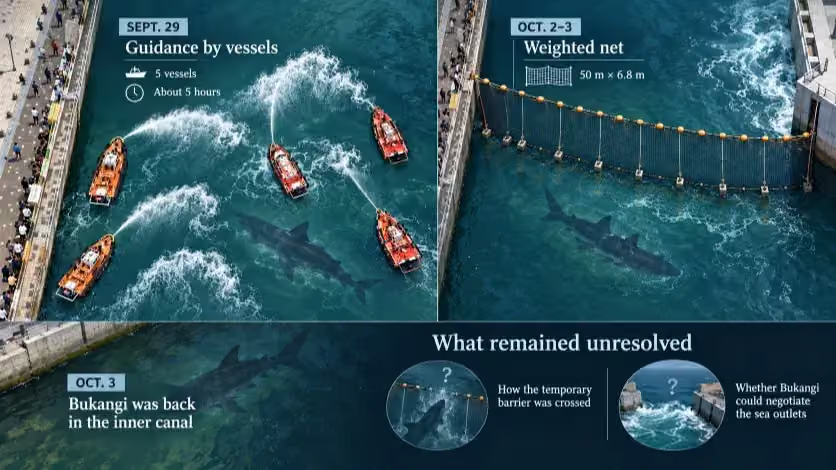
Bukangi, the Shark That Stayed in Busan’s North Port
A rescue net guided Bukangi toward the sea, but the dusky shark returned to B...
More from the author
More from this byline
Stay with the same line of reporting through more work from this byline.
- NewsOct 12, 2026
Bukangi, the Shark That Stayed in Busan’s North Port
 NewsOct 6, 2026
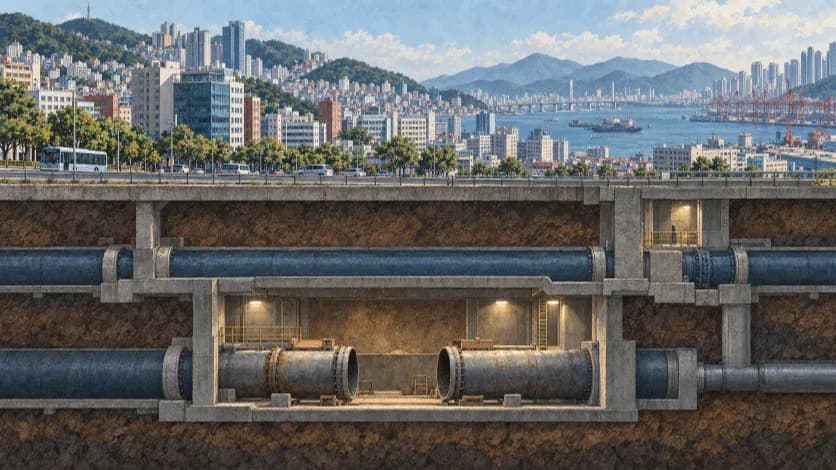
Busan’s Water System Is Entering a Harder Era of Renewal
Reader Signal
Community readWhat did this report leave you with?
Choose the signal that best reflects your reading. Select it again to remove it.
One response per article
No response selected
A moderated conversation about the reporting.
One-level replies and newsroom moderation keep the conversation anchored to this article.
Discussion Status
Open
Please sign in to join the discussion.
Newsletter
Weekly reporting and context from Busan and Korea.