The Ceasefire Discount: Why the Strait of Hormuz Remains Risky
Oil prices can recover long before tankers, insurers and refiners trust Hormuz again. The result is a costlier energy system built around alternative routes, strategic stocks and contracts designed to survive the next failed ceasefire.

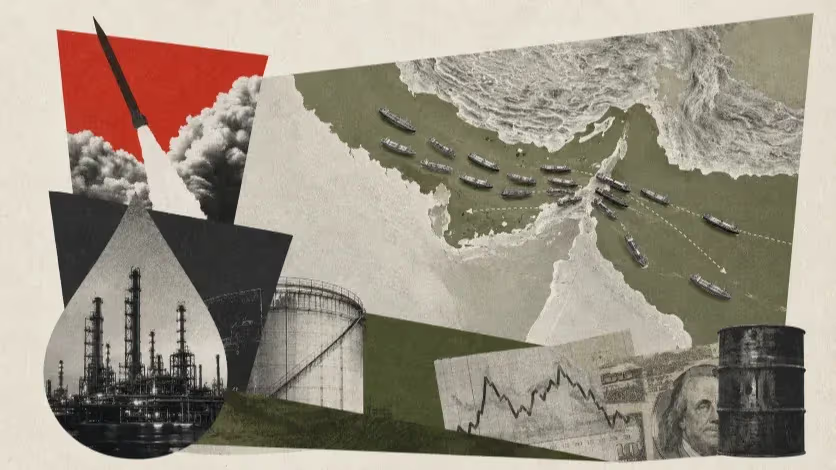
Repeated US–Iran truces have reopened the Strait of Hormuz without settling the rules that govern its passage. Gulf exporters and Asian importers are now reorganising energy supply around the possibility that the next agreement will fail.
At least four oil and gas tankers approaching the Strait of Hormuz turned back on July 8 after renewed attacks on commercial vessels, while the traffic that had begun recovering under a June truce fell close to a standstill. A small number of ships continued to leave the Gulf, sometimes with their tracking systems disabled, but the movement of individual vessels no longer amounted to a schedule that owners, charterers and refiners could treat as dependable.
Oil markets reached a less severe conclusion. Brent rose nearly 5 per cent to $78.02 a barrel after US President Donald Trump declared the interim agreement with Iran over, yet the increase remained modest beside the consequences of a prolonged closure of the world’s most important oil chokepoint. Investors had watched earlier rounds of fighting return to negotiation and were reluctant to price another interruption lasting for months. A tanker owner faced a different decision: once a ship, crew and cargo were committed to Hormuz, the exposure could not be reversed after the next diplomatic statement.
By July 12, the distance between those calculations had widened. Iran’s Revolutionary Guards said the strait was closed until further notice after firing on a vessel accused of using an unauthorised route. A Cyprus-flagged container ship was seriously damaged the following day, prompting another round of American strikes, even as Washington maintained that commercial traffic could continue. Iranian and US forces were again exchanging attacks across the region while diplomats discussed safe passage through the same waterway.
The latest rupture followed a 60-day memorandum signed in mid-June that had extended a tenuous ceasefire reached in April. Ships returned, delayed crude left the Gulf and producers began restoring output, but the parties never settled whether reopening Hormuz meant restoring unrestricted international navigation or recognising an Iranian role in approving routes and regulating passage. Commercial operators had begun repairing the previous disruption when the next confrontation arrived.
A ceasefire can still halt attacks, release stranded vessels and return millions of barrels to the market. What has diminished is its value as a promise about the next voyage. Insurers, shipowners, refiners and governments increasingly retain emergency contracts, larger stocks and alternative routes after traffic resumes because the calm may end before the supply chain has recovered. The shrinking commercial credit attached to each new truce is the ceasefire discount.
Hormuz Has Become the Negotiation
The conflict now extends beyond the timing of air strikes, sanctions relief and talks over Iran’s nuclear programme. Washington has demanded a public Iranian commitment to stop attacking vessels, keep every established channel open and permit toll-free passage. Iranian officials and the Revolutionary Guards have asserted a role in determining how ships move near the country’s coast, while talks involving Oman have focused directly on arrangements for safe transit. The passage itself has become one of the outcomes being negotiated.
Iran’s position has not always appeared internally coherent. US officials said Tehran had attributed recent attacks on Saudi and Qatari ships to rogue elements within its system and suggested a struggle between hardliners and pragmatists, an account that has not been independently established. The uncertainty still matters to commercial operators. A pledge made by Iranian diplomats does not tell an insurer how the Revolutionary Guards will treat a tanker entering a disputed lane several days later.
A complete blockade would impose heavy costs on Iran by restricting its own exports, hardening opposition among neighbouring Gulf states and giving the United States a clearer military rationale for attacking the coastal missiles, surveillance systems and naval assets needed to sustain the closure. Intermittent enforcement, whether centrally directed or produced by competing Iranian institutions, creates pressure at a lower cost. A warning shot, a disputed route instruction or an attack on a small number of vessels can force every owner and underwriter to reconsider the next sailing.
The three QatarEnergy carriers that turned back on July 8 were heading towards the Ras Laffan export system to collect LNG. Their diversion therefore affected cargoes that had not yet been loaded, demonstrating how a single maritime incident can disrupt production and delivery schedules far beyond the vessel directly involved. At the same time, a few crude and chemical tankers still passed through the strait, leaving Hormuz neither fully sealed nor dependable enough for regular commerce.
Commercial caution performs much of the coercive work. Insurers can shorten coverage, alter exclusions or advise owners to wait while risk is reassessed; crews can refuse assignments; charterers can cancel a vessel before loading. None of those decisions requires international recognition of an Iranian right to control the waterway. Their combined effect raises freight, delays cargoes and makes importers pay for the possibility of Iranian interference even when no formal transit fee is collected.
American military power addresses only part of the problem. Naval forces can patrol channels and strike weapons used against merchant vessels, but an escort cannot guarantee that an attack will not occur after a tanker enters the Gulf, persuade a crew to accept the voyage or compel a private insurer to renew cover at its former price. Washington can keep a route technically navigable while the commercial system continues to treat it as unstable.
Gulf governments are caught between the American and Iranian positions. Saudi Arabia, the UAE, Kuwait, Bahrain and Qatar reject any Iranian claim over the maritime outlet carrying much of their export revenue, while an extended American offensive exposes their ports, refineries, cities and military facilities to retaliation. Iran’s July attacks on sites across several Gulf states showed that the security of Hormuz cannot be separated from the security of the infrastructure surrounding it.
Oman and other mediators may still organise a corridor, notification process or temporary understanding that allows another group of ships to pass. Commercial normality requires a longer horizon. A tanker fixed for delivery several weeks ahead must be able to rely on the same rules that governed the vessel crossing today without its insurer and charterer reopening the political question before every departure.
When the Price Recovers Before the Route
Financial markets price the expected direction of future supply, while the physical energy system has to repair disruptions that have already occurred. Global oil production rebounded by 4.1 million barrels a day in June as Hormuz flows resumed and Gulf output partially recovered, but world supply remained 9.4 million barrels a day below its pre-war level. The recovery depended on the truce lasting long enough for production, shipping schedules and depleted inventories to stabilise.
A tanker delayed inside the Gulf cannot immediately collect replacement oil in the Atlantic, and a refinery cannot switch among crude grades without changing product yields and operating plans. Strategic stocks cover part of that interval, but every barrel released reduces the buffer available for the next interruption and creates another purchase once the emergency has passed.
Repeated ceasefires can therefore make financial investors less sensitive to renewed fighting while making physical operators more cautious. Traders may expect another negotiation because previous confrontations produced one. Refiners, shipowners and governments remember that those negotiations repeatedly failed before normal schedules and inventories had been restored. The remaining risk moves away from the benchmark price and settles in insurance, longer voyages, larger stocks and contracts preserving access to distant supply.
Those arrangements encounter a physical limit. Nearly 20 million barrels a day normally pass through Hormuz, while the pipelines capable of reaching another coast can redirect only a fraction of that volume.
The Politics of Limited Exits
An average of 19.87 million barrels a day of crude, condensate and petroleum products passed through Hormuz in 2025, representing roughly one-quarter of global seaborne oil trade. About 80 per cent travelled to Asia. Saudi Arabia and the UAE operate the only large crude pipelines reaching terminals outside the strait, and the International Energy Agency estimates that between 3.5 million and 5.5 million barrels a day of additional capacity may be available under different operating conditions. Even the upper estimate would accommodate little more than one-quarter of normal Hormuz oil traffic.
Pipeline nameplates provide only the starting point. Domestic refineries consume part of the flow, maintenance can constrain pumping, and western terminals require storage, grade-segregation capacity and enough berths to load redirected crude. A producer may own an external route without every buyer holding the contractual right to use it when the system is full.
Saudi Arabia controls the larger outlet. The East–West Pipeline connects the kingdom’s eastern production system with Yanbu on the Red Sea. Aramco has reported capacity of 7 million barrels a day, although the IEA says sustainable operation at that level had not been robustly tested. About 2 million barrels a day were using the line in early 2026, leaving an estimated 3 million to 5 million barrels of spare capacity depending on operating conditions and the export capability of Saudi Arabia’s western coast.
The crisis demonstrated that the system could handle far more than its previous flow. Korea Energy Economics Institute researchers found that average Yanbu loadings had reached about 4.5 million barrels a day by April 13, serving Asian customers as well as shipments moving towards Egypt’s SUMED network. The increase confirmed the practical value of the Saudi bypass while transferring pressure to storage, loading terminals and tanker availability on the Red Sea.
A cargo leaving Yanbu has escaped Hormuz without escaping every maritime risk. An Asia-bound tanker must travel through the Red Sea and Bab el-Mandeb, while European shipments continue towards Suez or take the longer route around Africa. The corridor is valuable because its principal vulnerabilities differ from those inside the Gulf, although it still relies on another exposed chain of pumping stations, storage farms, ports and sea lanes.
Riyadh is considering an expansion of 1 million to 2 million barrels a day and has held preliminary discussions with Kuwait, Bahrain and Qatar about possible use of the system. Construction would take years and require agreements over tariffs, crude quality, guaranteed volumes and emergency priority. No regional allocation regime has been announced.
Even without explicit political conditions, operating a regional export corridor would increase Saudi Arabia’s structural influence over neighbouring producers. Kuwait or Bahrain could reduce their exposure to Iranian pressure while placing part of their export continuity in infrastructure controlled by Aramco. Decisions made for legitimate operational reasons—serving domestic refineries, managing grades or honouring existing contracts—could determine whether another Gulf government continued receiving oil revenue during a closure.
The UAE has built a smaller, more integrated alternative. The Abu Dhabi Crude Oil Pipeline runs 400 kilometres from Habshan to Fujairah on the Gulf of Oman. Its reported capacity is close to 1.8 million barrels a day, with about 1.1 million normally exported through the route and as much as 700,000 barrels a day potentially available above that level during a disruption.
Fujairah combines pipeline arrival, storage, crude blending, tanker loading and marine-fuel services. ADNOC can organise cargoes outside Hormuz, transfer oil between vessels or connect an external loading point with stocks held closer to Asian refineries. The buyer receives access to a logistics platform rather than production volume alone.
Abu Dhabi is accelerating another pipeline intended to double export capacity through Fujairah from 2027. The project was about half complete in May. Expanding the eastern outlet would allow a larger share of UAE production to avoid Hormuz, while increasing the strategic value and military exposure of the tanks, power systems and loading facilities concentrated there.
Saudi Arabia and the UAE consequently offer several different forms of security. A contract naming a terminal inside the Gulf leaves the cargo dependent on Hormuz. A contract that reserves pipeline and terminal space at Yanbu or Fujairah provides a separate route, while oil already loaded or stored inside the importing country has completed more of the vulnerable journey. A general pledge of priority does not carry the same operational value as an allocated berth.
Qatar cannot reproduce that escape through a crude pipeline. Just over 112 billion cubic metres of LNG passed through Hormuz in 2025, representing almost one-fifth of global LNG trade. About 93 per cent of Qatar’s LNG exports and 96 per cent of the UAE’s used the strait, with almost 90 per cent of the combined flow destined for Asia. No alternative route can bring a comparable volume of gas to the global market at short notice.
A Qatari outlet on another coast would require much more than a pipe. Gas processing, liquefaction trains, electricity supply, cryogenic tanks, specialised berths and a durable transit agreement would have to be constructed as a second industrial system. When empty LNG carriers turned away from Ras Laffan in July, the production and liquefaction capacity waiting behind them could not be transferred elsewhere.
Iraq possesses a northern route to the Turkish Mediterranean, but legal and political disputes have repeatedly interrupted its operation. Other proposed corridors towards Syria, Jordan, Oman, the Red Sea or the Mediterranean remain construction plans or diplomatic concepts rather than capacity available to an importer during the present emergency. A route drawn on a map cannot protect a refinery until the pipeline operates, the terminal loads ships and the buyer holds a contract giving it access.
Importers unable to secure space at Yanbu or Fujairah had to rely on distant suppliers, vessels already at sea and the fuel stored inside their own borders.
Importers Store Time
Asian importers cannot build another coast from fields they do not own. Their first protection lies closer to home: strategic and commercial stocks, cargoes already under way, contracts outside the Gulf and domestic industries capable of adapting while replacement supply travels farther.
China entered the crisis with the broadest combination of options. The US Energy Information Administration estimated that it held nearly 1.4 billion barrels of oil when the war began, although that total included strategic and commercial inventories whose immediate availability was not fully disclosed. Continental pipelines from Russia and Kazakhstan supplied oil without entering Hormuz, while Chinese refiners could lower runs rather than replace every disrupted Gulf barrel at the highest crisis price. Rapid electric-vehicle adoption and flexibility in oil and petrochemical production further reduced the volume requiring immediate substitution.
Those choices redistributed dependence rather than eliminating it. Larger pipeline flows increased the importance of Russia and Central Asian transit, while stocks drawn during the crisis had to be replaced later. China’s advantage lay in the range of adjustments available before the disruption reached consumers: inventories, continental supply, domestic output and slower growth in transport-fuel demand could all absorb part of the loss.
Japan depended more heavily on time held in formal reserves. Middle Eastern producers supplied 94 per cent of its crude in 2025, leaving Tokyo highly exposed when Hormuz traffic collapsed. The government began releasing reserves equivalent to about 50 days of consumption in March while refiners arranged larger imports from the United States and other sources. By June 8, Japan still held stocks equal to 201 days of consumption across government, private and producer-linked reserves.
The inventories bridged more than a long voyage. Japanese plants had been configured mainly for medium-sour Middle Eastern crude, whereas many American and Atlantic-basin alternatives were lighter and produced a different mix of fuels. Oil already stored at home gave engineers and traders time to adjust blends and refinery operations without allowing the shipping delay to become an immediate shutdown.
India faced a shorter buffer and several fuels requiring separate responses. More than 40 per cent of its oil had come from the Middle East, while the country was also heavily dependent on Gulf LPG and Qatari LNG. New Delhi said in late March that it had secured around 60 days of oil supply through existing stocks, purchased cargoes and scheduled deliveries. The figure described the expected continuity of the supply chain; it did not mean that 60 days of crude were already held in government caverns.
Indian refiners could increase Russian and Atlantic-basin crude purchases, but those barrels could not replace LNG or the specialised LPG shipments used for household cooking. The government raised domestic LPG production, secured additional cargoes from suppliers including the United States and Russia, and managed gas allocations separately from the crude response. India’s experience showed how a country may appear adequately supplied in aggregate while remaining exposed in a fuel that depends on a different vessel, terminal and storage system.
China reduced the amount of oil requiring immediate replacement, Japan used reserves to cover the journey from new suppliers, and India divided the emergency by fuel. Their experiences make rankings based only on stockpile days increasingly misleading. The quantity held inside a country matters alongside refinery compatibility, the route available to replenish it and the amount of demand that can be adjusted before the stock is exhausted.
Korea Starts Counting Routes
South Korea entered the crisis with a diversification policy that had already altered the composition of its crude imports. Freight support and refinery adaptation raised the North American share above 23 per cent in 2025. During March and April, Korean refiners imported about 600,000 barrels a day of US crude—33 per cent more than their pre-war average of roughly 450,000 barrels a day—even as Asian buyers competed for the same replacement supply. The policy delivered oil through a chain physically separate from Hormuz when the alternative was most needed.
Conventional customs data still concealed the concentration that remained. Saudi Arabia, Iraq, Kuwait and the UAE appeared as separate national suppliers, although much of their crude reached Korea through the same maritime passage. Seoul said Hormuz had carried 61 per cent of Korean crude and 54 per cent of naphtha imports in the previous year.
KEEI researchers tested the difference by grouping suppliers according to common geopolitical and physical exposure. The Herfindahl–Hirschman Index rises as imports become concentrated in fewer suppliers or risk groups. Korea’s standard country-based score was around 0.2, suggesting substantial diversification, while the measure exceeded 0.5 when the Middle East or Hormuz-dependent suppliers were treated as a connected source of risk. When Saudi Arabia and the UAE were separated from the Hormuz group to reflect their bypass pipelines, concentration eased again. The calculation used 2024 trade-network data and showed why the physical route can matter as much as the national flag attached to the cargo.
The adjusted index does not prove that every Korean contract with Aramco or ADNOC can use Yanbu or Fujairah. It identifies the question that trade statistics cannot answer: whether a producer’s ownership of a bypass translates into an enforceable right for the buyer when pipeline and terminal capacity are scarce.
Seoul’s emergency diplomacy began to address that distinction. On April 15, the government announced agreements covering 273 million barrels of crude and 2.1 million tonnes of naphtha through routes outside Hormuz. Saudi Arabia agreed to ship about 50 million barrels already allocated to Korean companies through Red Sea ports in April and May. Riyadh also promised to prioritise Korean buyers when allocating and shipping another 200 million barrels through the end of the year. Kazakhstan committed 18 million barrels, while Oman promised 5 million barrels of crude and 1.6 million tonnes of naphtha.
A diplomatic commitment, a priority clause, an allocated Yanbu slot, a loaded tanker and crude held beside a Korean refinery may all be described as secured oil, although they remain exposed to different numbers of decisions before the fuel becomes usable. The first Saudi cargoes had designated western loading. The later 200 million barrels carried priority treatment rather than a fixed loading schedule, leaving actual deliveries dependent on production, pipeline space and available ships when Korean refiners nominated their cargoes.
The Saudi arrangement mattered because Seoul negotiated the route attached to the volume. Aramco’s ability to produce another barrel could not protect oil trapped inside the Gulf; the scarce assets were space in the East–West Pipeline and loading capacity at Yanbu. Korean energy diplomacy had moved beyond identifying who could sell crude and begun asking whether the crude had a viable way out.
Domestic reserves covered the interval before replacement voyages arrived. At the end of December 2024, the latest published KNOC baseline, South Korea operated nine stockpile sites with total capacity of 146 million barrels and held 99.49 million barrels of government reserves, excluding joint stocks. International joint-stockpiling arrangements covered another 23.13 million barrels, including 13.3 million barrels of Middle Eastern crude held through agreements with Saudi Arabia, Kuwait and the UAE.
Those barrels share a domestic location without carrying identical rights. The state controls government reserves, refiners and traders own commercial inventories, and foreign-producer stocks remain governed by contracts covering sale and emergency access. Oil already inside Korea nevertheless has an immediate advantage: the vulnerable international voyage has been completed.
The durability of that protection depends on replenishment. Saudi crude stored in Korea becomes more valuable when Aramco can replace it through Yanbu, while UAE oil gains similar resilience when ADNOC can load another cargo at Fujairah. Domestic storage and the producer’s external terminal form one supply chain, even though the assets are thousands of kilometres apart.
The long-term partnership announced by ADNOC and South Korea on July 8 develops that connection. The agreement covers crude supply, emergency coordination and expanded joint stockpiling, building on a March UAE pledge to supply up to 24 million barrels. ADNOC and Seoul will also discuss access to Korean storage linked with domestic refining assets. The pledged barrels should not be treated as oil already deposited under unconditional Korean ownership; the strategic value lies in arranging production, alternative routing, storage and emergency procedures before the next interruption.
Korea’s oil ledger now needs to record route exposure, contractual access and onshore availability alongside national origin. Gulf cargoes still dependent on Hormuz carry a different risk from Saudi and Emirati oil with confirmed external loading. Non-Gulf volumes that refiners can expand during an emergency form another category, while government-owned or contractually accessible oil already inside Korea provides the fastest response.
The categories would remain approximate because private contracts are confidential, pipeline availability changes and refineries cannot process every crude in equal proportions. They would still reveal whether supplies listed under different national flags were likely to disappear together.
Korea’s earlier diversification passed a meaningful test. Refiners expanded American imports, the government obtained Saudi Red Sea allocations and domestic stocks bridged the longer replacement voyages. The crisis exposed the next weakness in the ledger: separate producing countries can converge on one route, while ownership of a bypass does not automatically grant access to the customer.
Failure Diversification
Counting supplier countries remains useful, but it cannot reveal why those supplies might fail. Several Gulf exporters can be interrupted at Hormuz; American crude avoids the strait while remaining exposed to Gulf Coast storms and export terminals; continental pipelines reduce maritime exposure while increasing dependence on transit states. A reserve protects the opening weeks of a crisis but loses strategic value when every possible replacement cargo must use the route that forced the release.
A barrel’s national origin identifies the producer. Its practical security depends on the passage it follows, the buyer’s terminal allocation, the stage reached in the voyage and the authority attached to the oil after it enters storage. Saudi crude loaded inside the Gulf, the same grade assigned to Yanbu and Saudi oil already held in Korea belong to one national supply relationship but present three different operational risks.
Fuel types require separate treatment as well. Crude can be stored at large scale and moved through conventional pipelines; LNG remains tied to liquefaction plants, cryogenic tanks, specialised vessels and receiving terminals; LPG and naphtha rely on their own shipping and industrial systems. A portfolio that looks diversified in aggregate can still allow one disruption to remove the fuel households or factories need first.
Failure diversification means organising the principal components of supply so they are unlikely to become unavailable through the same physical, political or contractual breakdown. Major Asian economies will remain dependent on imported energy. Resilience lies in preserving enough independent options to prevent one confrontation from disabling the entire chain.
That separation costs more than concentrating trade around the cheapest normal route. Refineries maintain the capacity to process additional grades, governments finance oil held in reserve, producers preserve pipeline and terminal room that may remain partly unused, and importers retain distant suppliers despite higher freight. Repeated ceasefires have turned those expenses into part of ordinary energy management.
The Uncertainty Tax
The price of the Hormuz crisis is easiest to see when ships stop and crude futures rise. Much of it remains after benchmarks fall, embedded in shorter insurance contracts, longer voyages, larger inventories and infrastructure kept ready for the next emergency.
The $40 billion US maritime reinsurance facility illustrates how the burden moves beyond the oil market. The International Development Finance Corporation committed $20 billion of rolling coverage, while Chubb and six additional American insurers provided another $20 billion. Chubb manages underwriting, pricing and claims, while government agencies screen eligible vessels. Public support increases the losses the market can carry without resolving the political conditions that made the route dangerous.
Replacement cargoes distribute the cost across freight, finance and refinery operations. Oil from the United States, Brazil or another distant producer can reach Asia without entering Hormuz, but the longer journey ties up a tanker and its cargo for additional weeks. Refiners finance the shipment for longer and may receive a grade producing a less useful mix of fuels. The geopolitical premium rarely appears as a single fee; it enters charter rates, working capital, refinery yields and the number of ships needed to sustain the same daily flow.
Pipelines create a quieter expense because their emergency value depends partly on unused capacity. A system operating at its commercial maximum before the crisis has no room to absorb diverted production when the main route closes. Saudi Arabia and the UAE must preserve pumping, storage and terminal flexibility whose financial return may appear modest during uninterrupted trade.
Strategic stocks carry costs before and after a release. Governments finance storage and the crude held inside it, then have to replace the barrels once the emergency ends. The IEA coordinated a record release of 400 million barrels during the conflict, while Reuters calculated that disruption and emergency draws removed roughly 1.5 billion barrels from global inventories. Replenishment could add about 506,000 barrels a day to demand late in 2026 and as much as 664,000 barrels a day during 2027.
The expense eventually reaches households even when governments suppress an immediate rise at the pump or on electricity bills. Refiners absorb freight and feedstock costs, insurers price possible losses, national oil companies finance external routes and public budgets support reserves or guarantees. Regulated utilities can postpone adjustments, transferring the burden into subsidies, debt or later tariffs. Stable consumer prices may indicate that the shock has been relocated rather than removed.
Another US–Iran agreement could lower oil within hours and allow delayed vessels to clear the strait. Commercial normality will take longer. Tanker owners will watch whether ships complete repeated voyages under the same rules; insurers will decide whether cover can be renewed without emergency exclusions; importing governments will test whether depleted stocks can be replenished without recreating the exposure that forced the release.
The Gulf energy order had long rested on an expectation that serious interruptions would remain brief enough for diplomatic and military pressure to restore trade before companies had to redesign their supply chains. That expectation has weakened without another waterway, security authority or accepted body of navigation rules emerging to replace it.
On July 8, oil traders concluded that renewed fighting would probably return to negotiation. Several tanker owners and their insurers decided that probability was insufficient to justify the voyage.
Prices can recover before confidence in the route does.
Continue this reporting
Reporting on the same issue
Related coverage selected from the article's desk, topics and newsroom relationships.
 NewsOct 21, 2026
What a Small Mackerel Is Worth
Busan’s catch is dominated by small mackerel even as some buyers need larger...
 NewsSep 21, 2026
Europe’s Electrical-Steel Safeguard Now Reaches Inside the Transformer
A new EU safeguard follows electrical steel into certain finished transformer...
 NewsSep 14, 2026
Foreign Tourist Spending Is Reshaping Busan’s Nampo District
Foreign spending is making long-empty commercial space valuable again in Namp...
More from the author
More from this byline
Stay with the same line of reporting through more work from this byline.
- NewsOct 21, 2026
What a Small Mackerel Is Worth
Reader Signal
Community readWhat did this report leave you with?
Choose the signal that best reflects your reading. Select it again to remove it.
One response per article
No response selected
A moderated conversation about the reporting.
One-level replies and newsroom moderation keep the conversation anchored to this article.
Discussion Status
Open
Please sign in to join the discussion.
Newsletter
Weekly reporting and context from Busan and Korea.