South Korea’s AI Chip Boom Faces a Factory Test in Ports and Manufacturing
A record $102 billion export month showed how AI semiconductors can lift Korea’s trade account. The next test will come from defect rates, machine downtime, port delays and supplier margins.

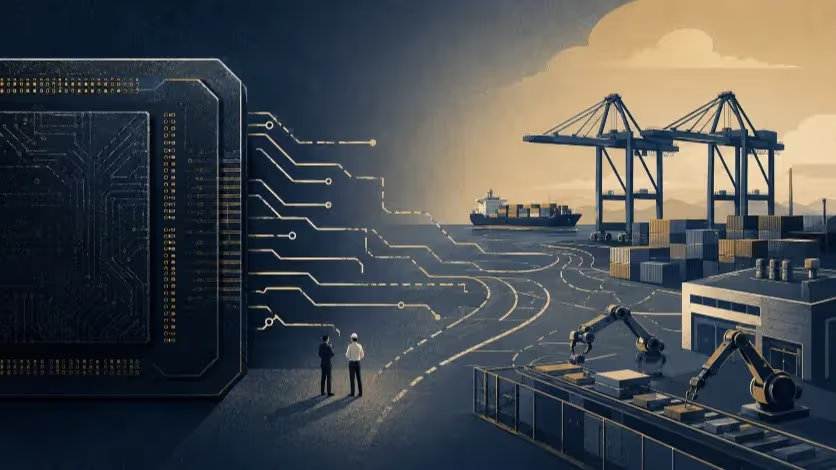
A $102 billion export month showed how global AI demand can lift Korea’s trade account. The next evidence will be harder to see: defect rates, machine downtime, port delays and supplier margins.
South Korea crossed a trade threshold in June, selling $102.25 billion in goods abroad in a single month. The figure put the country in a group previously reached by Germany, China and the United States, and gave Seoul its strongest export growth rate since 1978. The record was large enough to look like a national manufacturing surge. Its product mix told a narrower story.
Semiconductors did most of the work. Chip exports rose 199.5 percent from a year earlier to $44.8 billion, accounting for roughly 44 percent of June shipments. Computer exports jumped 308.8 percent as global spending on artificial intelligence infrastructure lifted demand for servers, memory and related equipment. Steel products rose 9.6 percent, helped by data center construction. Petroleum product exports gained on higher oil prices. Shipments to the Middle East fell 8.4 percent.
Based on the reported export total and growth rates, semiconductors appear to have accounted for roughly 70 percent of the year-on-year increase in June exports. The estimate changes how the record should be read. A $100 billion month showed the strength of Korea’s AI-linked export channel. It said less about whether the average factory was becoming more productive.
Factory surveys were already less exuberant. South Korea’s manufacturing purchasing managers’ index remained above the 50 line that separates expansion from contraction, but slipped to 52.1 in June from 54.8 in May. Factory activity expanded for a seventh month, yet the pace slowed as export demand weakened.
Export data record what leaves the country. PMI surveys record what managers see before goods leave the plant: orders, input prices, delivery times, material availability and confidence. A chipmaker selling high-value memory into the AI server cycle and a supplier waiting on costlier parts may both appear inside the same manufacturing data. Their month does not feel the same.
The next evidence will not look like the June export release. It will show up in smaller ledgers: how long machines stay down, how many parts fail inspection, how quickly containers move through yards, and whether suppliers can protect margins when orders weaken or input costs rise.
A $102 billion month, led by chips
The June trade figures showed how quickly AI infrastructure spending can reshape Korea’s export account. Total exports rose 70.9 percent from a year earlier. Imports increased 30.1 percent to $66.1 billion, leaving a record monthly trade surplus of $36.15 billion.
The increase did not spread evenly across the manufacturing base. Semiconductors alone generated $44.8 billion in exports. Computer shipments, another AI-linked category, rose more than fourfold. Steel gained from data center construction demand. Exports to China and the United States rose sharply, while the Middle East declined.
The size of the record made it a national headline. The composition made it a semiconductor story with wider implications for companies that were not selling directly into the AI server cycle. Memory chips, high-bandwidth products, servers and data center supply chains lifted the national numbers. Petrochemical producers, auto-parts makers, machinery suppliers and smaller manufacturers faced a different mix of demand, costs and competitive pressure.
The concentration is not a reason to dismiss the record. Korea’s strongest industrial channel is exactly where global AI spending is moving. Samsung Electronics and SK Hynix sit at the center of the memory market that AI data centers need, and the government has paired their chip investments with broader AI and data-center plans. A chip-led export surge can strengthen the current account, support investment and raise growth forecasts.
The risk is in assuming that the same surge has already reached the rest of manufacturing. Export values can rise through price, product mix and shipment timing. A supplier’s operating conditions are measured in less visible terms: purchase orders, inventory, labor pressure, inspection failures, energy costs and whether customers accept higher prices.
Why managers still sounded cautious
Industrial output data offered a second warning. In May, South Korea’s overall industrial production fell 0.3 percent from the previous month, while mining and manufacturing output dropped 3 percent. Semiconductor production fell 10 percent, with officials pointing to memory-chip shipment adjustments, base effects and volume changes even as the sector’s fundamentals remained strong.
The chip sector’s export value can rise even when production schedules fluctuate. Memory prices, product mix and contract timing can lift dollar-denominated shipments faster than production volume. That difference helps explain why a country can post a record export month while output indicators and manager surveys look cooler.
Global conditions added pressure. Reuters’ survey of factory PMIs found that Asian manufacturing stayed resilient in June as AI-related demand supported activity, while war-driven energy costs and supply risks continued to weigh on factories. South Korea fit that pattern: strong AI-linked exports at the top of the trade account, higher costs and softer export orders inside parts of the factory economy.
A factory manager does not experience the AI cycle as a national trade figure. The relevant numbers are delivery times, input prices, staffing, machine availability, inventory, customer pricing power and the cost of rework. Those variables determine whether a larger export account becomes a better month on a company’s own balance sheet.
The June data do not support a simple manufacturing revival story. They show a high-value export surge concentrated in AI-linked products, while purchasing managers continued to report weaker export demand and cost pressure. The gap between the trade account and the shop floor is where Korea’s next industrial policy challenge begins.
Winners, laggards and exposed suppliers
June meant one thing for a memory supplier tied to AI servers and another for a petrochemical producer facing Chinese capacity or an auto-parts maker watching production shift overseas. Korean manufacturing is moving along several tracks at once.
The Korea Institute for Industrial Economics & Trade expects the country’s 13 flagship industries to follow divergent paths in 2026. IT and emerging industries are projected to lead growth as technological change accelerates, while materials industries face weaker external demand and China’s growing self-sufficiency in production.
Semiconductors sit at the strongest end of the map. KIET expects chip exports to keep benefiting from high-value products such as high-bandwidth memory and DDR5, although base effects are likely to moderate growth. Biohealth exports are also projected to rise, supported by high-value production and contract manufacturing.
Other sectors have less room to breathe. Materials producers remain exposed to energy prices, Chinese capacity and slower external demand. Battery-related domestic production faces pressure from overseas manufacturing shifts and slower electric-vehicle demand in some markets. Machinery and auto-parts suppliers have to manage both tariff risk and the localization of production abroad.
KDI’s macroeconomic outlook points to the same pattern. The institute projects Korea’s economy to grow around 2.5 percent in 2026 and about 1.7 percent in 2027. Equipment investment is expected to expand by around 3.3 percent in 2026, supported by semiconductor demand despite weakness in non-semiconductor sectors.
OECD also sees semiconductor exports driving Korean growth and private investment, with GDP projected to rise 2.6 percent in 2026 before moderating to 1.9 percent in 2027. Its outlook lists potential shortages linked to the Middle East conflict as a downside risk and strong demand for advanced semiconductors as an upside risk.
The pattern gives Korea a strong macro story and a difficult diffusion problem. High-value chips can lift trade totals, current-account balances and investment plans. Suppliers outside the AI infrastructure chain still have to absorb energy costs, compete with Chinese capacity, handle overseas production shifts and decide whether new automation spending will pay for itself.
From fabs to factory floors
Seoul’s physical AI agenda addresses a problem export data cannot solve by itself: how to raise output, reduce defects and stabilize operations in industries that do not benefit directly from AI server demand.
The government has placed semiconductors, physical AI and AI data centers inside a set of national mega projects. Its physical AI and robotics targets include becoming a global leader by 2030, commercializing humanoid robots for 10 major industries by 2028 and training 10,000 AI robotics experts within five years.
M.AX, the government’s manufacturing AI transformation program, gives the policy a more specific industrial shape. The Ministry of Trade, Industry and Resources describes the agenda through AI factories, on-site demonstrations of industrial robots and humanoids in manufacturing, and on-device AI semiconductors for AX products such as autonomous vehicles. MOTIR said it plans to invest KRW 1.1 trillion in its AX budget in 2026 to support wider adoption.
Those targets will matter only if they change operating variables inside plants. Factory AI has to produce gains in smaller increments: fewer defective parts, shorter inspection queues, less unplanned downtime, faster line changes, safer work and better use of equipment. Those figures do not arrive in a single trade release. They are collected in maintenance logs, quality-control systems, production schedules and supplier accounts.
The infrastructure requirement is different from a fab or a data center. AI-enabled factories need clean machine data, interoperable control systems, sensors, safety procedures, simulation environments and workers trained to operate alongside automated systems. A model that works in a demonstration cell has to survive dust, heat, vibration, mixed equipment, subcontractor workflows and production schedules that cannot stop for experimentation.
Smart-manufacturing research points to the same practical barriers. A 2026 roadmap on AI and machine learning for manufacturing identifies industrial data analytics, advanced sensing, autonomous systems, digital twins, robotics, logistics optimization and reliable operation as core adoption areas. It also lists obstacles familiar to factory operators: fragmented industrial data, heterogeneous sensing and control systems, trust, explainability and reliability in high-stakes environments.
Inspection before humanoids
The first useful versions of physical AI may look ordinary from outside the plant. A camera catches surface defects earlier. A mobile robot moves parts through a warehouse without blocking workers. Software flags a vibration pattern before a machine fails. A digital twin lets engineers test a production change before stopping real equipment.
Korea starts with a dense automation base. The International Federation of Robotics says the Republic of Korea has the world’s highest robot density, with 1,220 industrial robots per 10,000 manufacturing employees, growing by an average of 7 percent a year since 2019. Electronics and automotive manufacturing are the two largest industrial-robot customer bases in the Korean economy.
High robot density gives Korea an installed base, not a guaranteed lead in intelligent automation. Traditional industrial robots are strongest when the part, path and task remain predictable. Physical AI becomes useful when machines can adjust to variation: a misaligned component, a delayed part, a surface flaw, an unfamiliar object on a logistics route, or a machine signal that points to a coming failure.
Quality inspection is one of the clearest entry points. Production lines already generate images, sensor readings and test data. Vision models can classify defects, reduce manual reinspection and cut scrap before products leave the line. The business case is easier to calculate than for general-purpose robotics because it appears in defect rates, returns, rework hours and quality-control bottlenecks.
Factory logistics offers another early path. Plants and warehouses lose time when materials arrive late at a station, workers search for parts, forklifts compete for space or inventory data do not match the floor. Autonomous mobile robots and AI scheduling systems can improve flow without rebuilding an entire plant. The gain comes through shorter delays and better visibility, not a dramatic replacement of labor.
Predictive maintenance may matter most in heavy industry. A stopped line, failed crane, damaged pump or unexpected machine fault can wipe out the savings from smaller efficiency projects. AI systems that read vibration, temperature, pressure and operating histories can warn engineers before a failure turns into downtime. Petrochemical plants, steel mills, shipyards and port terminals have strong reasons to adopt those tools because equipment failures affect safety as well as output.
Safety slows the pace. A language model can produce a wrong answer without stopping a production line. A robot, autonomous vehicle or AI-guided machine can damage equipment, injure a worker or disrupt a shipment. A 2026 white paper on embodied AI described real-world deployment as a systems challenge involving safety, trust, lifecycle governance, human-centered design and evolving standards, rather than a problem solved by model capability alone.
The commercial path runs through bounded tasks before general autonomy. Inspection cells, warehouse routes, machine-health monitoring and digital-twin experiments allow manufacturers to measure performance without handing an entire production process to an unproven system. Each narrow use case produces operational data, and that data can train the next layer of automation.
Ports, shipyards and suppliers
Busan’s relevance lies in conditions that make AI deployment harder. Late vessel arrivals, crane schedules, container yards, outdoor shipyard work, subcontractor coordination, heavy equipment, safety rules and fragmented data are exactly the problems that do not appear inside clean semiconductor fabs.
The city is not Korea’s leading chip fabrication base. Its industrial value lies in the movement, assembly, maintenance and coordination of physical goods. Busan’s own export data already show the same uneven manufacturing pattern visible nationally. In April, the city’s exports rose 6.5 percent from a year earlier to about $1.36 billion, with vessels, electrical and electronic products, and machinery and precision instruments increasing, while passenger automobiles and auto parts declined.
Busan Port gives the region scale. The port handled 24.4 million TEUs in 2024, up 5.4 percent from the previous year, with transshipment accounting for 55.3 percent of the total. Busan Port Authority has set a 2026 throughput target of 25.4 million TEUs, about 500,000 more than in 2025. Scale alone does not make a port intelligent, but it gives AI systems a large and complex operating environment in which delays, equipment use and yard congestion carry measurable costs.
Busan Port Authority and the Busan IT Industry Promotion Agency have also begun work on a K-Maritime AI Belt strategy, with Busan positioned as a hub for integrating AI across ports, shipbuilding, defense and other maritime industries. The project includes identifying promising AI projects and building strategies for infrastructure, talent cultivation and startup support.
The port gives AI a demanding environment. Ships arrive late. Cranes, trucks and yard equipment operate under safety constraints. Containers move through multiple systems. Terminal operators need to coordinate carriers, workers, equipment, customs processes and inland logistics. AI applications in that setting are less about replacing one worker than about improving prediction, scheduling, maintenance and safety across a network.
Shipbuilding adds another layer of difficulty. Standard factory automation works best when parts and processes stay predictable. Shipyards involve large irregular structures, outdoor work, welding, painting, inspection, subcontractors and heavy logistics. A machine that can operate in that environment has to understand geometry, location, safety boundaries and workflow changes more flexibly than a robot fixed inside a clean cell.
Component suppliers face a quieter version of the same pressure. Many operate below the level where headline export gains are visible, and many lack the capital or data infrastructure of large manufacturers. A small supplier will not adopt AI because Korea has a national robotics target. It will adopt a system when it shortens inspection time, lowers scrap, prevents downtime or protects margins.
Busan has also moved to build a local manufacturing-AI framework. The city’s Manucon AX initiative is designed around regional manufacturing AI transformation, Busan-type anchor companies and field application cases for local firms, including small and medium-sized manufacturers.
The southeast therefore turns Korea’s AI strategy into a more practical question. Semiconductor exports can lift national trade figures from a handful of high-value industries. Physical AI has to earn its place where production is slower, dirtier, more irregular and more dependent on coordination among firms. Busan may not be the center of the chip boom. It is one of the places where Korea can learn whether AI works in plants, ports and supplier networks where delays, defects and downtime become costs.
The numbers to watch next
The June export record showed what global AI demand can do when it runs through one of Korea’s strongest industries. Chips converted the AI cycle into export dollars. Servers, memory, data centers and related materials gave the numbers force.
The next set of evidence will be smaller and harder to collect. It will come from defect rates, scrap rates, equipment downtime, inspection time, line-change speed, port waiting time, crane utilization, accident reports and supplier margins. Those figures will show whether AI has reached the factory floor.
Korea has reasons to compete in that next stage. Its factories already use robots at world-leading density. Its electronics, automotive, shipbuilding, battery and machinery sectors provide demanding industrial sites for AI-enabled systems. Its chipmakers can supply memory, processors and sensors for more intelligent machines. Its large manufacturers have the capital to test early systems.
The weaknesses are just as clear. Many factories do not have clean data. Many machines were not designed to share information. Safety requirements are higher than in software. Small and mid-sized suppliers need installation support, maintenance, worker training, cybersecurity, certification and proof that the technology lowers costs on their own balance sheets.
A showcase robot can impress in a demonstration plant and still fail in a crowded warehouse, an aging workshop or a shipyard exposed to weather and subcontractor schedules. A national target can bring funding and attention, but factory adoption will be decided by operating results.
The June numbers were written in export dollars. The next numbers will come from maintenance logs, inspection systems, port schedules and supplier accounts. Those records will show whether Korea’s AI gains have moved beyond chip exports and into the plants, ports and supplier networks where delays, defects and downtime become costs.
Continue this reporting
Reporting on the same issue
Related coverage selected from the article's desk, topics and newsroom relationships.
 NewsOct 21, 2026
What a Small Mackerel Is Worth
Busan’s catch is dominated by small mackerel even as some buyers need larger...
 NewsSep 21, 2026
Europe’s Electrical-Steel Safeguard Now Reaches Inside the Transformer
A new EU safeguard follows electrical steel into certain finished transformer...
 NewsSep 14, 2026
Foreign Tourist Spending Is Reshaping Busan’s Nampo District
Foreign spending is making long-empty commercial space valuable again in Namp...
More from the author
More from this byline
Stay with the same line of reporting through more work from this byline.
- NewsOct 21, 2026
What a Small Mackerel Is Worth
Reader Signal
Community readWhat did this report leave you with?
Choose the signal that best reflects your reading. Select it again to remove it.
One response per article
No response selected
A moderated conversation about the reporting.
One-level replies and newsroom moderation keep the conversation anchored to this article.
Discussion Status
Open
Please sign in to join the discussion.
Newsletter
Weekly reporting and context from Busan and Korea.