What Jeon Jae-soo Inherits After Winning Busan City Hall
Jeon Jae-soo’s victory changed Busan City Hall, but not the city’s governing map. The next test is whether he can turn a mayoral breakthrough into delivery across divided local governments, port institutions and inherited megaprojects.

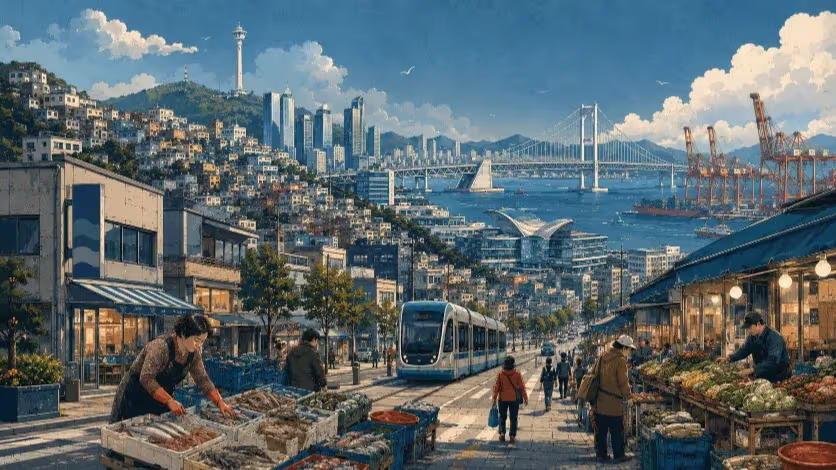
The Democratic wave reached Busan City Hall. Seoul shows why that wave still had limits. Busan’s gu/gun map, youth divide and inherited megaprojects will decide how far Jeon Jae-soo’s transition can go.
Jeon Jae-soo converted the Democratic Party of Korea’s national momentum into control of Busan City Hall. The victory was clear enough to end Park Heong-joon’s bid for a third term and return the DPK to the city’s top office. Yet the harder map begins below that victory. Busan did not give the new mayor a city that moves in one direction. The June 3 vote left him with a divided gu/gun structure, delivery demands along the Nakdonggang River corridor, North Port’s fragmented authority, eastern Busan’s conservative counterweight and a younger electorate split sharply by gender.
The election changed the voice from City Hall. The election did not give the DPK command of the whole city.
That distinction matters because Busan is not governed only from the mayor’s office. A mayor can set priorities, rename projects, redirect budget language and define the city’s public posture. The city’s 15 gu districts and one gun county carry those priorities into road works, permits, welfare delivery, district budgets, flood control, local business support, redevelopment conflicts and cultural facilities. A mayoral win can change the political weather in one night. Gu and gun governments decide how much of that weather reaches the ground.
The national result gave the DPK momentum. Broadcast exit polls placed the party ahead in most metropolitan and provincial contests, with several difficult races still classified as battlegrounds. Busan belonged to the difficult part of that map. The city was not a routine Democratic pickup. Conservative organization, older voters, eastern residential districts, Park’s incumbency and port-side local politics still carried weight. Jeon’s victory mattered because national momentum became executive power in a conservative-leaning major city.
Other battlegrounds show why that distinction matters. Daegu’s conservative wall narrowed but did not collapse. Seoul’s mayoral race moved toward a late-count reversal rather than a settled Democratic takeover. South Gyeongsang remained a hard test for a high-profile Democratic comeback. Busan gave the DPK something more concrete: City Hall. Jeon did not merely compress a margin. He changed the mayor’s office.
The breakthrough should not be mistaken for a takeover. Busan voters removed the PPP from the mayor’s office without removing the party from the city’s operating layer. The DPK won seven gu/gun governments: Yeongdo-gu District, Nam-gu District, Gijang-gun County, Buk-gu District, Saha-gu District, Gangseo-gu District and Sasang-gu District. The People Power Party won nine: Jung-gu District, Seo-gu District, Dong-gu District, Busanjin-gu District, Dongnae-gu District, Geumjeong-gu District, Yeonje-gu District, Suyeong-gu District and Haeundae-gu District.
That map is not only a partisan map. It is a delivery map.
Jeon won the authority to set Busan’s direction. He did not automatically win the local machinery needed to deliver that direction through every gu and gun government. The DPK can claim a mayoral breakthrough. The new mayor still has to pass through a city where western districts expect delivery, old port districts divide authority, eastern districts preserve a conservative counterweight and inherited projects already sit inside contracts, agencies and public expectations.
Seoul Moved Below City Hall. Busan Moved at City Hall.
Seoul clarifies the Busan result by contrast, but the comparison needs a careful baseline. In the 2022 local elections, the People Power Party won 17 of Seoul’s 25 district-chief races and the Democratic Party won eight. By the eve of the 2026 vote, however, the incumbent map had already shifted through resignations, party changes and local political movement. Seoul’s 2026 district results therefore should not be described as a simple one-line reversal unless the comparison is explicitly tied to the 2022 election result.
The structure still matters. Seoul’s mayoral race moved toward Oh Se-hoon after a late-count reversal, even though exit polling had initially placed Jung Won-oh ahead. The mayoral contest became a test of how far the Democratic wave could travel at the top of the capital’s government. In the late count, that wave did not make a Democratic takeover of Seoul City Hall look settled.
Below City Hall, however, Seoul told a different story. The district-chief layer showed a Democratic recovery from the PPP advantage created in the 2022 local election. Seoul therefore split power vertically: the mayoral race tilted back toward the conservative incumbent, while the district layer moved more strongly toward the Democrats than the mayoral race did.
Busan produced the opposite structure. Jeon changed City Hall, but the gu/gun map did not become a single Democratic machine. The DPK took the mayor’s office and seven local governments. The PPP retained nine local governments. Seoul’s Democratic recovery ran through district offices. Busan’s Democratic breakthrough ran through City Hall. Neither city gave one party an uncomplicated governing map.
The comparison matters because a national wave can hide different kinds of limits. In Seoul, the DPK’s strength below City Hall did not automatically settle the mayoral race. In Busan, Jeon’s victory at City Hall did not automatically consolidate the city’s operating layer. Seoul shows how a party wave can move through districts without securing the mayor’s office. Busan shows how a mayoral breakthrough can arrive without full control of the local machinery.
That contrast makes Busan’s result more important, not less. Jeon’s win was one of the clearest cases in which Democratic momentum became control of a conservative-leaning major city. Yet the Seoul comparison prevents the wrong conclusion. The election did not produce a uniform Democratic command structure in the country’s two largest cities. It produced layered power: mayoral offices, district governments and local constituencies moving at different speeds.
The Nakdonggang River Corridor Is a Base and a Burden
The first governing axis runs through the Nakdonggang River corridor. Buk-gu, Saha-gu, Gangseo-gu and Sasang-gu are often treated as a political belt. They should be read as an execution corridor. Western Busan is where airport access, industrial renewal, logistics, drainage, housing pressure and transport connections will be judged first. The corridor gave Jeon more than an electoral base. It gave him a delivery burden.
Gangseo-gu carries the clearest test. Gadeokdo New Airport sits around Gadeokdo Island in Gangseo-gu, and the official plan places the expected opening in 2035 with a total budget of 15.9 trillion won. The project does not sit inside City Hall alone. Airport, road and railway responsibilities are divided among separate implementing bodies, including the Gadeokdo New Airport Construction Authority, the Busan Regional Office of Construction & Management and Korea National Railway. Gangseo-gu can give Jeon political ground. Gadeokdo New Airport places that ground inside national agencies, access-road planning, construction schedules and rail delivery.
The same corridor contains older questions that cannot be solved by airport rhetoric. Saha-gu and Sasang-gu carry industrial corridors, working-class housing, aging infrastructure, traffic pressure and flood-related exposure. A city administration that speaks of maritime capital and global competitiveness will be judged there by drainage, commutes, industrial renewal and daily income. Western Busan can give Jeon a base. Western Busan will also be the first place to ask what that base produces.
Buk-gu adds a more cautious lesson. The district gives Jeon political familiarity, but Buk-gu should not be turned into a symbol detached from its administrative reality. Busan Buk-A, where a separate parliamentary by-election took place, should also not be folded too easily into the broader Buk-gu story. Buk-A is not all of Buk-gu. The contest involved unusual candidate conditions, a high-profile independent and a narrow result. The stronger evidence for Jeon’s governing conditions lies in the mayoral result, the gu/gun executive map and the project geography he inherits.
The Nakdonggang River corridor therefore belongs near the center of the article, not as a campaign map but as a governing map. A mayoral victory in western Busan carries an implicit promise: access to the new airport, better mobility, industrial renewal, flood protection, housing stability and daily administrative competence. Jeon’s first political advantage is also his first accountability zone.
North Port Gives Jeon a Stage, Not a Free Hand
The second governing axis is North Port. The old downtown and port-side map cannot be reduced to a single partisan label. Jung-gu, Seo-gu, Dong-gu and Yeongdo-gu sit inside different electoral and administrative relationships to City Hall. North Port itself belongs to a wider institutional field.
The second phase of the Busan North Port Redevelopment Project covers 2.28 million square meters around Jung/Dong-gu, including Jaseongdae Wharf, Busan Station, Busanjin Station container yard and Jwacheon-Beomil-dong. The project cost is listed at KRW 4.0636 trillion, and the developer is a Busan City consortium involving Busan City, Busan Port Authority, Korea Land & Housing Corporation, Busan Metropolitan Corporation and KORAIL.
North Port gives Jeon a stage, not a free hand.
A mayor can speak for Busan’s maritime identity from City Hall. A mayor cannot alone move port authorities, public corporations, district chiefs, ministries, railway interests or corporate headquarters. Jeon’s maritime-capital language will first be tested in the institutional field around North Port, where land, ports, rail, public developers and old-downtown residents already hold pieces of the execution map.
That matters because Jeon’s campaign placed maritime institutions and port-related power at the center of Busan’s future. A promise to make Busan a maritime capital sounds strongest when spoken from City Hall. The same promise becomes harder when it reaches ministries, courts, public corporations, shipping companies, port authorities and old-downtown land use. North Port will measure whether Jeon can turn maritime language into institutional coordination.
The North Port section should also discipline the broader interpretation of the election. A mayoral victory is not the same as institutional alignment. Busan’s maritime future runs through land owned and regulated by different actors, public corporations with their own mandates, national agencies with their own timetables and district governments that will have to answer to residents before they answer to a mayoral slogan. Jeon can place North Port at the center of his narrative. He cannot make the project move by narrative alone.
Eastern Busan and the Cost of Rebranding
The third governing axis is eastern Busan. Haeundae-gu, Suyeong-gu, Geumjeong-gu, Dongnae-gu and Yeonje-gu preserve a conservative counterweight inside the city’s local politics. The counterweight is not only electoral. Eastern Busan concentrates tourism, waterfront housing, property values, cultural consumption, private capital and the city-branding politics associated with the Park administration.
Jeon’s administration can begin from a western base. It cannot govern as a western administration.
The eastern counterweight will become visible when the new administration reviews cultural and global-city projects. Centre Pompidou Busan, the Busan Opera House, waterfront tourism and major cultural branding cannot be handled as abstract spending items. Those projects sit inside constituencies that care about prestige, local arts, tourism revenue, public cost and international identity. A sharp cancellation frame may satisfy one group of voters. A serious redesign will require contracts, operating-cost disclosure, local cultural participation and a credible replacement for Park’s global-city language.
Park’s city-building language relied heavily on the idea that Busan could compete as a global urban brand. The claim was not only cultural. It was tied to tourism, waterfront development, international events, private capital and the symbolic geography of eastern Busan. Jeon’s campaign language leaned more toward livelihood, maritime institutions and industrial restructuring. The first collision between those two languages may not come from ideology. It may come from deciding whether to cancel, redesign or absorb the cultural projects already in motion.
Eastern Busan will not be a passive audience for that decision. Haeundae-gu and Suyeong-gu do not experience cultural branding in the same way as Saha-gu or Sasang-gu. Waterfront visibility, visitor economy, property interests and global-city rhetoric carry different political meanings in the east. Jeon can argue for a city that spends less on prestige and more on residents. He will still have to define what replaces prestige in the districts where prestige has been part of the city’s economic story.
The Youth Vote Was Not One Generation
The youth vote adds another limit to a party-wave reading. The election produced a Democratic wave, but not a youth wave for the Democrats. Among younger voters, the decisive divide was not age alone but gender. Men in their 20s and younger leaned toward People Power Party candidates. Women in the same age group leaned strongly toward Democratic candidates. The gender divide continued among voters in their 30s, though the male gap narrowed.
“Youth vote” is too blunt a phrase for that electorate. Younger voters did not move as one generation. Younger men and younger women pointed in different political directions, and the national Democratic wave did not erase the split.
For Busan, the youth divide matters after the count more than during the count. Jeon’s victory should not be explained as a broad youth turn toward the DPK. A stronger reading places his win on a wider coalition: Democratic national momentum, middle-aged support, younger women, dissatisfaction with the existing city agenda, and local demands from western Busan and the Nakdonggang River corridor. Younger male conservatism remained part of the political environment the new mayor will inherit, even if it did not stop his victory.
That divide changes the meaning of youth policy. A mayor cannot answer a gender-split youth electorate with a generic jobs package. Younger men and younger women are moving through different political experiences around work, housing, military-service fairness, gender conflict, public safety, digital labor and social mobility. Busan’s next youth agenda will need to speak to those divisions without pretending that young voters form one political public.
A city that loses young people cannot afford a flat youth policy. Busan’s youth problem is usually described through outmigration, jobs and wages. Those remain central. The election adds another layer. Younger voters do not only ask whether a city can provide work. They also ask whether public institutions understand fairness, safety, housing, mobility, gender conflict and the credibility of local futures. A Democratic mayor cannot assume that young voters belong to him because the party won nationally. He will have to build separate lines of trust with voters who shared an age group but not a political direction.
The First Test Is Sorting, Not Slogans
The first test of the new administration will not be ideology. The first test will be sorting.
Jeon will not enter an empty City Hall. Busan already has a project map large enough to outlast one mayoral term: Gadeokdo New Airport, the Busan North Port Redevelopment Project, BuTX, Centre Pompidou Busan and the Busan Opera House. Each project carries a different authority structure. Each project touches a different part of the city’s electoral map. Each project will ask whether Jeon can turn a mayoral breakthrough into administrative control.
The new administration will have to classify inherited projects by five measures: legal commitment, fiscal exposure, district impact, central-government dependency and political value. A project tied to national agencies cannot be handled like a campaign promise. A cultural project with contracts, design work and operating costs cannot be treated only as symbolic spending. A private-investment railway cannot be judged only by its slogan of connectivity. A port redevelopment project cannot be reduced to maritime identity when public corporations, port authorities, railway interests and district governments hold pieces of execution.
Gadeokdo New Airport should be treated as national infrastructure with local consequences. BuTX should be treated as a private-investment connectivity test tied to airport access and east-west integration. North Port should be treated as a multi-authority redevelopment field. Centre Pompidou Busan should be treated as a cultural-branding inheritance, not only as a budget controversy. The Busan Opera House should be treated as a test of whether global prestige can be made legitimate inside local cultural policy.
Centre Pompidou Busan will force one of the earliest cultural choices. Busan signed a memorandum of understanding with the Centre Pompidou in September 2024, with the city planning construction in 2027 and public opening in 2031 under lawful procedures. The project was presented not only as a venue for international art, but also as a platform for local artists, exhibitions and workshops. Jeon can cancel, redesign or absorb the project into a new political language. Cancellation is the easiest message. Redesign is the harder governing choice, because redesign requires contract review, operating-cost disclosure, local-artist participation and a credible alternative to prestige-driven cultural policy.
The Busan Opera House belongs to the same cultural field, even if the project carries a different history and public meaning. The question is not whether Busan should have international cultural ambition. The question is whether Park’s global-city agenda can survive under a mayor who campaigned on livelihood, maritime institutions and industrial restructuring. A new administration can cut a ribbon differently from its predecessor. A new administration cannot make cultural infrastructure legitimate by changing the caption under the ribbon.
The sorting table should be public. Residents should know which projects will continue, which will be revised, which will be paused, and which will be renamed without changing substance. Busan’s next four years will not be defined by the first slogan from the new mayor. The new administration will be judged by how it moves through Gangseo-gu’s airport politics, the Nakdonggang River corridor’s delivery demands, North Port’s divided authority, eastern Busan’s conservative counterweight and a youth electorate split sharply by gender.
Jeon’s election changes the voice from City Hall. The gu/gun map will decide how far that voice can travel. Victory begins the transition. Governing begins with coordination.
Continue this reporting
Reporting on the same issue
Related coverage selected from the article's desk, topics and newsroom relationships.
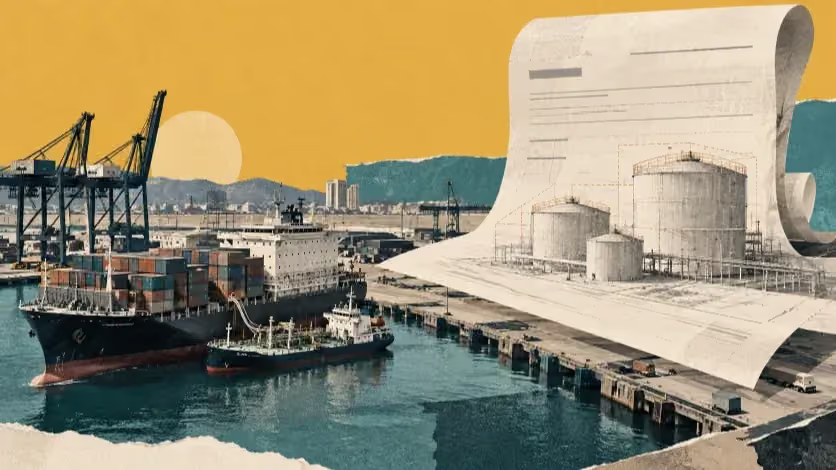 NewsOct 22, 2026
Busan Port’s LNG and Methanol Plan: Who Pays to Keep Fuel Ready?
Busan already supplies ships with LNG and methanol, drawing on regional and i...
 NewsOct 16, 2026
What Is Still Worth Going to See?
Busan’s biennale faces questions of artistic judgment and institutional care....
 NewsOct 14, 2026
What Became of Busan’s University Streets?
From 2015 to 2023, registered businesses grew near Pusan National University...
More from the author
More from this byline
Stay with the same line of reporting through more work from this byline.
- NewsOct 22, 2026
Busan Port’s LNG and Methanol Plan: Who Pays to Keep Fuel Ready?
 NewsOct 12, 2026
Bukangi, the Shark That Stayed in Busan’s North Port
Reader Signal
Community readWhat did this report leave you with?
Choose the signal that best reflects your reading. Select it again to remove it.
One response per article
No response selected
A moderated conversation about the reporting.
One-level replies and newsroom moderation keep the conversation anchored to this article.
Discussion Status
Open
Please sign in to join the discussion.
Newsletter
Weekly reporting and context from Busan and Korea.