The Long-Term Bill Behind Busan’s Public Projects
Busan’s public projects carry costs long after construction, from widening facility shortfalls to operator transitions at North Port and financing risks at Beomcheon

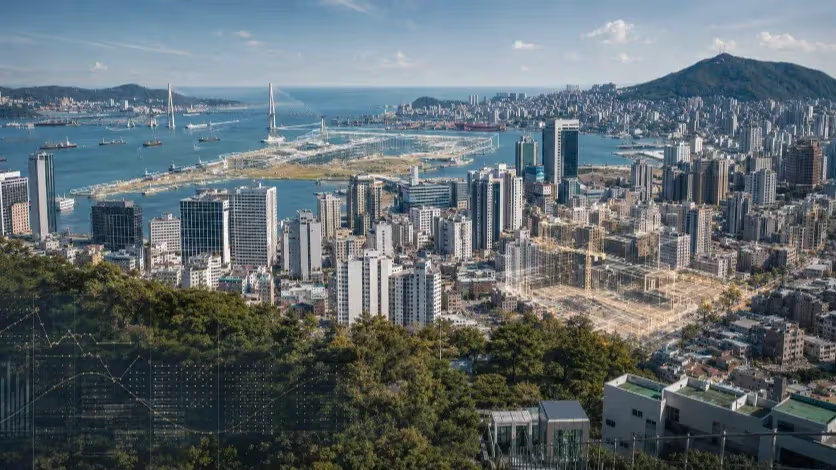
A review of municipal accounts, Busan Port Authority’s marina contracts and KORAIL’s Beomcheon tender shows how construction, operating support and project risk remain divided across separate institutions long after the initial investment decision.
Busan Port Authority closed the aqua facilities at the marina complex in Busan North Port on July 27, after announcing that a new operator would be selected and the pools and diving facilities prepared for reopening. BPA said operations were expected to resume during August, although the date remained dependent on the operator-selection process. The interruption began with an expiring operating arrangement, yet the authority continued to own the building, maintain the asset and determine how the public service would resume.
BPA had designed the marina around a mixture of direct management, contracted services and commercial leases. The authority retained planning, marketing, revenue collection and receivables management, while an outside contractor handled maintenance, security, cleaning, safety and operation of major functional areas. Accommodation, restaurants, cafés and retail units were to be filled under separate leases, leaving BPA to coordinate a complex whose parts could open, close or change operators on different schedules.
The division of work brought private expertise into daily operations without creating a single company responsible for the financial performance of the entire complex. A facilities contractor could finish its term without assuming the cost of the next structural repair, and a commercial tenant could vacate its unit without becoming responsible for the pools, berths or public areas. BPA remained the institution that had to bridge the period between operators and preserve a publicly financed asset after one agreement ended.
North Port offers a visible example of a wider problem in Busan’s public finances. Construction expenditure appears in one project budget, annual support is paid through another account, operating institutions record public transfers as revenue, and major repairs emerge later as separate capital appropriations. Each transaction may be correctly recorded, although the documents do not necessarily show the continuing cost of one asset in a single financial history.
Busan’s fiscal position gives those recurring obligations increasing weight. The city entered 2026 with a consolidated budget of 19.2973 trillion won, including a general account of 14.4046 trillion won, but locally generated revenue covered a declining share of the budget used to calculate its fiscal self-reliance ratio. The ratio fell from 43 percent in 2022 to 37.3 percent in 2026, as transfers and grants supplied a larger portion of municipal revenue. Social welfare accounted for 47.04 percent of general-account expenditure, while transport and logistics took another 9.17 percent.
A larger budget therefore did not give Busan an equivalent increase in spending discretion. Central-government funding often arrives with statutory programs, eligibility requirements and designated purposes, while welfare and public transport create recurring obligations that the city cannot quickly reduce when local tax revenue weakens. Previously built facilities add another layer of fixed expenditure because inspections, utilities, minimum staffing and essential repairs continue even when admissions or commercial income decline.
A Larger Budget, Less Room to Choose
Busan’s 2026 budget contains several figures that can all be described loosely as a deficit, although they measure different financial events. The city budgeted a consolidated fiscal deficit of 482.7 billion won after combining the general account, special accounts and funds, yet the general account itself showed a planned surplus of 820.4 billion won. Other special accounts recorded a deficit of 1.0091 trillion won and municipal funds planned a deficit of 319 billion won as they drew on accumulated balances and financed designated projects.
The consolidated figure does not mean that ordinary city administration lacked 482.7 billion won in cash. It describes the net position after combining accounts that follow different revenue sources, reserves and investment schedules. 부산’s 2024 settlement had already demonstrated the distinction: the city reported an actual consolidated fiscal deficit of 88.6 billion won while completing a general-account settlement of more than 13 trillion won and retaining substantial assets and fund balances.
Busan’s more persistent constraint comes from the composition of its revenue and expenditure. Own-source revenue amounted to 5.2196 trillion won within the 2026 fiscal self-reliance calculation, compared with 7.6256 trillion won in transfers, equalization resources and grants. The city also planned 643.5 billion won in municipal borrowing. More than half of the revenue base was therefore supplied through sources that were transferred, earmarked or borrowed rather than generated through local taxes and fees.
The pressure becomes concrete in services that cannot be withdrawn when revenue falls. Busan budgeted 227.2 billion won in 2026 to cover the projected gap between Busan Transportation Corporation’s revenue and operating cost, describing the payment as necessary to maintain continuous subway service. The subsidy supports a public function that fare revenue alone does not finance, but it also competes with welfare, repairs, debt service and new investment for the revenue that the city controls directly.
Public buildings create similar obligations on a smaller scale. A museum may postpone an exhibition and a stadium may seek more commercial events, but neither can abandon safety inspections, utilities or essential maintenance without allowing the asset to deteriorate. The initial construction budget produces a visible political decision, whereas the following decades of staffing, repair and replacement costs enter annual budgets as separate transactions.
Busan’s public-facility disclosures allow part of that long-term cost to be measured. The figures cover major facilities built at a cost of at least 30 billion won and report their management structure, staffing, annual attendance, operating expense and recorded revenue. Comparing the 2023 and 2024 disclosures shows that the annual cost of assets already completed can change more sharply than the citywide totals initially suggest.
The Cost of What Busan Already Built
Breeze in Busan recalculated the disclosures for 13 facilities that appeared in both years. Their combined operating expenses increased from 118.986 billion won in 2023 to 131.702 billion won in 2024, a rise of 10.7 percent, while recorded revenue fell from 85.250 billion won to 78.088 billion won. The resulting operating shortfall widened from 33.736 billion won to 53.614 billion won, increasing by 58.9 percent within a year.
Attendance declined from approximately 5.19 million to 4.62 million, although most of that change came from the Busan Museum of Art. Visits fell from 573,798 to 37,943 after the museum’s main building closed for renovation on December 18, 2023, while Space Lee Ufan remained open. The attendance total therefore reflects a major closure at one institution rather than a broad collapse in the public use of Busan’s cultural and sports facilities.
The increase in the operating shortfall was even more concentrated. Geumjeong Cycle Racing Stadium, Gangseo Sports Park and Busan Asiad Main Stadium accounted for 18.692 billion won of the 19.878 billion won deterioration across all 13 facilities, or approximately 94 percent. The citywide change was driven by three sharply different financial movements rather than a uniform decline across every venue.
Geumjeong Cycle Racing Stadium moved from a positive recorded balance of 2.920 billion won in 2023 to a shortfall of 5.048 billion won in 2024. Operating expenses rose from 21.686 billion won to 24.192 billion won as recorded revenue fell from 24.606 billion won to 19.144 billion won, even though attendance declined by less than 3 percent. Visitor numbers cannot explain the scale of the revenue change, leaving racing income, cost allocation and the accounting effects of institutional reorganization as material issues for further scrutiny.
Gangseo Sports Park recorded the opposite movement in public use. Attendance increased from 574,063 to 677,860, yet operating expenses more than tripled from 2.698 billion won to 8.368 billion won and the shortfall widened from 1.606 billion won to 7.237 billion won. Revenue remained close to its previous level, so almost the entire deterioration came from additional expenses rather than lower use. The summary disclosure does not separate repairs, utilities, staffing changes or reassigned shared costs, preventing readers from identifying the specific source of the increase.
Busan Asiad Main Stadium experienced both lower use and higher cost. Attendance fell from 330,502 to 124,073, recorded revenue dropped from 4.841 billion won to 2.448 billion won and expenses increased from 7.720 billion won to 10.421 billion won. The annual shortfall expanded from 2.880 billion won to 7.973 billion won as event and rental income weakened while the fixed cost of maintaining a large stadium continued.
The three facilities show why a citywide operating deficit cannot be interpreted as a single measure of performance. A cycle-racing venue depends on regulated gaming revenue, a community sports complex can attract more visitors while incurring major new costs, and a stadium’s income can change with a small number of concerts and matches. The operating shortfall measures the public contribution required under the accounting structure; it does not measure the social or cultural value of the service.
The disclosures also mix revenue generated by users with money transferred from another public account. Busan Cinema Center reported 13.507 billion won in operating revenue against 13.607 billion won in expenses in 2024, leaving a shortfall of only 100 million won. The revenue total included 10.542 billion won classified as income assigned through entrusted services, substantially more than the combined admissions, rental and commercial income shown in the table.
Busan Cultural Center recorded 37.161 billion won in revenue against 36.967 billion won in expense, producing a positive recorded balance of 194 million won. More than 33.6 billion won appeared under other revenue, while admissions, venue hire and rental income accounted for a much smaller share of the total. The classification may be valid within the institution’s accounts, but it does not allow a reader to distinguish income earned from audiences and tenants from operating support transferred through the public sector.
Public expenditure can consequently appear as facility revenue after crossing from one institutional ledger to another. A city grant or payment for commissioned services becomes income for the recipient, which then uses the money for staff, programming and maintenance. The accounting entries remain legitimate, although a near-balanced facility statement cannot establish that the asset financed itself through ticket sales, rentals or commercial activity.
A useful public measure would separate earned revenue from public operating support and capital expenditure. Admissions, parking, venue hire and private leases would show how much money the facility generated outside government, while municipal transfers would show the annual public contribution and major repairs would remain visible as a separate cost of preserving the asset. The current disclosures contain the relevant pieces across several accounts but do not consistently assemble them under the identity of the facility.
Several component fields in the city’s 2024 online table are also visibly misaligned, including implausible figures displayed for museum revenue and rental income. The totals in this analysis use the operating-cost and net-balance fields, which reconcile arithmetically, rather than the corrupted component entries. The formatting problem reinforces the need for machine-readable disclosures that preserve the relationship between each facility, its operating support and its externally earned income.
North Port’s Split Operating Model
BPA’s 2022 operating plan for North Port Marina placed construction, management and commercial activity under different arrangements. The authority budgeted 70.6 billion won for the marina complex, retained direct control over planning, promotion, marketing, revenue and receivables, and sought an outside contractor for maintenance, security, safety, cleaning and operation of functional facilities. Guest rooms, restaurants, cafés and retail units were to be leased separately.
The facilities-management procurement carried a budget of 4.743 billion won over 36 months, equivalent to approximately 1.581 billion won a year. BPA projected more than 4 billion won in new annual revenue from the marina, but that figure was a planning target rather than a reported operating result. The original documents do not place actual admissions, parking fees, berth charges and rent beside the full cost of management contracts, utilities, direct administration, repairs and periods of closure.
The operating structure purchased defined services without appointing one private party to carry the financial result of the complex as a whole. A contractor could deliver maintenance and staffing under an agreed price even when commercial units remained vacant, while tenants could operate individual businesses without accepting responsibility for public facilities elsewhere in the building. BPA retained the asset, the principal revenue strategy and the responsibility for costs excluded from each agreement.
The July closure made that residual responsibility visible. BPA had to organize the next operator, prepare safety and facility improvements and determine when the aqua facilities could reopen, because the end of one contract did not remove the authority’s obligation to maintain the complex. The public notices identify the transition but do not state the cost of lost revenue, repairs, procurement and the gap between operating arrangements.
An operating contract that expires does not establish that the overall model failed. Public owners routinely replace contractors and refurbish facilities. Financial performance can be evaluated only after actual user and commercial revenue is compared with management contracts, utilities, repairs, administration and capital renewal over the same period.
The documents reviewed for this article present the construction budget, operating plan, management procurement and temporary closure in separate records. They allow readers to identify important transactions but not to follow a continuous life-cycle account from construction through commercial occupancy, routine operation, contract transition and major renewal. The absence of that combined statement makes it difficult to determine whether the projected external revenue covered the recurring public cost of the marina.
KORAIL presented private developers with a different model at its rolling-stock maintenance depot in Beomcheon-dong. BPA retained the North Port asset and purchased particular services, whereas KORAIL required a developer to buy the railway land and carry development risk before the site could begin producing revenue.
Beomcheon’s Gap Between Payment and Revenue
KORAIL opened a private-developer tender for approximately 200,000 square metres of railway land in Beomcheon-dong in December 2024. The development plan would relocate the maintenance depot near Busan New Port Station and redevelop the existing site beside the Seomyeon commercial district. KORAIL and Busan agreed that residential land would account for no more than 30 percent of the site, public land would occupy at least 50 percent, and developers could propose the remaining commercial and office uses.
The tender was structured as a land sale in which the private developer would acquire KORAIL property. Public uses included roads, parks and planned facilities such as the Busanjin District health center and the Busan Family Court, reducing the proportion of land available to generate private housing, office and retail revenue. KORAIL published the minimum land price separately from the tender guidelines and required applicants to meet investment-grade credit standards.
No developer submitted an application by the deadline, and KORAIL later began reviewing the relocation method and development schedule. Reporting on the failed tender identified weak business feasibility and the long period before development could begin as major obstacles.
The financial difficulty arose from the sequence of the transaction. A developer would begin carrying land and financing costs before railway relocation and planning procedures allowed construction and sales to proceed. KORAIL and public authorities controlled major steps affecting the schedule, while the private consortium would continue to bear the cost of waiting and would later add construction and market risk.
The high public-land share served urban objectives that private development alone would not necessarily provide, including open space, public buildings and transport infrastructure. Those requirements nonetheless reduced the property from which the developer could recover land and financing costs. The 30 percent residential ceiling further limited the most immediate source of presale revenue, leaving a larger reliance on office and commercial demand.
The tender attempted to finance relocation and public infrastructure through the future value of private development. KORAIL would secure a buyer and a funding base for the railway move, Busan would secure public facilities through the land-use plan, and the developer would recover its investment after relocation, approval and construction. The dates on which the public institutions obtained value and the developer could begin earning revenue did not align closely enough to attract an application.
Revising the project will require more than another invitation to bid. Deferring land payments, phasing the sale, completing more of the relocation before transfer, financing public infrastructure separately or allowing more residential development would each improve the developer’s cash flow by shifting part of the cost or delay back to the public sector. Every option would also alter the balance between public objectives and private returns that shaped the original project.
The absence of a bidder did not remove the cost of the project. KORAIL retained the depot and relocation requirement, the redevelopment remained delayed, and the public agencies had to begin another round of planning. The financial exposure appeared as delay, further study and unrealized urban development rather than as an annual municipal operating subsidy.
North Port and Beomcheon reached the limits of private participation at different stages. BPA found companies willing to perform specific services because the authority continued to finance and control the marina, while KORAIL offered a package of land, timing and market exposure that no developer accepted. Both cases left the relevant public institution responsible for the next decision and the cost attached to it.
The Price Before Construction
Busan and the public agencies operating within the city already publish construction budgets, procurement notices, annual subsidies and facility accounts. The records follow departments, corporations and contracts, which means that one asset’s financial history is divided whenever responsibility moves from construction to operation, from an operating institution to a contractor or from routine management to capital repair.
A life-cycle financial statement would preserve the identity of the asset across those transitions. The statement would show construction cost, expected opening date, annual operating expense, externally earned revenue, public operating support, major equipment replacement and the cost of moving from one operator to another. Development tenders would add the land-payment schedule, approval milestones, holding period and the public response if no investor accepted the proposed terms.
The calculation would not require museums, transit systems or public waterfronts to operate as commercial businesses. A city can choose to subsidize cultural access, regional mobility or open public space when user fees cannot recover the social value of the service. The decision becomes more accountable when the annual contribution and renewal cost are disclosed before construction rather than emerging years later through separate grants and repair budgets.
Busan could apply the requirement to facilities and redevelopment projects above the existing financial-disclosure threshold. Forecasts would remain attached to the asset after opening, allowing the city and council to compare expected demand with actual use, identify changes in operating support and restate earlier years when institutional mergers or accounting changes break comparability.
North Port Marina would then carry one public record linking its construction budget, external revenue, management contracts, commercial occupancy, closures and major repairs. A revised Beomcheon tender would show when a developer must pay, when construction can realistically start, which public infrastructure is included and how long private capital is expected to remain tied up before revenue begins.
Busan’s declining fiscal self-reliance makes that continuity more important. Welfare, public transport and previously constructed facilities already absorb large portions of the revenue available to the city, while every new asset adds obligations that extend far beyond the budget year in which officials approve it. Individual subsidies and repairs may remain manageable when viewed separately, but their accumulation narrows the capacity to respond to demographic change, economic shocks and future infrastructure needs.
The public price of a project extends beyond the amount announced before construction. It includes the money required to staff and maintain the asset, replace equipment, manage the end of contracts and preserve service when external revenue falls below expectations. Busan’s accounts record most of those payments somewhere; a life-cycle statement would place them under the name of the project that created them.
The fiscal life of a public project begins when the ribbon is cut.
Continue this reporting
Reporting on the same issue
Related coverage selected from the article's desk, topics and newsroom relationships.
 NewsOct 16, 2026
What Is Still Worth Going to See?
Busan’s biennale faces questions of artistic judgment and institutional care....
 NewsOct 14, 2026
What Became of Busan’s University Streets?
From 2015 to 2023, registered businesses grew near Pusan National University...
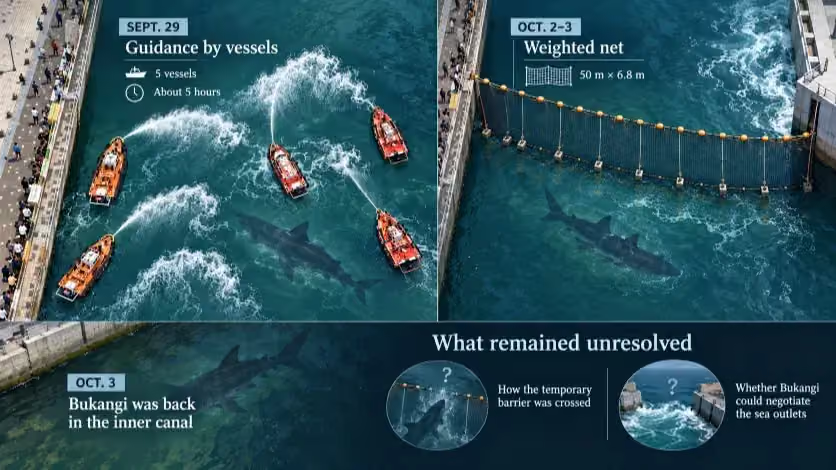 NewsOct 12, 2026
Bukangi, the Shark That Stayed in Busan’s North Port
A rescue net guided Bukangi toward the sea, but the dusky shark returned to B...
More from the author
More from this byline
Stay with the same line of reporting through more work from this byline.
- NewsOct 12, 2026
Bukangi, the Shark That Stayed in Busan’s North Port
 NewsOct 6, 2026
Busan’s Water System Is Entering a Harder Era of Renewal
Reader Signal
Community readWhat did this report leave you with?
Choose the signal that best reflects your reading. Select it again to remove it.
One response per article
No response selected
A moderated conversation about the reporting.
One-level replies and newsroom moderation keep the conversation anchored to this article.
Discussion Status
Open
Please sign in to join the discussion.
Newsletter
Weekly reporting and context from Busan and Korea.