Busan Secures 300MW for Eco Delta City. The Economic Test Comes Next
Busan has secured a path to 300MW of commercial electricity for a major Eco Delta City data-center project. Its physical scale is becoming clearer; the regional economic return is only beginning to be measurable.

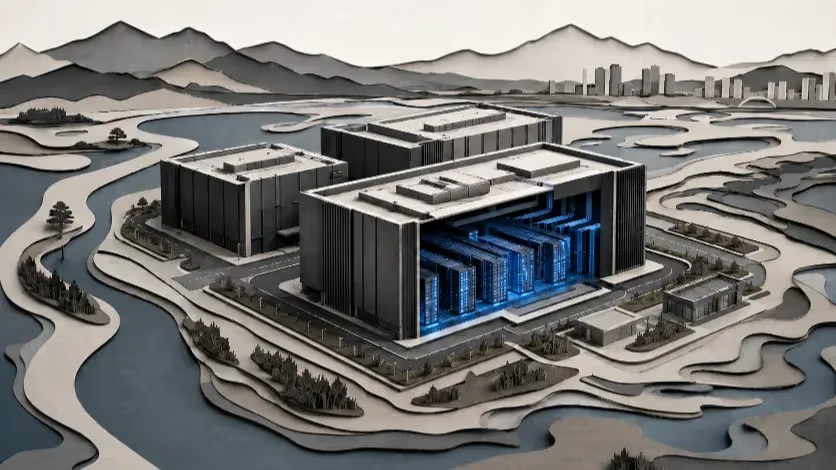
An Eco Delta City data-center project being developed for AI and cloud workloads has secured a path to 300 megawatts of commercial electricity, moving one of Busan’s largest digital-infrastructure developments closer to construction. The agreement strengthens the city’s place in Korea’s emerging AI infrastructure map while bringing a less visible part of the project into focus: where the economic value created around that infrastructure will ultimately settle.
Busan Eco Delta Green Data Center PFV said on Aug. 11 that it had signed an electricity-use agreement with Korea Electric Power Corp.’s Busan-Ulsan headquarters for 300 megawatts of commercial supply, supported by a separately configured 300MW standby system. Electricity is scheduled to become available on June 1, 2028 through a 345-kilovolt direct connection from the Singangseo substation. The project, in which Daesungmoon is the largest shareholder and IBK Investment & Securities and Industrial Bank of Korea are participating as investment partners, is currently described at roughly 2.5 trillion won and is targeting completion in the first half of 2028.
Securing electricity on that scale marks more than an administrative milestone. As artificial intelligence concentrates increasingly powerful accelerators into dense computing clusters, electricity has become one of the constraints that determine whether a prospective data-center site can move from paper to construction. Land, finance and fiber matter, but a developer that cannot obtain sufficient power within a commercially workable timetable has little more than a location. Korea’s industrial strategy now acknowledges the same constraint, pairing planned AI data-center expansion with available 345kV substation capacity, faster grid-impact reviews outside the capital region, water infrastructure and new approaches to electricity pricing for large computing loads.
The Aug. 11 agreement therefore gives the Eco Delta project a degree of physical definition it lacked when Busan first promoted the cluster through investment memoranda, projected employment and economy-wide multipliers in early 2024. Land and electricity are moving from investment-promotion language into identifiable commitments, while the eventual operator and tenants, permanent payroll, supplier network, tax position and actual resource use remain much less settled in the public record. That asymmetry is normal for a project that has yet to enter commercial operation, but it also changes the standard by which the development can be followed. Once a city can specify the power requirement, voltage and supply date, the economic returns attached to those commitments can also be examined more concretely.
Data centers are unusually resistant to evaluation through a single headline number. Buildings, high-voltage systems, cooling equipment, servers, accelerators and networking can absorb enormous sums even when the permanent workforce after construction is comparatively modest. The same facility may still become a substantial taxpayer, create long-term demand for specialist engineering and maintenance, expand telecommunications activity and, depending on who operates it, place cloud or infrastructure functions in the surrounding economy. The regional case therefore extends well beyond the familiar argument over job counts. It depends on the duration and location of the wages, contracts, taxes, technical work and commercial functions generated around the asset.
South Korea is preparing to make that question national. The government said in June that it intends to support an initial 8.4GW of major AI data-center developments associated with SK, GS and Naver, with a longer-term expansion taking planned capacity to 18.4GW by 2035. Those figures remain development plans rather than completed infrastructure, but they show how quickly computing is being folded into industrial and energy policy. Eco Delta City is reaching that debate early enough for some of its assumptions to be tested before the machines begin to run.
A Project Whose Numbers Have Changed Meaning
The latest 300MW figure can easily be read as the endpoint of a project that began near 140MW and simply grew larger. The public record is more complicated. Different numbers appeared at different stages of the development, and several describe different technical boundaries.
When the PFV was being structured in early 2024, contemporary reporting referred to a project of roughly 140MW and a target power usage effectiveness, or PUE, of 1.29. One account placed development expenditure at about 1.6 trillion won and described another 1.6 trillion won associated with the operating business, producing a combined figure of roughly 3.2 trillion won under the categories then being used. Those were early-stage descriptions rather than a final operating specification, and neither the capacity figure nor the cost convention can safely be treated as the direct predecessor of the 2.5 trillion won project now being reported.
The electricity figures themselves also describe different layers of the facility. Servers, storage devices and network equipment account for the IT load, while cooling, power conversion, distribution and other support systems consume additional electricity. A design target, an IT-load estimate, total facility demand and the capacity attached to a grid connection may all appear in the same project record without measuring the same thing. Arranging such figures into a smooth historical curve would make the development appear more precisely measured than it was at each stage.
By early 2025, the project had entered Korea’s power-system impact process with another number attached to it. Busan Eco Delta Green Data Center PFV was approved for 180MW, while a separate company, Busan EDC PFV, was approved for 120MW. Contemporary coverage combined the two approvals into 300MW for the Eco Delta cluster, but only 180MW belonged to the PFV that later announced the Aug. 11 electricity agreement. The cluster-level total therefore described a different entity boundary from the commercial contract announced this week.
The development footprint subsequently expanded. Later reporting associated the original site with 180MW and an additional parcel with another 80MW, producing a development figure of about 260MW, while an initial phase of receiving design was described at 100MW. One figure referred to the site plan, another to the broader development and another to a particular phase of electrical engineering. The figures become confusing only when they are read as successive estimates of the same continuous operating load.
The Aug. 11 announcement belongs to a more advanced stage of evidence. The PFV says it has entered an electricity-use agreement for 300MW of commercial supply, with power expected from June 2028 through a specified 345kV route. The contract itself has not been made public, so its detailed terms remain those disclosed by the project company, but the agreement records a contractual step toward serving the development rather than another early planning target.
The additional 300MW announced alongside the commercial supply is described as standby capacity. The PFV says the commercial and reserve systems are separately configured for reliability; the disclosure does not indicate that the facility would operate at a continuous 600MW load or explain how much upstream capacity must remain available for the reserve path during normal operation. The two numbers therefore describe different functions within the power architecture.
Cost estimates require the same attention to scope. The approximately 3.2 trillion won cited in 2024 explicitly combined development and operating-business estimates, whereas recent accounts describe the project itself at roughly 2.5 trillion won. Without a common accounting boundary, the difference says little about whether the underlying project has become cheaper.
The timetable has moved as well. When Busan announced the first four Eco Delta data-center investors in February 2024, the companies were expected to complete design and permitting during the year, begin construction in early 2025 and enter operation in the second half of 2027. By April 2025, the PFV itself was targeting construction in 2026 and completion in the first half of 2028. As of Aug. 11, 2026, the latest project announcement still described the development as entering the permitting and construction-preparation stage while maintaining the first-half 2028 completion target.
The current schedule may yet be met; a 2026 construction start remains possible. What the public record already shows is that the path from investment announcement to operating asset has taken longer than the earliest cluster timetable contemplated. That delay matters economically because utilities plan for prospective loads years ahead of consumption, investors deploy capital in stages and regional governments begin counting jobs and fiscal effects before the facility exists.
The project’s history is therefore better read as a gradual hardening of commitments than as a simple rise from 140MW to 300MW. A development concept acquired land, entered the grid-impact process, expanded its footprint and has now secured a more specific route to electricity. The employment figures published around the cluster deserve the same attention to boundaries and timing.
The Employment Ledger
Busan’s employment case began with figures much larger than the permanent workforces normally associated with individual data centers. In February 2024, the city said four companies would invest 3.6313 trillion won in the Eco Delta cluster and create 1,022 direct jobs. The same announcement projected 8.2982 trillion won in induced production, 3.4552 trillion won in induced value added and an employment-inducement effect of 55,449. The participating companies also agreed to cooperate on preferential hiring of local residents and the use of regional companies in construction and equipment installation.
A later city publication expanded the cluster to five companies. Planned investment increased to 4.2013 trillion won and direct employment to 1,068, with the group expected to develop five facilities containing roughly 100,000 servers. The wider economic estimates, however, remained exactly the same: 8.2982 trillion won of induced production, 3.4552 trillion won of induced value added and 55,449 induced jobs.
The city’s published material does not explain why the multiplier-based estimates stayed fixed while another company was added and both investment and direct employment increased. The model may have been calculated over a different project boundary, or later promotional material may simply have carried forward the earlier estimates. The available releases are not detailed enough to reconstruct the methodology. They do establish that the figures were not moving as one internally transparent series.
That matters because direct and induced employment describe very different economic activity. Construction workers, equipment suppliers and spending transmitted through other industries can generate genuine wages and jobs without becoming permanent data-center employees in Busan. The published headline figures do not show how the 55,449 induced jobs are distributed over time, how much reflects the construction cycle or what proportion would occur in the city rather than elsewhere in Korea. The figure remains useful as an estimate of broader induced activity, but its meaning is narrower than the headline number might suggest to a reader looking for permanent local positions.
Another employment total entered the record through a different policy boundary in 2026. When part of Eco Delta City was designated an Opportunity Development Zone, Busan said 14 companies planned 5.3615 trillion won of investment and 965 jobs. Those companies span data centers, mobility and robotics, making the figure unsuitable as an updated headcount for the earlier five-company data-center cluster.
The underlying problem is familiar in capital-intensive infrastructure because the labour profile changes sharply over the life of the asset. Building a modern data center requires earthworks, structural trades, high-voltage electrical systems, generators, fire protection, cooling infrastructure, security, networking and the installation and commissioning of computing equipment. The workforce can be large when multiple structures and technical systems are being built simultaneously; after commissioning, the same capital stock can be managed by far fewer people.
Virginia offers a useful mature-market comparison because data-center development there has existed long enough for both phases to be observed. Industry representatives told the Virginia Joint Legislative Audit and Review Commission that a typical 250,000-square-foot facility might employ about 50 full-time workers, around half of them contractors, while construction of a single building generally lasts 12 to 18 months and can put roughly 1,500 workers on site at peak activity. JLARC’s broader analysis nevertheless found substantial economic benefits from the industry, estimating 74,000 supported jobs, $5.5 billion in labour income and $9.1 billion in annual state GDP, with much of the impact originating in construction rather than continuing facility operations.
Local fiscal effects were substantial in some Virginia jurisdictions as well. Data centers accounted for only a small share of local revenue in some places and a much larger share in mature clusters. That experience makes the industry difficult to classify through a single labour measure. A facility with a modest permanent payroll can still carry a large tax base and support specialist contractors, while enormous construction expenditure can coexist with a comparatively lean operating workforce.
Research updated by Brookings in August 2026 adds another form of evidence. Dany Bahar and Greg Wright assembled records for roughly 1,500 U.S. data-center facilities and 52 projects that had been announced but later cancelled, linking them to county-level employment and wage data. The cancelled projects provide an unusually useful comparison because developers tend to choose places that already possess favorable land, electricity, fiber and economic conditions; comparing them only with ordinary counties risks crediting the data center for growth that was already underway.
Their latest estimates associate the arrival of a first large data center with a 56 percent increase in local data-processing employment over the first decade and a 43 percent increase in telecommunications employment, translating to roughly 100 to 200 jobs in a typical treated county depending on facility type. The researchers did not find a corresponding statistically significant wage increase. Brookings describes the work as continuing research, and some results have changed as the sample expanded, so the study is most useful here as evidence about the direction and approximate scale of local effects rather than as a formula for Korea.
The variation between facilities may matter more than the average. Brookings found stronger telecommunications effects around hyperscale campuses than around colocation centers, where providers lease powered space and infrastructure to customers whose engineering and commercial organizations may remain elsewhere. That distinction reaches directly into Eco Delta City, because the PFV has not yet publicly specified its permanent operating workforce, eventual employee-contractor mix, occupational structure or local hiring share. KT’s 2025 partnership with the project was framed around design and construction support and efforts to attract global cloud providers, indicating that the commercial layer was still being assembled rather than presented as a settled operating model.
As construction advances, the employment account can become much more concrete. Construction work can be measured in a way that preserves its duration instead of blending it into a permanent headcount; direct employees can be separated from contractors; local recruitment can be compared with earlier commitments; and supplier employment can be attributed according to where firms and workers are actually located. Those measures would show which portion of the activity survives the construction cycle and becomes part of Busan’s labour market.
Who Carries the Grid Commitment
The labour effects of a data center emerge as people are hired and construction begins, whereas many of its consequences for the electricity system arise years earlier, when utilities must decide how much transmission, substation and generation capacity to prepare for a customer whose eventual operating load remains prospective. The electricity consumed inside the finished building is only one part of that relationship; another lies in the assets and reserve capability that have to exist before the first commercial workload can run.
Virginia’s JLARC study is instructive because it found that existing rates appropriately allocated current electricity costs to the customers responsible for them, including data centers. The more difficult problem appeared further into the planning horizon, where very large projected loads can require generation and transmission that would otherwise not be built and where an error in the forecast can leave long-lived infrastructure without the revenues expected to support it.
Under the scenarios JLARC examined, generation- and transmission-related costs for a typical Dominion Energy residential customer could rise by roughly $14 to $37 a month in constant dollars by 2040. The commission separately warned that infrastructure could become stranded if projected data-center demand failed to materialize after investment had already been made, recommending measures intended to keep those costs from falling onto the existing customer base.
The risk arises from the different timelines on which developers and utilities operate. Data-center companies have a strong commercial incentive to secure power early because a site without an assured connection may never become viable, while a utility cannot wait for servers to arrive before deciding whether the surrounding network can accommodate several hundred megawatts. Some projects will ramp as expected, others will proceed in phases, and some will shrink or disappear. Planning too little capacity can delay investment and strain reliability; planning too much can leave a system with assets constructed around revenues that never arrive.
Oregon has responded by moving more of that uncertainty into the contractual relationship with very large loads. Its POWER Act framework and subsequent regulatory work have included minimum-payment structures, longer commitments for major customers and exit provisions intended to make companies bear more of the cost of capacity reserved for them if actual consumption falls short or a project leaves before associated infrastructure has been recovered. Beginning in July 2026, Portland General Electric’s revised allocation produced an average rate increase of 29 percent for large energy users, including data centers, while reducing rates for other customer groups. Oregon’s market differs fundamentally from Korea’s, but the policy illustrates how a large-load contract can distribute forecasting and infrastructure risk as well as charge for electricity.
The PFV’s Aug. 11 announcement does not provide enough information to make an equivalent judgment about the KEPCO agreement. It identifies commercial and standby capacity, the voltage of the connection and the expected supply date, but leaves minimum-demand obligations, the duration of firm commitments, the division of costs between dedicated connection assets and upstream network reinforcement, the pricing of the standby arrangement and the consequences of delay or underutilization outside the public disclosure. Those terms may sit inside the contract, but their economic effect cannot be evaluated from the announcement alone.
Site-level deliverability also matters more than broad regional generation statistics. Busan and the southeast are frequently presented as attractive destinations for computing infrastructure because they face different electricity conditions from the congested Seoul metropolitan area, yet a surplus of generation somewhere in the region does not place hundreds of usable megawatts at an individual Eco Delta parcel. Transmission lines, substations, transformers, protection systems, redundancy and the claims of other customers determine what can reach the site and on what timetable.
The planned 345kV direct connection is consequential because it converts a general claim about the southeast’s energy position into an engineering route for a specific large load. Korea’s national strategy is preparing to repeat that exercise on a much larger scale, with the government proposing to disclose available capacity at 345kV substations, accelerate grid-impact reviews for projects outside the capital region and develop electricity tariffs suited to AI data centers as planned capacity moves toward gigawatt scale. If a substantial share of the announced 18.4GW is ultimately built, computing will become a structural component of national power planning rather than a specialized class of commercial demand.
The Wider Public Bargain
The power system represents the largest physical commitment around a major data center, but the public side of the transaction extends into land, taxation, infrastructure and regional-development policy. Eco Delta City is itself a planned urban and industrial development, and part of its first stage entered Korea’s Opportunity Development Zone system in February 2026, with Busan announcing 5.3615 trillion won of planned investment and 965 jobs across 14 companies in data centers, mobility and robotics.
The national program is designed to alter corporate location decisions. Qualifying businesses that establish operations in Opportunity Development Zones can receive substantial corporate or individual income-tax relief, alongside local-tax benefits and other forms of support intended to pull capital toward regions outside the Seoul metropolitan area. Busan is therefore competing for data-center investment within a policy framework that deliberately lowers the private cost of locating in the region in exchange for expected future employment, investment and tax revenue.
That exchange becomes harder to assess when the asset is exceptionally capital-intensive. A project currently described at roughly 2.5 trillion won will not leave 2.5 trillion won circulating through the Busan economy. Civil works and building construction can create substantial local contracts and wages, while transformers, switchgear, cooling systems, servers, networking equipment and advanced accelerators may be produced by companies elsewhere in Korea or overseas. Some of those purchases still strengthen Korean industry, but the portion that changes Busan’s economy depends on which firms receive the contracts, where the workers live, how the project is taxed and which functions remain after the buildings are completed.
The U.S. incentive landscape shows why gross investment is an incomplete measure of the bargain. The National Conference of State Legislatures reports that 38 states offer data-center-specific incentives, frequently through sales and use tax exemptions, property-tax relief or other concessions. Several states have added capital, employment or wage thresholds as the industry has matured and electricity demand has grown. Virginia, meanwhile, combines substantial state tax concessions with significant local data-center tax bases in some of its most developed markets. The same project can therefore be heavily incentivized and fiscally valuable at the same time; the balance depends on what governments ultimately collect and what economic activity remains in the jurisdiction.
For the Eco Delta PFV, that calculation is still ahead. The Opportunity Development Zone defines the broader incentive regime, but public material does not yet identify which benefits the 300MW project will claim, how much tax expenditure will be attributable to it or what annual local revenue will be generated after commercial operation begins. A project-level fiscal account will only become meaningful once the facility starts using the incentives and paying the taxes associated with the operating asset.
Land carries another form of value even when the transaction itself occurs on ordinary commercial terms. Eco Delta City was not created solely as a data-center park; its development encompasses residential, commercial, research and industrial uses. A large computing facility therefore occupies a parcel and a share of available electricity that could have supported another activity with a different employment, tax and productivity profile. The case for data centers becomes stronger when the infrastructure helps other firms become more productive or supports strategic capabilities that alternative uses would not have created, which is why the economic effect beyond the property line matters so much.
Cooling and water require the same project-specific approach. The PUE of 1.29 cited in 2024 was an early design target rather than measured performance for the facility now moving toward construction, while current public disclosures do not provide an updated PUE, water-usage-efficiency target or expected annual water consumption. Virginia’s statewide review found wide variation in water demand according to facility size, density and cooling method, making generic comparisons of limited value until the Busan project discloses its actual engineering design.
Those engineering choices may also open a regional industrial market. AI accelerators are pushing heat density higher and making thermal management, electrical systems, sensors, controls and maintenance more central to data-center operation. Korea’s national AI infrastructure strategy explicitly treats power and cooling technologies as part of the domestic ecosystem it wants to build. The regional gain will depend on whether Busan firms end up designing, commissioning and maintaining those systems or whether the expertise continues to arrive from suppliers based elsewhere.
Where the Value Lands
Facilities with similar power demand can sustain very different economies around them. A hyperscale cloud campus may combine the building, server fleet, network architecture and infrastructure teams inside one corporate system; a colocation provider can lease powered space to customers whose engineers and commercial operations remain elsewhere; an accelerator-heavy AI facility can house hardware of immense value even when the models trained on it and the companies monetizing them are based hundreds or thousands of kilometers away.
Brookings’ finding that telecommunications employment grew more strongly around hyperscale locations than around colocation facilities provides empirical support for the significance of operating structure. Megawatts reveal how much electricity a facility may require, but they reveal very little about who owns the computing hardware, where the engineers work, where customers are billed or where operating decisions are made.
Busan already operates inside a similar geography of value through its port. Vast quantities of cargo pass through the city while brands, finance, intellectual property and strategic decisions remain distributed among companies elsewhere in Korea and around the world. The port is economically indispensable without controlling every layer of value attached to what moves through it. Computing can produce an even sharper separation because the processors may operate in Busan while software development, billing, customer support and corporate management take place almost entirely elsewhere.
A server rack in Eco Delta City could contain accelerators designed in the United States, Korean high-bandwidth memory and cooling equipment supplied by another manufacturer, while running software written elsewhere for customers who may never know the machine is physically located in Busan. Such interdependence is normal in a global technology industry. The regional opportunity lies in the functions that generate recurring income, expertise and commercial relationships that workers and firms in Busan can use again after the original construction spending has ended.
Electrical engineering, thermal management and critical-facility maintenance offer one route because they remain closely tied to the physical site. Large AI facilities require high-voltage systems, protection equipment, uninterruptible power, generators, controls and cooling architectures that must operate to demanding reliability standards. Korea already possesses sophisticated manufacturers and engineering companies in many of these fields. A sufficiently large concentration of data centers in western Busan could create enough recurring demand to support specialist teams, contractors and inventories that would not be economical around a single isolated facility.
The transition will take time. Operators entering a new market often rely on vendors with established data-center experience because failures in electricity or cooling can interrupt services far beyond the site itself. Regional contractors may win substantial civil and general construction work while specialist commissioning and maintenance remain concentrated in national or international supply chains. The local economy begins to deepen when Busan firms move into those recurring assignments, acquire certifications required by critical infrastructure and use experience gained in Eco Delta City to compete for work elsewhere.
Recurring procurement offers a better measure of that development than the local-content share during construction. Excavation, concrete and ordinary site services often favor regional firms for logistical reasons. A multi-year contract for high-voltage maintenance, liquid-cooling commissioning, controls or network operations reflects expertise that can accumulate, support permanent employment and eventually generate business outside the original project.
Universities and technical colleges could feed the same market if training is built around occupations that actually appear. “AI talent” is too broad a category to describe the workforce required by a large computing facility. Facility electricians, mechanical technicians, controls engineers, network operators, cybersecurity staff, reliability engineers and accelerator-cluster administrators follow different educational pathways, some through universities and others through technical training and certification.
For a city concerned about the outflow of younger workers, the important issue is whether those occupations form a career ladder in Busan. A facility can recruit a small group of experienced specialists from Seoul and operate successfully without changing the opportunities facing local graduates. A regional labour market begins to form when younger workers can enter the sector locally, accumulate expertise and progress into engineering and management roles as additional projects arrive.
Compute access creates another possible connection to the wider economy. Busan manufacturers, logistics companies, universities and startups can already purchase remote computing services, so the presence of nearby servers alone offers little advantage. The infrastructure becomes more valuable to the regional economy when proximity changes the conditions of access through specialized support, data-governance arrangements, research collaboration, service models or commercial relationships tailored to local industries.
The manufacturing opportunity is more complicated than a promise of abundant processors. Smaller industrial companies often face fragmented production data, inconsistent sensors, limited software expertise and difficulty maintaining applications after a subsidized pilot ends. Additional computing power cannot repair those weaknesses. A stronger regional market would connect the data-center layer with integrators capable of working inside factories, usable industrial data and service companies that can turn AI experiments into systems firms continue to operate after public support ends.
Busan Port presents a similar possibility at greater operational scale. Computer vision, simulation, equipment monitoring, scheduling and logistics optimization can all require substantial computing resources, but the enduring value lies primarily with the organizations that develop, integrate and maintain those systems. A nearby data center can support such work, particularly where resilience, data governance or network architecture favors domestic infrastructure, but the engineering and commercial capability still has to be built around the machines.
The eventual tenant structure of the Eco Delta project is therefore economically more important than the prestige attached to any single global name. KT said in 2025 that it would contribute design and operating expertise and use its global network to help attract cloud-service providers, while the PFV has described ambitions to develop related industries around the facility. Those commitments will become testable as the project moves toward operation. Engineering teams, network functions, long-term suppliers and technical partnerships settling in Busan would indicate one form of regional embedding; a facility whose higher-value functions remain organized elsewhere could still become commercially successful and fiscally useful while producing a narrower local transformation.
Different operating models need not be ranked along a single scale. A colocation facility can have modest direct employment while generating substantial taxes and a strong maintenance market. An AI compute cluster can create exceptional demand for cooling and electrical engineering while leaving model development elsewhere. A hyperscale operator can deepen telecommunications activity without creating a broad software hub around the campus. The more useful comparison is among the channels of return that actually develop around each model.
Permanent payroll, recurring contracts awarded to Busan firms, supplier certifications, engineering teams based in the region, graduates entering relevant occupations, local research expenditure and the number of regional companies making productive use of the infrastructure would together reveal far more about the cluster’s economic depth than another aggregate multiplier calculated before commercial operation. They would show whether the investment has created capabilities capable of generating income again.
An Early Test of Korea’s Larger Bet
Korea’s national AI infrastructure program will make that local accounting more important rather than less. The government’s June plan calls for an initial 8.4GW of major projects and a longer-term total of 18.4GW by 2035, while tying the build-out to regional electricity availability, water, dedicated tariffs and domestic power and cooling technologies. If even a substantial portion of that capacity is constructed, cities outside Seoul will be asked to accommodate a new class of industrial load whose physical scale resembles traditional heavy infrastructure even though its direct employment profile may be much smaller.
Moving data centers away from the capital region would clearly redistribute construction and electricity consumption. Whether it also redistributes cloud companies, software teams, commercial headquarters, engineering functions and the ownership of digital services will depend on the organizations that follow the physical assets.
Eco Delta City is useful as an early case because several inputs are becoming concrete while many of the outputs remain open. The project has a defined development company, land, a grid-impact history and now an announced commercial electricity agreement with a supply date and high-voltage connection. The final tenant mix, permanent workforce, realized incentives, local procurement after construction and location of the technical functions associated with the computing capacity remain less visible.
By the time commercial electricity is scheduled to arrive in June 2028, the evidence available to evaluate the project should look very different from the material used during the investment-promotion stage. Realized capital spending can be separated from announced expenditure; construction employment from continuing payroll; direct staff from contractors; regional supplier contracts from procurement elsewhere in Korea or overseas. The load that actually materializes can be compared with contracted capacity, while the cost and ownership of connection infrastructure can be understood in greater detail.
Fiscal performance will also move from projection toward observation. Incentives actually claimed can be placed beside taxes actually collected, while operating PUE, cooling design and water use can replace early estimates. Training programs can be followed through hiring and retention rather than enrollment, and procurement records can show whether regional companies remain involved once the buildings have been commissioned.
Some of the most revealing evidence will come from functions that never appear in the original construction budget: where network and reliability engineers are based, which firms maintain the electrical and cooling systems, whether university programs feed workers into occupations in the city, whether regional manufacturers and port-related companies become meaningful users of the infrastructure, and whether Busan firms acquire expertise that allows them to compete for work outside Eco Delta City.
The facility has not yet been built, so many of those outcomes remain unknowable. That uncertainty is part of the project’s present stage rather than evidence for or against the investment. What has changed since 2024 is the quality of the physical commitments against which future performance can be measured. The early project moved through several capacity definitions, an evolving timetable and different collections of employment figures before arriving at a 300MW commercial supply announcement. The next phase should produce a record based less on projections and more on actual payroll, contracts, tax receipts, electricity use and operating decisions.
A relatively modest permanent workforce would not weaken the regional case if the facility becomes a durable source of fiscal revenue, recurring contracts, specialist engineering work and technical capability. Conversely, a very large capital investment would carry less weight as a regional-development achievement if most of the commercial and technical activity surrounding it remained organized elsewhere.
By 2028, Busan should therefore be able to judge the project through a record extending well beyond megawatts and announced investment: the wages paid in the city, the contracts renewed there, the taxes entering public accounts, the expertise accumulated among workers and suppliers, and the operating functions that choose to settle around the infrastructure.
Busan is moving closer to demonstrating that it can host computing at the physical scale demanded by the AI economy. Whether that achievement becomes a durable regional advantage will depend on what develops above and around the infrastructure once the machines begin to run, and on how much of that economic capability remains in the city after the electricity has been supplied.
Continue this reporting
Reporting on the same issue
Related coverage selected from the article's desk, topics and newsroom relationships.
 NewsOct 22, 2026
Busan Port’s LNG and Methanol Plan: Who Pays to Keep Fuel Ready?
Busan already supplies ships with LNG and methanol, drawing on regional and i...
 NewsOct 16, 2026
What Is Still Worth Going to See?
Busan’s biennale faces questions of artistic judgment and institutional care....
 NewsOct 14, 2026
What Became of Busan’s University Streets?
From 2015 to 2023, registered businesses grew near Pusan National University...
More from the author
More from this byline
Stay with the same line of reporting through more work from this byline.
- NewsOct 22, 2026
Busan Port’s LNG and Methanol Plan: Who Pays to Keep Fuel Ready?
 NewsOct 12, 2026
Bukangi, the Shark That Stayed in Busan’s North Port
Reader Signal
Community readWhat did this report leave you with?
Choose the signal that best reflects your reading. Select it again to remove it.
One response per article
No response selected
A moderated conversation about the reporting.
One-level replies and newsroom moderation keep the conversation anchored to this article.
Discussion Status
Open
Please sign in to join the discussion.
Newsletter
Weekly reporting and context from Busan and Korea.