Busan’s Maritime Capital Test Is Moving Power, Not Buildings
The oceans ministry’s headquarters fight is only the surface. Busan’s harder challenge is whether North Port, Gangseo, BIFC, HMM and the maritime court can form one circuit of policy, cargo, capital, law and corporate decision-making.

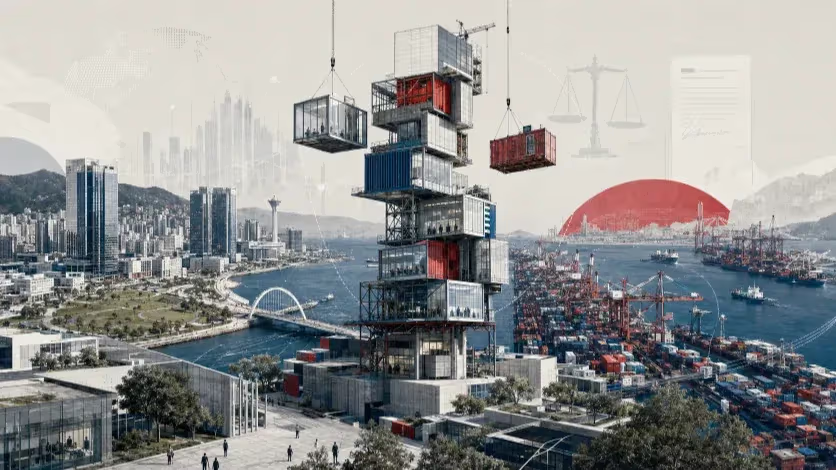
The headquarters race is only the surface. Busan’s real test is whether policy, cargo, capital, law and corporate decision-making can finally operate in the same city.
Busan’s latest maritime debate looks, at first, like a contest over land. The Ministry of Oceans and Fisheries needs a permanent headquarters after its relocation to the city, and rival districts are making their cases: North Port with its old-harbor symbolism and redevelopment logic, Gangseo with its proximity to Busan New Port and the future Gadeokdo New Airport, and the financial district around Busan International Finance Center with its claim to maritime finance. The question appears administrative. Where should the ministry build?
The location fight is only the surface. Busan already moves cargo. What it has not fully captured is maritime power — the ability to regulate, finance, insure, litigate and profit from the movement of ships, capital and risk.
That distinction matters because the pieces are now moving at the same time. The Ministry of Oceans and Fisheries completed its relocation to Busan in December 2025 as part of the national government’s push to turn the port city into a global maritime hub. HMM, Korea’s largest container carrier, has since moved toward shifting its headquarters from Seoul to Busan, with plans to complete legal procedures and move the chief executive office to the city. South Korea’s new maritime and international commercial courts are scheduled to open in Busan and Incheon in March 2028. BIFC already houses the Marine Finance Center, where maritime departments of KEXIM, KDB and KSURE were moved in 2014 to create a one-stop maritime finance service.
Together, those moves begin to form the outline of a maritime capital. But an outline is not a system. A ministry building can be moved by administrative order. A corporate headquarters can change its registered address. A court can open in temporary premises. A financial center can fill office floors. Maritime power moves more slowly. It moves when lenders, insurers, lawyers, regulators, shipping executives and public agencies begin making decisions in the same city.
For Busan, the real test is no longer whether it can attract institutions. The harder question is whether those institutions can form a working circuit. North Port, Gangseo, BIFC, HMM and the planned maritime court are often treated as separate stories. They are better understood as unfinished parts of the same machine.
A Headquarters Fight Becomes a Map of Maritime Power
The permanent site for the Ministry of Oceans and Fisheries will determine more than where civil servants work. It will signal how Busan intends to arrange the functions of a maritime capital inside the city.
The ministry is expected to select a permanent headquarters site through a public competition among Busan’s local governments, with institutional clustering among the key selection criteria. Local contenders have already framed their arguments around different futures for the city: Dong-gu and Jung-gu point to North Port, Nam-gu to the BIFC area, and Gangseo-gu to the western logistics corridor around New Port and airport access.
A headquarters in North Port would place national maritime administration inside the old harbor, next to the city’s most politically visible waterfront redevelopment project. That choice would strengthen the argument that North Port should become the public face of Korea’s maritime economy, not merely another waterfront district pulled between tourism, commercial real estate and civic space. It would also tie the ministry to Busan Station, the old downtown, the international ferry terminal and the symbolic history of the port that built the city.
A headquarters in Gangseo would tell a different story. It would align the ministry with the westward movement of port operations, the growth of Busan New Port, the logistics parks and industrial land around the western corridor, and the planned Gadeokdo New Airport. That choice would emphasize the operational future of the maritime economy rather than the symbolic recovery of the old harbor. Gangseo’s argument is not weak. It is simply based on a different definition of maritime power: cargo, infrastructure, air-sea logistics and industrial execution.
A BIFC-linked argument pushes the question in a third direction. It asks whether maritime policy can be tied to capital. Busan has long promoted itself as a specialized financial center for maritime and derivatives finance, and the Marine Finance Center was designed to bring together the maritime-finance functions of major policy-finance institutions. Yet the existence of financial infrastructure does not prove that financial authority has moved. The unresolved question is whether ship-finance decisions, insurance capacity, credit assessment and investment structuring can be made in Busan rather than merely serviced from Busan.
That is why the headquarters race should not be read as a local bidding contest among districts. North Port, Gangseo and BIFC represent three different layers of the maritime economy. North Port offers administration, visibility and downtown redevelopment. Gangseo offers logistics execution and industrial scale. BIFC offers the possibility, still unproven, that Busan can handle the money and risk behind shipping.
The ministry’s site selection will not settle all of those questions. No single building can. But it will set the first spatial hierarchy. It will show whether the national government sees Busan’s maritime-capital project primarily as a downtown administrative anchor, a western logistics platform, or a broader system that must connect policy, cargo and capital.
That is the point at which the debate becomes larger than the ministry. If Busan treats the headquarters as a prize, the city may win a building. If it treats the headquarters as an anchor, it can begin to ask a more difficult question: which functions must gather around it, which must remain closer to the port and airport, and which financial and legal decisions must move before the city can claim more than symbolic maritime status?
North Port Has the Face. Gangseo Has the Engine.
North Port’s strongest argument begins after the cargo leaves. The westward shift of port operations has weakened the old harbor as a working container hub, but it has strengthened the policy case for turning it into something else: a public maritime district where national administration, shipping companies, civic waterfront space and old-downtown regeneration can meet. Busan Metropolitan City describes the first phase of North Port redevelopment as a project covering Busan North Port piers, with waterfront parks, port infrastructure and commercial and business facilities, while Busan Port Authority frames Busan North Port as a redevelopment project where business and public waterfront uses can coexist.
That is why a ministry headquarters in North Port would carry more weight than a normal government office. It would not be located near today’s main container traffic. It would be placed where Busan is trying to decide what the old harbor should become after its industrial function has moved west. Without a strong public anchor, North Port can drift between commercial real estate, tourism facilities and disconnected civic space. A headquarters for the Ministry of Oceans and Fisheries would fix a different identity onto the waterfront: not a theme-park version of the port, and not only a shopping or leisure district, but a national maritime-administration address inside the old city.
Gangseo’s claim works from the opposite direction. It does not need the old harbor’s symbolism because its case is operational. Busan New Port already functions as the city’s modern container base, with Busan Port Authority saying it operates 23 container berths and promotes high-value-added logistics as a future-oriented port.
The planned Gadeokdo New Airport sharpens that argument. The western corridor is where Busan can connect ships, aircraft, industrial land, logistics parks and future air-sea cargo systems. The national government has already described the need to link Busan Port with Gadeokdo New Airport to develop a land-sea-air logistics hub.
A headquarters in North Port would still need Gangseo. That is the point often lost in the local bidding frame. North Port can give the maritime-capital project its face, but it cannot replace the western logistics system where cargo, port automation, cold chains, green bunkering, maintenance and repair, and port-linked manufacturing will have to operate. Gangseo may be less compelling as the symbolic address of a national ministry, but it is harder to ignore as the physical operating system of Busan’s future maritime economy.
The better question, then, is not whether North Port or Gangseo represents the “real” maritime city. Both do, at different levels. North Port is where Busan can turn a vacated working harbor into the public front office of maritime administration. Gangseo is where the same project must prove it can handle the movement of goods, vessels, aircraft, fuel, equipment and industrial capital. One concentrates meaning. The other concentrates function.
A serious maritime-capital plan would make that division explicit. The ministry’s permanent headquarters may belong more naturally in North Port if the goal is to anchor national maritime administration inside the old harbor and tie it to HMM, the ferry terminal, Busan Station and downtown redevelopment. Gangseo, in turn, should not be treated as the consolation prize. It would need formal execution functions: smart-port coordination, New Port expansion, airport-linked logistics, green-fuel infrastructure, maritime manufacturing and data-driven cargo systems. If those functions remain vague, a North Port headquarters could become a symbol without an engine. If Gangseo is elevated without a civic and administrative center, Busan could gain a logistics platform without a maritime capital.
The division also exposes a political risk. North Port’s redevelopment was sold to the city as a way to reopen the waterfront and restore the old downtown. A ministry headquarters and HMM office tower could strengthen that project by giving it public and industrial purpose. They could also narrow it if waterfront land becomes an enclave for national agencies and corporate offices. Gangseo faces a different risk. Its future is tied to large infrastructure timelines — New Port expansion, logistics parks, airport construction and transport links — that can produce plans faster than they produce a working urban economy.
Busan’s choice is therefore not a clean choice between nostalgia and practicality. North Port is not merely nostalgic, and Gangseo is not merely practical. The old harbor offers a rare chance to turn maritime administration into an urban institution visible from the city center. The western corridor offers the industrial scale without which that institution would have little to administer. The ministry site can set the hierarchy, but the maritime-capital project will succeed only if Busan designs the two spaces as parts of the same system.
Moving an Address Is Easier Than Moving Decisions.
HMM gives Busan the corporate anchor that its maritime-capital campaign has long lacked. The Ministry of Oceans and Fisheries can bring policy, budgets and public-agency coordination to the city, but a ministry alone cannot create a maritime economy. A shipping company does something different. It creates transactions: vessel purchases, chartering, fuel contracts, insurance, cargo sales, legal disputes, treasury decisions and port-service demand. If HMM’s move becomes more than a registered-address change, Busan would gain not only a flagship name but a stream of decisions that can pull lawyers, bankers, brokers, insurers and logistics firms closer to the city.
The first steps are now real. HMM shareholders approved the relocation of the company’s headquarters from Seoul to Busan in May, after management and the labor union reached an agreement, and the company said it would complete legal procedures and move the chief executive office to Busan by the end of the year. The relocation followed the Ministry of Oceans and Fisheries’ move from Sejong to Busan in December under President Lee Jae Myung’s pledge to develop Busan into a major maritime hub in Northeast Asia.
But the harder test begins after the paperwork. A headquarters can move faster than the functions that make a shipping company powerful. Finance teams, global sales networks, chartering desks, legal departments, treasury operations, investor relations and risk-management units do not automatically follow a change in articles of incorporation. HMM plans to move the CEO’s office first, while the scale and timing of the broader move are to be decided through further talks; some functions, including sales and finance, may remain in the Seoul area as branch operations.
That single detail changes the meaning of the relocation. If sales and finance remain substantially tied to Seoul, Busan gains the formal headquarters but not all of the commercial machinery behind it. The city would still benefit from HMM’s presence, especially if the CEO’s office and future North Port building give the shipping line a visible institutional base. But the deeper maritime-capital claim depends on which decisions move: who negotiates contracts, who structures vessel financing, who manages currency and fuel risk, who handles legal exposure, who speaks to investors, and where those people meet banks, insurers and public agencies.
The same distinction applies to the ministry. The Ministry of Oceans and Fisheries has completed its move to Busan, but a permanent headquarters site would do more than settle the ministry’s address. It would decide where policy coordination begins to cluster. If the ministry’s permanent home sits in North Port, next to HMM’s planned office and the old downtown, Busan can try to build an administrative-corporate maritime district. If the ministry’s operational relationships remain scattered across Seoul, Sejong, Busan and port sites, the city may receive the institution without capturing the daily gravity of policy-making.
This is why HMM and MOF should be read together. One is the state’s maritime policy anchor; the other is the country’s largest container carrier. Their moves could reinforce each other if the ministry generates regulatory and public-finance demand in Busan while HMM generates corporate demand for finance, law, insurance and logistics services. They could also sit beside each other without forming much of a system if the ministry becomes an administrative island and HMM keeps its most market-facing functions elsewhere.
North Port would magnify that test. A ministry headquarters and an HMM tower in the old harbor would create a powerful image: national maritime policy and Korea’s flagship shipping company facing the same waterfront. That image matters, especially for a city trying to turn a former working port into the public face of its maritime economy. Yet image alone will not build the services layer that Busan needs. The real question is whether HMM’s presence would bring enough deal flow to BIFC, enough legal work to the planned maritime and international commercial court, and enough procurement and operational demand to port-linked industries.
Busan’s risk is not that the moves are meaningless. They are meaningful. The risk is that they stop at the level of institutional relocation. A ministry building can change the map of government. A corporate headquarters can change the map of prestige. A maritime capital requires a different kind of movement: decisions that used to be made elsewhere must begin to be made in Busan.
Money and Law Are the Missing Test.
BIFC exposes the hardest part of Busan’s maritime-capital claim. North Port can give the project a face, Gangseo can give it an operating base, and HMM can give it a corporate anchor. Finance is less visible. It does not move because a city builds a tower or wins a ranking. It moves when credit committees, insurers, investors, brokers and lawyers decide that deals can be structured, priced and defended in the same place.
Busan has built part of that architecture. The Marine Finance Center opened in BIFC in 2014 after the maritime departments of KEXIM, Korea Development Bank and Korea Trade Insurance Corporation were relocated there, creating what Busan’s financial-center materials describe as the basis for a one-stop maritime-finance service. Around BIFC, Busan also clusters marine-finance-related entities including the Marine Finance Center, KAMCO Ship Investment Management, Korea Marine Finance Corporation and Korea Ship Finance, according to Busan’s financial hub materials.
Those assets matter because Busan’s weakness has never been the absence of maritime activity. The city has cargo, port operators, shipbuilding regions nearby, public agencies and now a stronger claim to maritime administration. What it has not clearly secured is financial authority. The stalled relocation of Korea Development Bank remains the clearest example. KDB is not just another tenant in a financial district. It is one of Korea’s central policy-finance institutions, and the relocation debate has always been about whether decision-making power in industrial and shipping finance can move out of Seoul. Without that kind of authority, BIFC risks becoming a service platform for maritime finance rather than the place where the most important financial decisions are made.
That distinction should shape how Busan’s finance story is written. A maritime-finance cluster cannot be measured only by the number of institutions inside BIFC or by whether global firms open local offices. The real test is transaction depth. Are ship-finance deals being structured in Busan? Are risk models, insurance terms, guarantee decisions and investment committees located there? Do shipping companies meet their lenders and legal advisers in Busan because the city is where the work happens, or because it is where branch offices sit? Those questions become more urgent if HMM’s financial and sales functions remain partly tied to Seoul after its headquarters relocation.
The planned maritime and international commercial court belongs in the same section, not in a separate legal story. Maritime finance is a risk business before it is a money business. A vessel loan depends on contracts that can be enforced, collateral that can be claimed, insurance that can respond to loss, and disputes that can be resolved in a predictable forum. Busan Metropolitan City says the Busan Maritime and International Commercial Court is confirmed to open on March 1, 2028, after related legislation passed the National Assembly, and describes it as an institution connected to the city’s long effort to host a specialized maritime court.
That gives Busan a legal institution that could strengthen its financial claim, but only if the court becomes part of a wider services market. A court building does not automatically create maritime law. It needs case flow, specialized judges, lawyers who understand shipping contracts, arbitrators, insurers, P&I clubs, brokers, banks and companies that choose Busan as a place to resolve disputes. The same problem appears in finance. A Marine Finance Center gives Busan infrastructure. A functioning maritime-finance market requires enough deals, expertise and authority to make the infrastructure matter.
The link between money and law is where Busan’s maritime-capital project becomes more serious than a relocation policy. Finance prices risk. Law defines risk. Insurance distributes risk. Arbitration and courts settle risk when contracts break. If those functions remain in Seoul, London, Singapore or Hong Kong while Busan hosts the ministry, HMM’s headquarters and a new court, the city will have gained institutional symbols without fully capturing the services economy around shipping.
The opportunity is still real. The Marine Finance Center gives public-finance institutions a base. The maritime court can provide legal gravity. HMM can generate corporate demand. BIFC can concentrate professional services around a financial district. But each piece is incomplete by itself. A broker without deal flow is an outpost. A financial center without authority is a building. A court without a surrounding legal market is a public institution, not an industry.
That is why BIFC and the court should be treated as Busan’s services layer. North Port may host the policy face of the maritime capital. Gangseo may move the cargo. HMM may bring the corporate name. BIFC and the court must do something more difficult: turn maritime activity into financial, legal and insurance work that stays in the city. If they fail, Busan will remain a powerful port with new institutions. If they work, the city can begin to claim a share of the high-value decisions that usually sit behind the movement of ships.
Busan Needs a Circuit, Not a Skyline.
Busan’s maritime-capital project is arriving at a difficult global moment. Maritime trade is not expanding into a simple growth story that any port city can ride. UN Trade and Development projected global maritime trade growth to slow to 0.5 percent in 2025 before averaging about 2 percent annually from 2026 to 2030, with geopolitical tension, trade-policy disruption and longer shipping routes reshaping the cost of moving goods.
That matters for Busan because the next stage of maritime power will not be measured only by cargo volume. It will be measured by the ability to manage uncertainty. A city that wants to become a maritime capital must do more than host ships and terminals. It must price fuel risk, insure geopolitical risk, finance low-carbon vessels, resolve contract disputes, coordinate public agencies, and connect port infrastructure with corporate decisions. In that environment, North Port, Gangseo, BIFC, HMM and the planned maritime court are not separate development items. They are either pieces of one circuit or expensive symbols that remain loosely connected.
Climate finance points in the same direction. The Poseidon Principles, a global framework for assessing and disclosing the climate alignment of ship-finance portfolios, says its 2025 disclosure report represents almost three-quarters of the global ship-finance portfolio and covers 35 signatories. That figure matters because ship finance is no longer only about lending against steel. Lenders are increasingly asked to judge carbon pathways, vessel efficiency, fuel transition plans and regulatory exposure.
That is where Busan’s weakness and opportunity meet. The city has a port, a financial district, a planned court, a ministry relocation and a major carrier preparing to move its headquarters. But those assets do not automatically produce a maritime-services economy. If a low-carbon vessel is financed in Seoul or London, insured abroad, legally structured outside Busan and operated through a port system in which local agencies play only a supporting role, Busan remains a powerful port city with limited command over the value chain. If the same transaction brings together MOF policy, HMM demand, BIFC financing, legal support from the maritime court and operational capacity in Gangseo, the city begins to look less like a logistics node and more like a maritime decision-making center.
The distinction is crucial. A headquarters can be photographed. A circuit cannot. It appears in meeting calendars, credit memos, arbitration clauses, insurance contracts, procurement decisions, port-data systems and investment committees. It appears when a shipping company no longer needs to go elsewhere to arrange finance, settle disputes, manage regulatory risk or coordinate public support. It appears when public agencies, corporate executives, lenders and lawyers begin to treat Busan as the place where maritime problems are solved, not merely the place where ships arrive.
That is why the ministry site should not be judged only by who wins the local contest. North Port may be the stronger location for the headquarters if Busan wants to anchor maritime administration in the old harbor and tie it to downtown redevelopment and HMM’s planned presence. Gangseo remains indispensable if the city wants the cargo, airport, logistics and industrial systems to operate at scale. BIFC and the maritime court must become the layer that turns those movements into finance, law, insurance and risk-management work. HMM must show whether a company can move not just its formal address but enough of its decision-making to change the city’s economic gravity.
Busan may win the buildings: a ministry headquarters, an HMM office, a maritime court, a larger financial complex. The harder test is whether it can move the decisions. A maritime capital is not made by a skyline of institutions. It is made when policy generates demand, companies create transactions, courts make risk predictable, finance prices that risk, and logistics infrastructure turns decisions into movement. North Port, Gangseo, BIFC and the maritime court are not rival symbols. They are unfinished parts of the same machine.
Continue this reporting
Reporting on the same issue
Related coverage selected from the article's desk, topics and newsroom relationships.
 NewsOct 22, 2026
Busan Port’s LNG and Methanol Plan: Who Pays to Keep Fuel Ready?
Busan already supplies ships with LNG and methanol, drawing on regional and i...
 NewsOct 16, 2026
What Is Still Worth Going to See?
Busan’s biennale faces questions of artistic judgment and institutional care....
 NewsOct 14, 2026
What Became of Busan’s University Streets?
From 2015 to 2023, registered businesses grew near Pusan National University...
More from the author
More from this byline
Stay with the same line of reporting through more work from this byline.
- NewsOct 22, 2026
Busan Port’s LNG and Methanol Plan: Who Pays to Keep Fuel Ready?
 NewsOct 12, 2026
Bukangi, the Shark That Stayed in Busan’s North Port
Reader Signal
Community readWhat did this report leave you with?
Choose the signal that best reflects your reading. Select it again to remove it.
One response per article
No response selected
A moderated conversation about the reporting.
One-level replies and newsroom moderation keep the conversation anchored to this article.
Discussion Status
Open
Please sign in to join the discussion.
Newsletter
Weekly reporting and context from Busan and Korea.