Busan’s World Heritage Test Begins After the Committee Leaves
As South Korea hosts UNESCO’s World Heritage Committee for the first time, Busan is preparing an expanded 11-site wartime-capital property. Its historical case is persuasive; the harder test is defining the evidence, boundaries and authority needed to protect it.

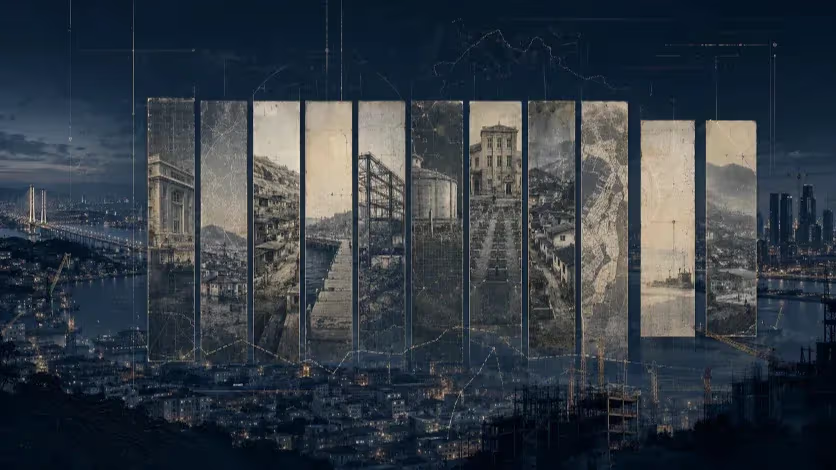
As South Korea hosts the World Heritage Committee for the first time, Busan is preparing an expanded Korean War property for international review. The city has assembled a persuasive account of wartime survival; it must now define the evidence, boundaries and public authority required to protect it.
On the second floor of the Busan Modern and Contemporary History Museum, eleven scale models have been arranged into a city at war. Government buildings represent the institutions that kept the Republic of Korea functioning after the capital moved south. Hillside settlements trace the lives of people who arrived without permanent housing, while a harbour pier, a bridge and a reservoir show how supplies, movement and water sustained a city whose population and responsibilities had expanded under emergency conditions. Former foreign facilities and the United Nations Memorial Cemetery complete Busan’s account of the military, diplomatic and humanitarian presence concentrated in the city during the Korean War.
The exhibition presents those places as one connected urban system. Visitors can move from state administration to refugee housing, from port logistics to international cooperation, without leaving the room. The models give physical form to the proposition Busan wants the world to accept: that the city’s 1,023 days as South Korea’s wartime capital survive through a group of places that operated together, rather than through a single monument or government building.
The international public record still describes an earlier version. UNESCO’s Tentative List contains the nine-component property submitted by South Korea in 2023, before Yeongdo Bridge and Bokbyeongsan Reservoir were added during later domestic review. The entry proposes criterion (iii), presenting the sites as exceptional testimony to the continuation of government, the lives of displaced people and the international support assembled in Busan.
Publicly available materials do not establish whether an updated eleven-component entry has already been sent to the World Heritage Centre or will be transmitted as the city prepares its next application. The difference may reflect the timing of a proposal moving through separate national and international procedures, yet it leaves outside readers looking at a property that no longer matches the one Busan is displaying at home.
That discrepancy will sit outside the formal agenda when the World Heritage Committee meets in Busan from July 19 to 29. The committee is scheduled to examine 33 nomination files, including new nominations and changes to existing properties, alongside 147 reports on the condition of places already on the World Heritage List. Busan’s wartime-capital sites are not among the properties awaiting a decision.
Their absence gives the meeting much of its local significance. Busan will host the institution that determines which places possess Outstanding Universal Value and whether governments are keeping the commitments made when earlier properties were inscribed. Once the delegations leave, the city will return to its own application. Busan has said the expanded property is being prepared for UNESCO preliminary assessment and that the request, following consultation and review with national heritage authorities, is expected to be submitted in the September cycle.
Busan has already built a coherent historical argument. The demanding work ahead lies in converting that argument into a property that can be evaluated and governed: identifying the physical evidence carried by every component, explaining why all eleven are needed, drawing boundaries around places that remain in active use and establishing which public authority can intervene when conservation conflicts with port development, infrastructure operations or the needs of residents. The committee meeting will give Busan an international audience for its history. The application that follows will have to show whether the city is prepared to place its own decisions under the heritage principles it is asking UNESCO to recognise.
The Work That Begins After Recognition
New inscriptions will supply the most visible moments at BEXCO. A favourable vote produces applause, national statements and a new name on the World Heritage List. The larger body of work awaiting the committee concerns properties whose celebrations took place years or decades ago. The agenda includes 53 reports involving properties on the List of World Heritage in Danger and 93 concerning other listed sites facing threats or management problems.
Those cases provide a more practical account of the World Heritage system than the ceremony surrounding inscription. UNESCO does not take ownership of a listed place, and the committee does not replace domestic planning authorities. Roads, buildings, energy facilities, tourist infrastructure and changes in land use continue to be approved by national governments, municipalities and local agencies. When those decisions threaten the characteristics for which a property was recognised, however, the dispute can enter an international monitoring process. The committee may ask the responsible state to reassess a project, complete a heritage-impact study, strengthen protection or report again within a fixed period.
The relevance to Busan is immediate because its proposal is embedded in the ordinary machinery of a working city. Pier 1 lies within a redevelopment district and is being prepared for a new economic use. Ami-dong and Uam-dong contain homes rather than vacant ruins. Yeongdo Bridge carries traffic, and Bokbyeongsan Reservoir belongs to the infrastructure that serves present-day Busan. Former government and foreign facilities have also acquired later public functions. World Heritage recognition would leave those activities in place while requiring decisions about them to follow a shared account of what must survive.
That account will first be tested through UNESCO’s preliminary-assessment procedure. The assessment is a mandatory documentary review intended to examine whether a proposed property has the potential to justify Outstanding Universal Value and whether the emerging arguments concerning authenticity, integrity, comparative significance, protection and management can support a future nomination. It does not include a field mission. Exhibitions, heritage tours and professional contacts during the committee session may sharpen Busan’s research, but they cannot replace the evidence assembled in the formal submission.
The procedure also prevents the host-city role from being confused with a procedural advantage. Visiting specialists may question how a reservoir communicates a role that is mostly technical, how much wartime fabric remains in a bridge altered through decades of use or how an inhabited settlement can be conserved without turning its residents into part of a historical display. Such encounters may help Busan identify weaknesses before the dossier enters formal review, but the assessment will return to the same questions asked of every state: what exactly is being proposed, how it compares internationally and whether the authorities responsible for the property can protect the value they describe.
Busan is consequently preparing something more complicated than a collection of monuments. Its proposed heritage reaches into housing, water supply, transportation, public investment and waterfront redevelopment—the same fields in which conservation disputes at established World Heritage sites later emerge. The preliminary assessment will begin testing whether those parts can be understood and managed as a single property rather than as a group of places connected primarily by historical narrative.
How the Wartime Capital Grew from Nine Sites to Eleven
The property entered on UNESCO’s Tentative List in 2023 followed a relatively clear three-part structure. Former presidential, government and meteorological facilities represented the continuation of national administration. Ami-dong and Uam-dong represented the lives of displaced Koreans. Pier 1, former American facilities, Camp Hialeah and the United Nations Memorial Cemetery represented the international military, diplomatic and humanitarian presence concentrated in Busan. South Korea proposed criterion (iii), describing the series as testimony to the way an existing city adapted to govern the country, sustain refugees and secure outside assistance during war.
The series already extended beyond conventional monumental heritage. It placed residential neighbourhoods and port infrastructure beside official buildings and memorial grounds, acknowledging that the wartime capital could not be understood through the actions of the state alone. Its public structure nevertheless treated government, refugee life and international cooperation as parallel fields, without fully explaining the urban systems through which they depended on one another.
Busan’s 2024 effort to enter South Korea’s Priority World Heritage List was held for further work. The city’s own record of the process says reviewers sought reconsideration of components without sufficient relationship to the wartime-capital argument and a clearer selection logic for the serial property. When the proposal returned and was selected in November 2025, Yeongdo Bridge and Bokbyeongsan Reservoir had been added, and the national announcement said both the criteria and narrative had been strengthened.
The additions changed the proposal more substantially than the numerical increase suggests. Yeongdo Bridge brings civilian movement and separation into a series previously centred on institutions, settlements and international operations. The bridge continued to connect central Busan and Yeongdo, while refugees used the crossing and its surroundings to exchange information, search for relatives and arrange meetings when ordinary communication had collapsed. Bokbyeongsan Reservoir introduces the municipal infrastructure needed to sustain a city whose population and administrative burden had risen rapidly, placing water supply alongside cabinet offices, port operations and temporary housing as part of the wartime-capital system.
The eleven-site version therefore presents Busan as an emergency urban system. State administration, civilian displacement, port logistics, foreign intervention, transportation and water supply were not isolated episodes occurring within the same municipal boundary. They were interdependent functions through which an existing port city absorbed the responsibilities and population of a nation at war.
That interpretation may give Busan a more distinctive international position. Numerous cities have served as temporary or wartime capitals, while many others have received displaced populations or hosted foreign military operations. Busan’s strongest claim may lie in the combination: surviving evidence of national administration, mass displacement, international assistance and urban infrastructure operating together across one functioning city.
The breadth of that claim places a heavier evidentiary burden on the application. Every component of a serial property must make an identifiable contribution to the value asserted for the whole. A presidential residence can be tied to state continuity through its rooms, plan and documentary history. The United Nations Memorial Cemetery has a defined commemorative and international institutional role. A working bridge, reservoir or repeatedly altered residential district carries its history through a different mixture of fabric, setting, use and memory.
The two refugee settlements demonstrate why a single category is insufficient. Ami-dong developed when refugees constructed homes on the terrain of a former Japanese cemetery, incorporating available stones and landforms into a new hillside community. Uam-dong developed through the subdivision and occupation of structures built as a cattle quarantine and holding facility during the colonial period. One records the construction of shelter on difficult ground; the other records the conversion of an existing institutional complex into emergency housing. Their separate inclusion gains meaning from that material difference.
Selecting eleven sites also determines which parts of wartime Busan become internationally visible. The city depended on hospitals, schools, markets, railway facilities, factories and cultural institutions that do not appear in the proposed property. A nomination cannot absorb every place connected to the period. The line between a related historical site and an indispensable component nevertheless shapes the version of wartime Busan that will be presented to the world.
The current selection gives strong weight to national continuity, refugee survival and cooperation involving the United Nations and the United States. The bridge and reservoir deepen the account of civilian movement and urban operation, yet their inclusion requires Busan to explain what disappears from the argument if either is removed and why other associated places remain outside the proposed boundary.
International comparison must evolve at the same time. The 2023 Tentative List entry refers to Kaunas as a Lithuanian temporary capital then still on the Tentative List. Kaunas entered the World Heritage List later that year, recognised for the modernist urban transformation created while it served as Lithuania’s provisional capital. Busan can now compare itself with a completed nomination whose value, boundaries and management commitments have been formally examined, rather than with another preliminary proposal.
Busan has commissioned additional research to verify and strengthen the proposed Outstanding Universal Value, and the city has made several reports available through its policy and heritage platforms. The latest public information, however, remains divided among documents produced at different stages: UNESCO’s nine-site entry, the domestic decision adding two places, an eleven-site municipal platform and the materials now being prepared for preliminary assessment. The movement from nine to eleven has strengthened Busan’s explanation of how the wartime city functioned, but it has also made the selection, material evidence and present-day governability of each component more consequential.
Normandy and Getbol: Memory and Completeness
Two cases on the Busan agenda illustrate different demands that can be placed on a World Heritage proposal. France is seeking recognition for the Normandy beaches where Allied forces landed in June 1944, a coastline whose historical importance is already understood internationally. South Korea is asking the committee to approve a major expansion of Getbol, Korean Tidal Flats, a natural property inscribed in 2021 whose initial boundaries did not contain the ecological system as completely as the state now proposes. One file tests how a vast memory is attached to selected physical evidence; the other tests whether the components of a serial property contain the relationships needed to support its value.
France proposed the D-Day landing beaches under criteria (iv) and (vi). The draft decision before the committee recommends inscription under criterion (vi), grounding the property’s proposed value in the direct and material association between the coastline and the events of June 1944 rather than accepting its military structures as an outstanding architectural or technological type under criterion (iv). The serial property contains selected beaches, defensive works, remains of the artificial Mulberry harbour, traces of combat and memorial landscapes.
The international familiarity of D-Day does not eliminate the need to define where the history remains physically legible. France has not proposed every location connected to the invasion or the liberation of Western Europe. It has selected stretches of coastline where terrain, structures and spatial relationships can sustain an account extending far beyond the limits of the property. Those places must also be protected against coastal change and later development that could weaken the connection between the surviving landscape and the event being commemorated.
The comparison with Busan remains conditional because UNESCO’s public entry currently lists the Korean property under criterion (iii). South Korea’s 2025 domestic decision said the criteria and narrative had been supplemented but did not publish the full revised criteria. Should the future application rely on criterion (vi), UNESCO’s principles for places associated with memories of recent conflict would require more than a declaration that the Korean War was historically important. The state would need to explain the tangible connection between the events and each proposed site, compare the property with other places carrying related memories and document meaningful participation by communities affected by the interpretation and management of the heritage.
Such requirements would complicate Busan’s attractive language of humanitarian assistance, international solidarity and survival. The city’s wartime history also includes mass displacement, civilian poverty, political conflict, military control and the reuse of spaces created under Japanese colonial rule. An international account built around peace and cooperation would need to accommodate those histories instead of smoothing them into a single commemorative message. The significance of refugee memory would also have to remain attached to the material form of the settlements, bridge, port and institutional sites rather than resting on the emotional power of the story alone.
Getbol presents another kind of difficulty. The property inscribed in 2021 comprised four components protecting tidal-flat habitats used by migratory waterbirds along the East Asian–Australasian Flyway. The Phase II proposal is a significant boundary modification intended to improve the ecological representation and integrity of the serial property. The original inscription decision already recognised that additional components and revised boundaries could more fully cover critical habitats used by waterbirds.
The proposed expansion matters because ecosystems do not stop at the line of an administrative map. Feeding, breeding and resting habitats depend on connected coastal processes, while water quality, fishing activity, reclamation and development outside one component can alter conditions inside another. Enlarging the property therefore adds ecological completeness and a wider network of local authorities, protected areas and communities whose decisions must remain compatible.
Normandy asks whether selected physical remains can carry a memory extending far beyond the French coast. Getbol asks whether the parts of a serial property contain enough of the living system that gives them international value. Busan will eventually face both forms of scrutiny: its wartime history must acquire significance beyond Korea, while eleven sites with different physical forms and present-day uses must operate as a sufficiently complete and governable property.
The Bid Is Already Entering City Decisions
Pier 1 provides the clearest current example. The proposed heritage component stands inside the North Port redevelopment area, where former harbour land is being assigned new public and economic functions. Busan is preparing a disused warehouse at the pier for Global Startup Hub Busan, a project intended to house startups, investors and supporting organisations. The design competition explicitly asked architects to reconcile the new facility with the registered heritage value of Pier 1, and the winning proposal retained the warehouse form while adding business, public and historical spaces.
Adaptive reuse can protect a historic structure by giving it a continuing purpose and keeping it accessible. It can also change circulation, internal organisation, service access and the relationship between a building and its surroundings. The wartime meaning of Pier 1 did not reside in a warehouse facade alone. It developed through the quay, harbour water, transport routes and the movement of troops, relief supplies and displaced people. A successful project must allow those relationships to remain understandable after the new use has taken hold.
Archaeological work at the startup-hub site reinforces the need for careful coordination. An investigation conducted from September to December 2025 produced 70 recorded objects that entered the statutory process for excavated heritage. The notice does not establish that the finds are central to the proposed World Heritage value, nor does it show that the startup project has damaged the site. It confirms that redevelopment is proceeding while historical evidence within the project area is still being documented.
The administrative challenge is wider than architecture. The department promoting the startup hub is expected to create a visible and active economic facility. Heritage officials must determine which structures and spatial relationships carry the pier’s historical significance. The port authority manages the surrounding redevelopment area, and the future operator will make decisions about vehicles, security, events and public access. Integrated management will have substance only when one of those actors can be required to alter a plan that weakens the historical setting.
Ami-dong brings the same issue into private and inhabited space. The proposed component grew when refugees occupied the site of a former Japanese cemetery and used its steep terrain and remaining materials to construct homes, retaining walls and steps. Its historical value extends beyond selected stones or individual houses to the dense plots, narrow paths and gradual transformation of emergency shelter into a permanent neighbourhood.
In May 2024, Busan established a district-unit plan for part of Ami-dong and published the associated planning area and implementation documents. The plan can protect the physical form that supports the heritage proposal while bringing conservation rules into everyday decisions about roofs, walls, safety and rebuilding. Preservation in an inhabited neighbourhood is consequently different from maintaining a museum or memorial ground: the material evidence is intertwined with homes that must continue to function.
Political opposition has emerged. A city councillor representing the district has argued that the planning and heritage policies restrict property rights, give insufficient weight to residents’ views and risk turning an ageing neighbourhood into a tourism product. Those statements demonstrate the existence of a dispute, although they do not establish the opinion of the community as a whole. Publicly available sources reviewed for this article do not provide consolidated figures showing how many repair or reconstruction applications have been approved, restricted or refused, how many properties have been purchased by public authorities or what formal powers residents will hold in the future management body.
The distinction between consultation and authority is crucial. A public meeting can demonstrate that residents were informed or invited to speak. Governance determines whether they can alter a repair standard, a tourism route, an acquisition proposal or the interpretation that will be presented internationally. Should South Korea later rely on criterion (vi), UNESCO’s principles for memories associated with recent conflict would give this issue added weight by requiring meaningful participation from affected communities in defining the value and interpretation of the property.
Uam-dong presents another set of physical and social choices. Its wartime settlement formed through the conversion of a cattle quarantine complex created during the colonial period. Refugees divided the barracks into domestic spaces, while parts of the original structural frame, alleys and wells survived through subsequent decades of residential use. Busan’s heritage platform states that former residents, their descendants and later arrivals continue to live in the area.
The difference between Uam-dong and Ami-dong strengthens the urban argument behind the application. Ami-dong records new construction on the terrain of a cemetery. Uam-dong records the reuse of an existing institutional facility. Both reveal the speed and ingenuity with which displaced people adapted spaces never intended to serve as permanent housing, and both continued to change as temporary accommodation became community.
Conservation cannot therefore be reduced to restoring one representative structure at each site. Busan must decide how much of the surrounding paths, plots, altered homes and later adaptations belongs to the evidence being protected. A reconstruction that recreates a chosen moment in the early 1950s may erase changes through which residents made the settlement habitable, while unrestricted replacement could remove the spatial and material features on which the nomination depends.
Similar decisions will arise across the enlarged series. Yeongdo Bridge must serve present-day traffic while retaining the features and setting associated with wartime movement and separation. Bokbyeongsan Reservoir belongs to a modern technical system whose historical role is less visible than that of a government building. Institutional components are administered by different municipal and national bodies, while the port and residential sites sit within development and housing policies that respond to priorities other than heritage.
An integrated management plan cannot remain an organisational chart attached to an application. Its credibility will be visible in the authority to require changes when a redevelopment project weakens Pier 1’s historical setting, in the standards governing repairs in Ami-dong and in decisions about what is preserved or reconstructed in Uam-dong. UNESCO may evaluate that system years from now, but Busan’s capacity to operate it is already being revealed through decisions made today.
The Narrow Timetable to 2030
The World Heritage Committee’s departure at the end of July will be followed quickly by the next stage in Busan’s own campaign. The city has said the preliminary-assessment request will be finalised through consultation with national heritage authorities and submitted to the World Heritage Centre in September. Busan continues to identify 2030 as its target year for inscription.
UNESCO’s published procedure suggests that 2030 is the earliest plausible decision year rather than a distant target containing room for several attempts. A complete preliminary-assessment request must reach the World Heritage Centre by September 15. The Secretariat then checks whether the submission is complete before it enters substantive review. A file that does not pass that stage must be supplemented for a later annual cycle.
Under UNESCO’s published timetable, a complete request submitted in September 2026 would be expected to receive an assessment by October 2027. UNESCO requires at least 12 months between receipt of that assessment and submission of the related full nomination. Since complete nomination dossiers enter the regular process through a February 1 deadline, the October 2027 result would come too late for February 2028. The first available full-nomination deadline would therefore be February 2029, leading to possible committee examination in 2030. This sequence is an inference from UNESCO’s official timetable rather than a detailed schedule published by Busan.
That timetable leaves limited room for delay. An incomplete preliminary request could cost an annual cycle before substantive review begins. An assessment requiring major changes to the international comparison, component selection, boundaries or management system could make the February 2029 deadline difficult to meet, while missing that deadline would move committee consideration beyond 2030.
The purpose of preliminary assessment is to identify those problems before a state invests in a final dossier. A demanding response would not mean that Busan’s history lacks international significance. It could mean that the property needs more time to define which sites carry that significance and how they will be protected. Maintaining the 2030 target should not lead the city to settle uncertain boundaries or management rules that will affect development and residents for decades.
Hosting the committee does not shorten the procedure. The event can improve international awareness, provide contact with specialists and concentrate political attention and funding. UNESCO’s published process contains no exemption from preliminary assessment, accelerated review or host-city preference. The distinction between visibility and evaluation will become clear once the official programme ends and the application enters documentary review.
From a Public Story to a Public Property
The most useful legacy of the committee session will become visible in the records Busan makes available afterward. Current information is distributed across several stages: the nine-component Tentative List entry submitted in 2023, the 2025 domestic decision adding two components, Busan’s eleven-site heritage platform and exhibition, and the preliminary-assessment materials now being prepared.
The first unresolved public question concerns what South Korea intends to nominate. An updated entry or a clear account of its submission status would show how the two additions changed the property’s name, proposed criteria, Outstanding Universal Value and comparison with other places. The issue is less whether officials have produced such a document internally than whether international readers and residents can examine the same eleven-site property that Busan is publicly promoting.
The physical boundaries carry greater consequences. Maps must establish whether the application protects a building, a wider landscape or the spatial relationship between several features. At Pier 1, the boundary and buffer zone will shape how future harbour development and the startup hub are assessed. In Ami-dong and Uam-dong, those lines could determine which homes, paths and neighbouring areas enter the proposed property or its protective setting. At the bridge and reservoir, they will define which changes to operating infrastructure require heritage review.
The final public question concerns binding authority. Listing the institutions responsible for individual components will not create integrated management. Busan must specify how one decision emerges when a port-development plan, infrastructure requirement, municipal economic project or household repair conflicts with the heritage value of the series. The composition and powers of the coordinating body, together with the role granted to residents, will show whether cooperation is a formal mechanism or an aspiration.
Greater disclosure would expose the proposal to criticism and could reveal disagreements that an exhibition does not need to resolve. That exposure is part of the transition from public history to public policy. Boundaries, conservation rules and management decisions may affect infrastructure, public investment and privately occupied land well before the committee makes a final decision.
Busan can tell a persuasive story through eleven models. A World Heritage property demands something more durable: a record that outsiders can test, lines that agencies must respect and rules that the city is willing to enforce against its own projects.
After the Committee Leaves
When the committee closes on July 29, its decisions will enter UNESCO’s record and the visiting delegations will leave Busan. The museum exhibition will continue, but the people who encountered its eleven-site narrative will have no formal role in deciding whether the proposal can support inscription.
Within roughly seven weeks, Busan expects to enter the first international review of its own case. The preliminary-assessment request will have to restate the history displayed in the museum through the language of potential Outstanding Universal Value, comparative analysis, component selection, physical attributes, protection, management and community participation.
The public materials reviewed for this article do not establish that the necessary answers are absent from the application now being prepared. They show that Busan remains in the process of bringing an expanded domestic proposal, its international public record and the city decisions already affecting the proposed components into a single, defensible framework.
Busan will host the World Heritage Committee for ten days. The longer test begins afterward, when the city must turn its wartime history into a governable public property and apply the rules required to protect it to its own government.
Continue this reporting
Reporting on the same issue
Related coverage selected from the article's desk, topics and newsroom relationships.
 NewsOct 16, 2026
What Is Still Worth Going to See?
Busan’s biennale faces questions of artistic judgment and institutional care....
 NewsOct 14, 2026
What Became of Busan’s University Streets?
From 2015 to 2023, registered businesses grew near Pusan National University...
 NewsOct 12, 2026
Bukangi, the Shark That Stayed in Busan’s North Port
A rescue net guided Bukangi toward the sea, but the dusky shark returned to B...
More from the author
More from this byline
Stay with the same line of reporting through more work from this byline.
- NewsOct 14, 2026
What Became of Busan’s University Streets?
 NewsSep 28, 2026
Why Some Commercial Space in Busan Is Hard to Reuse
Reader Signal
Community readWhat did this report leave you with?
Choose the signal that best reflects your reading. Select it again to remove it.
One response per article
No response selected
A moderated conversation about the reporting.
One-level replies and newsroom moderation keep the conversation anchored to this article.
Discussion Status
Open
Please sign in to join the discussion.
Newsletter
Weekly reporting and context from Busan and Korea.