Why Fruit Prices Remain High in Korea: Inside the Wholesale Monopoly and Reform Debate
Since the 1980s, public wholesale markets like Garak have shaped fruit distribution in Korea. Decades later, five corporations control most transactions, operating under licenses rarely challenged.

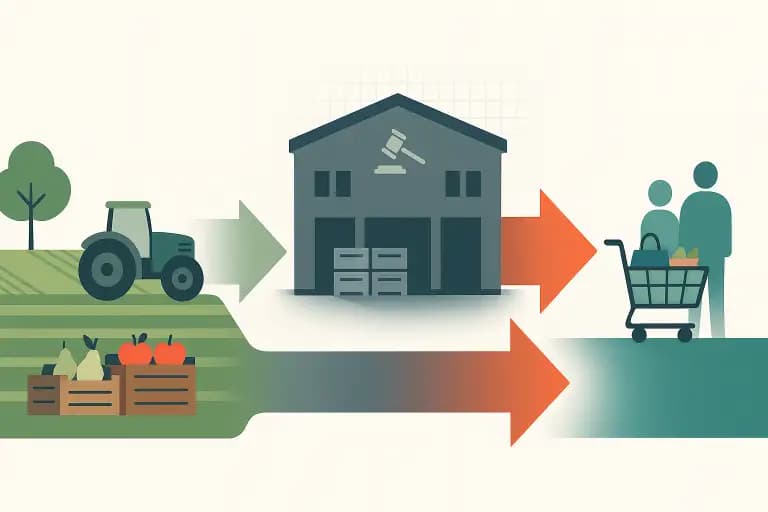
Fruit prices in South Korea are consistently among the highest in the OECD. Periodic spikes during holiday seasons attract public attention, but the underlying issue is structural. The distribution system channels nearly half of consumer spending into logistics, commissions, and margins, leaving farmers with about half of the final price.
The wholesale market framework, established in the late 1970s and formalized with the opening of Garak Market in 1985, was designed to improve transparency and protect producers. It created designated corporations with exclusive rights to handle sales, mandated consignment of produce, and relied on daily auctions for price discovery. These rules stabilized transactions but concentrated market power in a small number of firms.
Attempts to bypass wholesale markets through direct contracts and online platforms have expanded. Large retailers, food service buyers, and pilot online exchanges now account for a growing share of trade. Yet these channels also introduce costs for logistics, certification, and platform commissions. They have not offset the structural inefficiencies that keep consumer prices high and farm incomes limited.
This study examines the historical development of wholesale markets, the concentration of wholesale corporations, the mechanisms of price formation, and the evolution of direct and online alternatives. It evaluates the distribution structure in comparison with Japan and the United States and reviews reform proposals aimed at competition, transparency, and efficiency.
1976 Reform and the Opening of Garak Market
In the 1970s the government sought to replace fragmented local trading with a centralized system. The Agricultural and Fishery Products Distribution Act of 1976 established the legal basis. In 1985 the Garak Wholesale Market opened in Seoul as the first large public facility of its kind.
The system had three core elements. First, mandatory consignment required farmers to deliver produce through licensed wholesale corporations rather than sell directly to traders. Second, auctions were made the standard method for price formation, replacing private negotiations that often lacked transparency. Third, immediate settlement rules ensured that farmers received payment as soon as goods were sold, reducing the risk of delayed or unpaid transactions.
These mechanisms addressed problems in the earlier distribution model, where commission agents operated with little oversight and farmers lacked bargaining power. By consolidating trade under one roof and publishing daily auction prices, the wholesale markets provided national reference prices and stabilized payment flows.
The design solved short-term issues of fairness and reliability but also entrenched exclusivity. Only designated corporations could handle sales, and auctions became the dominant channel. These institutional choices created the framework within which later concentration and rigidity would develop.
Five Firms at the Center of Korea’s Largest Market
Key wholesale corporations operating the fruit & vegetable segment at Garak Market.
Garak Market today accounts for more than one-third of all wholesale fruit and vegetable trade in South Korea. Within Garak, five private corporations dominate transactions. Their major shareholders are industrial conglomerates or investment groups rather than producer cooperatives.
Licenses for wholesale corporations are rarely revoked or reassigned. Once designated, a corporation retains its position for decades with limited scrutiny. This creates a protected environment with little competition.
Financial data reflect this position. Average operating margins exceed 15 percent, far above typical margins in distribution sectors. Dividends to parent companies have been substantial, and transactions involving the sale of corporate stakes have generated large capital gains. The corporations function not only as distributors but also as valuable financial assets.
Revenue derives primarily from commissions on auction sales. The statutory ceiling is 7 percent, and in practice most corporations charge between 4 and 7 percent. Because competition is minimal, rates remain clustered and stable. Collusion cases have been documented. In 2018 four Garak corporations were fined for setting identical commission levels. Regulatory intervention has been limited, and sanctions have not altered the basic structure.
The result is a concentrated system in which farmers and buyers have few alternatives. Wholesale corporations retain control over access to the market floor, and their profitability rests on an institutional design that restricts entry and preserves long-term privileges.
Farmers’ Share Falls Below 50 Percent
The distribution of fresh fruit in South Korea follows several stages: farm production, shipment through producer organizations or local centers, consignment to wholesale corporations, auction to intermediate buyers, and resale through retail channels. Each stage adds costs.
Data from the Korea Agro-Fisheries and Food Trade Corporation show that in 2019 farmers received about 52.5 percentof the consumer price. By 2022 the figure had fallen to 50.3 percent, with distribution costs rising to nearly half of total expenditure. Within this share, wholesale operations accounted for around 11 percent, while retail distribution accounted for more than 27 percent.
The auction mechanism contributes to volatility. Prices fluctuate daily according to supply and demand conditions. Weather shocks or seasonal shortages translate quickly into consumer price spikes. Conversely, bumper harvests depress farm incomes through rapid price declines. The system provides transparency but amplifies instability.
Multiple handling points reduce efficiency. Produce is moved, sorted, and repackaged several times before reaching consumers. Each transfer involves logistics costs and margins. The structure benefits intermediaries but erodes both farm revenues and price stability.
Comparisons with other countries highlight the gap. In Japan, a larger share of transactions now occur through negotiated contracts rather than auctions, reducing volatility. In the United States, distribution relies heavily on direct contracts between producer organizations and large retailers, with wholesale markets playing only a limited role. Both models show lower dependence on commission-based auctions and shorter chains between farms and consumers.
In South Korea, nearly half of what households pay for fruit is absorbed before it reaches producers. This ratio has persisted despite incremental reforms and continues to shape the debate on structural change.
Farmers Gain Higher Prices but Face New Pressures
Over the past two decades, the share of agricultural products distributed through wholesale markets has declined. Large retailers, food service companies, and public procurement programs increasingly source produce through direct contracts with producer organizations or cooperatives. This shift reduces reliance on auctions and allows some farmers to secure fixed prices in advance.
Direct trade removes one layer of commission. Farmers may receive higher unit prices, and buyers gain stable supply with standardized quality. Public programs for school meals and local food centers provide additional channels, supported by municipal governments.
However, bargaining power is uneven. Large retailers dictate contract terms, while small producers lack leverage. Requirements for consistent volume, uniform packaging, and year-round supply increase costs for farms that operate on small scale. Compliance often requires investment in sorting and cold storage facilities beyond the means of individual growers.
Quality and safety controls vary. In wholesale markets, residue and grading inspections are conducted by public authorities. In direct trade, oversight depends on GAP or organic certification and on buyer-commissioned private tests. Large retailers enforce regular checks, but small-scale or online direct sales rely mainly on producer declarations. This creates disparities in consumer protection.
The scale of direct trade remains limited compared with wholesale markets. While it has grown steadily, it has not displaced the central role of auctions in price formation. Direct trade adjusts margins and conditions for specific buyers but does not alter the structure of distribution.
Electronic Bidding and Digital Documentation at Garak
Since 2022 the government has introduced online wholesale platforms as a supplement to physical auctions. Transactions are conducted through electronic bidding systems, supported by digital documentation such as electronic shipping notes. Pilot projects at Garak Market have extended to a small number of staple vegetables and fruit varieties.
The purpose is to shorten distribution, reduce handling costs, and provide stable prices. Farmers upload shipment information in advance, allowing logistics scheduling and reducing congestion at market facilities. Buyers place bids electronically, and transactions are recorded in real time.
Initial results indicate modest gains. Pilot programs report higher producer returns and lower distribution cost ratios compared with conventional auctions. Large-scale buyers, including supermarkets and processors, have participated, while adoption among small and medium buyers remains limited.
Digital reform also includes logistics standardization and automation. Pallet specifications, cold-chain management, and automated sorting systems are being introduced to reduce inefficiency. The government has set targets for expanding electronic shipping notes across all major wholesale markets by 2027.
Challenges remain. Participation is voluntary, and entrenched wholesale corporations retain control over most volume. Small producers face technical barriers and limited digital capacity. Trust in electronic contracts and dispute resolution mechanisms is still developing.
The online model demonstrates potential to improve efficiency and transparency but remains marginal relative to physical auctions. Its growth depends on policy support, integration with existing markets, and willingness of both producers and buyers to adopt new practices.
Breaking Entrenched Privileges in Wholesale Licensing
Reform of the wholesale distribution system has moved from academic debate to the center of policy discussions. The government has identified competition, transparency, efficiency, and producer support as the main priorities. Each of these targets responds directly to structural weaknesses that have kept fruit prices high and farmer incomes constrained.
The first priority is to alter the licensing regime for wholesale corporations. For decades, once a corporation was designated it retained its position almost permanently. Reform plans call for fixed license terms, mandatory performance evaluations, and open bidding when licenses expire. The intent is to introduce contestability into a market where entry has been effectively blocked. Without new entrants, commission rates have remained clustered and service quality stagnant. By requiring periodic reassessment, regulators aim to create pressure for cost reduction and innovation.
The second element is greater transparency in fees and transactions. Current commission rates are set within a legal ceiling but rarely vary, and the basis for additional charges is not clear to producers. Proposals include differentiated commission structures linked to service quality, mandatory disclosure of corporate accounts, and publication of settlement practices. These measures are designed to prevent collusion, strengthen bargaining positions of farmers, and give buyers clearer information on cost components embedded in prices.
A third focus is digitalization. Pilot projects at Garak Market have shown that electronic documentation and online bidding can reduce logistics delays and transaction costs. The government plans to expand the system nationwide by 2027, integrating electronic shipping notices, standardized pallets, and automated logistics scheduling. The expectation is that digital tools will both lower costs and provide a full trace of transactions, limiting opportunities for opaque practices.
Producer support forms the fourth pillar. Small-scale farms cannot easily participate in direct contracting or online markets without collective infrastructure. Policy measures emphasize strengthening producer organizations, expanding cold-chain capacity, and subsidizing certification and inspection. By enlarging the role of producer cooperatives, the state seeks to balance the negotiating power of farmers against both wholesale corporations and large retailers.
Governance reform is the final strand. Oversight has long been fragmented across ministries, local governments, and market operators. A joint supervisory body has been proposed to unify licensing, fee regulation, and monitoring of digital transition. Such coordination is expected to reduce regulatory gaps that have allowed long-standing inefficiencies to persist.
The reform agenda faces resistance from entrenched wholesale corporations that benefit from the current model. Yet the political and economic costs of inaction are becoming more visible. Farmers remain limited to about half of consumer spending on fruit, and households face prices well above international levels.
The history of wholesale markets in South Korea shows how a system built to stabilize transactions and protect farmers gradually created concentration and rigidity. Direct trade and online platforms have offered alternatives but have not displaced the central role of designated corporations and daily auctions.
Reform is now directed at introducing competition, clarifying cost structures, and modernizing logistics through digitalization. The ultimate test will be whether these measures can shift a distribution system that absorbs nearly half of consumer expenditure into one that delivers higher returns to farmers and more affordable prices to consumers.
The Weekly Breeze
Keep pace with Busan's deep narratives.
Delivered every Monday morning.