Loaf of bread in Korea costs nearly double Japan and more than France
International comparisons show Korea leading regional price charts as the market lacks low cost supermarket anchors.

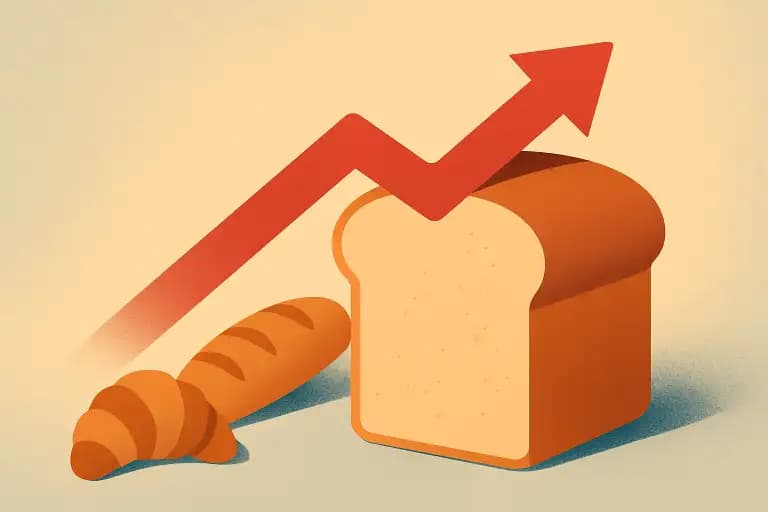
South Korea’s bread prices have risen at a pace that sets the country apart from other advanced economies. In August 2025, the consumer price index for bread increased by 6.5 percent from a year earlier, while overall consumer prices rose by 1.7 percent. For half a year, bread inflation has run at more than four times the headline rate, creating a gap between official statistics and what households experience in daily purchases.
A standard 500-gram loaf costs about 4,200 won in South Korea. The same product sells for roughly 2,100 won in Japan, between 1,300 and 1,800 won in the United States, and about 1,700 won in France. All of these countries rely heavily on imported wheat and dairy inputs, but none shows a price level as high as Korea. A temporary “990-won salt bread” promotion in Seoul drew crowds and headlines, highlighting consumer frustration and the rigidity of the market.
Bread in South Korea is shaped by a cost structure in which labor and fixed expenses carry unusual weight. Wages account for close to 29 percent of bakery costs, more than three times the average share in the food industry, and commercial rents in dense urban areas add further pressure. Raw materials make up about half of costs.
Almost all wheat, butter, and sugar are imported, leaving bakeries exposed to exchange rates and international commodity swings. Mills and distributors carry inventories purchased months earlier, so global price declines filter through only after long delays. Franchise logistics add another layer. Large chains operate centralized factories that produce frozen dough and ship it nationwide for in-store baking.
The model guarantees consistency but adds transport, storage, and royalty fees. Independent bakeries face the same supply chains and have limited room to reduce costs. When input prices rise, consumer prices adjust quickly. When input prices fall, high fixed costs and franchise overhead prevent a parallel decline.
The bakery market is dominated by large franchises such as Paris Baguette and Tous Les Jours. Their nationwide networks rely on the same central factory system, embedding overhead into every product. This structure creates the appearance of variety but leaves most bread on the same cost base.
Independent shops exist but draw from the same suppliers and compete on style rather than price. What is absent is a strong low-cost baseline. In Europe and North America, supermarkets anchor the market with cheap private-label loaves, allowing consumers to choose between basic and premium options.
In Japan, supermarkets provide affordable staple bread while specialty shops charge more for differentiated products. South Korea has no equivalent floor. Packaged bread in convenience stores or supermarkets is priced closer to franchise levels than to discount benchmarks, and bread consumption is viewed less as a necessity than as a discretionary or indulgent item. Even basic loaves or rolls are positioned at premium prices.
International comparisons highlight the divergence. France sells a traditional baguette for about 1.20 euros, while premium bakeries operate separately at higher prices. U.S. retailers offer standard loaves for around a dollar, relying on scale to maintain minimal margins. Japan keeps its staple bread relatively inexpensive despite high import dependence. South Korea lacks such segmentation, leaving consumers with prices that in other markets would be reserved for premium categories.
Bread prices in South Korea also show limited responsiveness when costs abroad fall. Increases in wheat or dairy costs are transmitted within months, but declines often take far longer to reach the shelf. Inventory contracts slow the process, franchise logistics remain fixed, and labor and rent do not adjust downward. The asymmetry leaves consumers with the impression of one-way pricing: quick to rise, slow to fall. This rigidity has turned bread into a symbol of cost-of-living pressure that official averages fail to capture.
Regulators have taken note. The Fair Trade Commission has identified high labor shares, concentrated supply in flour and sugar, and opaque franchise logistics as factors sustaining prices. Proposals include greater transparency in cost pass-through and monitoring of raw material effects on retail pricing.
Supermarkets and convenience stores have tried to build private-label bakery lines, but their reach remains limited. Policy discussions have explored diversifying wheat imports and encouraging competitive distribution, while industry voices warn that intervention could harm franchisees operating on thin margins. Consumer groups continue to argue for a widely available low-cost product as the only durable relief.
Bread in South Korea shows how industrial structure and consumer culture can sustain elevated prices regardless of international trends. A combination of labor-intensive operations, costly retail space, centralized franchise models, and the absence of a low-cost baseline has pushed bread into the realm of premium goods.
In other markets, supermarkets keep basic loaves inexpensive and treat bread as an essential staple. In South Korea, the same product is positioned as a discretionary purchase. Without changes to distribution, competition, and cost transparency, the pattern is unlikely to shift, and bread will remain both a daily necessity and a marker of the country’s broader structural inflation.
The Weekly Breeze
Keep pace with Busan's deep narratives.
Delivered every Monday morning.