Abolishing South Korea’s Prosecution Service May Not End Prosecutorial Power
Draft laws to abolish the prosecution service promise a historic break with concentrated prosecutorial power, but unresolved warrant authority, supplemental investigation rules and inter-agency transfer mechanisms could preserve old leverage in a new legal structure.

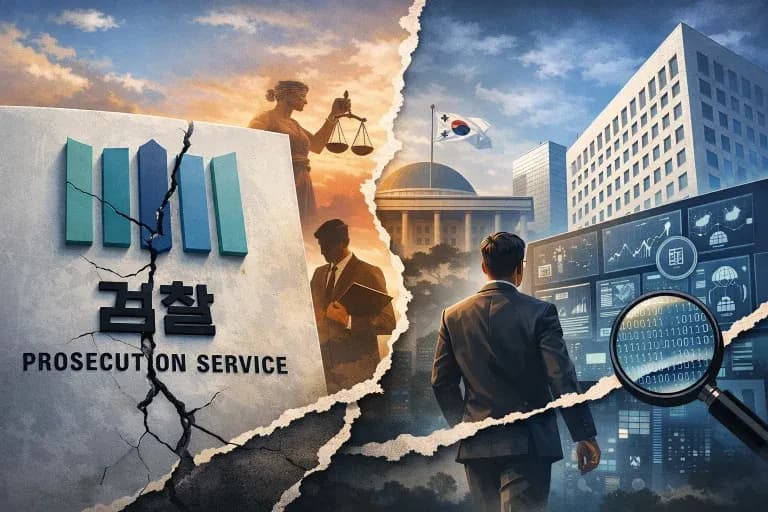
South Korea’s criminal justice system is heading toward its sharpest institutional break since the founding of the republic. Under the revised Government Organization Act, the Supreme Prosecutors’ Office structure is set to disappear on Oct. 2, 2026, with its core functions divided between a new Public Prosecution Office under the Justice Ministry and a new Serious Crimes Investigation Office under the Interior Ministry. The government finalized the bills in a Cabinet meeting on March 3 after an initial legislative notice in January and a revised notice on Feb. 24, then moved into a separate round of public consultation on unresolved criminal procedure issues.
The statutory design is more consequential than the abolitionist headline suggests. The draft Public Prosecution Office Act does not reduce prosecutors to courtroom lawyers. It defines prosecutorial functions to include decisions on indictment, maintenance of public prosecution, warrant applications and direction over their execution, consultation and support for judicial police officers, supervision of special judicial police, recovery of criminal proceeds, and international criminal cooperation. Direct investigative authority is removed from the text, but the coercive gateway of warrant practice and the supervisory link to special judicial police remain in place. The proposed settlement is not a clean severance between investigation and prosecution. It is a narrower, more selective redistribution of prosecutorial power.
The draft Serious Crimes Investigation Office Act creates a separate problem of equal weight. The government narrowed the agency’s remit from nine crime categories to six, placing corruption, economic crime, defense procurement, narcotics, national security-related crime and cybercrime within its core mandate. It also abandoned a dual-track personnel model in favor of a single investigator rank structure, a revision explicitly framed as a response to criticism that the new body could become a second prosecution service. That adjustment resolves a symbolic objection, not an operational one. The crimes left inside the new agency’s jurisdiction sit at the high end of evidentiary and analytical difficulty, requiring financial tracing, digital forensics, cross-border coordination and evidentiary integration on a scale that no organizational relabeling can supply by itself.
The decisive legal questions remain outside the institutional bills. The government has acknowledged that supplemental investigation powers and related Criminal Procedure Act issues still require concentrated review through March and April. That leaves the operational core of the new system unsettled: who corrects investigative defects, how investigative and prosecutorial bodies exchange views before transfer, what limits apply to prosecutorial intervention after formal separation, and whether the new architecture dismantles prosecutorial dominance or preserves it through warrants, supervisory authority and pre-indictment coordination. The present bills redraw the map of criminal justice authority. They do not yet resolve the legal mechanics that will determine whether South Korea has abolished the prosecution service in substance, or only redistributed its leverage across a new institutional grid.
The legal architecture of residual prosecutorial power
The central weakness in the current design lies in the gap between institutional separation and functional disentanglement. The bills remove prosecutors from the category of direct investigators, but they do not place the new prosecution body outside the investigative chain. Article 4 of the draft Public Prosecution Office Act preserves prosecutorial authority over warrant applications, direction over warrant execution, consultation and support for judicial police officers, supervision of special judicial police, criminal asset recovery and international criminal cooperation. That formulation matters because it leaves prosecutors at the points where coercive procedure, evidentiary preservation and inter-agency coordination are decided. A prosecutor stripped of formal investigative initiation power but left in control of these procedural junctions remains capable of shaping the trajectory of a case before indictment.
The warrant structure is the clearest example. Formal separation loses much of its practical force if the body conducting the investigation cannot independently cross the threshold into compulsory process. Under the draft, prosecutors continue to occupy that threshold. A system built on the premise that investigators investigate and prosecutors prosecute would ordinarily require the prosecution service to evaluate cases at the charging stage. The present bills retain prosecutorial leverage earlier in the process, at the stage where search, seizure, detention and record acquisition determine whether an investigation can proceed on its intended path. The issue is not theoretical. In a system centered on documentary evidence, digital extraction, account tracing and device forensics, the timing and framing of warrant applications often determine the evidentiary record long before the question of indictment is formally reached.
The same structural tension appears in the treatment of special judicial police. The draft does not abolish prosecutorial oversight in that domain. It preserves a legal channel through which prosecutors may continue to influence investigative sectors that already operate outside the ordinary police structure. That is not a peripheral detail. Special judicial police units are active in regulatory, financial, environmental, customs and other specialized fields where documentary intensity is high and legal framing is often contested from the outset. Retaining prosecutorial direction and supervision there means that one of the most legally sensitive parts of the investigative landscape remains tied to prosecutorial authority even after the headline reform. A criminal justice system can be described as reorganized under such a model. It cannot yet be described as fully insulated from prosecutorial command.
The coordination clauses deepen the ambiguity. The draft Public Prosecution Office Act authorizes consultation and support for judicial police officers; the draft Serious Crimes Investigation Office Act requires close cooperation between investigators and prosecutors, prompt notification to prosecutors when investigations are opened, and the exchange of views before transfer. Those provisions are defensible as a hedge against procedural breakdown. They are also broad enough to reproduce hierarchical habits under a different vocabulary. The language of cooperation does not, by itself, establish equality of institutional position. In systems with a long history of prosecutorial dominance, undefined consultation mechanisms can operate as informal control devices, particularly when one side retains the authority to handle warrants, review records and determine indictment. What has been removed in express command can return through structured dependence.
The retention of legacy hierarchy within the new prosecution body sharpens that concern. The government preserved the title of prosecutor general and maintained the high-level prosecutorial tier rather than collapsing the structure into a flatter indictment service. The official rationale was constitutional caution. The institutional consequence is different. A reform advertised as a break with the prosecutorial state continues to embed central command features associated with that model. Titles alone do not determine legal power, but they are rarely neutral in bureaucratic systems built on rank, chain of command and internal discipline. When the old hierarchy survives inside the new institution, continuity cannot be dismissed as merely semantic. It becomes part of the legal architecture through which authority is exercised, distributed and defended.
The bills also introduce stronger disciplinary controls over prosecutors, including dismissal as a formal sanction and performance review metrics tied to outcomes such as reversals and acquittals. Those provisions are likely to be presented as instruments of accountability against an historically insulated elite. They may prove to be that. They may also alter prosecutorial incentives in ways that pull decision-making toward caution, internal conformity and institutional risk avoidance. A prosecution service that remains deeply involved in warrants, case review and special police oversight while operating under intensified disciplinary pressure may become less autonomous without becoming less influential. The formal reduction of power and the informal adaptation of power are not the same event. In legal systems under rapid structural transition, they often occur at the same time.
The unresolved issue of supplemental investigation powers sits above all of these provisions. The government has made clear that the most consequential questions will be handled through later amendments to the Criminal Procedure Act. That sequencing leaves the present bills in an unstable position. If prosecutors retain broad authority to seek or conduct supplemental investigation, the separation of investigation and prosecution risks becoming nominal. If that authority is reduced to weak requests without binding force or procedural speed, the system risks delay, evidentiary decay and repeated transfer between agencies. The current statutes establish institutions while postponing the terms on which those institutions will actually interact. That legislative order all but guarantees that the real content of the reform will be decided not by the symbolic abolition of the prosecution service, but by the later drafting of procedural interfaces.
The point is narrower than a general indictment of reform and more serious than a drafting quibble. South Korea is not confronting a simple question of whether prosecutors should keep direct investigative powers. It is confronting the harder question of whether a prosecution-centered system can be disassembled without leaving prosecutors in control of the procedural chokepoints that continue to shape investigation from the outside. The current bills do not yet answer that question in the affirmative. They narrow prosecutorial authority, but they do not fully sever the legal channels through which prosecutorial influence can continue to organize the investigative field.
The new investigative state and the problem of relocated concentration
The draft Serious Crimes Investigation Office Act places the new agency under the Interior Ministry and assigns it responsibility for six categories of major crime: corruption, economic crime, defense procurement, narcotics, national security-related offenses and cybercrime. The jurisdictional revision from the earlier nine-category model was presented as a narrowing measure, intended to reduce overlap and answer criticism that the agency risked reproducing the old prosecutorial apparatus under another label. The reduction in scope does not alter the character of the institution being created. The state is transferring some of the most politically sensitive and evidentially complex investigations in the system to a new executive-branch body with nationwide reach and an independent statutory identity. That is not dispersal in the ordinary sense of the term. It is a change in the location and form of concentration.
The placement under the Interior Ministry is not a secondary administrative detail. It goes to the constitutional and institutional logic of the reform. The prosecution service was long criticized as an autonomous power center capable of acting with weak external restraint. The legislative answer now offered is to remove major investigations from that structure and lodge them in an agency situated inside the executive branch. The draft limits ministerial direction in individual cases, but general supervision over personnel, budget, organization and administrative control remains inseparable from ministerial placement. A criminal justice order designed to weaken prosecutorial dominance may, under this model, strengthen the executive’s long-term capacity to shape investigative priorities through managerial rather than case-specific means. The legal prohibition on direct intervention in a single file does not eliminate structural dependence on the ministry that houses the institution.
The personnel design reveals a second tension. The government abandoned the earlier dual-track model and moved to a single investigator rank structure in part to blunt the charge that the new body would become a second prosecution service. The revision addresses an issue of appearance. It leaves unresolved the problem of functional composition. Corruption, financial misconduct, cyber-enabled offenses and national security cases demand layered expertise: forensic accounting, digital extraction, data reconstruction, technical attribution, mutual legal assistance and evidentiary management under trial standards. A unitary rank system may simplify chain of command. It does not answer how legal specialization, analytical depth and operational continuity are to be developed across fields in which investigative failure often occurs not at the level of effort, but at the point where complex evidence must be translated into sustainable proof. The statute can create an office. It cannot legislate competence into existence.
The transfer and overlap provisions compound the risk. The draft authorizes requests for case transfer where another investigative body is handling matters that fall within the new agency’s jurisdiction, and it contemplates reciprocal movement of cases among agencies. That structure is framed as a coordination device. In practice, it creates a legal field in which police, the new serious crimes agency and other specialist bodies may each claim institutional primacy over the same politically charged matter. Corruption and economic crime rarely present as neatly bounded categories. They arrive through mixed fact patterns, partial records, overlapping suspects and competing legal characterizations. Without highly specific statutory thresholds, fixed timelines and a binding resolution mechanism, transfer authority can become a means of institutional contest rather than a method of rational allocation. A system that multiplies gateways without sharply ranking them invites jurisdictional struggle at the front end of major cases.
That problem acquires sharper force once the agency’s relationship with prosecutors is considered. The draft Serious Crimes Investigation Office Act requires investigators to cooperate closely with prosecutors, to notify prosecutors when investigations are opened, and to exchange views before cases are transferred. The arrangement is presented as a safeguard against fragmentation. It also means that the new investigative body begins operation inside a framework of legally required proximity to the institution from which power is ostensibly being withdrawn. If the reform’s declared object is to dismantle prosecutorial dependence, then an investigative office obligated to maintain continuous procedural contact with prosecutors begins with a built-in contradiction. The danger lies less in explicit command than in patterned adjustment: investigators anticipating prosecutorial expectations at the outset, prosecutors shaping evidentiary direction before formal transfer, and both institutions reproducing, through consultation, the hierarchy the reform is supposed to disassemble.
The narrowing of jurisdiction from nine categories to six has its own legal significance. It removed several highly contested fields from the proposed mandate and left the new agency with a portfolio more tightly centered on corruption, finance, national protection and technologically intensive crime. That recalibration reduces one form of institutional sprawl. It increases the stakes of performance inside the domains that remain. The resulting agency is no longer drafted as a universal elite investigator. It is drafted as a concentrated high-complexity bureau. Such a body cannot be judged by the symbolism of its distance from the prosecution service. It must be judged by whether it can absorb investigations that depend on long-form financial reconstruction, encrypted communications analysis, cross-border records and integrated digital proof. The text of the bill states what the office may investigate. It does not yet show, in legal or budgetary design, how the state intends to build an institution capable of doing so at scale.
The underlying issue is not whether the new agency is too strong or too weak in the abstract. It is whether the reform has replaced a prosecution-centered concentration of authority with a more opaque concentration distributed across the executive branch, overlapping specialist bodies and an unfinished procedural interface with prosecutors. The old problem was vertical integration inside one institution. The new problem may be horizontal fragmentation under executive supervision. Neither condition guarantees restraint. Neither, by itself, guarantees competence. The legal question raised by the current draft is whether South Korea is building an investigative body insulated enough to break from prosecutorial dominance, yet structured enough to avoid becoming a new site of concentrated and weakly reviewable state power.
The procedural void
The organizational statutes do not determine how the new order will function at the point where investigations fail, stall or arrive in incomplete form. That question has been deferred to later amendments to the Criminal Procedure Act, and the government has expressly identified supplemental investigation powers as one of the issues still under review through the current consultation process. The result is an inversion of legislative sequence. The state has specified the institutions before settling the rules that govern error correction, record completion, evidentiary supplementation and the timing of prosecutorial intervention once a case leaves the hands of investigators. In any criminal process, those are not secondary matters. They define whether the architecture can absorb defective investigations without collapsing into delay, attrition or procedural repetition.
Supplemental investigation is the fault line on which the entire reform turns. A prosecution office with no meaningful capacity to cure material defects in a case file may become dependent on repeated remands to the investigative body. A prosecution office that retains a broad power to direct or conduct supplemental inquiry risks re-entering the investigative field through another doctrinal door. The distinction is not semantic. It determines whether the reform produces a prosecution service confined to charging and trial work, or a prosecution service able to influence witness strategy, documentary supplementation and evidentiary framing after formal separation has already been announced. If legislators leave the concept open-ended, the old hierarchy may survive through procedural vocabulary. If they strip it down to a weak and slow request mechanism, the burden of incompleteness shifts onto victims, courts and the timing rules of criminal litigation.
The practical consequences are acute in record-heavy cases. Economic crime, corruption, cyber-enabled offenses and procurement fraud do not arrive as self-contained files. They require reconstruction of transaction chains, attribution of device use, sequencing of communications, verification of corporate structure and the integration of expert material into a form that can survive adversarial scrutiny. An incomplete investigative record in such matters cannot always be repaired through broad instructions from a distance. Yet a system that permits prosecutors to move too deeply into record-building after transfer recreates the very concentration the reform is intended to dismantle. The legal design must therefore answer a narrower and more technical question than current rhetoric has allowed: what specific acts of supplementation remain permissible, by whom, at what stage, on what timetable, and under what review. Without those boundaries, the reform remains conceptually underwritten and operationally indeterminate.
The risk of cyclical transfer is not speculative. Once separate investigative and prosecutorial bodies are created without a settled supplementation regime, any serious disagreement over evidentiary sufficiency can push a file into repeated movement between agencies. The institutional bills contemplate cooperation and exchange of views before transfer. They do not, on their own, establish hard limits on the number of returns, the scope of supplementary requests, or the time within which deficiencies must be cured. A major case can therefore become trapped in a loop: investigators submit, prosecutors identify gaps, the file returns for further work, records are supplemented unevenly, legal characterization shifts, and the matter re-enters prosecutorial review under tighter time pressure and weaker strategic coherence. In a high-volume system, procedural loops of that kind do not merely inconvenience the agencies involved. They change the practical threshold for bringing difficult cases at all.
The absence of settled criminal procedure rules also leaves transfer authority underdefined at the very moment the state is multiplying investigative actors. The Serious Crimes Investigation Office, the police and other specialist bodies will encounter overlapping fact patterns in corruption, financial misconduct, cyber incidents and state-protection cases. An organizational statute can authorize transfer requests. It cannot by itself determine priority when two agencies classify the same facts differently, when one body has already undertaken coercive measures, or when evidentiary continuity would be broken by reassignment. In major investigations, jurisdiction is not simply a matter of subject-matter labels. It is shaped by sequencing, seized materials, witness contact, digital preservation and litigation posture. Transfer rules drafted at a high level of abstraction tend to fail precisely where the legal and practical cost of reassignment is highest.
This uncertainty extends to the handling of pre-transfer consultation. The current bills permit or require institutional communication before cases are passed on for charging decisions. That may reduce one kind of fragmentation. It may also erode accountability by making authorship of strategic decisions harder to identify. Where investigators adjust record-building in response to prosecutorial expectations before formal transfer, and prosecutors later assess a file shaped in part through that anticipatory exchange, responsibility becomes diffuse at the point where it matters most. Failures can be attributed to the investigating body’s execution, to prosecutorial caution, to timing constraints, or to the interface itself. A system that combines separation in formal competence with interdependence in pre-indictment shaping must define the boundary between advice and influence with great precision. The current framework does not yet do so in enacted procedural terms.
Legislative incompleteness has another effect. It displaces the real normative choices from public headline to technical drafting. The visible political act is the abolition of the prosecution service. The less visible legal act will be the drafting of the rules that determine who may supplement a file, when prosecutors may intervene, how disputes over transfer are resolved and how delays are controlled. Those procedural provisions will decide whether the reform produces a prosecution service limited to indictment and trial, a hybrid institution that continues to shape investigations indirectly, or a fragmented model in which no actor can efficiently repair evidentiary defects once they emerge. The structural significance of those choices is greater than the nominal replacement of one agency with two.
The present stage of reform therefore cannot be assessed through institutional bills alone. A criminal justice system is not defined only by where authority is housed. It is defined by the procedures through which incomplete facts become admissible proof, by the channels through which one agency compels action from another, and by the legal thresholds that separate coordination from domination. South Korea has drafted the outer frame of a post-prosecution-service order. It has not yet enacted the code that determines whether that order will function as a cleanly divided system, a disguised continuation of prosecutorial influence, or an unstable arrangement in which major cases deteriorate between institutions.
Comparative baselines and the AI-era collapse of prosecutor exceptionalism
Comparative law does not support a simple claim that advanced criminal justice systems separate investigation from prosecution in a uniform way, nor does it support the older Korean premise that prosecutors must retain investigative primacy because they possess superior legal judgment. The institutional record points elsewhere. In the United Kingdom, the Serious Fraud Office is a non-ministerial department that fights complex financial crime and combines investigative and prosecutorial functions inside a single specialist body. In the United States, the Justice Department’s Public Integrity Section oversees the investigation and prosecution of federal crimes affecting government integrity, investigates and prosecutes especially sensitive corruption cases, and supervises election-crime enforcement nationwide. Those models are not built on a theory of prosecutorial superiority in the abstract. They are built on the proposition that certain classes of crime require tightly integrated technical, evidentiary and charging capacity.
That distinction is critical for the Korean debate. Foreign systems that preserve or combine investigative and charging authority do so in relation to institutional design, subject-matter complexity and accountability architecture. They do not rest their legitimacy on the notion that prosecutors as a professional class are inherently better investigators than specialized agencies. The British SFO is organized around serious and complex fraud. The U.S. Public Integrity Section is organized around corruption and election crimes. In both instances, the case for integration flows from the structure of the offense and the requirements of proof, not from an open-ended belief that criminal process should default to prosecutor-led investigation across the board. Comparative experience therefore cuts against a prosecutor-centered ideology far more than it validates one.
The French model underscores the same point from another direction. French prosecutors direct investigations, oversee police custody and decide whether to prosecute within a criminal process that has never treated the prosecutor as a courtroom figure detached from the evidentiary phase. Yet that system is embedded in a distinct procedural tradition and cannot be lifted out of context as a transferable defense of prosecutorial command in South Korea. Comparative borrowing becomes misleading when one element is isolated from the broader legal order that gives it shape. The proper lesson is narrower. No serious jurisdiction organizes criminal procedure around an abstract belief in prosecutorial intellectual primacy. Systems allocate functions according to legal tradition, control mechanisms, institutional capability and the kinds of offenses the state is trying to manage.
The arrival of AI intensifies that conclusion. Europol’s report on AI and policing treats artificial intelligence as an operational tool for the law-enforcement community, aimed at improving how agencies process large volumes of information, identify patterns and implement technology responsibly and compliantly in daily work. That framing captures the decisive shift in modern investigation. The evidentiary center of gravity has moved toward machine-assisted review of communications, financial flows, network structures, images, device histories and multilingual data sets. Competence in that environment depends less on the professional prestige of the person directing the file than on access to technical infrastructure, data governance, model validation, forensic workflows and specialists capable of translating machine outputs into legally usable evidence. Prosecutorial status by itself confers none of those capacities.
Once investigation is understood as a data-intensive and systems-dependent function, the old argument that prosecutors should hold investigative authority because they are better equipped to analyze cases begins to collapse on its own terms. Legal expertise remains indispensable, but its role changes. The central prosecutorial contribution in an AI-mediated process lies in admissibility, legality, evidentiary framing, disclosure obligations and trial strategy. It does not follow that prosecutors should therefore command the investigative chain as such. On the contrary, the more technically dense the investigative environment becomes, the stronger the institutional case for specialized bodies equipped for digital forensics, financial reconstruction, cyber attribution and cross-border evidence management, with prosecutors positioned at defined legal checkpoints rather than installed as general supervisors of the entire process.
That is where the Korean reform debate becomes more exacting than the familiar binary between full separation and retained prosecutorial oversight. The issue is not whether Korea should imitate the United Kingdom, the United States or France in formal structure. The issue is whether it is building a system that matches the actual composition of contemporary crime. Corruption, procurement fraud, market manipulation, narcotics logistics and cyber-enabled offenses now turn on encrypted communications, platform records, layered ownership structures, tokenized transfers, forensic accounting and machine-assisted review. A state can answer that reality by preserving prosecutor-centered control, by creating specialist integrated agencies, or by separating technical investigation from charging and trial. It cannot answer it through institutional nostalgia. A model defended on the premise that prosecutors must remain central because of their superior analytic ability belongs to an earlier procedural imagination than the one modern evidence now demands.
Comparative analysis therefore produces a stricter conclusion than either side of the domestic argument often acknowledges. It does not establish that prosecutors must be removed from every investigative function in every legal system. It does establish that any claim for retained prosecutorial authority must be justified in narrowly institutional terms: what crime category is involved, what technical capacities are needed, what review mechanisms exist, what coercive powers attach, and how accountability is secured. The Korean debate has too often treated prosecutorial involvement as either a constitutional necessity or a historical pathology. Foreign models and AI-era practice both suggest a different approach. Investigative authority should attach to demonstrated institutional capability and legally bounded necessity, not to inherited professional hierarchy.
Set against that standard, the central weakness of the current Korean reform is not that it seeks to curtail prosecutorial investigation. It is that the bills have not yet fully specified what specialized investigative competence will replace the authority being removed, nor what precise procedural limits will govern prosecutorial re-entry through warrants, supervisory channels or supplemental review. Comparative law does not rescue the argument for preserving broad prosecutorial control. It sharpens the demand for a more exact legislative settlement: one that assigns technical investigation to institutions built for it, confines prosecutors to clearly delimited legal functions, and avoids rebuilding the old hierarchy through procedural indeterminacy.
What genuine reform would require
A durable settlement cannot be built by abolishing the prosecution service in statute while leaving its operational leverage intact in procedure, hierarchy and institutional habit. The reform will have to answer three distinct questions in positive legal form. The first concerns coercive process. So long as prosecutors remain the exclusive gateway for warrants, any claim that investigative authority has been materially decentralized remains incomplete. The second concerns supplementation. If prosecutors retain an elastic power to repair investigative defects after transfer, separation hardens into symbolism. If they are confined to nonbinding requests without enforceable deadlines, the system invites drift, repetition and evidentiary decay in major cases. The third concerns agency interface. A criminal process that creates multiple investigative bodies without ranking their priority, fixing transfer rules and defining the legal consequence of inter-agency disagreement does not disperse power in a disciplined way; it redistributes uncertainty.
The present bills also require a clearer theory of institutional capacity than they currently supply. The Serious Crimes Investigation Office is being assigned a portfolio that includes corruption, economic crime, defense procurement, narcotics, national-security offenses and cybercrime. Those are not ordinary police files under a new signboard. They demand sustained technical depth: forensic accounting, digital extraction, cross-border record acquisition, platform-data interpretation and the disciplined conversion of machine-processed material into courtroom evidence. Europol’s guidance on AI and policing treats artificial intelligence as part of a wider law-enforcement capability stack rather than a substitute for institutional design. That is the point Korean legislation has not yet fully absorbed. An office charged with high-complexity crime cannot derive competence from rank reform or jurisdictional narrowing alone. It requires statutory alignment with training, staffing, data governance, forensic infrastructure and review protocols robust enough to withstand litigation.
The prosecution side requires an equally disciplined redefinition. A post-prosecution-service order can justify a prosecution body that controls indictment, trial strategy, disclosure, legality review and the framing of evidentiary sufficiency. It cannot claim to have dismantled prosecutor-centered power while preserving undefined supervisory channels over judicial police, elastic consultation clauses and early-stage influence over record formation. The draft Public Prosecution Office Act still places prosecutors at warrant practice, special judicial police oversight, criminal asset recovery and international criminal cooperation. Those functions may each be defensible in isolation. Taken together, they show that the reform has not yet drawn a hard boundary around what prosecutors are no longer allowed to organize from outside the investigative file. Genuine reform requires that this boundary be stated with greater exactness than the current legislative language provides.
Comparative experience offers a workable standard. The Serious Fraud Office in the United Kingdom and the Public Integrity Section in the United States each tie institutional design to subject-matter complexity rather than to a generalized premise of prosecutorial superiority. Europol’s AI framework points in the same direction by locating investigative effectiveness in technical systems, responsible deployment and agency-wide capability. South Korea’s reform will become coherent only when it does the same: assign complex investigation to bodies built for technical inquiry, define prosecutors as legal actors with sharply bounded powers, and draft procedural rules that prevent old dependencies from reappearing through new terminology. The foreign lesson is not that one model must be copied. The lesson is that no advanced system can rely on professional mythology where institutional design is required.
The deeper issue is one of constitutional method. South Korea is not merely reallocating administrative tasks. It is attempting to unwind a structure in which investigation, indictment and state authority were historically concentrated in one institution. Reforms of that magnitude fail when they confuse formal subtraction with structural transformation. Prosecutors may lose their direct investigative title and still retain enough procedural control to shape the evidentiary field. A new investigative agency may inherit headline jurisdiction and still remain dependent on ministerial oversight, prosecutorial gateways and undefined transfer rules. The difference between reform and reconfiguration lies in whether the law eliminates those dependencies in enforceable terms. On the present text, that work remains unfinished.
A serious legislative endpoint would therefore have to satisfy a narrower but more demanding test than the current political framing suggests. It would need to break the institutional expectation that prosecutors remain the default coordinators of serious criminal process; restrict prosecutorial functions to expressly enumerated legal tasks; impose hard rules on transfer, supplementation and timing; and equip the new investigative office with the technical capacity its statutory mandate presupposes. Without those conditions, the prosecution service may disappear as an organization while its methods of influence survive in procedure, and the new investigative order may inherit broad responsibility without acquiring the autonomy or competence required to discharge it. That is the unresolved legal fact beneath the rhetoric of abolition.
Abolition is not dismantlement
The current reform is best understood not as the legal extinction of prosecutorial power, but as a contested attempt to redraw the routes through which that power operates. The government has chosen the most visible institutional act available to it: abolish the prosecution service as an organization, divide its headline functions, and relocate major-crime investigation to a new body outside the old prosecutorial chain. That choice has political force and historical meaning. It does not settle the more difficult legal problem. A prosecution-centered system is not dismantled merely because direct investigation is deleted from one statute and assigned to another agency. It is dismantled only when the mechanisms through which prosecutors continue to shape coercive process, evidentiary formation, file completion and inter-agency movement are either extinguished or confined within precise and reviewable limits. On the present bills, that severance has not yet been completed.
The tension runs through the architecture of the reform itself. The Public Prosecution Office is drafted as a post-investigative body, yet it remains positioned at warrant applications, warrant execution direction, supervision of special judicial police, asset recovery and other procedural nodes that influence the development of cases before indictment. The Serious Crimes Investigation Office is drafted as the state’s new specialist major-crimes investigator, yet it is housed within the executive branch, tied to prosecutors through mandatory cooperation and pre-transfer exchange, and assigned a portfolio whose complexity far exceeds what can be guaranteed by jurisdictional language alone. These are not incidental drafting choices. They reveal a reform that has subtracted from the prosecution service’s formal identity more decisively than it has severed the legal and bureaucratic dependencies through which prosecutorial influence has historically been exercised.
That is why the unresolved Criminal Procedure Act amendments matter more than the abolition clause itself. The decisive questions are procedural and highly specific. Who may cure an investigative defect once a file has crossed into prosecutorial review. What acts count as permissible supplementation and what acts amount to a return to investigative control. Whether a prosecution office may shape a case through warrant leverage while disclaiming investigative responsibility. How transfer disputes are resolved when multiple agencies assert jurisdiction over overlapping conduct. Whether there are binding time limits, ranked priorities and review mechanisms strong enough to prevent major cases from drifting through loops of reassignment and partial repair. A system can survive institutional separation if those rules are hard, narrow and enforceable. It cannot survive on aspiration, informal consultation and open-textured cooperation clauses in matters where evidentiary continuity and coercive timing determine the life of a case.
The comparative and technological dimensions sharpen rather than soften that conclusion. Foreign models do not validate a generalized claim that prosecutors should command investigations because they are intellectually superior legal actors. The British and American examples most often invoked are organized around specialized institutions and offense-specific design, not prosecutorial exceptionalism. Europol’s AI policing framework points in the same direction by locating investigative strength in technical infrastructure, organizational capability and responsible deployment rather than in inherited professional hierarchy. In an evidentiary environment defined by encrypted communications, platform records, forensic accounting, cross-border data production and machine-assisted pattern recognition, the old Korean claim that prosecutors must remain central because they are best equipped to analyze crime appears increasingly detached from the actual composition of modern investigation. The question is no longer who holds the highest legal prestige. The question is which institution can collect, preserve, structure and litigate technically dense evidence under conditions of procedural legality and democratic restraint.
The failure mode of the current reform is therefore more exact than either side of the political argument usually concedes. The danger is not simply that prosecutors lose too much power, nor simply that they retain too much of it. The greater danger is a dual defect: prosecutors may remain sufficiently embedded in the procedural chokepoints of investigation to preserve old patterns of influence, while the new investigative office may assume extensive responsibility without the settled procedural autonomy and technical capacity necessary to discharge it. Under that configuration, the state would not have replaced a prosecution-centered order with a cleaner division of labor. It would have created a more opaque structure in which authority is diffused on paper, contested in practice, and difficult to attribute when major cases fail.
The real constitutional test is therefore narrower and harder than the rhetoric of reform. It is not whether the prosecution service can be abolished in name. It is whether the law can terminate the expectation that prosecutors remain the default organizers of serious criminal process while simultaneously building a specialist investigative body capable of handling corruption, financial crime, national-security offenses, narcotics and cybercrime at a genuinely national and technically competent level. That requires more than institutional division. It requires strict enumeration of prosecutorial functions, enforceable limits on supplementation and transfer, procedural rules that prevent dependency from re-entering through consultation, and a resource model aligned with the analytical demands of contemporary evidence. Without those elements, abolition remains a symbolic act with uncertain operational meaning.
South Korea has reached the point at which the prosecution service can be dismantled as an administrative form. The unresolved question is whether prosecutorial power can be dismantled as a governing logic. The answer will not be found in the title of the new institutions, nor in the formal deletion of direct investigation from the prosecutor’s job description. It will be found in the procedural code, the warrant gateway, the transfer rules, the supervision clauses, the staffing model of the new investigative office and the extent to which the old hierarchy survives through legally sanctioned proximity. The reform has opened a constitutional break with the past. It has not yet proved that it can close the system through which that past reproduced itself.
Continue this reporting
Reporting on the same issue
Related coverage selected from the article's desk, topics and newsroom relationships.
 NewsSep 26, 2026
South Korea’s 490 Regional Doctor Seats Begin a Longer Route to Care
South Korea’s first 490 regional-doctor seats tie medical-school admission to...
 NewsAug 30, 2026
The Hidden Economics of South Korea’s Public Transport
Busan’s latest transport review exposes a wider national problem: South Korea...
 NewsAug 11, 2026
Korea’s Innovation Cities Did Not Grow the Same Way
Nearly two decades after South Korea began relocating public institutions, th...
More from the author
More from this byline
Stay with the same line of reporting through more work from this byline.
 NewsSep 16, 2026
Busan’s Young-Adult Migration Turns Sharply at 25–29

Reader Signal
Community readWhat did this report leave you with?
Choose the signal that best reflects your reading. Select it again to remove it.
One response per article
No response selected
A moderated conversation about the reporting.
One-level replies and newsroom moderation keep the conversation anchored to this article.
Discussion Status
Open
Please sign in to join the discussion.
Newsletter
Weekly reporting and context from Busan and Korea.