The Forgotten Farmers Behind Korea’s Rice Price Debate
Rising market prices have not translated into higher farm incomes. With fertiliser and labour costs outpacing gains, farmers remain on the brink. Treating rice only as a consumer story risks undermining the very sector that ensures food security.

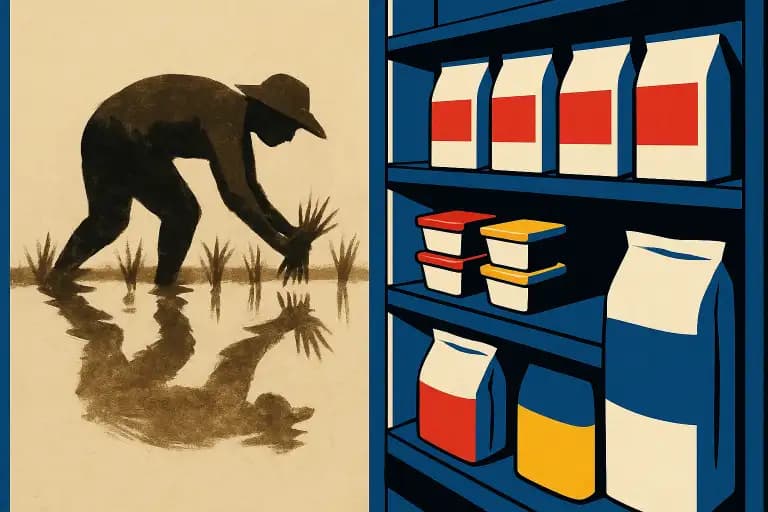
This autumn, a 20-kilogram sack of rice in Seoul markets costs more than 67,000 won — roughly a third higher than a year ago and the sharpest rise in over a decade. The increase has unsettled households, small restaurants and traditional brewers alike, while offering little relief to farmers squeezed by rising input costs.
Local coverage has attributed the surge to last year’s government decision to stockpile 260,000 tons of surplus rice and to the newly revised Grain Management Act, portraying these as triggers of today’s spike. Some reports have gone further, warning of a “Japan-style rice shock.” Yet stockpiling alone cannot explain why prices have moved so abruptly, nor why producers see scant benefit. The surge reflects a deeper imbalance: shrinking consumption, fragile production capacity, climate pressures and fragmented policy. Beyond the cost of a bowl of rice, the debate raises questions about Korea’s ability to safeguard its last self-sufficient staple.
Media Narratives: A Narrow Lens
Korean media outlets have largely framed this year’s price rise as a tale of government missteps. Headlines emphasise the Grain Management Act — revised earlier in 2025 after a political standoff — or last year’s stockpiling exercise, as if these measures alone had driven the rally. Some have even suggested that Korea is on the brink of a “Japan-style rice shock,” echoing Tokyo’s long struggle with rigid supply controls and abrupt price spikes.
Such framing is convenient but narrow. The revised law, due to take effect in 2026, does not mandate automatic government purchases. Its core mechanism is a supply-demand committee designed to pre-empt imbalances. Linking it directly to this year’s surge glosses over the fact that most provisions have yet to be implemented.
The Japan comparison is equally misleading. This year’s turbulence in Tokyo stemmed from decades of acreage reduction, a near-total ban on imports and typhoon damage — conditions that differ sharply from Korea’s system, which includes WTO-mandated imports and over a million tons in state reserves. The parallel may resonate politically, but it obscures more than it clarifies.
Equally absent in much of the coverage is the farmer’s position. Stories of 2,000-won rice bowls or shrinking restaurant margins dominate headlines, while the paradox facing farm households — rising output prices but falling net incomes due to fertiliser and labour costs — is rarely considered. By focusing solely on consumers, much of the press reduces a structural problem to a seasonal scare.
The Grain Management Act: Policy or Scapegoat?
The Grain Management Act has become a lightning rod in the rice debate. Originally tabled in 2023, it sought to require government purchases of surplus rice whenever production exceeded demand. The proposal won farm group support but was vetoed by the president, who warned of spiralling fiscal costs and chronic overproduction.
A revised version passed in early 2025 after months of negotiation. The compromise removed the automatic purchase clause and instead established a Grain Supply-Demand Committee. Its mandate is to anticipate imbalances and coordinate limited intervention before prices collapse. The new framework is scheduled to take effect in 2026.
Critics argue that even in its weaker form, the law risks encouraging overproduction in expectation of state support. They point to budgetary pressures and past cycles of surplus stockpiling. Supporters counter that without a credible safety net, small farms will continue to exit the sector, eroding the country’s last line of food self-sufficiency.
What is often overlooked is that the law’s impact will depend less on its legal text than on its execution. Timely intervention, accurate demand forecasting and disciplined release of reserves will determine whether the system cushions volatility or exacerbates it. At stake is not just short-term price stability but the survival of a production base central to Korea’s food security.
Production and Consumption: A Growing Imbalance
Rice production in Korea has been edging downward for years, shaped less by sudden shocks than by slow demographic and economic trends. Government data estimate the 2025 harvest at 3.57 million tons, slightly below the 3.70 million tons of 2023. The acreage under cultivation has contracted as ageing farmers leave the sector, while younger generations show little interest in taking up paddy farming.
At the same time, yields per hectare have improved modestly thanks to mechanisation and seed technology, masking the severity of the decline in land use. Without these gains, the fall in output would have been steeper. The long-term concern is not next year’s harvest but the gradual erosion of the production base.
Consumption has fallen even more steeply. Per capita rice intake slipped to 55.8 kilograms in 2024, the lowest on record and less than half of what Koreans ate in the 1980s. Dining habits have shifted toward bread, noodles and processed foods. Rice-based beverages and instant products have partially offset the decline, but overall demand has shrunk. Policymakers face the paradox of trying to curb output while also worrying about volatility.
This imbalance creates structural fragility. On paper, Korea produces more rice than it consumes — by an estimated 160,000 tons in 2025. In practice, mismatches in timing, distribution and quality create sudden shortages. Early-harvest varieties run out before mid- and late-season crops enter the market, while regional surpluses move slowly. The result is a market that appears oversupplied in aggregate yet can swing into scarcity within weeks.
2025 Price Surge: Layers of Stress
The sharp escalation of rice prices in 2025 reflects a confluence of cyclical and structural forces, rather than a single disruption.
Seasonal dislocations. Korea’s staggered harvest has always created temporary gaps. In September, early-season varieties had been depleted while mid- and late-season crops were still maturing. Under normal conditions, the gap narrows quickly. But thin reserves and heightened expectations encouraged speculative buying, turning a routine interval into a price shock.
Climatic and biological stress. Prolonged monsoon rains reduced photosynthetic efficiency and slowed grain filling, particularly in southern provinces. Outbreaks of brown planthopper and rice blast disease exacerbated local yield losses. National output declined only marginally, but regional disruptions constrained availability in wholesale markets, showing how sensitive distribution remains to modest environmental stress.
Policy-induced tightness. The government’s decision in late 2024 to withdraw 262,000 tons from circulation illustrates the limits of reactive intervention. Intended as a buffer against collapsing farmgate prices, it effectively lowered carryover stocks. By mid-2025, when demand strengthened, the absence of reserves amplified volatility.
Market dynamics. Anticipation of higher prices accelerated hoarding among traders and end-users, magnifying the imbalance. Food service operators reported a 30–40 per cent rise in raw grain costs within weeks, prompting menu changes and surcharges.
Distributional consequences. Downstream industries absorbed the shock unevenly. Restaurants passed costs to consumers, with rice bowls in Seoul routinely priced at 2,000 won. Traditional brewers, reliant on specific grades, suspended operations. Farmers faced a paradox: higher nominal farmgate prices but shrinking margins as fertiliser, pesticide and labour costs rose faster than output values.
Japan’s “Rice Shock”: Parallel or Red Herring?
The frequent invocation of a “Japan-style rice shock” in Korean media demands scrutiny. While the comparison has rhetorical force, its analytical value is limited.
Japan’s volatility is rooted in structural choices. For decades, Tokyo implemented acreage reduction programmes to manage surpluses while maintaining a near-total import ban. Combined with repeated typhoon damage and an ageing farm population, these policies created a brittle equilibrium. Retail prices exceeding ¥4,200 for five kilograms this year reflect those accumulated constraints.
Korea operates under markedly different conditions. WTO commitments oblige Seoul to import more than 400,000 tons annually, and national reserves typically exceed one million tons. These buffers, while imperfect, provide levers unavailable to Tokyo. Korea’s surge stems less from structural bans or decades-long acreage manipulation than from short-term supply gaps, pest outbreaks and policy sequencing missteps.
The Japan analogy obscures more than it illuminates. It frames Korea’s problem as an external inevitability rather than a set of domestic governance and adaptation challenges. The real lesson from Japan is not inevitability but the risk that rigid frameworks, when misaligned with shifting consumption and environmental realities, can turn manageable imbalances into chronic fragility.
Food Security: Beyond the Price of a Bowl
Beyond immediate price movements, the surge raises broader questions of food security. Rice remains Korea’s only staple grain where domestic production still covers national demand. Wheat and corn depend on imports for more than 95 per cent, leaving rice as the last bulwark of self-sufficiency.
That bulwark is weakening. Per capita consumption has halved since the 1980s, falling to 55.8 kilograms in 2024. The average rice farmer is now over 67 years old, with rural outmigration continuing. Mechanisation has supported productivity, but without generational renewal the base is eroding.
A food system cannot be judged solely by temporary price levels. Farmers are leaving rice not because it sells too cheaply, but because net incomes are unsustainable. Fertiliser and labour costs outpace output prices, and interventions remain reactive rather than anticipatory. Without stronger mechanisms — contract farming linked to demand forecasts, more efficient reserve management, and incentives for younger farmers — Korea risks hollowing out the sector that sustains food sovereignty.
Internationally, the stakes are higher. Climate volatility, export restrictions from major suppliers and geopolitical tensions all underscore the vulnerability of heavy import dependence. If Korea allows rice production to decline unchecked, it will lose not just a cultural staple but a strategic buffer in an uncertain global food market.
Food Security and the Cost of Neglect
Public debate over rice prices in Korea has been cast too narrowly as a clash between consumer burdens and government intervention. Headlines dwell on whether the Grain Management Act distorted the market or whether restaurants can still serve a bowl of rice at 2,000 won. But food security is not measured in retail menus. It depends on whether farmers can continue to cultivate the fields that sustain the national diet.
The data are sobering. Per capita rice consumption has fallen from nearly 120 kilograms in 1990 to 55.8 kilograms in 2024, with forecasts dropping below 50 within five years. Farm household incomes have declined by more than 30 per cent since 2020, eroded by rising fertiliser and labour costs. Research on eco-friendly farming suggests a potential 380,000-ton decline in output if subsidies are misaligned. And despite a million-ton reserve system, Korea’s grain self-sufficiency lingers below 50 per cent — among the lowest in the OECD.
In this context, blaming temporary spikes on the Grain Management Act misses the deeper crisis. The real question is how to sustain the one crop where Korea still achieves near self-sufficiency. Ignoring farm viability is not just an economic oversight but a strategic blind spot. In a climate era where vegetable prices already rival manufactured goods, reducing agriculture to a story of “consumer costs” is reckless.
Food does not originate in restaurants or retail aisles. Every bowl, every grain begins with farmers, who are asked to deliver stability under increasingly unstable conditions. If they cannot make a living, they will leave the land. Once that base erodes, Korea will face not a debate over rice bowls but the harder reality of whether it can secure staple food at all.
Journalism that frames the issue as “law versus consumers” abdicates its responsibility. The tougher questions remain: How can demand-based contracting prevent chronic surpluses and collapses? What institutional design ensures reserves are deployed effectively under climate stress? What balance between imports and self-sufficiency safeguards food sovereignty in an age of disrupted trade?
The scandal is not that rice prices are high. It is that the farmer — and by extension, the nation’s food security — has been treated as an afterthought.
The Weekly Breeze
Keep pace with Busan's deep narratives.
Delivered every Monday morning.