Nakdonggang Estuary: How Busan’s Growth Sacrificed Korea’s Largest Wetlands
Busan’s Nakdonggang estuary has lost 60% of its wetlands to development. Can sustainability still guide the city’s future?

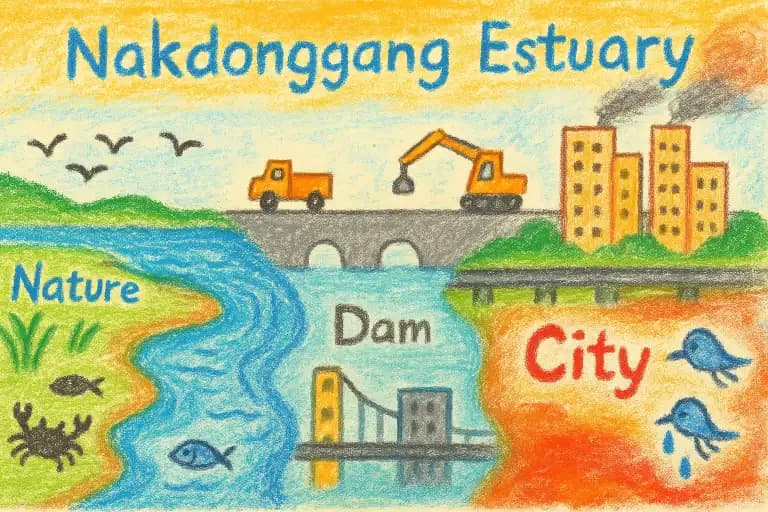
Busan, South Korea — On the tidal flats of the Nakdonggang River estuary, silence has replaced the once-deafening calls of migratory birds. Where winding coastlines once absorbed the ebb and flow of brackish water, today factories and apartment towers rise on reclaimed land. The estuary—once one of Korea’s richest ecological frontiers—has been reduced to fragments, its wetlands shrinking from more than 230 square kilometers in the 1960s to less than 90 today.
The decline was not sudden. It unfolded in stages: the 1987 construction of the Nakdonggang Estuary Barrage, decades of land reclamation for industrial zones and housing complexes, the building of Busan’s New Port, and now the construction of Eco Delta City—an “eco-smart” development whose very name belies its ecological cost. Each project came with warnings, studies, and reports, but always after the fact.
That is the paradox confronting Busan today. Environmental research institutions continue to release assessments documenting the damage—vanishing halophyte habitats, declining waterbird populations, stagnant waters increasingly vulnerable to algal blooms. Yet these reports read less like policy blueprints and more like epitaphs. They describe what has already been lost rather than preventing the next wave of destruction.
As Busan accelerates its westward expansion—new bridges across the estuary, subway extensions through newly built apartment districts, and a planned international airport on Gadukdo Island—the city faces a deeper question: can sustainability still be reclaimed, not as a slogan but as a design principle? Or will the Nakdonggang estuary stand as a case study in how development, left unchecked, devours the very ecological foundations that cities depend upon?
From Protected Monument to Reclaimed Frontier
The story of the Nakdonggang River estuary is not one of sudden catastrophe, but of incremental erosion. Each generation has witnessed a new layer of construction, a new justification for reshaping the landscape, and a new loss that was quietly accepted as the price of growth.
In 1966, the estuary was declared a protected natural monument. At the time, its wetlands stretched across more than 230 square kilometers, an expanse of tidal flats teeming with shellfish, fish, and migratory birds. Over the following decades, however, protection was chipped away. Through twelve separate rounds of deregulation and boundary changes, the designated area was steadily reduced. Today, less than 90 square kilometers remain—just over one-third of what was once safeguarded.
The turning point came in 1987 with the completion of the Nakdonggang Estuary Barrage, a massive structure built to prevent flooding, secure water for agriculture, and support industrial expansion. While it achieved its economic aims, the barrage cut off the estuary’s natural exchange of fresh and salt water. The result was a brackish ecosystem turned stagnant and increasingly freshwater, undermining the delicate balance on which fish nurseries, wetland plants, and migratory birds depended.
From there, reclamation projects gathered pace. In the 1990s, the tidal flats at Myeongji and Noksan were buried under soil to make way for industrial complexes and new housing districts. Busan’s New Port, launched in the 2000s, consumed still more coastal wetlands. What had once been a meandering shoreline was straightened into concrete embankments, leaving little space for the tides.
By the 2010s, the narrative of growth was unstoppable. Eco Delta City, planned as a “smart eco-city,” became the emblem of westward expansion. Covering nearly 12 square kilometers and designed for more than 70,000 residents, the project is marketed as sustainable innovation. Yet it stands on reclaimed land that once absorbed floods, stored carbon, and provided food for migratory birds.
Taken together, these developments represent not isolated projects but a cumulative transformation. Each decision—whether to build a barrage, reclaim a mudflat, or erect another bridge—was framed as progress. But over sixty years, the accumulation of such progress has left the Nakdonggang estuary fundamentally altered, its ecological resilience weakened, and its role as a natural buffer against climate extremes diminished.
Why Warnings Always Arrive Too Late
If the ecological decline of the Nakdonggang estuary has been visible for decades, why have warnings consistently arrived too late to prevent it? The answer lies not in a lack of data, but in the structural logic of development policy itself.
First, there is the sequence problem. In South Korea, as in many rapidly developing economies, the order has been fixed: approve development, conduct environmental impact assessments, then release reports documenting the harm. Assessments are fragmented, confined to individual projects rather than the broader system. The construction of the estuary barrage was evaluated in isolation, as was the reclamation of tidal flats for industrial complexes, as was the expansion of the port. What was never assessed was the cumulative impact of these interventions taken together.
Second, there is the financial driver. After the costly Four Major Rivers Project left the national water corporation, K-water, with heavy debt, development projects like Eco Delta City became not just urban planning ventures but also fiscal tools. The promise of selling housing plots and real estate offered a way to offset financial burdens. The result was a powerful incentive to frame reclamation and construction as “green growth,” even when the ecological costs were irreversible.
Third, there is the institutional limitation. Local research bodies, such as municipal institutes, have produced valuable reports documenting ecological decline: the collapse of halophyte habitats, the shrinking of migratory bird populations, the loss of agricultural land to apartment complexes. But these reports are descriptive rather than preventive. They lack the political leverage to halt or reshape projects once national or municipal development priorities are declared. In practice, they serve as documentation of losses already incurred.
Finally, there is the political economy of infrastructure. In west Busan, projects like subway undergrounding and new estuary bridges are justified as modernization. Yet closer inspection reveals they are driven by local constituencies—apartment complex residents demanding tunnels to avoid noise, politicians promising bridges as symbols of regional growth. Long-term sustainability, whether ecological or fiscal, takes a back seat to short-term electoral gain.
The result is a cycle in which development proceeds first, critique follows later, and sustainability becomes an afterthought. By the time a report concludes that bird populations have halved or wetlands have vanished, the bulldozers have already moved on to the next project. In this sense, the reports themselves become part of the cycle: not instruments of prevention, but post-mortems of an estuary steadily sacrificed to economic expediency.
When ‘Eco’ Becomes a Brand, Not a Blueprint
The contradictions of Busan’s westward expansion are perhaps most visible in Eco Delta City. Marketed as a “smart eco-city,” the project promises green innovation, advanced water management, and carbon-neutral design. In promotional brochures, renderings show sleek apartments framed by waterways and green spaces. Yet the land beneath these images tells a different story. Eco Delta City sits on what was once tidal flat—a living ecosystem that absorbed floods, filtered water, and fed migratory birds. Its very foundation is ecological loss.
The dissonance does not end there. Urban transport projects across the Nakdonggang estuary reveal a similar gap between rhetoric and reality. Subway extensions are described as sustainable mobility investments, yet many of the proposed underground segments were not conceived for system-wide efficiency but to appease residents of new apartment complexes. Noise and landscape preservation for specific constituencies outweighed broader questions of carbon reduction or integration with existing transport networks.
Bridges across the estuary are framed as regional connectors, vital for logistics and growth. Yet each new span further alters tidal flows, reshapes sediment patterns, and complicates future estuary restoration. Instead of strengthening the ecological resilience of the river system, these projects entrench dependency on concrete, asphalt, and cars.
Meanwhile, local research institutes continue to release reports documenting the collapse of bird habitats and the stagnation of estuarine waters. These studies are important records, but they function less as blueprints for action than as acknowledgments of what is already gone. They embody a strange paradox: institutions tasked with safeguarding sustainability have become chroniclers of its erosion.
The language of “eco,” “smart,” and “green” thus obscures the underlying trajectory. Far from representing a sustainable turn, these projects illustrate how environmental branding can mask an unsustainable core. The Nakdonggang estuary is not becoming greener. It is becoming narrower, harder, and less alive—even as it is packaged as a showcase for ecological design.
What Cannot Be Restored—and What Is at Stake
For the Nakdonggang estuary, certain thresholds have already been crossed. Reclaimed tidal flats will not return to their natural state; the soil has been buried under factories, apartment complexes, and port terminals. The meandering coastline has been straightened into concrete embankments, eliminating the subtle curves that once nurtured diverse habitats. Restoration, in the full sense of the word, is no longer possible.
The ecological consequences are measurable. Populations of wintering waterbirds, once numbering in the tens of thousands, have declined sharply. Halophyte meadows of Scirpus planiculmis, a critical food source for swans, have been reduced by more than two-thirds since 2005. With their foraging grounds diminished, birds are increasingly dependent on artificial feeding programs—an unsustainable crutch that underscores the collapse of natural systems.
The water itself tells the same story. Since the closure of the estuary barrage in 1987, flows have stagnated, salinity has shifted, and algal blooms have become recurrent. More recently, the risk of toxin exposure from these blooms has escalated, raising concerns not only for biodiversity but also for public health. In an estuary that once flushed itself through tidal exchange, water now lingers, trapped behind gates designed for flood control but inadvertently fostering ecological decline.
Climate change compounds these pressures. Rising sea levels, intensifying rainfall, and droughts all interact with an estuary already stripped of its natural buffers. Wetlands that once absorbed excess water and served as carbon sinks are gone, replaced by impervious surfaces that amplify flood risk. Far from fortifying the city against climate extremes, development has made Busan more vulnerable.
Yet development continues. New bridges promise greater connectivity, a planned international airport on Gadukdo Island looms on the horizon, and urban expansion westward shows no sign of slowing. The irony is stark: in the name of modernization, Busan is dismantling the very ecological defenses it will need most in the decades ahead.
Designing with Nature Before It’s Too Late
If full restoration of the Nakdonggang estuary is beyond reach, the question becomes: how can Busan embed sustainability into the design of what comes next? The answer lies not in nostalgia for what has been lost, but in a deliberate shift from after-the-fact assessments to before-the-fact design principles.
Operational change is the first step. The Nakdonggang Estuary Barrage does not have to remain a static structure. Adaptive management—partial and seasonal gate openings tied to tidal cycles and rainfall patterns—can restore some exchange between fresh and salt water. Such measures would not recreate the original estuary, but they could reintroduce brackish dynamics vital for fish nurseries, aquatic vegetation, and migratory birds. Defining key performance indicators (salinity ranges, sediment flows, biodiversity counts) would make sustainability measurable and accountable.
Institutional reform is equally crucial. Environmental impact assessments must evolve from project-level paperwork into system-level analysis. A Cumulative Impact Assessment (CIA) framework would evaluate the combined effects of ports, bridges, airports, and housing districts on the estuary as a whole. Without such a shift, piecemeal approvals will continue to erode ecological resilience in increments too small to stop, yet devastating in aggregate.
Design innovation must embrace nature, not fight it. Nature-Based Solutions (NBS) can be integrated into urban and transport planning: preserved wetlands as flood buffers, ecological corridors connecting remaining habitats, and vegetated zones that filter runoff before it reaches the river. Instead of treating these elements as optional landscaping, they must become core infrastructure, recognized for the climate defense services they provide.
Finally, governance and finance must align with sustainability goals. As long as public corporations depend on land development to offset deficits—as K-water has done since the Four Major Rivers Project—ecological priorities will remain secondary. Establishing dedicated ecological restoration funds, insulated from real estate pressures, would help correct this imbalance. Likewise, opening real-time data on water quality, bird populations, and sediment conditions to public access would democratize oversight and reduce the opacity that enables environmental neglect.
These measures will not bring back the estuary of the 1960s. But they can ensure that Busan’s future development does not repeat the same mistakes, and that sustainability becomes more than a marketing slogan. The choice is whether the next generation inherits a city designed for resilience—or one still governed by the inertia of short-term expediency.
The Estuary as Cautionary Tale, and a Choice for the Future
The trajectory of the Nakdonggang estuary offers lessons far beyond Busan. Around the world, coastal cities face the same dilemma: the drive for growth colliding with the limits of fragile ecosystems. From Jakarta’s sinking neighborhoods to the vanishing wetlands of the Mississippi Delta, the pattern repeats: development proceeds first, sustainability is considered later, and by the time reports are written, the damage is already locked in.
The lesson is not that environmental assessments are useless, but that they are insufficient when confined to the margins of policy. As long as sustainability is treated as an appendix—an afterword rather than a blueprint—cities will continue to sacrifice their most valuable ecological defenses in the name of progress. What Busan demonstrates is how quickly those defenses can vanish, and how difficult, even impossible, they are to restore once lost.
Yet there is another lesson here, too: adaptation remains possible, but only if the paradigm shifts. Embedding sustainability at the design stage, redefining infrastructure to include wetlands and buffers, and realigning public finance away from land-driven revenue models are not radical ideals. They are pragmatic necessities in an era of climate extremes.
For Busan, the choice is stark. It can continue down the current path, where “eco” cities are built on reclaimed mudflats and bridges multiply across a weakened estuary. Or it can learn from its own history and treat sustainability not as a marketing term but as the foundation of urban survival.
The estuary has already lost much of its voice—the tidal flats that once breathed, the birds that once filled the sky. What remains now is a decision about whether the city itself will find the foresight to survive. The Nakdonggang River cannot return to what it was, but Busan can still decide what it will become.
The Weekly Breeze
Keep pace with Busan's deep narratives.
Delivered every Monday morning.