Nuri’s Fourth Flight Signals a New Phase for Korea’s Space Program
South Korea’s Nuri rocket completed its fourth flight with a clean night launch, placing 13 satellites into orbit and supplying new data for the country’s reorganized space program.

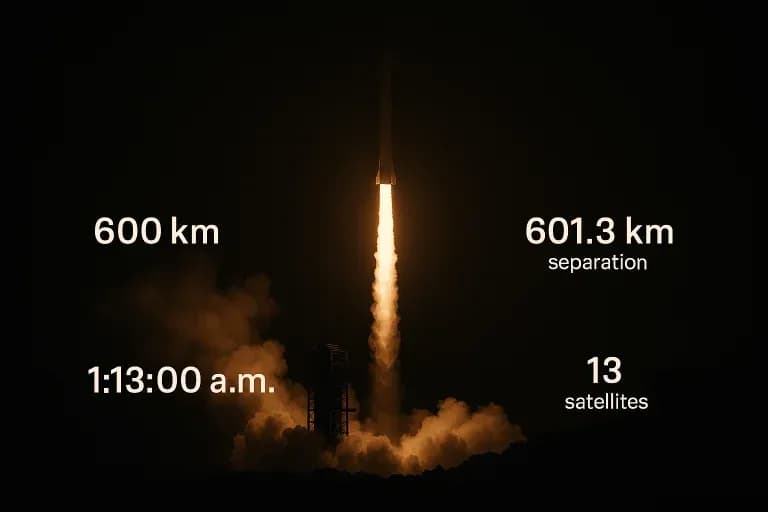
South Korea’s Nuri rocket has settled into a steady rhythm after several years of trial flights, and the latest mission showed how much the program has changed in a short time. The fourth launch, carried out with a vehicle built under a private contract for the first time, placed thirteen satellites into orbit and added another block of flight data to a program that now feeds directly into national planning. The shift in responsibility to a new space agency has also begun to reshape how decisions are made, replacing the patchwork oversight that carried the earlier stages of development.
Nuri’s Flight Record Becomes a Working System
South Korea’s Nuri rocket lifted off from the Naro Space Center at 1:13:00 a.m. on the morning of the fourth mission, climbing through a sequence that engineers have become familiar with over the past few years. The first-stage engines separated a little over two minutes into flight at an altitude of about 65 kilometers, followed by fairing release near 211 kilometers. The second stage completed its burn at around the four-minute mark, and the vehicle reached roughly 600 kilometers by the time the upper stage stabilized for payload deployment.
The mission unfolded without deviations. CAS500-3 separated at 601.3 kilometers about 790 seconds after launch, and the twelve CubeSats followed in order between the 813- and 914-second marks. Ground controllers at the South Pole’s King Sejong Station made the first contact with the primary satellite shortly before 2 a.m., confirming solar panel deployment and stable onboard systems. The smaller satellites are expected to check in over the next several passes, depending on their individual communication schedules.
This fourth flight represented more than another technical milestone. It was the first Nuri vehicle produced under the new arrangement that shifts assembly and integration work from the Korea Aerospace Research Institute to Hanwha Aerospace, which now manages the bulk of the build process. The launch showed that the production transition had not altered the rocket’s behavior—an important point, given that the same company will handle the next two missions scheduled through 2027. Officials involved in the flight noted that the handover allowed the institute to focus on development tasks while the new production line prepared vehicles for regular launches.
Nuri’s path to this point had a more tentative beginning. The 2021 debut flight climbed to the intended altitude but fell short on orbital velocity, a shortfall that engineers expected as they adjusted upper-stage performance. The follow-up in 2022 put a 1.3-ton test payload and several verification satellites into orbit, giving the country its first independently launched satellite and confirming the three-stage design. The third mission in 2023 carried eight satellites, one of them commercial, signaling that the vehicle had moved beyond a purely government research role.
The rocket’s design remains consistent: four 75-ton first-stage engines in a clustered arrangement, a vacuum-adapted engine of the same class on the second stage and a 7-ton upper-stage engine. The configuration lifts 1.5 to 1.9 tons into Sun-synchronous orbit, a segment comparable to India’s PSLV and Europe’s Vega system. Larger vehicles in Japan and the United States still carry heavier payloads, but Nuri’s stability across four flights places Korea in the group of nations able to operate a domestically built orbital launcher on a repeatable schedule.
Much of the attention on the 2025 mission focused on its payloads. CAS500-3 carried instruments for ionospheric and geomagnetic measurements, while the smaller spacecraft conducted tests on communication links, biomedical exposure and material durability. One of the satellites carried domestically produced components undergoing qualification for future commercial missions. With four flights complete and additional launches in preparation, Nuri has become a dependable platform for groups that once relied on foreign launch services to place their experimental hardware in orbit.
A Single Agency Takes Control of a Fragmented Program
South Korea’s space program operated for decades under a structure that left major decisions divided among several ministries, with the Korea Aerospace Research Institute carrying most of the engineering work. KARI built the satellites, ran sounding-rocket programs and led early launch-vehicle development, but it did so without the ability to steer long-term policy or coordinate industry involvement on its own. As missions became more complex, particularly after the early Nuri flights, the limits of this arrangement became clear to both engineers and policymakers.
By the time Nuri reached its second successful flight, discussions about restructuring had already gained momentum. Launch schedules depended on one ministry, satellite procurement on another, and exploration studies on a third. Programs that required multiyear funding often stalled as offices worked through separate approval paths. The issue resurfaced after the third mission in 2023, when the possibility of moving Nuri production to a private line made the absence of a unified authority even more visible.
The government addressed the structural gap in 2024 by creating the Korea AeroSpace Administration, a single agency intended to take over national launch programs, satellite development and long-range exploration planning. The agency opened its headquarters in Sacheon in May and began absorbing responsibilities that had been split across science, industry and transport portfolios. One of its early tasks was overseeing the transition of Nuri’s production to Hanwha Aerospace, which now handles the assembly and integration work for upcoming flights. KASA also became the point of contact for the companies supplying propulsion systems, avionics and satellite components.
The shift allowed program managers to place launch schedules, satellite readiness and industrial capacity within the same planning cycle for the first time. It also brought clarity to the next set of missions. Officials confirmed that two additional Nuri flights are slated through 2027, a timeline meant to raise reliability ahead of the heavier, reusable launcher now moving through development. The agency is using data accumulated from the first four missions—including detailed flight telemetry, staging performance and payload separation behavior—to finalize requirements for the next-generation vehicle.
KASA’s arrival did more than simply reassign responsibilities. It altered the pace of decisions that had previously moved through multiple ministries and gave program offices a single route for budget and contract approvals. The agency still works alongside KARI, which continues to handle major engineering tasks, but the direction of the national program now runs through a central institution rather than a loose network of them. That change has shaped both the 2027 launch sequence and the broader planning underway for the propulsion and landing systems required for Korea’s next launcher.
Funding and Strategy Shift Toward Bigger Missions
Government support for Korea’s space program changed direction as leadership shifted during the years surrounding the Nuri missions. The Yoon administration introduced long-range goals early in its term, including a Korean lunar landing in 2032 and a broader exploration roadmap that extended into the 2040s. These plans framed the country’s ambitions, but they came at a time when national R&D budgets were under pressure. Space projects continued, though often with smaller increases than program managers expected, and several development lines advanced more slowly than their technical roadmaps suggested.
The funding environment turned again in 2025. The first national R&D proposal submitted under the Lee Jae-myung administration included a sizable increase—more than 19 percent across major accounts—and the space agency’s allocation surpassed ₩1.1 trillion for the 2026 fiscal year. That level of funding allowed KASA to move beyond the maintenance phase that characterized some of the earlier years and begin preparing programs that had been on hold. The agency placed the final two Nuri missions, scheduled through 2027, on a firmer footing and began incorporating flight data from the 2025 launch into requirements for the heavier, reusable launcher expected later in the decade.
Work on that next-generation vehicle has become one of KASA’s central efforts. Engineers are testing propulsion systems and landing hardware that differ significantly from the architecture used in Nuri and will require new manufacturing processes. Some of the initial specifications draw directly on the performance margins observed during the fourth flight, including staging behavior and payload separation timing. The agency intends to use those measurements to refine the mass ranges and trajectories planned for the new launcher.
Satellite programs are unfolding in parallel. Development teams for the Korean Positioning System have been reviewing mission profiles for the regional navigation satellites expected to support aviation, maritime operations and ground mobility services. Several small-satellite constellations designed for Earth observation and communication have moved from concept to production planning, and spacecraft carrying experimental communication hardware—some linked to early 6G testing—are in preparation for upcoming missions. These lines of work had progressed unevenly in the past but now move with clearer budgeting and scheduling.
Exploration planning continues on a separate track. Engineers working on the lunar landing target have been refining propulsion and landing requirements while updating the overall mission timeline. Science teams involved in deep-space research have revived proposals for missions expected in the 2030s and 2040s, many of which depend on the next-generation launcher now under development. With programs spread across launch, satellite and exploration lines moving through the same budget cycle, the national plan has taken on an internal coherence that was difficult to achieve under the earlier multi-ministry structure.
The program now operates with clearer schedules, broader funding and a single agency directing the work that earlier moved through separate offices. Additional Nuri flights planned through 2027 will show how far the new structure can carry the system while engineers press ahead with propulsion and landing hardware for the next-generation launcher. For the first time, Korea’s space effort moves with the expectation of regular orbital missions instead of one-off demonstrations, supported by a framework built to handle the demands of heavier vehicles and more complex exploration plans.
The Weekly Breeze
Keep pace with Busan's deep narratives.
Delivered every Monday morning.