How Trump’s Insurrection Act Gambit Redefines U.S. Democracy and Federal Power
The Trump administration’s use of the Insurrection Act and National Guard reveals a deeper constitutional shift—how law itself becomes a tool of control.

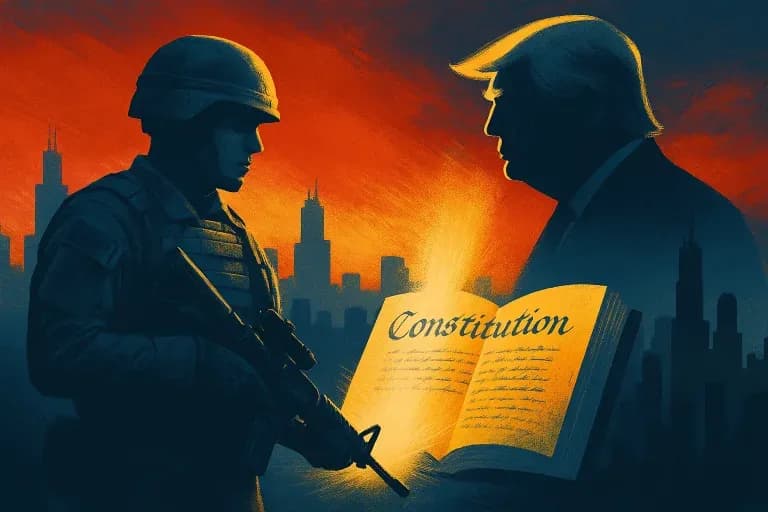
When Law Arrives in Uniform _ In Chicago, Trump’s use of the Insurrection Act turns domestic law enforcement into a constitutional experiment in real time.
In the early hours of October 7, 2025, convoys of the Texas National Guard entered the outskirts of Chicago under federal orders. The mission, described by the Trump administration as an “interstate law enforcement support operation,” marks the first time in modern history that one state’s troops have been deployed into another without its consent. The official justification — combating “migrant-related unrest” — masks a far more consequential act: a reinterpretation of constitutional authority under the Insurrection Act.
President Trump’s directive does not explicitly violate existing law. Instead, it exploits its ambiguities. The Insurrection Act of 1807, long dormant but never repealed, permits the president to use military forces within U.S. borders when “law enforcement becomes impracticable.” It is a clause that rests almost entirely on presidential discretion, a legal gray zone that expands whenever a leader decides to define disorder on his own terms. For decades, that discretion remained theoretical. This week, it became operational.
Across the country, the response has fractured along constitutional lines. In Oregon, a federal judge issued an injunction calling the planned deployment “untethered to the facts.” California’s governor, Gavin Newsom, vowed to sue, labeling the move “a federal intrusion.” Illinois governor J.B. Pritzker, facing the reality of foreign-state troops on his streets, framed the issue differently: “The law itself is being rewritten through its execution.” Legal scholars warn that these words are not rhetorical. The moment a president invokes the Insurrection Act — even by suggestion — the balance between civil authority and military command begins to shift, often in ways that courts can slow but not reverse.
What is unfolding in Chicago is more than a security operation. It is a constitutional experiment in real time, testing the elasticity of federal power and the endurance of judicial restraint. The soldiers on the ground represent not a rebellion suppressed, but a legal question enforced. And as convoys move deeper into the urban grid, the lines between legality, legitimacy, and loyalty grow less distinct — a reminder that in the United States, law itself can travel under orders.
How the Insurrection Act Became a Governing Tool
A deep look at how the Insurrection Act’s elastic clauses let the president expand authority under the guise of legality and order.
The Insurrection Act has existed in the American legal code for more than two centuries, a relic of the early republic designed to manage crises the Constitution could not yet imagine. Passed in 1807, the statute empowers the president to deploy federal troops domestically in cases of “rebellion,” “insurrection,” or when “law enforcement becomes impracticable.” For most of modern history, its invocation has been rare and politically perilous. Presidents have used it sparingly — Eisenhower in 1957 to enforce school desegregation in Little Rock, George H. W. Bush in 1992 to control the Los Angeles riots — each time emphasizing that military involvement in civil life is an exception, not a precedent.
The legal language that defines this authority is deceptively simple and dangerously elastic. While Section 251 allows deployment at the request of a state governor, Sections 252 and 253 permit unilateral action by the president when he deems ordinary law enforcement insufficient. There is no statutory requirement for congressional approval or prior judicial review. In practice, this means the president’s interpretation of “impracticable” or “rebellion” becomes law in the moment of decision. The courts can intervene only after the fact, and by then, troops are already in motion. Legal scholars often describe this as the most potent discretionary clause in U.S. statutory law — a provision that concentrates executive power precisely when democratic systems are most vulnerable.
Under President Trump, that discretion has become the centerpiece of a broader constitutional experiment. His advisers have argued that repeated civil unrest, mass migration, and local resistance to federal policy amount to a “systemic breakdown of law enforcement,” thereby justifying preemptive military assistance. By framing political opposition and civic protest within the vocabulary of disorder, the administration effectively recasts the Insurrection Act from an emergency statute into a standing instrument of governance. What had been a legal safeguard for extraordinary circumstances is being reinterpreted as an ongoing administrative tool — a way to normalize the presence of military authority in domestic affairs without formally declaring martial law.
The danger, as constitutional lawyers point out, is not merely that the law is being used, but that it is being absorbed into ordinary policy. The more the Insurrection Act is invoked or even threatened, the more it shifts from a legal exception to a political habit. Courts can issue injunctions, and Congress can express opposition, but neither institution can undo the precedent once it becomes practice. Each deployment — whether blocked, reduced, or delayed — extends the statute’s reach by reaffirming its existence. In this way, the Insurrection Act has evolved from a dormant emergency clause into a living mechanism of executive power, reshaping the boundary between civil authority and the command structure of the state.
Law as a Catalyst for Disorder
Analysts warn that Trump’s troop deployments turn unrest into justification, blurring protest with rebellion and dissent with crisis.
The deployment of National Guard units and federal enforcement agencies such as ICE has been framed by the administration as a necessary response to rising unrest near the southern border and in major urban centers. Yet behind the official narrative of “public order” lies a deliberate political design. Each deployment is not simply a reaction to disorder but a means of constructing it — a cycle in which federal intervention generates the very instability that later serves as its justification. Analysts within the RAND Corporation and the Brookings Institution have described this approach as a “self-fulfilling rebellion,” in which law enforcement becomes both the trigger and the rationale for expanded executive power.
The mechanism is subtle but measurable. By sending troops into states that explicitly oppose federal migration policy — California, Illinois, and Oregon among them — the administration ensures public demonstrations, legal challenges, and civil resistance. These reactions, once visible, can then be framed as evidence that local governments have lost control. Under this logic, civic protest becomes proof of governance failure, and governance failure becomes the legal threshold for invoking the Insurrection Act. The administration does not need chaos to erupt spontaneously; it only needs opposition to appear sufficiently organized to be defined as rebellion. In this sense, public order is not being defended but reclassified.
This strategy relies on a particular legal psychology — the ability to conflate political dissent with administrative breakdown. By redefining protests, policy resistance, or sanctuary initiatives as breaches of public safety, the federal government moves the debate from the realm of politics into the realm of security. Once a matter is classified as security, the executive gains almost unlimited discretion. This transition from policy disagreement to “security emergency” allows the White House to act unilaterally while framing its actions as reluctant necessity. The law, in this model, is not a constraint but a narrative tool — a text through which power explains itself.
Critics warn that such tactics erode the distinction between governance and control. When dissent itself becomes a trigger for emergency authority, the state’s capacity for self-correction diminishes. Every protest risks becoming a pretext for militarization, and every lawsuit becomes a signal for further intervention. What appears on the surface as a conflict between local and federal power is, at a deeper level, a feedback system: disorder invoked, authority expanded, and the law stretched to contain both. This cycle, if normalized, transforms legal governance into a permanent state of managed instability — a system in which provocation is not a byproduct of power, but one of its methods.
Courts as the New Battleground
Court injunctions now serve as the only brake on executive power — a slow constitutional war fought through time and procedure.
While troops move on the ground, the more decisive battle is unfolding in courtrooms. Federal judges in Oregon, Illinois, and California have become the first arbiters of a dispute that blurs the boundary between law enforcement and military power. Their injunctions and rulings — temporary, cautious, and procedural — now serve as the only functioning brake on executive expansion. In early October, a district court in Oregon blocked the federal deployment order, citing a “lack of factual basis” for the claim that local authorities had lost control. The ruling was narrow in scope, but its implications were vast: it reaffirmed that even in moments of emergency, presidential discretion remains subject to evidence and review. Within hours, the Department of Justice filed an appeal, arguing that “the President’s determinations under the Insurrection Act are not justiciable” — a phrase that signals a direct confrontation between executive immunity and judicial oversight.
The appeals now proceeding through multiple circuits illustrate a larger constitutional dilemma. The judiciary’s ability to restrain executive power depends not on the clarity of law but on the speed of litigation. Every injunction delays deployment; every appeal restores it. The law thus becomes a moving equilibrium, oscillating between enforcement and restraint. Legal scholars describe this as a form of “temporal warfare” — a contest over time rather than principle, where the faster branch of government effectively wins. The executive can act immediately, the courts only after action has begun. As a result, judicial victories often arrive after the facts have changed, turning legality into a retrospective exercise.
At the heart of this conflict is the question of reviewability. The administration’s argument — that decisions made under the Insurrection Act are inherently political and therefore beyond judicial reach — revives an old debate about the limits of the courts in matters of national security. If the courts accept this claim, the Act could effectively become self-justifying, immune from external scrutiny once invoked. If they reject it, the judiciary risks being drawn into direct opposition with the presidency, transforming legal procedure into a test of constitutional endurance. Either outcome pushes the American system into territory it has rarely entered: a live contest over who interprets the emergency powers of the state.
For now, the rulings remain fragmented. District judges issue temporary restraining orders; circuit courts weigh appeals; the Supreme Court stands in the distance, silent but inevitable. Each level of review adds legitimacy to the process but also time to the crisis. Legal observers warn that by the time a definitive decision reaches Washington, the political landscape may have shifted beyond judicial relevance. In this sense, the courts are both the last defense and a delayed one — guardians of the Constitution who must race against the speed of power itself. What began as a deployment order has become an experiment in the limits of adjudication, where the authority of the law is measured not only in its logic, but in its ability to act before the facts are rewritten.
The Governors’ Revolt
Governors challenge cross-state Guard deployments, framing their lawsuits as a defense of constitutional balance and state sovereignty.
Across the country, the political geography of the United States is beginning to resemble a map of constitutional stress points. The deployment of National Guard troops from Texas into Illinois and the federal mobilization orders affecting California and Oregon have transformed federalism from an administrative arrangement into a contest of authority. For the first time in decades, state executives are not merely opposing a president’s policy but directly challenging his interpretation of the law itself. The coordinated resistance led by governors Gavin Newsom and J.B. Pritzker has evolved from public dissent into a structured institutional response. Both leaders have threatened to withdraw from the National Governors Association (NGA), an act that would convert symbolic protest into a formal rupture within one of the last bipartisan organs of U.S. governance. Their argument is clear: when the association remains silent in the face of federal overreach, silence itself becomes complicity.
Behind these political gestures lies a deeper legal question — whether states retain any operational sovereignty once their own National Guard units are federalized or replaced by out-of-state forces. Under Title 32 of the U.S. Code, governors serve as commanders-in-chief of their Guard units unless those forces are activated under Title 10, which transfers control to the Department of Defense. Trump’s recent actions blur this distinction, asserting the right to deploy Guard troops across state lines under the Insurrection Act without the consent of the affected governors. Constitutional scholars note that such a maneuver effectively inverts the logic of federalism: the federal government now claims authority to override not just state policy, but state command structures themselves. The legal precedent, if upheld, would narrow the practical autonomy of states to a symbolic level.
The political consequences are already visible. Democratic-led states are coordinating legal challenges not only to specific troop movements but to the broader principle of unilateral federal deployment. California’s attorney general has initiated a multi-state lawsuit, arguing that the president’s actions violate both the Posse Comitatus Act and the constitutional guarantee of a republican form of government. The litigation, joined by Illinois, Oregon, and Washington, is less about immediate relief than about defining the limits of executive coercion. The governors’ coalition frames their opposition not as resistance to federal power per se, but as an act of constitutional stewardship — an attempt to preserve the balance between national defense and domestic self-government. Their strategy is procedural, not revolutionary, but its implications are systemic.
The confrontation now extends beyond the courtroom into the political architecture of the Union. The NGA’s threatened collapse signals the erosion of consensus-based governance at the intergovernmental level, while state legislatures in several regions are preparing resolutions reaffirming their authority over domestic security. For scholars of American constitutionalism, these developments mark the reemergence of a long-dormant question: whether the United States is a federation of governments or a hierarchy of command. If federal authority continues to expand through military channels, state sovereignty may survive only as rhetoric. In that sense, the governors’ revolt is not simply a political protest but a test of the republic’s structural coherence — a reminder that federalism, once broken, is far harder to restore than to erode.
South Korea’s Coup and America’s Constitutional Stress Test
A comparison of how South Korea’s institutions ended a coup by law — and how America’s slower checks could let power outpace justice.
When President Yoon Suk-yeol of South Korea declared martial law in December 2024, the constitutional crisis that followed was resolved not through force, but through procedure. Within hours, the National Assembly voted to nullify the decree under Article 77(5) of the Korean Constitution, which grants parliament the explicit power to terminate martial law by majority vote. The president, legally bound to comply, refused. Four months later, the Constitutional Court removed him from office, citing abuse of emergency powers and violation of civilian supremacy. The speed and clarity of this process were not accidental; they were designed into the post-authoritarian architecture of Korea’s democracy. Its legal framework assumes that crises will come — and therefore embeds a “single-switch” mechanism to restore normalcy before authority consolidates.
The American system operates differently. Its checks are numerous, but none are immediate. The Insurrection Act allows the president to act first and be challenged later, while the courts require time, evidence, and standing to intervene. Congress retains the theoretical power to revoke or amend the statute, but legislative action moves on a political calendar, not an emergency one. As a result, the U.S. design favors restraint over reaction, but at the cost of speed. Power can thus operate in the temporal space between action and adjudication — the very interval in which executive authority expands. In this structure, the Constitution is not a switch but a circuit: robust in theory, slow in practice, and vulnerable to overload.
Comparatively, South Korea’s response illustrates what constitutional theorists call “reflexive democracy” — a system able to self-correct within its own institutional logic. The United States, by contrast, represents “deliberative democracy,” whose strength lies in the dispersion of power but whose weakness is its procedural latency. The Korean model collapses crises through rapid institutional consensus; the American model absorbs them through prolonged legal negotiation. Neither system is superior by design, but their divergences reveal a central truth: in moments of constitutional stress, democracy depends less on the morality of leaders than on the mechanics of law. Where the law hesitates, power accumulates.
In both cases, the boundary between legality and legitimacy is the decisive frontier. Korea’s institutions acted as a unified organ, interpreting emergency as a threat to the system itself. The American institutions, more fragmented by design, interpret the same conditions as a test of endurance. This difference explains why Korea’s coup failed in days while America’s legal confrontation may endure for months. One system extinguishes emergency by statute; the other manages it by litigation. Both reveal, in opposite ways, how democracies survive their own exceptions — not by avoiding crises, but by determining who is allowed to end them.
Law, Power, and Precedent
As legal battles mount, experts see three paths — judicial restraint, executive dominance, or a cycle of perpetual legal ambiguity
The confrontation now unfolding between state authority and the federal executive has entered a phase where every action — judicial, military, or rhetorical — carries the weight of precedent. What happens next will not simply determine whether troops remain in Chicago or return to their bases in Texas. It will determine how American law interprets itself when tested by power. The path forward will not be defined by a single ruling or decision, but by a sequence of institutional reactions that either reinforce or erode the limits of executive authority.
If the lower courts maintain their current stance, reaffirming their jurisdiction over presidential determinations made under the Insurrection Act, the system will hold — though just barely. Such an outcome would reassert the judiciary’s role as a conditional brake, forcing the executive to justify every claim of emergency with evidence rather than assertion. Yet even in restraint, the precedent survives: that a president may invoke the Act preemptively, and only afterward be told to stop. The law, in this sense, would remain functional but not fully sovereign — capable of regulating action, but only after action has already reshaped the terrain it governs.
The more volatile path lies in the possibility that the courts decide otherwise, declaring the president’s determinations “nonjusticiable” — a political question beyond judicial review. This argument, now gaining quiet traction in conservative legal circles, would mark a subtle but profound redefinition of constitutional power. Once the judiciary withdraws from the field, the Insurrection Act ceases to be a statute constrained by oversight and becomes instead a self-executing instrument of command. The boundaries of emergency would then exist only within the president’s interpretation of them. Such an outcome would not announce dictatorship; it would legalize discretion — an expansion of authority justified by law’s own silence.
Between these poles lies the most likely course: a protracted cycle of appeals, injunctions, and partial deployments that turn legality into an evolving equilibrium. Each ruling temporarily shifts the balance, but none resolves it. In this environment, the law becomes elastic — not because it changes, but because it must constantly adjust to the pace of events. The longer the confrontation endures, the more each institution — courts, Congress, governors — adapts to uncertainty as a working condition. Stability, once a goal, becomes a rhythm; and that rhythm is sustained not by consensus, but by fatigue.
In the background of this procedural stalemate stands the Supreme Court, the final arbiter of an argument that has already redrawn the map of American governance. Whether it intervenes or waits, the Court’s eventual decision will not simply interpret a statute; it will define the relationship between emergency and democracy. For now, the United States exists in a suspended state — neither at war nor at peace, neither constitutional crisis nor constitutional routine. It is a republic in rehearsal, learning to govern itself through the choreography of uncertainty.
The Age of Managed Instability
In today’s America, law no longer restrains power — it hosts it. A democracy governed through crisis, precision, and exhaustion.
What is emerging in the United States is not the breakdown of law, but its reconfiguration. Power no longer seeks to escape legality; it seeks to inhabit it. The modern presidency has learned that it does not need to abolish the Constitution to command through it — it only needs to master its ambiguities. The Insurrection Act of 1807, once a dormant safeguard against chaos, has become the perfect vessel for this transformation: a legal framework that allows authority to expand precisely because it remains legal. Every court injunction, every appeal, every procedural delay becomes part of the choreography, not the opposition. The system resists, but in resisting, it adapts.
This is the logic of managed instability — a form of governance that maintains the appearance of legality while normalizing the rhythm of emergency. It is not dictatorship, but something subtler: a democracy that functions through permanent exception, in which uncertainty itself becomes a mode of control. Under this system, stability is not restored; it is administered. The courts issue rulings, the governors protest, the soldiers return and redeploy — and the cycle repeats, each time more routinized, less shocking, more plausible. The crisis becomes governance, and governance becomes the art of managing crisis.
The deeper danger is psychological rather than procedural. When the law is repeatedly bent but never broken, societies begin to forget the difference. Citizens adapt to ambiguity; institutions learn to perform resistance without expecting resolution. The vocabulary of outrage dulls into the language of protocol. Over time, legitimacy becomes less about whether power is justified, and more about whether it follows the correct form. In that sense, the erosion of democracy does not announce itself with violence — it arrives as administrative continuity.
Yet within this managed instability lies a paradoxical resilience. The same system that enables expansion also preserves resistance; each ruling, protest, and injunction becomes a small act of constitutional memory. The danger is not that democracy collapses, but that it becomes proceduralized — surviving through the very mechanisms that exhaust it. America’s crisis, then, is not the death of law but its overuse. The republic continues to function, but increasingly as an algorithm: a self-adjusting structure of rules that can absorb disorder without resolving it. It endures not because it restores order, but because it has learned how to live without it.
The convoys in Chicago will eventually withdraw, the lawsuits will conclude, and the news cycle will move on. Yet what remains is a new constitutional condition — a state of governance in which law and power have become indistinguishable in practice, if not in text. It is a system that promises protection through control, order through motion, legality through exhaustion. The United States has entered an era not of rebellion or reform, but of equilibrium maintained by tension — a republic sustained by its own instability, managed with precision, and mistaken for peace.
The Weekly Breeze
Keep pace with Busan's deep narratives.
Delivered every Monday morning.