Busan’s Nakdonggang River Parks Capture the Colors of Autumn
Autumn paints Busan’s Nakdonggang River parks in gold, white and pink as fields of cosmos, buckwheat and pink muhly bloom under a carefully managed ecological plan.

Busan, South Korea — Autumn comes quietly to Busan. Along the Nakdonggang River, the air turns dry, the light sharpens, and color begins to move through the floodplains. Yellow in the north, white near the middle, pink farther south where the bamboo stands. Families walk the river paths. Cyclists slow near the reed beds. A low wind carries the smell of mud and fading water.
The Nakdonggang River is Korea’s longest waterway, cutting through Busan before meeting the sea. What were once flood-control zones have become a connected chain of ecological parks—Hwamyeong, Samnak, Daejeo, and Eulsukdo—stretching more than twenty kilometers along the river. Each section serves a different rhythm of the season. The city’s Nakdonggang River Management Headquarters oversees them, planting seasonal flowers, trimming wetland grasses, and keeping the river margins open to both people and wildlife.
At Hwamyeong Ecological Park, a short walk from Gupo Station, fields of yellow cosmos fill the open ground near the lotus pond. The new kochia shrubs, planted in spring, are now turning deep red. By mid-October, the color will reach its peak. From a distance, the floodplain looks like a moving tapestry—bright, then dim, then bright again as clouds pass. The park sits between the levee and dense housing blocks, a small pocket of space where the city exhales.
Farther downstream, Samnak Ecological Park spreads wide across the middle of the river basin. Buckwheat flowers cover the bird feeding area, a white surface that moves like foam when the wind crosses it. The site serves both as landscape and habitat: its open layout supports migratory birds while offering space for families and cyclists. The Family Park zone, planted with rotating seasonal species, reflects Busan’s effort to make an engineered floodplain breathe like a living one.
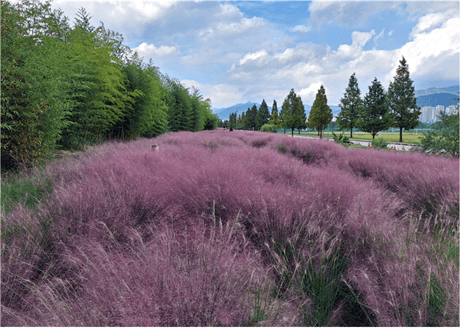
Across the river, Daejeo Ecological Park draws the largest crowds each autumn. About 14,000 square meters of pink muhly—Muhlenbergia capillaris—cover the fields near Parking Lot No. 2. In the afternoon light, the grass turns to rose mist, blurring the line between the bamboo trail and the riverbank. It looks effortless, but the management is deliberate. The city trims the muhly after flowering to stop seed dispersal and monitors soil changes every year. Officials argue the site’s width prevents crowding, a lesson learned after Eulsukdo removed its muhly field in 2020 due to ecological concerns. The result is a managed beauty—carefully maintained, openly debated, quietly controlled.
Downstream, the river slows near the estuary. Eulsukdo Ecological Park lies at the meeting point of freshwater and tide, part of the Nakdonggang River Estuary designated as Natural Monument No. 179. The wetlands here form one of the nation’s key habitats for migratory birds. Early in the morning, the sound of wings replaces the city’s traffic. The park’s walkways keep visitors above the reeds, allowing observation without intrusion. The Nakdonggang Estuary Eco Center coordinates research, education, and monitoring programs, keeping human presence secondary to the land’s rhythm.
Pink muhly, though beautiful, has become a national conversation. The National Institute of Ecology classifies the plant as a Level-2 Ecological Risk Species—meaning it is not invasive under law, but requires long-term observation. Studies suggest possible allelopathic effects, where its roots may suppress native species in certain soils. Yet in managed environments like Daejeo, the impact appears limited. Some local governments have begun phasing out the plant, replacing it with native alternatives that mirror its color palette without ecological risk. Busan continues to study the balance between attraction and caution.
“The goal is not to remove beauty, but to manage it responsibly,” said Kim Kyung-hee, director of the Nakdonggang River Management Headquarters. Maintenance crews cut the muhly in November, collect soil samples, and track seed movement along the levee. Signs remind visitors to stay on paths. The system is practical, not poetic—an attempt to hold tourism and ecology in the same frame without breaking either.
By late autumn, the color drains from the riverbanks. The pink turns gray. The wind grows colder, and the fields empty out. Birds arrive as people leave. In winter, these parks are almost bare, except for the sound of water under the bridges. But the structure remains—a network built to absorb floods, hold soil, and offer a margin of space where the city can slow down.
The Nakdonggang River no longer divides Busan; it anchors it. What began as an engineering project has become a landscape of negotiation—between water and land, management and chance, people and time. For a brief season, the parks show what that balance can look like: color without excess, beauty under watch, nature not as spectacle but as continuity.
The Weekly Breeze
Keep pace with Busan's deep narratives.
Delivered every Monday morning.