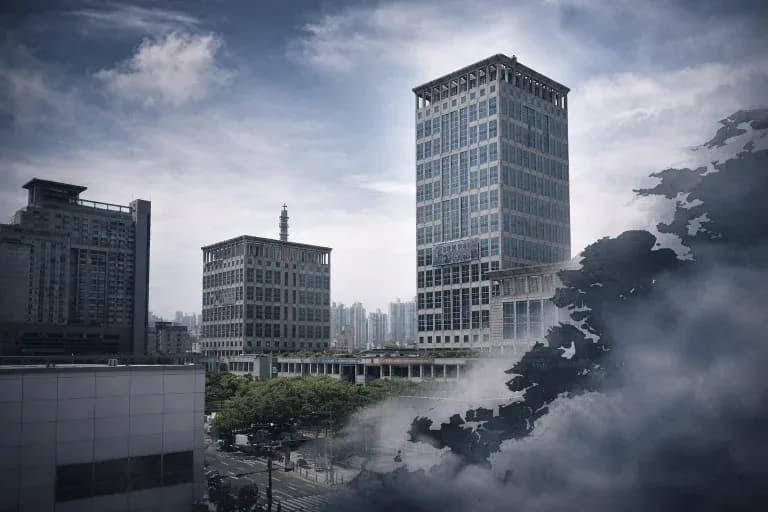
Busan’s Metropolitan Capacity Continues to Erode
Busan appears to be recovering as visitor numbers and participation metrics rise. Beneath these indicators, however, the city’s capacity to retain workers, sustain stable employment, and function as a metropolitan center continues to erode.

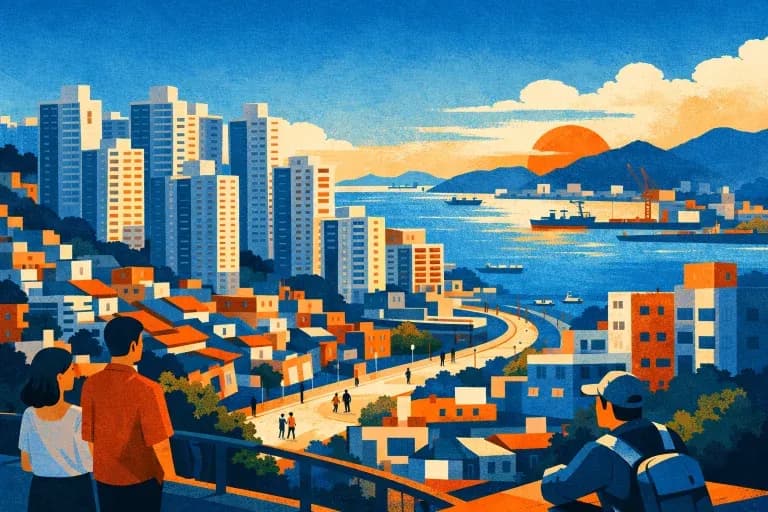
Busan appears busier than it has been in years. Visitor numbers are rising, living population indicators are expanding, and participation metrics tied to tourism, culture, and local programs now dominate official narratives of urban recovery. On the surface, the city seems to be regaining momentum.
Beneath these signals, however, metropolitan permanence has not recovered. The capacity to sustain long-term residence, stable employment, and productive urban life—the core functions of a metropolitan city—continues to erode. Increased circulation has failed to translate into durable settlement. What current indicators record is movement and activity, not the city’s ability to retain working-age residents, support continuous careers, or sustain stable urban communities.
The widening gap between heightened circulation and declining settlement capacity is not the product of demographic inevitability. It is the outcome of a planning framework that systematically misinterprets structural erosion as a shortage of activity rather than as a breakdown of metropolitan function.
Settlement capacity—the defining function of a metropolitan city—has continued to decline in Busan despite growing visibility. Retention of working-age populations, continuity of employment, and durability of residential life have weakened even as circulation intensifies. These trends point to a structural imbalance: policies that reward presence without commitment.
Administrative planning in Busan has increasingly addressed settlement loss through vitality-oriented tools. Living population strategies, workation centers, local creator programs, and tourism-led activation initiatives are presented as corrective mechanisms. In practice, they elevate presence over permanence.
Policies designed to manage short-term engagement have gradually displaced those required to restore production, employment stability, and residential continuity. In a metropolitan city, this substitution carries significant consequences.
Busan’s scale amplifies the effect. Historically structured around industrial labor, logistics, and dense settlement, the city now channels fiscal resources, planning attention, and institutional capacity toward programs optimized for immediate visibility. Meanwhile, the slower and more demanding work of rebuilding metropolitan function recedes from priority.
Circulation-Oriented Policy Architecture
Circulation-oriented governance has reshaped Busan’s policy hierarchy. Urban recovery is framed increasingly as the restoration of movement rather than the reconstruction of settlement. This shift has not occurred through a single initiative, but through the cumulative elevation of short-term engagement programs into the core of metropolitan strategy.
Workation centers, local creator initiatives, tourism activation schemes, and living population frameworks share a common logic. Each emphasizes entry, participation, and turnover. Performance is measured through utilization rates, visitor counts, program enrollment, and duration of stay. These metrics reward immediacy and visibility while remaining largely disconnected from employment continuity, wage formation, or residential permanence.
At the heart of this architecture lies policy misclassification. Instruments originally designed for peripheral or depopulating regions—where limited external activity may slow demographic decline—have been repurposed for a metropolitan city whose viability depends on sustained production and labor retention. In this context, transient engagement does not complement settlement capacity; it competes with it.
Budgetary structures reinforce the distortion. Circulation-oriented programs generate predictable outputs within short budget cycles and align easily with grant-based funding and annual performance reviews. By contrast, investments tied to industrial upgrading, career formation, and wage convergence require longer horizons and involve greater administrative risk. Over time, governance systems select for policies that demonstrate activity without altering economic structure.
Institutional fragmentation amplifies the effect. Multiple public agencies pursue parallel activation goals, each optimizing for participation-based indicators within its own mandate. Tourism bodies, urban regeneration units, youth programs, and innovation offices operate along adjacent tracks. Aggregate movement increases, yet no shared accountability exists for settlement outcomes.
Urban function erodes incrementally under this regime. Production-oriented populations—those whose careers, skills, and households anchor metropolitan life—receive diminishing policy attention. Housing affordability, employment stability, and industrial continuity are addressed indirectly, if at all. Meanwhile, transient populations are incorporated into performance accounting as proxies for vitality.
Convenience-Centered Urbanism and Spatial Substitution
Spatial planning reflects the same logic. Convenience-centered urbanism has emerged as the dominant physical expression of circulation-oriented governance in Busan. Planning priorities increasingly emphasize neighborhood accessibility, service proximity, and short-range mobility. Urban improvement is defined by ease of use rather than by productive capacity or settlement durability.
Fifteen-minute planning frameworks sit at the center of this shift. Designed to ensure daily services within walkable distance, these models privilege proximity metrics and lifestyle indicators. In Busan, they have been elevated to a flagship planning narrative despite physical and structural constraints that complicate their metropolitan application.
Topography and inherited urban form impose limits. Mountainous terrain fragments neighborhoods and constrains road networks. Industrial-era housing and infrastructure persist across inner districts, reflecting development patterns formed under earlier economic assumptions. These conditions restrict lateral connectivity and hinder the creation of continuous, self-sufficient living zones at scale.
As a result, improvement becomes selective. Areas with flat land, redevelopment potential, or recent investment absorb amenity upgrades, while aging inner-city districts experience relative decline. Accessibility expands unevenly, reinforcing fragmentation between new developments and established cores rather than restoring metropolitan coherence.
Functional substitution accompanies spatial adjustment. Planning attention concentrates on pedestrian access, amenity distribution, and localized service provision. The requirements of metropolitan life—employment density, industrial adjacency, and career mobility—receive diminishing emphasis. Neighborhood satisfaction may improve in isolated pockets, yet citywide productive capacity remains unresolved.
Housing-led development intensifies the imbalance. In the absence of robust industrial anchoring, spatial policy gravitates toward large-scale residential construction on available plains and reclaimed land. Apartment complexes emerge as visible markers of progress, driven by administrative feasibility and immediate output rather than integration with employment ecosystems. Settlement expands in form while weakening in substance.
Urban fragmentation deepens. New residential districts function as consumption-oriented enclaves with limited job integration. Aging cores lose permanent residents without gaining productive replacements. The city grows outward and upward, yet fails to consolidate the conditions required for durable urban life.
Administrative Convenience and Functional Decline
Administrative convenience has become a decisive organizing principle in Busan’s governance. Policy selection increasingly favors programs that are easy to design, quick to evaluate, and safe to defend within standardized performance frameworks. This preference has produced not structural recovery, but a gradual and measurable decline in metropolitan function.
Youth retention offers the clearest signal. Despite the expansion of vitality-oriented programs, working-age outmigration persists, particularly among early-career cohorts. Participation in short-term initiatives rarely converts into residential commitment. Existing policy instruments provide few mechanisms to transform temporary presence into long-term settlement.
Labor-market quality has deteriorated alongside increased activity. Employment growth concentrates in tourism, events, and short-cycle service sectors aligned with circulation-oriented policy. These sectors are characterized by wage compression, irregular contracts, and weak career ladders. For highly educated workers, professional continuity increasingly requires relocation rather than progression within the city.
Industrial capacity has thinned rather than diversified. Firm survival remains fragile. Headquarters and research-intensive functions show limited attachment. Entrepreneurial activity skews toward micro-scale consumption instead of scalable production. Innovation policy, fragmented across agencies, prioritizes branding and visibility over accumulation of industrial capability.
Institutional structures reinforce the imbalance. Public bodies operate with overlapping mandates—tourism activation, local creation, urban regeneration, youth engagement—each accountable for participation-based outputs. No single authority bears responsibility for settlement recovery, wage convergence, or industrial permanence. Functional outcomes disperse across organizational boundaries, unmanaged and effectively unowned.
Research and evaluation mechanisms have failed to correct course. Analytical capacity is often deployed after political decisions are made, validating preselected strategies rather than interrogating metropolitan relevance at the design stage. Evidence accumulates post-implementation, while policy replication substitutes for contextual diagnosis.
Budgetary incentives compound the distortion. Programs aligned with central-government grants and standardized templates receive priority, offering predictable short-term outputs. Long-horizon investments—industrial upgrading, labor-market restructuring, inner-city settlement recovery—entail greater uncertainty and weaker immediate visibility. Administrative risk aversion thus selects circulation over transformation.
2026 and the Question of Urban Choice
The approach of the 2026 local elections places Busan’s trajectory at a point of reckoning. Electoral cycles do more than select leadership; they reset priorities, performance metrics, and definitions of success. In Busan, the coming election arrives amid a widening gap between visible activity and metropolitan viability.
Recent governance has prioritized circulation as a substitute for settlement. Policies centered on vitality, convenience, and short-term engagement have expanded measurable movement while leaving core urban functions unresolved. Branding initiatives—from vague global aspirations to slogans such as “Busan is good”—have amplified visibility without clarifying direction. They signal a city increasingly defined by experience rather than by structure.
The electoral moment matters because it establishes the next planning baseline. Campaign narratives will emphasize livability, accessibility, and activation. These themes align easily with existing performance metrics. Yet a metropolitan city cannot sustain itself on ease of use alone. Without a parallel commitment to settlement capacity—employment stability, wage progression, and industrial continuity—such narratives risk reinforcing functional decline.
The choice facing Busan is structural rather than partisan. Continuation of circulation-oriented governance will further entrench a model optimized for visibility and short-term satisfaction. A shift toward function-centered governance would require reordering institutional priorities, consolidating fragmented agencies, and redefining success around retention and production rather than participation.
Cities do not fail because people stop visiting. They fail when those who could stay no longer choose to do so. The 2026 election will signal whether Busan continues to govern itself as a destination—or reclaims the permanence required to function as a metropolitan city.
The Weekly Breeze
Keep pace with Busan's deep narratives.
Delivered every Monday morning.