Busan to Host 2031 International Congress on Industrial and Applied Mathematics
Busan has been confirmed as the host of the 2031 International Congress on Industrial and Applied Mathematics. The six-day event at BEXCO will bring around 5,000 researchers, scientists, and industry professionals from more than fifty countries.

Busan, South Korea — Busan has been chosen to host the 2031 International Congress on Industrial and Applied Mathematics. The decision was made on September 13, 2025, at the council’s board meeting in Hanoi after a two-year selection process. Delegates weighed bids from three finalists—Busan, Boston and Brisbane—before confirming Busan as the next host after The Hague in 2027.
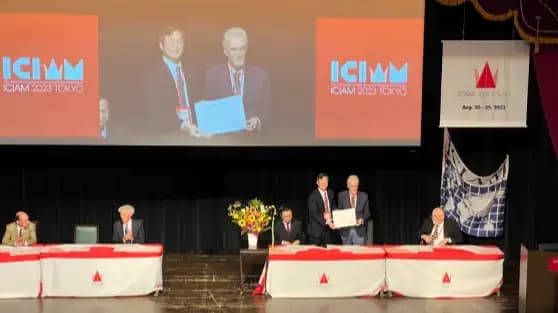
The congress, known as ICIAM, takes place once every four years and is regarded as the central gathering in applied and industrial mathematics. It began in Paris in 1987 and has since moved between major academic and industrial cities, including Washington, Hamburg, Sydney, Zurich, Vancouver, Beijing, Valencia and Tokyo. The most recent meeting took place in Tokyo in 2023, and The Hague is preparing for 2027. Attendance has typically been in the range of several thousand participants, most of them traveling internationally.
ICIAM is not a general mathematics gathering but a congress built around how mathematics is used in practice. It is run by the International Council for Industrial and Applied Mathematics, an umbrella body of national and regional societies. The meeting draws people who work on numerical methods and modeling, as well as engineers, scientists and industry specialists who apply those tools in areas such as energy, logistics, finance and health. The week usually combines large lectures with dozens of focused sessions and includes the presentation of international prizes in applied mathematics.
For 2031, the congress is scheduled for June 22 to 27 at BEXCO, Busan’s main convention complex. The facility offers large auditoriums, exhibition halls and parallel meeting rooms, and has hosted other international conferences of similar size. Organizers project about 5,000 participants from more than fifty countries.
The choice of Busan followed the usual ICIAM process. Candidate cities submitted preliminary bids in early 2024. Delegates then visited each location: Busan in December, Brisbane in February, and Boston in April. The board gathered in Hanoi the following September to make the final decision. The schedule had been clear from the start, and the process ran as expected.
For Korea, this will be the largest international mathematics meeting since the International Congress of Mathematicians took place in Seoul in 2014. Domestic societies, including the Korean Society for Industrial and Applied Mathematics and the National Institute for Mathematical Sciences, are expected to take the lead in preparing the program.
Applied mathematics reaches well beyond university departments. It shapes epidemic modeling, shipping routes, financial risk management and climate projections, and it is central to the design of new materials. For Busan, a port city whose economy is built on trade and logistics, the subjects discussed at the congress will connect directly to local industry, from port efficiency to energy systems and data-driven planning.
Preparations will now shift to forming local and scientific committees, setting the program, and coordinating with international societies. Each edition of ICIAM also hosts the awarding of several international prizes, which recognize advances in applied mathematics and its applications.
ICIAM has rotated among major academic centers for almost forty years. In 2031, that cycle will bring it to Busan, giving Korea another opportunity to host a large gathering of the global mathematics community.
The Weekly Breeze
Keep pace with Busan's deep narratives.
Delivered every Monday morning.