Busan Relocates Nakdonggang River Eco Cruise to Hwamyeong Pier
Busan has moved its Nakdonggang River Eco Cruise to Hwamyeong Pier as part of its plan to revitalize the city’s western waterfront. The new sunset route runs daily through March 2026.

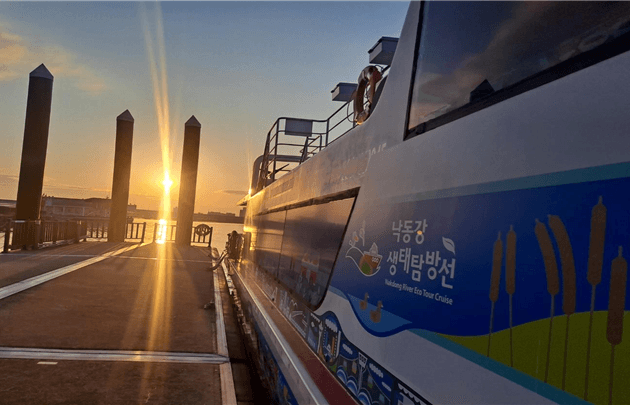
Busan, South Korea — The Nakdonggang River Eco Cruise, a small but symbolic part of Busan’s effort to reconnect with its river, will shift its operations to Hwamyeong Pier in November. The change follows navigation limits near Eulsukdo, where the lower section of the Nakdonggang is under cultural heritage protection through March next year.
For the next five months, the cruise will depart from Hwamyeong, on the east bank of the river, at 5 p.m. each day except Mondays and Tuesdays. The route runs about eight kilometers, passing under Daedong-Hwamyeong and Gupo bridges before returning to the pier after forty minutes. The Busan Tourism Organization will operate the “Noeul Tour” — literally “sunset tour” — free of charge between November 5 and 16 as a pilot, before beginning regular paid service on November 19. Fares are set at 7,000 won for adults, 5,000 won for youth and seniors, and 4,000 won for disabled passengers and veterans.
Season & Notes
Hwamyeong Pier
Thu–Sun · Route: Hwamyeong ⇄ Daedong-Hwamyeong Bridge ⇄ Gupo Bridge ⇄ Hwamyeong
| Run | Dep. | Arr. | Notes |
|---|---|---|---|
| #1 | 11:00 | 11:50 | Daytime |
| #2 | 14:00 | 14:50 | Daytime |
| #3 | 15:30 | 16:20 | Daytime |
| #4 | 17:00 | 17:40 | “Noeul Tour” (Sunset) |
Mulgeum Pier
Wed · Route: Mulgeum ⇄ Mulgeum area (round trip)
| Run | Dep. | Arr. | Notes |
|---|---|---|---|
| #1 | 11:00 | 11:50 | Daytime |
| #2 | 13:30 | 14:20 | Daytime |
| #3 | 15:00 | 15:50 | Daytime |
Fares
* ID / proof required for concessions. Schedule may change due to weather or operations.
Access
At first glance, the move looks procedural, the result of seasonal conservation rules. But within the city government, it is read as a larger signal — an attempt to give shape to a new western waterfront, one that mixes ecology, recreation, and remnants of industry. The Nakdonggang, Busan’s inland river and its longest waterway, divides the city’s industrial west from its residential east. From Hwamyeong’s side, the sun sets across the river, casting wide reflections over the bridges and low plains. From Gangseo on the opposite bank, the view is reversed: the light fades behind the land. Geography alone explains why the eastern edge of the river has become the stage for most of Busan’s ecological parks.
Hwamyeong Ecological Park, where the pier stands, is part of a sequence that runs south through Samnak, Daejeo, and Eulsukdo. Each park occupies what was once floodplain or undeveloped land, now restored with wetlands, trails, and observation decks. Together, they form what officials describe as the “Nakdonggang Ecological Belt,” a zone where restoration and urban use overlap. The new cruise is meant to extend that network onto the water, allowing visitors to see the city’s river corridor from the same level as its migratory birds and cyclists.
The area around Hwamyeong offers enough to fill a day without leaving the river. Visitors can walk or cycle through the ecological park, cross the pedestrian Noeul Bridge for a wide sunset view, or visit Gupo Market nearby. Downstream, Samnak Park’s open fields and birdwatching decks link to Eulsukdo’s wetlands at the river’s mouth. The city hopes that combining these sites with the cruise will increase visitor stays and help shift tourism toward Busan’s western districts, which remain less visited than its coastal neighborhoods.
The relocation also fits into a broader adjustment in how Busan manages its riverfront. Along the Nakdonggang’s east bank, Gangbyeon-daero carries trucks between industrial zones while cyclists ride on parallel paths beside them. Factories and logistics centers still dominate parts of the landscape, but the city has been steadily reclaiming the banks for public access. Hwamyeong, situated midway between dense residential blocks and reclaimed wetlands, has become a testing ground for this mixed urban ecology.
For officials at the Busan Tourism and MICE Bureau, the “Noeul Tour” is both a tourism product and a policy experiment. “The Nakdonggang is not just a river, it’s part of how the city breathes,” said director Kim Hyun-jae. “We want residents to experience the river as a place that belongs to daily life, not just a view from a bridge.” The bureau plans to monitor passenger demand during the trial run before extending operations into the winter season and exploring night cruises or local market collaborations.
The move reflects Busan’s longer-term attempt to rebalance tourism across its districts. For decades, most visitors have gathered along Haeundae and Gwangalli beaches, leaving the western side defined by transit lines, warehouses, and industrial sprawl. The Nakdonggang initiative offers a different approach — not competition with the coast, but contrast. The river is quieter, slower, and closer to the city’s interior rhythm. Its transformation into a tourism corridor suggests that Busan’s growth may no longer depend solely on the sea.
As dusk falls, the Hwamyeong pier hums with the sound of a small motor and the low murmur of passengers. The boat moves upriver, passing the steel arches of Gupo Bridge, where the water carries a faint reflection of orange light. When the cultural restriction lifts in March, Eulsukdo may reopen to boats, and the route could shift again. For now, the center of the river has moved north, where Busan’s plan for a more balanced city meets the evening current of the Nakdonggang.
The Weekly Breeze
Keep pace with Busan's deep narratives.
Delivered every Monday morning.