Busan Fireworks Festival Marks 20 Years With Expanded Show
Busan marks the 20th year of its fireworks festival this weekend with its largest show yet over Gwangalli Beach. About a million spectators are expected as more than 7,000 personnel are deployed to ensure a safe, orderly night along the waterfront.

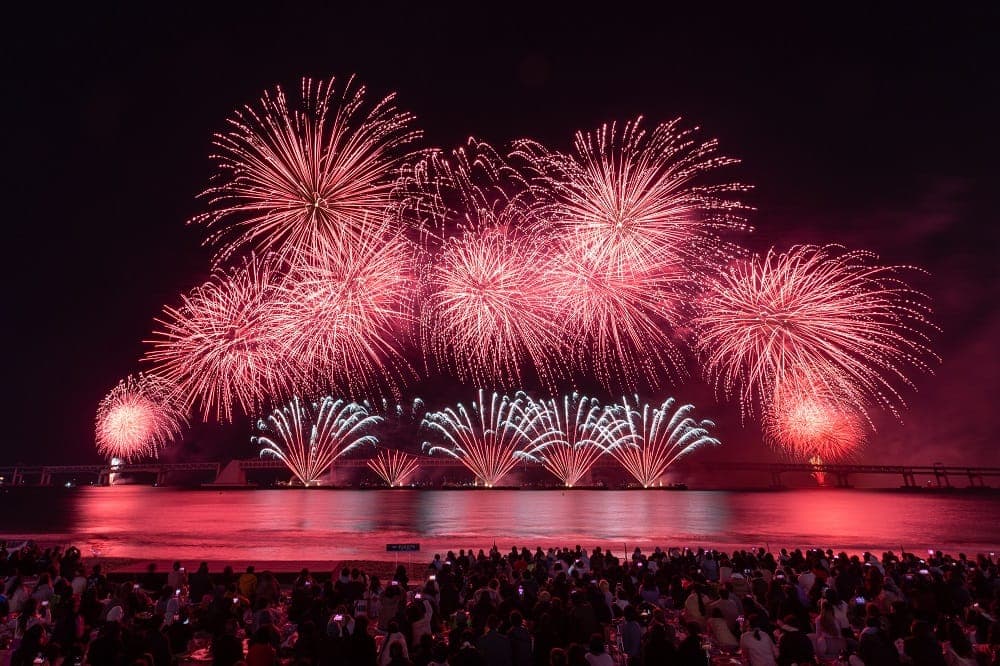
BUSAN, South Korea — Busan will celebrate the twentieth year of its signature fireworks festival this weekend, staging its largest and most technically ambitious show to date. The display, set for Saturday evening along Gwangalli Beach, Igidae and Dongbaekseom Island, is expected to draw about a million people and test the city’s capacity to manage one of the nation’s biggest public gatherings.
What began in 2005 as a side event to the APEC summit has grown into a defining part of Busan’s civic calendar. The festival has outlived its original diplomatic purpose and become a measure of how South Korea’s second city manages spectacle and safety in the same frame. This year’s edition, marking the event’s twentieth anniversary, is designed to show that scale can coexist with precision.
The program departs from previous two-act formats to include three main segments. The opening sequence, titled 20th Anniversary Celebration, pairs K-pop artist G-Dragon’s Übermensch with an AI-generated orchestral arrangement. A fifteen-minute international show by Japan’s Hibikiya Company follows, and the finale, produced by Hanwha Corporation under the theme Twenty Autumns, will unfold as a twenty-minute series of cascading and “catch-ball” effects that leap between barges and the Gwangandaegyo Bridge. Thirteen barges will be used this year—five more than in 2024—and the bridge’s upgraded lighting system will be synchronized with the fireworks for the first time.
City officials have made safety their dominant theme. More than seven thousand personnel from the police, fire and transit services will be deployed, supported by real-time monitoring across forty-two designated zones. Access to the beach will be suspended once capacity is reached, and aerial observation vehicles will track crowd density along the coastal road. Thirty-one ambulances and seven first-aid posts will stand by. Metro Line 2 trains will run every three to four minutes, and twenty-one bus routes will extend service until midnight. Sections of the Gwangandaegyo Bridge will close from mid-afternoon, while nearby roads will be sealed off earlier in the day.
Mayor Park Heong-joon said the administration would “remain on alert until the last visitor returns home,” calling public safety “a value that allows no compromise.” The comment reflects a wider caution in Korea since the Itaewon crowd crush in 2022, after which local governments tightened rules for large-scale gatherings. Busan’s control center now integrates feeds from more than two hundred cameras and uses algorithms to flag areas where movement slows or density spikes.
The festival’s economic footprint is substantial. About fourteen thousand paid seats have been arranged, with roughly five thousand expected to be purchased by foreign visitors—an increase over last year’s 4,400. The event supports Busan’s target of attracting three million international tourists this year, part of its drive to brand itself as a “global tourism hub.” Hotels in the Gwangalli area report near-full occupancy, and the city has sent inspectors to check price labeling and hygiene at local restaurants. A public hotline will operate through the weekend for consumer complaints.
Technically, this year’s show is also a demonstration of precision engineering. Hanwha’s pyrotechnic team says the digital firing system allows millisecond timing between barges spaced across the bay, producing what organizers describe as “a dialogue in light.” The upgraded bridge lighting will serve as a visual axis, pulsing in sequence with the music rather than simply framing it.
Environmental concerns have become part of the planning. Cleanup crews and volunteers will begin work as soon as the show ends, restoring the beach and surrounding roads before dawn. Residents have been asked to join a “take-your-trash-home” campaign to minimize waste, a practice the city has promoted at large events in recent years. Officials have not announced any air-quality monitoring for the evening, but environmental groups have urged the city to begin long-term measurement of particulate emissions from fireworks as part of its sustainability goals.
The festivities will start long before sunset. From 2 p.m., the beachfront will host Fireworks Street, with street performers and small exhibitions marking the festival’s history. At 6 p.m., messages from citizens will be projected across the Gwangandaegyo Bridge, followed by several short preview bursts before the main program begins at 7. The show will be broadcast live on Busan MBC, KNN television and radio, and the city’s YouTube channel.
For many residents, the event is both celebration and test. Vendors along the promenade began setting up early in the week, and police barriers now line the access roads. “We prepare for this like New Year’s Eve,” said one vendor selling grilled squid near the beach. “It’s busier every year, but people feel safer now that the city controls the flow.”
As the fireworks festival turns twenty, Busan is using the occasion to display more than pyrotechnics. The event has become an index of how a modern city balances exuberance with order—a performance as much about management as light. When the last bursts fade over the bridge on Saturday night, the measure of success may not be how bright the sky becomes, but how smoothly a million people make their way home.
The Weekly Breeze
Keep pace with Busan's deep narratives.
Delivered every Monday morning.