Quantum Computing: Separating Fact from Fiction
Quantum computing is a topic that has been capturing the imagination of people for decades. With its promise of solving problems that classical computers cannot and its potential to change the way we live and work, it's not surprising that there is a lot of hype and speculation surrounding this field. However, not all of what you may have heard about quantum computing is accurate. In this editorial, we aim to separate fact from fiction and provide a clearer understanding of what quantum computin


Quantum computing is a topic that has been capturing the imagination of people for decades. With its promise of solving problems that classical computers cannot and its potential to change the way we live and work, it's not surprising that there is a lot of hype and speculation surrounding this field. However, not all of what you may have heard about quantum computing is accurate. In this editorial, we aim to separate fact from fiction and provide a clearer understanding of what quantum computing is, what it can and cannot do, and what the future of this field may hold.
Myth 1: Quantum Computing Smartphones are Coming
It is often assumed that one day, we will all have quantum computing smartphones in our pockets. However, this is unlikely to happen anytime soon. Unless an everyday task is found that cannot be done efficiently with a classical computer, there is no real use for quantum computing smartphones. All conceivable everyday usage of smartphones are much more efficient with classical computing than quantum computing methods. The main use for quantum computing is to create better and better simulations of our natural world, to simulate and model quantum mechanics and quantum systems, and to push boundaries in areas such as physics, biology, chemistry, and medicine.
Myth 2: Quantum Computers are Just Better Classical Computers
Quantum computers are not simply better versions of classical computers. They operate using a wholly new way of computing that utilizes quantum phenomena such as superposition and entanglement to carry out computation. This new method of computing extends our current computing capabilities and is not just a newer version of your laptop 20 years down the line.
Myth 3: Quantum Supremacy
In 2019, Google claimed to have achieved "quantum supremacy" with their superconducting computer. However, this claim is controversial, and there is much debate over what quantum supremacy actually means. While the leaps and bounds made in the field of quantum computing are exciting and promising, it's important to keep in mind that this is an evolving field, and there is still much to learn and discover.
Myth 4: Parallel Processing in One System Using Multiple Universes
It is widely assumed that quantum computers operate by utilizing parallel processing in one system, making them faster than classical computers. However, this is not the case. A quantum computer does not try all answers in parallel and instantly pick the best one. Instead, it uses the concept of interference to cancel out the paths leading to a wrong answer and add up the paths leading to the right answer. This was accomplished in a quantum algorithm for factoring integers, known as Shor's Algorithm. The idea of parallel processing in one system assumes the many-worlds interpretation of quantum mechanics, but this is not widely accepted.
Myth 5: Quantum Computers are Just Faster Classical Computers
Quantum computers are not necessarily faster than classical computers. While there are speed-ups for specific problems, quantum computers are only faster than classical computers for some types of problems. It's important to understand that quantum computers have limitations and are not a one-size-fits-all solution.
Myth 6: Will Quantum Machines Become Conscious?
There is a persistent myth that quantum machines may become conscious. This idea is based on the assumption that consciousness is mysterious and quantum mechanics is mysterious, so maybe the two mysteries are connected. However, there is no scientific evidence to support this idea, and it is not considered a legitimate area of study within the field of quantum computing.
In conclusion, while quantum computing is a fascinating and promising field, it is important to separate fact from fiction and have a clear understanding of what it can and cannot do. By doing so, we can better appreciate the advancements made in this field
Continue this reporting
Reporting on the same issue
Related coverage selected from the article's desk, topics and newsroom relationships.
 NewsOct 19, 2026
What an Accurate Rainfall Forecast Can Still Miss
AI weather forecasts can capture where rain will fall while underestimating i...
 NewsOct 7, 2026
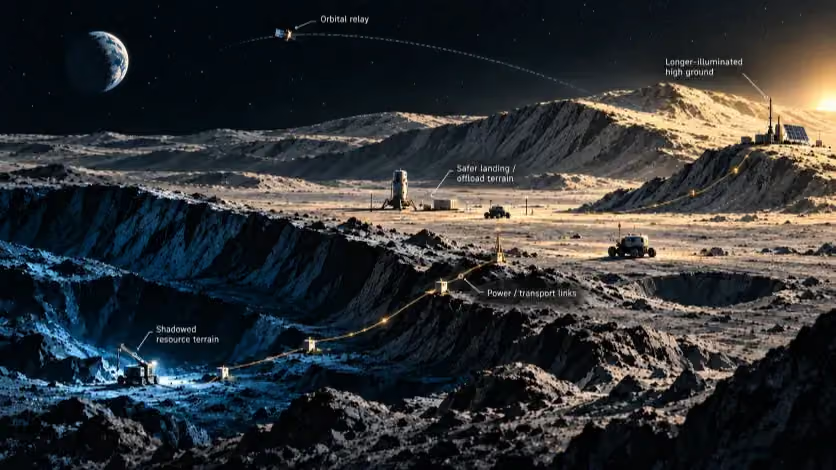
The Moon’s Industrial Future Begins With What Missions No Longer Need to Carry
Water, sunlight, safe landing terrain, communications and power do not natura...
 NewsOct 2, 2026
AI Is Reallocating the World’s Memory Factories
AI demand is forcing memory makers to decide how scarce DRAM capacity is divi...
More from the author
More from this byline
Stay with the same line of reporting through more work from this byline.
 NewsOct 9, 2026
Why “Busan Is Good” Falls Short as a City Brand
 NewsSep 18, 2026
The Other AI Race Is for the Freedom to Change Course
Reader Signal
Community readWhat did this report leave you with?
Choose the signal that best reflects your reading. Select it again to remove it.
One response per article
No response selected
A moderated conversation about the reporting.
One-level replies and newsroom moderation keep the conversation anchored to this article.
Discussion Status
Open
Please sign in to join the discussion.
Newsletter
Weekly reporting and context from Busan and Korea.