From Print to Prompt: AI and the Next Rewriting of Human Thought
Reading and writing were cultural technologies long before they became school skills. Print multiplied external memory, smartphones made it constantly reachable, and AI is now moving into the middle of thought itself.

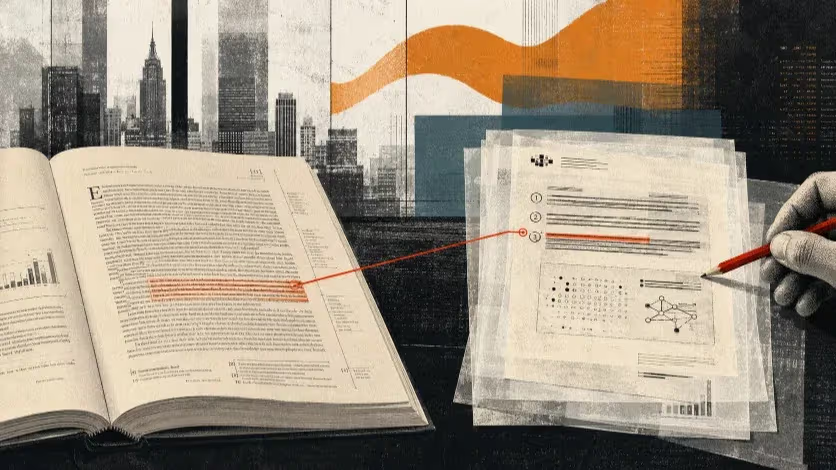
Reading and writing were cultural technologies long before they became school skills. Print multiplied external memory, smartphones made it constantly reachable, and AI is now moving into the middle of thought itself.
A reporter opening a 90-page regulatory filing no longer has to begin with the first page. She can ask a model to find the disputed clauses, compare the document with an earlier version, extract the fiscal claims and flag the paragraphs likely to carry the story. The PDF still sits on the screen. The first ordering of its meaning has already happened somewhere else.
A student assigned a difficult essay meets the same sequence in another form. A chatbot supplies the thesis, the background, the vocabulary and the likely criticism before the student has struggled through the argument. A researcher facing a new field can ask for the papers that matter first. A manager can ask for the risks in a report rather than read the report from the beginning. Across classrooms, newsrooms and offices, the first encounter with knowledge is moving from the source to a generated layer of interpretation.
The change is often described as a crisis of attention or a shortcut around reading. The deeper story is older and more consequential. Human beings did not evolve for books. Reading emerged when writing systems trained older visual and language circuits to handle marks on a surface. The page, the codex, the index, the footnote and the printed book were never natural homes for thought. They were artifacts that trained the brain to move through external symbols with discipline.
Writing placed memory outside the body. Books gave external thought a durable sequence. Print lowered the cost of copying that sequence and helped turn written language into public infrastructure. Search engines indexed the archive. Smartphones made the archive portable, social and continuous. AI now enters at a more intimate point in the chain. It does not merely help readers find text. It begins to interpret, rank, summarize and draft from text before the reader has made first contact.
The consequences reach beyond the familiar argument over paper and screens. Paper protected useful conditions: stable location, visible sequence, easy return and a slower path to judgment. Digital systems loosened those conditions while expanding access. AI changes the timing of interpretation itself. The reader no longer asks only where the source is. The reader receives an account of what the source means.
The central skill of the next reading culture may therefore shift from endurance alone to delegation. Strong readers will still need the patience to follow a long argument. The higher skill will be knowing when a machine’s map can save time, when it hides the terrain and when a claim must be reopened in the original before it can be owned.
Humans Were Not Born to Read
Modern arguments over reading often begin too late. They start with paper against screens, books against phones, attention against distraction. Those comparisons matter, but they treat reading as if it were an old human possession now being disturbed by newer machines. The history of the brain points in another direction.
Human beings evolved for speech long before they encountered alphabets, pages or printed books. Spoken language moves through bodies, voices, faces and shared situations. Reading asks the brain to do something stranger. It asks the eye to treat marks on a surface as language, memory, evidence and authority. No dedicated organ evolved for that task. Children have to be taught to read because the brain does not arrive with a ready-made circuit for letters, margins, footnotes or page numbers.
Neuroscientists often describe reading as an example of neural reuse. Older systems for vision, object recognition, sound and language become trained to cooperate around a cultural invention. The left ventral occipitotemporal cortex, often associated with visual word recognition, does not appear because evolution prepared human beings for print. It becomes specialized through exposure, instruction and practice. Reading, in that sense, is a cultural discipline installed on biological hardware.
That distinction changes the argument over AI. A machine summary does not invade a natural act. It enters a trained circuit that earlier artifacts already shaped. The scroll trained one pattern of memory. The codex trained another. Page numbers gave claims an address. Indexes made non-linear search possible inside a bounded object. Margins turned private reaction into a visible companion to the text. Footnotes created a disciplined route between assertion and support. Print did not merely carry language; it trained readers to move through language in particular ways.
The book became powerful because it stabilized the conditions around thought. A long argument could be held in sequence. A reader could return to an earlier passage without reconstructing the entire path. A claim could be located, copied, cited, disputed and taught. The physical object slowed the encounter enough for confusion to become part of understanding. Difficulty was not an accident of the old medium. Difficulty often marked the places where the reader’s mind was being asked to build a new relation among terms, evidence and judgment.
Schools built their authority around that discipline. A classroom did not simply give students texts. It trained them to remain with a text, to hold earlier claims in memory, to distinguish a paraphrase from a quotation, to move from summary to interpretation and to write in response. Literacy became an institutional achievement because the biological brain alone could not produce it. The page, the lesson, the assignment and the examination formed an environment in which the brain learned to treat written symbols as public thought.
The mistake in much contemporary debate lies in treating the printed book as the natural state of reading. The book was never natural. It was one of the most successful artifacts ever built for disciplining attention. Its success can make the later arrival of screens and AI look like a fall from an older human essence. A longer view suggests another pattern. Human beings keep building devices that move memory, language and judgment outside the body, then train themselves to recover those externalized forms as thought.
AI belongs inside that history, although it changes the pressure point. Earlier reading artifacts organized the text and the reader’s route through it. AI can organize the meaning before the reader begins. A page number tells the reader where a claim lives. A search engine tells the reader where related material may be found. A model can tell the reader what the claim means, why it matters, which passage appears central and how the argument might be summarized. The artifact no longer waits for the reader to perform the first ordering.
That shift does not make older reading skills obsolete. It raises their value in a different form. The ability to follow a long argument still matters because machine summaries tend to flatten sequence. The ability to locate a claim still matters because generated answers can detach statements from their supporting context. The ability to write after reading still matters because prose remains one of the main ways a person discovers whether a borrowed explanation has become an owned judgment.
Advanced literacy therefore cannot be defined as a return to paper alone. Paper preserved a set of conditions that mattered: sequence, location, return, delay and visible support. AI-era literacy has to recover those conditions without assuming the old artifact will remain the default interface for knowledge. The central problem is no longer whether the reader uses a screen, a book or a model. The problem is whether the reader still passes through the cognitive work that made reading a human skill: decoding, holding, comparing, doubting, returning and reformulating in one’s own language.
The brain will not evolve for AI on the timetable of a product cycle. Education, work and media systems will move much faster. They will decide which parts of the reading circuit remain practiced and which parts become optional. A culture that treats generated summaries as completed understanding will train one kind of mind. A culture that uses them as maps to be checked, resisted and rewritten will train another.
Writing Made Thought External
Reading cannot be understood apart from writing. The reader enters a system that began when human beings learned to place language outside the body. Speech disappears as it is spoken. Writing holds a sentence still long enough for it to be inspected, doubted, rearranged and carried beyond the moment that produced it.
That act changed more than communication. It changed the conditions under which thought could be formed. A spoken claim depends on memory, presence and social situation. A written claim can be removed from the speaker, placed beside another claim, copied into a record, marked in a margin, quoted in a dispute and returned to years later by someone the writer never met. Writing gave thought a surface.
The surface mattered. Once a thought could be seen, it could be worked on. A list could become an account. An account could become an argument. An argument could become a doctrine, a law, a poem, a scientific paper or a bureaucratic file. The mind no longer had to hold every relation internally. Marks on a surface could carry sequence, hierarchy, emphasis and contradiction. The page became a workspace where memory and judgment met.
Books extended that externalization. They did not merely gather pages. They arranged thought into navigable architecture. Chapters created sequence. Tables of contents previewed structure. Indexes allowed the reader to enter from the side. Footnotes connected claims to other claims. Bibliographies mapped intellectual ancestry. Margins left room for the reader to answer back. A book was not only a container for language. It was a machine for organizing return.
The discipline associated with reading grew from that architecture. A reader trained by books learned to hold a claim across distance, to remember where an idea first appeared, to notice when a later paragraph altered an earlier premise. The physical structure of the artifact helped the mental structure of the task. The reader did not merely decode words. The reader moved through an external arrangement of thought and rebuilt it internally.
Writing also changed the writer. A person who writes does not simply pour out a completed idea. The act of writing often produces the idea it appears to record. A sentence exposes a weak relation. A paragraph reveals that an example belongs elsewhere. A quotation forces a distinction. A revision shows that the first claim was too broad. Writing lets the mind meet its own unfinished form.
That slow confrontation has been central to intellectual work. Drafting, annotating, outlining, citing and revising are not decorative steps added after thinking. They are part of thinking. A draft gives judgment something to resist. A note preserves a half-formed connection before it disappears. A citation disciplines an assertion by tying it to a source. Revision turns private uncertainty into public structure.
AI enters this process at a delicate point. It can produce the outline before the writer has struggled with structure. It can smooth a paragraph before the writer has discovered why the paragraph resists order. It can generate a summary before the reader has felt which parts of the source are difficult. The assistance can be useful, especially when a task is too large, technical or urgent for unaided reading. Yet the tool intervenes inside the very process through which reading and writing have long trained thought.
The risk does not lie only in factual error or plagiarism. Those problems are visible enough to attract policy. A deeper risk appears when the machine removes the unfinished state too quickly. A fluent answer can arrive before the user has formed a question sharply enough to own it. A polished paragraph can conceal the absence of judgment. A summary can give the sensation of command before the reader has met the evidence that should complicate it.
The same feature also carries a promise. Used as a partner rather than a replacement, AI can make the external surface of thought more responsive. It can show alternative structures, expose missing assumptions, test a claim against possible objections and return a rough idea in a form the writer can attack. The value depends on whether the user treats the machine’s output as finished prose or as material for further thinking.
The older technologies of writing gave human beings a way to think with marks. AI gives them a way to think with generated replies. That change does not erase the need for writing. It changes where writing’s highest value may lie. In an environment where machines can produce acceptable sentences, the scarce human skill becomes the ability to use writing to recover judgment: to decide what the sentence should mean, what evidence it can bear and what claim the writer is prepared to defend.
Print Changed the Cost Structure of Knowledge
Writing gave thought an external surface. Print changed the cost of reproducing that surface.
Before movable type spread through Europe, a book carried the weight of labor embedded in each copy. A manuscript had to be written out, corrected, preserved and circulated through narrow channels of church, court, university or private patronage. Texts traveled, but slowly. Errors entered by hand. Access depended on location, wealth, language, institution and permission. The written artifact existed, yet scarcity shaped who could handle it and how far its authority could travel.
Printing altered that arrangement by changing the economics of text. A work could be reproduced in hundreds or thousands of copies with greater speed and relative uniformity. Readers separated by geography could encounter the same edition. Teachers could assign the same passage. Reformers could argue from the same pamphlet. Scientists could describe a method and expect distant readers to inspect it. Administrators could circulate rules, forms and proclamations in a more stable written form.
The cultural effects went beyond volume. Print helped turn written language into public infrastructure. Repeated editions pushed spelling, grammar and usage toward standard forms. Vernacular languages gained weight as vehicles for literature, religion, law and political argument. A local speech community could become a reading public. A reading public could become a market, a constituency or a nation. The printed page did not simply spread ideas already formed elsewhere. It helped create the conditions under which ideas could appear durable, shared and debatable.
Print also changed authority. A manuscript culture often tied knowledge to custody: the monastery, the scholar, the court, the archive, the teacher who possessed the text. Print loosened that custody. The author, publisher, printer, bookseller and reader entered a wider chain. A text could circulate beyond the institution that first held it. Commentary could answer commentary. Errors could be repeated more widely, but corrections could also travel. The same technology that stabilized knowledge also multiplied dispute.
That combination matters for any comparison with AI. Media revolutions rarely improve one human faculty in isolation. They change the social machinery around cognition. Print did not make every reader wiser. It lowered the cost of textual possession and changed the scale at which memory, argument and instruction could operate. The result included literacy, propaganda, scholarship, bureaucracy, religious conflict, standard languages and commercial publishing. The artifact opened possibilities. Institutions, markets and readers decided which possibilities became dominant.
The printed book then trained a particular image of serious knowledge. A strong argument appeared as a sequence of pages. A field could be entered through a textbook, a monograph, a journal issue or a reference work. Authority attached to authorship, citation, edition and publisher. A reader learned to trust the architecture: title, table of contents, chapter, note, bibliography, index. Knowledge had a physical and editorial shape.
That shape became so familiar that later technologies were judged against it. Radio seemed too fleeting. Television seemed too visual. The web seemed too scattered. Smartphones seemed too fragmentary. Each new medium appeared to threaten the discipline of the book because the book had made its own discipline feel natural. Yet print itself had once disrupted older forms of memory, teaching, copying and authority. The book was not the end of mediation. It was a powerful stage in mediation’s history.
AI should be compared with print at the level of cost structure rather than metaphor. Print lowered the cost of copying text. Search lowered the cost of locating text. Smartphones lowered the cost of reaching text at any hour and in almost any place. AI lowers another cost: the cost of producing an initial interpretation from text. It can turn a report into claims, a dispute into positions, a field into a reading list, a transcript into action items and a rough idea into publishable prose.
When a cost falls, behavior changes around it. Cheap print encouraged more reading publics, more pamphlets, more textbooks, more standardized language and more public argument. Cheap search encouraged skimming, comparison, retrieval and source-hopping. Cheap interpretation will encourage a different set of habits: asking before reading, summarizing before inspecting, drafting before thinking through structure, comparing before mastering the sources being compared.
The gain is real. AI can lower the entry barrier to difficult material. A non-specialist can approach a technical field. A reporter can triage a long filing. A student can ask for vocabulary before entering an unfamiliar essay. A researcher can map a debate before choosing what to read closely. Access expands when interpretation becomes cheaper.
The danger follows the same logic. Cheap interpretation can also make premature understanding feel adequate. A reader may receive the contour of an argument before encountering the argument’s sequence. A writer may receive a polished paragraph before discovering the relation the paragraph should express. A newsroom may identify the clause that matters without noticing the definition that limits it. A public conversation may move faster because summaries circulate before evidence has been inspected.
Print created a larger reading public by multiplying texts. AI may create a larger interpreting public by multiplying usable accounts of texts. The achievement should not be dismissed. More people may enter fields that once excluded them by language, expertise or time. Yet interpretation, like print, will not distribute its benefits evenly. Readers with background knowledge will use AI to test, compare and challenge. Readers without that discipline may receive fluency as authority.
The historical comparison cuts against both nostalgia and simple optimism. Print did not save thought by itself. It reorganized the conditions under which thought moved. AI will do the same at a deeper point in the process. The printed book changed who could hold a text. AI changes who, or what, first arranges the meaning of a text before a human reader takes responsibility for it.
Search and Smartphones Changed Access
Print multiplied texts. Search changed the reader’s route to them.
A printed book asked the reader to enter through an ordered front door: title, preface, chapter, page, note, index. The web opened side doors everywhere. A reader could arrive at a paragraph through a keyword, a quotation, a link, a dataset, a forum post or a fragment copied into another page. The authority of sequence weakened. The authority of retrieval grew.
Search engines trained a different habit from books. The reader no longer had to remember the full document, or even the title. A phrase, a name, a figure or a half-remembered claim could reopen the path. Knowledge became less dependent on possession and more dependent on location. The skilled reader learned to ask where a claim came from, which version ranked higher, which result repeated the same source and which page offered the primary record.
That habit expanded intelligence in practical ways. A reporter could compare a minister’s speech with the original budget line. A researcher could move from an abstract to a citation network. A citizen could check a public statistic against the agency table. A student could find a lecture, a paper, a glossary and a critique in the same session. Search made verification faster because it brought distant sources close.
The same architecture also changed memory. Readers began to remember paths as much as contents: the query that worked, the page that held the chart, the site that kept the archive, the search term that reopened the field. The mind did not simply store less. It stored differently. Internal recall became entangled with external retrieval.
Smartphones pushed that arrangement into ordinary life. Search no longer belonged to the desk, the library or the office. A phone placed the external archive in a pocket and made reading available in transit, in queues, between messages, during meals and inside conversations. The distance between uncertainty and lookup collapsed. A fact could be checked before a disagreement ended. A headline could be shared before an article was finished. A question could become a search before it became a thought.
The gain was enormous. Access widened. More people encountered more language, more news, more images, more arguments and more specialized knowledge than earlier media environments allowed. A worker could read a technical answer on a bus. A parent could look up a medical term in a waiting room. A student outside elite institutions could enter lectures, archives and translations that once required geography or status. The phone made public knowledge portable.
The cost came through the same door. Portability broke the boundary around reading. The screen that opened the article also carried the message, the map, the payment app, the camera, the game, the social feed and the next alert. Reading became easier to start and easier to abandon. A source could be checked quickly, then lost under ten other openings. The reader gained access while losing enclosure.
Feeds added another discipline. Books trained sequence. Search trained retrieval. Feeds trained readiness for interruption. Headlines, clips, captions, comments, charts and notifications arrived as a continuous stream of partial contexts. The reader learned to scan for relevance, emotional charge, social signal and novelty. Those skills are not trivial. Modern life requires rapid sorting. A person facing too much information must decide what deserves a second look.
Yet rapid sorting is not the same as judgment. A feed rewards the moment of recognition: familiar names, strong emotion, visible conflict, immediate usefulness. A long argument rewards the slower act of relation: how one claim depends on another, where the evidence narrows, which premise changes under pressure. Smartphones did not destroy the second skill by themselves. They made the first skill more frequent.
The result was a new cognitive bargain. Readers became better at entry and movement. They could reach more sources, compare more claims and share more knowledge. They also spent more time in fragments, moving between pieces before any one piece could become a stable structure. The web and the phone made the archive available; they did not supply a hierarchy for using it.
AI arrives after that bargain has already reshaped reading. It does not enter a quiet culture of books. It enters a culture trained by search results, tabs, snippets, dashboards, notifications and social feeds. The overloaded reader is older than the chatbot. The desire for a generated answer grows from an environment where the source is easy to find and hard to prioritize.
That background matters because AI can look like a cure for digital overload. A model can gather the scattered field, compress the links, name the dispute and present the relevant passages. For readers exhausted by search, the appeal is obvious. The machine promises to turn movement back into order.
Yet the order arrives with its own power. Search still asked the reader to choose among sources. A generated answer performs part of that choosing in advance. The reader sees a synthesis before seeing the materials from which the synthesis was built. The old skill of moving across sources gives way to a new skill: inspecting the path that the machine has already taken.
The smartphone made knowledge reachable anywhere. AI makes interpretation reachable before the source. Earlier tools reduced the distance between a person and a text. AI reduces the distance between a person and a usable account of a text. The shorter route can open difficult fields to more readers. It can also train readers to accept arrival before travel.
AI Is External Inference
AI does not arrive as another screen. It arrives as a reader before the reader.
A search engine points outward. It gives the user a list of possible paths: the agency page, the journal article, the court filing, the explainer, the dataset, the older version, the commentary that may or may not deserve attention. The burden remains visible. The reader still has to choose, compare, discard and return.
A generative model changes that order. It receives the question, crosses the available material, selects what appears relevant and returns an answer in prose. The user does not first meet a field of sources. The user meets an organized account. The answer may carry links or citations, but the first impression is no longer a map of possible routes. It is a claim about the route already taken.
That makes AI different from the earlier tools that surrounded reading. Writing externalized memory. Print multiplied memory. Search indexed memory. Smartphones made memory portable and continuous. AI begins to externalize inference. It does not simply help a reader find what has been written. It proposes what the written material means.
The change appears small in daily use because the interface feels conversational. A user asks for the argument of an article, the risk in a policy, the dispute in a legal filing, the difference between two scientific papers or the strongest objection to a draft. The model responds as if the early work of reading has already been done. It has ranked, compressed, translated, compared and arranged. The task that once unfolded inside the reader’s encounter with the source has moved into a generated reply.
The value should be taken seriously. Every major artifact in the history of reading solved a real human constraint. Writing helped memory survive the moment. Print helped texts survive scarcity. Search helped sources survive scale. Smartphones helped access survive distance. AI helps readers survive overload. It gives form to fields too large to cross unaided.
A dense report becomes enterable. A foreign-language document becomes usable. A technical dispute becomes less opaque. A student can ask for the terms before reading the essay. A reporter can locate the paragraphs that deserve human checking. A researcher can map a field before choosing which papers require slow attention. AI can lower the threshold of entry into knowledge that would otherwise remain locked behind expertise, time or language.
The danger begins in the same place as the usefulness. A machine that lowers the cost of entry can also lower the felt need for encounter. A generated answer can give the user enough structure to speak, write or decide before the source has imposed its resistance. The reader receives the shape of an argument without its sequence, the conclusion without the hesitation that produced it, the claim without the full weight of the evidence that limits it.
The problem reaches beyond error. A model can misstate a fact, attach a claim to the wrong source or rely on outdated material. Those failures matter, especially in news, policy, medicine and law. Yet a deeper change can occur even when the answer is broadly accurate. The model may remove the friction through which understanding usually forms. It can make a hard text feel handled before the reader has discovered why the text was hard.
Difficulty has an intellectual function. A confusing method section tells the reader where the claim narrows. A buried definition tells the lawyer where the obligation changes. A footnote tells the historian which archive carries the dispute. A table tells the policy analyst whether a headline number survives its denominator. A generated summary may mention those parts, but mention is not the same as encounter. The reader who meets the friction directly learns where judgment has to slow down.
AI also changes the location of authorship. A user who asks for a summary remains a reader. A user who asks for a memo, a paragraph, a comparison or a headline becomes something else: an editor of generated reasoning. The model supplies language that already carries emphasis, order and implication. The human task shifts from producing the first structure to deciding whether the structure can be used, revised or rejected.
That shift can raise the level of work for experts. A skilled user can ask a model to stress-test a claim, find missing cases, surface counterarguments, compare jurisdictions, translate jargon or expose assumptions. Used that way, AI becomes a pressure tool against the user’s own first reading. It can widen the field before the expert narrows it again.
The same tool can weaken work when users accept fluency as completion. A non-specialist may not know which caveat disappeared. A student may not notice that a summary has turned an author’s hesitation into a thesis. A manager may not see that the risk paragraph rests on a source adjacent to the question rather than responsive to it. A newsroom may treat a located passage as a verified claim before the document’s definitions and dates have been checked.
External inference requires a new discipline because it hides part of the route. A printed page showed its sequence. A search result showed its list. A generated answer presents a synthesis whose internal choices are harder to see. The reader must learn to ask what the answer selected, what it omitted, what it merged and what kind of source would change it.
AI makes interpretation cheaper. Cheap interpretation will change behavior, just as cheap print and cheap search changed behavior. More people will enter difficult domains. More drafts will appear. More summaries will circulate. More claims will sound ready before they have been earned. The culture that forms around AI will depend on whether readers treat generated interpretation as the end of reading or the beginning of a more demanding act of recovery.
The New High Skill Is Governing Delegation
The older ideal of literacy placed dignity in endurance. A strong reader could remain with a difficult text, follow the sequence of an argument, remember where a term first appeared and return to the passage where a claim turned. A strong writer could build a structure from notes, drafts, evidence and revision. Those abilities will not disappear. In many fields they will become more valuable because fewer people will practice them routinely.
AI changes the setting in which those abilities operate. The reader no longer faces only the source. The reader faces a source, a summary of the source, a comparison with other sources, a generated explanation, a draft paragraph and a recommendation about what matters. The old task was to understand the text. The new task is to decide which part of the encounter with the text can be delegated.
Call the emerging skill delegation literacy: the ability to know what can be safely outsourced to a machine, what must be inspected directly and what must be reclaimed before a judgment can be owned.
Delegation literacy begins with a distinction between entry and authority. AI can help a reader enter a field. It can define terms, identify the structure of a report, translate unfamiliar language and locate sections that deserve attention. Those uses lower the threshold of access. They do not confer authority. A generated map of a policy paper does not become the policy paper. A summary of a study does not become the study. A model’s comparison of two legal positions does not become legal reasoning until a human has checked the text, the date, the definitions and the consequences.
The expert reader will therefore use AI unevenly. She may use it broadly at the beginning and narrowly at the point of judgment. She may ask for a map, then ignore the map where the claim becomes consequential. She may let the model gather possible objections, then read the strongest objection in its original form. She may accept help with vocabulary, chronology or version comparison, but reopen the source before quoting, publishing or deciding.
That pattern reverses a common assumption about AI and expertise. The expert does not need AI because she knows less. She may use AI because she knows enough to distrust the first answer. Background knowledge lets her notice when a summary sounds too smooth, when a missing qualification matters, when a cited source is adjacent rather than responsive, when a comparison has merged two different categories. AI may become more powerful in expert hands precisely because experts know where not to believe it.
The novice faces a different risk. A generated answer can feel like a completed understanding because it supplies the shape that the novice cannot yet build alone. It names the thesis, explains the terms and offers a usable paragraph. The learner may never feel the resistance that teaches the structure of the field. The tool then performs not only the task, but part of the training that would have built the learner’s own judgment.
That risk does not justify a simple ban. Removing AI from learning environments would not restore an earlier reading culture. Students already live in an economy of search, feeds, snippets, subtitles, recommendation systems and generated answers. The better question is how to make the act of delegation visible. A student who uses AI to understand an essay should have to mark where the model helped, where the source complicated the model’s account and which sentence in the original resisted summary. The assignment should train recovery, not concealment.
Newsrooms face the same problem under deadline. AI-assisted document review can help reporters move through filings, transcripts, budgets and court records that would otherwise consume days. The danger comes when a passage surfaced by a model becomes a publishable claim without a return to the document. A newsroom can use machine triage, but it cannot outsource the chain of evidence. The published sentence still has to rest on a source that an editor can inspect.
Professional writing will change in a similar direction. A model can draft a memo, headline, brief, abstract or report section. The scarce skill becomes less the ability to produce acceptable prose on the first attempt and more the ability to decide whether the generated prose contains a defensible judgment. A polished paragraph may be grammatically sound and intellectually empty. A rough human sentence may carry the unresolved question that the final piece must answer. The writer’s work moves from fluency toward ownership.
Ownership becomes the moral center of AI-era writing. A person can ask a machine for language, but the final claim still needs a human who can explain it, defend it, revise it and accept responsibility for its consequences. The writer who cannot restate a generated sentence in her own terms does not yet own the sentence. The analyst who cannot trace a generated conclusion back to evidence does not yet own the conclusion. The editor who cannot distinguish machine inference from source assertion does not yet own the publication.
The highest form of reading may therefore become selective depth. The serious reader will not read everything slowly. The volume of documents makes that impossible. The serious reader will move quickly through low-stakes material, use AI to map unfamiliar terrain and reserve slow attention for the hinge points: the method, the definition, the number, the exception, the quotation, the footnote, the clause that changes the meaning of the whole.
Selective depth differs from skimming because it is accountable. Skimming moves quickly because attention is thin. Selective depth moves quickly because the reader has chosen where attention must thicken. It asks the reader to know which parts of a text can be compressed and which parts cannot survive compression.
That ability will increasingly separate expert readers from merely efficient ones. Efficiency values speed, coverage and output. Expertise values the location of uncertainty. The expert knows when an answer is good enough for orientation, when it is good enough for conversation and when it is not good enough for publication, policy, diagnosis, litigation, investment or teaching. AI makes those thresholds more important because it produces language that can travel before the underlying judgment is ready.
The next literacy divide will not separate people who use AI from people who refuse it. Refusal may preserve some older habits, but it will not define expertise in environments where AI-mediated reading becomes routine. The sharper divide will separate those who allow AI to complete the circuit from those who use AI to open the circuit and then close it themselves.
What Institutions Must Redesign
Delegation literacy will not emerge by telling people to be careful. The older reading culture was not built by advice alone. Schools, libraries, publishers, editors, exams and professions created routines that trained readers to handle written thought in disciplined ways. AI-mediated reading will need its own routines. Without them, convenience will become the curriculum.
Schools face the first test because students meet AI at the same time they are still building the circuits that reading and writing require. A ban treats AI as an external threat. Unrestricted use treats it as a neutral aid. Both approaches miss the central problem. The tool now enters the learning process at the point where students once struggled to form summaries, detect structure, find evidence and produce language of their own.
A serious classroom response would make that intervention visible. A student who asks a model to explain an essay should not be rewarded for hiding the step or punished simply for using it. The assignment should ask what the model captured, what it missed and where the original text resisted the summary. Students should mark the paragraph that changed their understanding, identify the caveat that disappeared in the generated account and rewrite one machine-made explanation in their own language after returning to the source.
That kind of task would not treat AI as a shortcut around reading. It would turn AI into an object of reading. The model’s answer becomes a draft interpretation that students have to inspect. The original text remains the authority, but the classroom now trains a second skill: reading the machine’s reading.
Writing instruction also has to change. If a model can produce a fluent paragraph, teachers can no longer treat fluency as the main evidence of thought. They will need to ask for traces of judgment: notes, source passages, rejected claims, revision histories, explanations of why one structure was chosen over another. A final essay may matter less as a finished product unless the student can show how the argument was built.
Newsrooms require a parallel redesign under greater pressure. Reporters already face documents too long, technical and numerous for older routines. AI can help scan budgets, court filings, regulatory papers, transcripts, procurement records and scientific reports. Used well, it can widen the scope of reporting by surfacing passages that would otherwise remain buried.
The newsroom rule should be clear: machine triage can guide reporting, but it cannot become the published chain of evidence. A model may point to the clause. A reporter must read the clause. A model may compare versions. An editor must know which version supports the published sentence. A model may draft a summary. The newsroom must distinguish source assertion, reporter interpretation and machine inference before the story goes out.
Publishers face a different but related challenge. Their traditional strength was never the fastest delivery of information. A serious book, journal, magazine or long essay earned authority by arranging a field: selecting evidence, sequencing argument, weighing disagreement and giving readers a durable structure. AI threatens the weaker forms of that authority because summaries and synthetic explanations can circulate before the publication itself is read. Yet AI may also increase the value of publications that make their evidence architecture visible.
A publisher designing for AI-era readers should assume that many readers will encounter a book or report through excerpts, search snippets, generated summaries, interviews and secondary accounts before they open the original. The publication must therefore make return easier. Notes should not function as decorative proof of scholarship. Data, sources, corrections, version histories and methodological limits should be easier to inspect across print and digital forms.
The strongest publications may become those that give readers more than prose. They will provide the path by which the prose can be tested. A policy report should make the table behind the headline figure accessible. A work of nonfiction should separate archival evidence from interpretation. A scientific publisher should help readers see method, limitation and replication status without flattening them into summary. A news feature should show where documents, interviews and analysis meet.
Platforms sit underneath all three institutions. Their design choices will train habits at scale. A model that answers smoothly while hiding quotation, paraphrase, uncertainty and source gaps teaches one form of reading. A model that makes the path back to passages visible teaches another. The interface matters because readers often follow the path of least friction. If the path to another summary is easier than the path to the source, the system will train movement away from evidence.
AI reading systems should therefore be judged by more than speed, fluency and user satisfaction. They should be judged by how well they preserve the user’s ability to inspect the answer. Does the system show which sentence is quoted and which is paraphrased? Does it mark inference separately from source claim? Does it show date, version and context? Does it make a contrary source easier to find? Does it invite the user to reopen the passage where the judgment depends?
Those questions may sound technical, but they are cultural. The codex, the index, the footnote and the bibliography once trained readers by giving knowledge a navigable shape. AI interfaces will train readers too. They will decide whether generated interpretation becomes an opaque surface or a map with recoverable routes.
Institutions should resist the temptation to frame the issue as a choice between old reading and new tools. The older reading culture was itself a tool culture. It built habits around artifacts that once seemed artificial and later felt natural. The task now is not to restore the book as the only serious form of thought. The task is to carry forward the discipline the book helped train: return, sequence, evidence, revision and responsibility.
The Page Trained One Discipline. The Prompt Requires Another.
The future of reading will not be decided by a return to the old page or by surrender to the prompt. Both stories are too small for the change now under way.
The printed page will remain one of the strongest environments ever built for sustained attention. It holds language still. It gives a claim a location. It makes sequence visible and return cheap. It slows the reader enough for difficulty to become productive. Those qualities still matter, and the readers who retain them will carry an advantage into any medium that follows.
Yet the page cannot remain the default interface for all serious knowledge. Public life now begins in forms the book was not built to contain: live filings, data dashboards, preprints, transcripts, regulatory updates, code repositories, satellite images, social feeds, machine translations and AI-generated summaries. The older discipline of reading has to survive in environments that do not look like the older artifact.
Human beings were not born into books. They built books, then trained themselves around them. The page became natural only after institutions, professions and habits made it feel that way. AI will follow the same pattern unless schools, newsrooms, publishers and platforms intervene deliberately. The tool will not merely serve an existing reading culture. It will help train the next one.
The crucial question is which parts of thought that culture will still ask human beings to perform.
A model can summarize a report. It cannot decide which claim a journalist should publish. A model can draft a paragraph. It cannot make the writer responsible for the judgment inside it. A model can compare papers. It cannot know which methodological limit should change a field’s confidence. A model can point to the source. It cannot substitute for the reader’s encounter with the passage where meaning turns.
The new scarcity will not be access. Access has been expanding for centuries: writing moved memory outside the body, print multiplied texts, search indexed them, smartphones made them portable and AI now renders them conversational. The scarce ability will be recovery. Readers will need to recover the source from the summary, the evidence from the claim, the uncertainty from the fluent answer and their own judgment from the language a machine has made available.
That ability will not belong only to scholars. It will matter in ordinary civic life. A patient reading a medical explanation, a voter reading a policy promise, a parent reading school guidance, a worker reading a contract, a citizen reading a breaking-news summary and a student reading an assigned essay will all face the same hidden decision: whether the generated account is enough, or whether the claim now carries enough consequence to require return.
Earlier reading cultures trained that decision through friction. A reader had to turn the page, follow the chapter, copy the quotation, check the note, write the summary and revise the draft. AI can remove much of that friction. Some of the removal will be liberating. Much human effort has been spent on finding, formatting, translating and rephrasing material before real judgment could begin. Removing that burden can widen access to difficult knowledge.
The danger appears when all friction is treated as waste. Some resistance protects thought. The pause before a definition, the struggle with a method, the awkwardness of a first draft, the need to restate an argument in one’s own terms — these moments are not inefficiencies left over from the print age. They are part of how understanding becomes accountable.
The next reading culture will therefore have to distinguish between friction that blocks access and friction that builds judgment. AI should remove the first kind. It should not erase the second by accident.
That distinction gives institutions their task. Schools should not ask students merely to avoid AI or use it more efficiently. They should teach students to audit machine interpretations against difficult passages and to show where their own judgment formed. Newsrooms should use AI to widen document work while keeping a visible path from published sentence to source record. Publishers should make the architecture of evidence easier to inspect when readers arrive through search, snippets and generated summaries. Platforms should design AI interfaces that show quotation, paraphrase, inference, uncertainty, date and source gap rather than hiding them inside polished prose.
The page trained one discipline by holding text in place. The prompt requires another discipline because it moves so quickly from request to answer. The reader has to supply what the interface no longer guarantees: delay, return, suspicion, context and ownership.
AI will not end reading. It will change where reading begins and where judgment must be recovered. The strongest readers will not be those who reject machine help, nor those who accept it as completed understanding. They will be the readers who know how to use generated interpretation as an entrance without letting it become the destination.
Reading after the page will be faster, more assisted and less linear. It may also become more demanding. The human task will shift from reaching information to governing the route by which information becomes belief, language and action. In that shift, literacy will no longer mean only the ability to read and write. It will mean the ability to decide which parts of thinking can be delegated, which must be inspected and which must finally be reclaimed.
Continue this reporting
Reporting on the same issue
Related coverage selected from the article's desk, topics and newsroom relationships.
 NewsOct 19, 2026
What an Accurate Rainfall Forecast Can Still Miss
AI weather forecasts can capture where rain will fall while underestimating i...
 NewsOct 7, 2026
The Moon’s Industrial Future Begins With What Missions No Longer Need to Carry
Water, sunlight, safe landing terrain, communications and power do not natura...
 NewsOct 2, 2026
AI Is Reallocating the World’s Memory Factories
AI demand is forcing memory makers to decide how scarce DRAM capacity is divi...
More from the author
More from this byline
Stay with the same line of reporting through more work from this byline.
 NewsSep 16, 2026
Busan’s Young-Adult Migration Turns Sharply at 25–29

Reader Signal
Community readWhat did this report leave you with?
Choose the signal that best reflects your reading. Select it again to remove it.
One response per article
No response selected
A moderated conversation about the reporting.
One-level replies and newsroom moderation keep the conversation anchored to this article.
Discussion Status
Open
Please sign in to join the discussion.
Newsletter
Weekly reporting and context from Busan and Korea.