Busan’s AI Traffic Plan and the Reality of Smart Traffic Systems
From adaptive signal control and smart intersections to reinforcement learning and predictive traffic management, the real story is not whether cities mention AI, but whether they have built the infrastructure to use it.

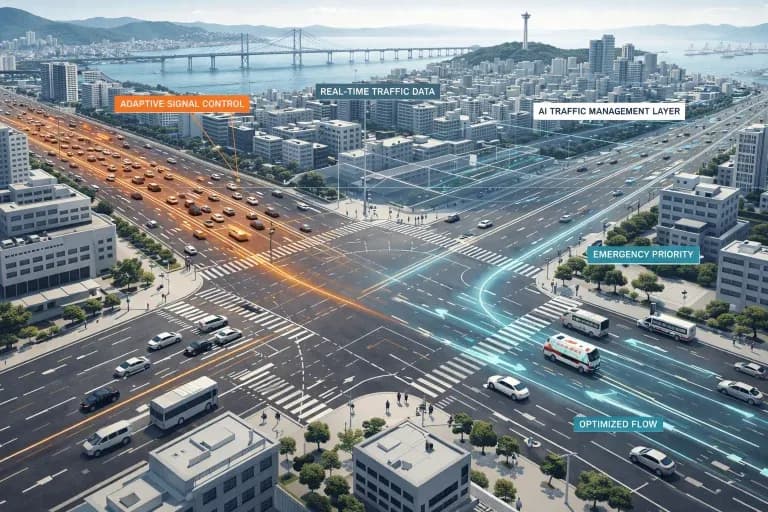
Busan says it is building an AI-based traffic management system. On paper, the package is ambitious: more smart intersections, wider real-time signal information, expanded emergency-vehicle priority, flood alerts at vulnerable junctions, and a new layer of “AI-based” traffic control. The city says it has already built out smart-intersection infrastructure and secured an additional KRW 4.5 billion in national funding for the next phase. But that is precisely where the real story begins. In traffic engineering, “AI” is one of the most overused words in public-sector technology — often applied to systems that range from mature signal-control tools to projects that are still closer to procurement intent than operational proof.
Real traffic AI is not a slogan. It is a stack. It begins with intersections that can reliably detect vehicle movements, queues, turning flows, pedestrians, and abnormal events in real time. It depends on signal controllers that can act on that data, communications links that can move it without delay, and performance systems that can show whether the timing changes improved anything at all. That is why the most advanced traffic systems in the world are not defined by futuristic language, but by operational depth. London migrated its traffic signal system in 2024 to a cloud-based Real Time Optimiser platform, and TfL’s network is described as one of Europe’s largest, with around 6,400 automated signalized junctions and pedestrian crossings. In Australia, SCATS is not a concept but a live traffic-management platform used across dozens of countries and tens of thousands of intersections.
That distinction matters because software is now moving faster than infrastructure. In the research literature, traffic AI has pushed beyond classical adaptive control into reinforcement learning, prediction-based optimization, and multi-agent coordination. But the deployment frontier remains much narrower than the research frontier. Recent 2025 reviews make the point clearly: the field is advancing quickly, but real-world deployment still runs into the same hard constraints — messy data, scaling problems, explainability, safety requirements, and the stubborn gap between simulation and live streets. In other words, city traffic does not become intelligent just because an algorithm exists. It becomes intelligent when a city can sense, decide, intervene, and verify at operational scale.
That is the standard Busan now has to meet. Korea is not entering this field from scratch; it already has substantial ITS infrastructure, a strong public-sector deployment tradition, and real experiments in smart intersections, signal optimization, and emergency-vehicle priority. But being technically capable is not the same as proving that a given city has built a measurable, resilient operating system. Busan’s latest announcement is therefore best read not as evidence of an AI breakthrough, but as a test of implementation depth: whether the city can turn mature traffic technologies, selective AI methods, and administrative ambition into a system that is specific enough to procure, robust enough to run, and transparent enough to evaluate.
What counts as AI in traffic management?
The term “AI traffic management” is often used as if it describes a single technology. It does not. In practice, it covers a wide spectrum, from conventional signal automation to research-stage learning systems that are still far from routine citywide deployment. A city can truthfully say it is using “AI” while referring to very different levels of technical capability. Some systems merely automate responses to known conditions. Others continuously adapt to live traffic. A smaller group tries to predict what will happen next. Only at the far end do systems begin to resemble what most people imagine when they hear the term AI: software that learns across a network, updates decisions dynamically, and improves its own control strategy over time.
At the lowest end are rule-based automated systems. A fixed-time signal plan that changes by time of day, a controller that extends green time when a detector is triggered, or a camera system that flags a specific violation based on pre-set conditions can all be part of a modern traffic operation. But these systems do not infer, forecast, or learn. They follow logic that engineers have defined in advance. They may improve consistency and reduce delay, but that is automation, not intelligence in the stronger technical sense.
The next layer is adaptive control, and this is where the discussion becomes more serious. Adaptive traffic systems do not simply follow a preset schedule. They monitor live conditions — changing volumes, queues, turning flows, arrival patterns — and adjust signal timing in response. FHWA’s guidance on adaptive signal control is built around exactly this distinction between static plans and responsive timing. London’s signal operations and SCATS belong to this category. These systems are not “AI” in the science-fiction sense, but they are unquestionably intelligent in the operational sense: they take live data, process it quickly, and alter control decisions in the field.
Beyond adaptation lies predictive traffic AI. This is a more demanding category because the system is no longer only reacting to the present. It is trying to estimate the near future: which approach will saturate first, where queues will spill back, when a corridor will destabilize, whether a pedestrian conflict is becoming more likely, or how a surge in demand after an event will propagate through nearby intersections. Once a system begins to forecast demand or risk and uses those forecasts to shape signal timing, routing recommendations, warning systems, or priority logic, it becomes much more reasonable to describe it as AI. The important shift is from responsive control to anticipatory control.
At the far end is learning-based and cooperative control. This is where reinforcement learning, deep reinforcement learning, and multi-agent traffic signal control enter the picture. In these systems, intersections may be treated as agents that optimize their own decisions while coordinating with neighboring intersections. The 2023 Seoul/Gangnam study is notable precisely because it moves beyond theory and reports field applicability of an RL-based traffic signal control model in a real congestion setting. But this is also the point at which public rhetoric and technical reality diverge most sharply. In academic work, these methods are increasingly sophisticated. In live urban operations, they are still constrained by much harder questions: whether the model generalizes beyond the environment in which it was trained, whether it remains safe under unusual conditions, whether it can be audited after something goes wrong, and whether city agencies are prepared to maintain it.
A more honest way to think about traffic AI, then, is as a ladder rather than a label. At the bottom is digital automation. Above it is adaptive control. Above that is prediction. At the top is learning and network-wide coordination. The mistake in much public discussion is to flatten all four into one word. That flattening makes ordinary automation sound more advanced than it is, while making genuinely difficult systems seem easier to deploy than they are. The real question for any city project is not whether officials used the term AI, but which rung of that ladder the system actually occupies.
The mature layer: what already works in the real world
Before getting to the more speculative end of traffic AI, it helps to start with the systems that already work — not in conference demos or simulation papers, but on real streets, under live demand, with all the constraints that make city traffic management difficult in the first place. That mature layer is less glamorous than public AI language often suggests. It is built not around self-learning autonomy, but around dependable detection, fast adjustment, and continuous operational feedback. The most advanced traffic systems in daily use today are usually not the most futuristic-sounding ones. They are the ones that can keep a large urban network legible and responsive minute by minute.
London is one of the clearest examples. In 2024, TfL completed the migration of its traffic signal system to a cloud-based Real Time Optimiser platform, replacing an aging control environment with one designed to improve journey times, traffic flow, and incident response across the network. The scale matters: roughly 6,400 automated junctions and pedestrian crossings. A control method that works at one corridor is not the same thing as a system that can remain stable and useful across thousands of sites with different street geometries, modal conflicts, and operating priorities.
Australia’s SCATS matters for a different reason. It is not just a city deployment but an exported operating model. SCATS describes itself as an intelligent, real-time traffic management platform, and its materials say it has been installed at more than 63,000 intersections across 216 cities in 32 countries. Whatever one thinks of platform language, the practical point is straightforward: the global market has already validated a certain type of traffic intelligence. That type is not a generalized AI brain sitting above the city. It is a control architecture that monitors traffic states, adjusts signal timings in response, and does so reliably enough for agencies to keep using it across very different urban contexts. That is what maturity looks like in this field: not novelty, but durability.
The United States offers a different version of maturity. It has not produced a single globally dominant traffic-control platform on the symbolic level of SCATS, but it has built something equally important: a dense performance culture around traffic operations. FHWA’s work on Automated Traffic Signal Performance Measures is central here. ATSPM is not one algorithm. It is a suite of high-resolution data, performance measures, and analysis tools that support performance-based traffic signal operations, maintenance, management, and design. That sounds procedural, but it goes to the heart of real traffic intelligence: not only making decisions, but knowing, in a technically defensible way, whether those decisions were any good.
There are also systems that sit between the mature operating core and the research frontier. Pittsburgh’s Surtrac is the most cited example. It emerged from Carnegie Mellon as a real-time adaptive control system using local scheduling and decentralized coordination between intersections. It was piloted in live urban conditions, not just in abstract benchmarks. That matters because it shows there is a middle category between classical adaptive systems and the more experimental reinforcement-learning literature: systems that are genuinely intelligent in how they compute and coordinate, but still narrow enough in scope to be fielded and improved incrementally.
What all of these systems share is more instructive than what separates them. None of them depends on rhetorical vagueness. None becomes intelligent simply because a city calls it AI. They become intelligent by doing a small number of difficult things consistently well: detecting the state of the network in usable detail, translating that state into timing decisions quickly enough to matter, coordinating across space rather than only at isolated intersections, and producing operational evidence that engineers can inspect afterward. The mature layer is therefore best understood not as yesterday’s technology, but as the part of the stack that has already survived contact with the real world.
The research frontier: where the literature is moving faster than deployment
If the mature layer shows what cities already know how to run, the research frontier shows what they are still trying to make reliable. Over the past several years, the center of gravity in the traffic-control literature has shifted toward reinforcement learning, deep reinforcement learning, and multi-agent coordination. The premise is appealing. Instead of relying mainly on pre-engineered response rules or adaptive logic tuned by traffic engineers, a control system could learn directly from traffic states, optimize decisions over time, and coordinate across multiple intersections as conditions change. In academic terms, this is where traffic AI becomes more than a responsive operating tool. It becomes an attempt to build a system that can improve its own control policy under complex, dynamic conditions.
There are good reasons this literature has grown so quickly. Urban traffic is a classic sequential decision problem: conditions evolve continuously, interventions have downstream effects, and the “right” decision at one intersection depends on what is happening elsewhere in the network. Recent reviews make clear that by 2025, RL-based traffic signal control had become one of the dominant research streams in the field, with growing emphasis on multi-agent systems, hybrid methods, and practical deployment constraints.
But this is also the point where the distance between papers and streets becomes most obvious. A traffic-control model can perform impressively in simulation and still fail when moved into a live city. Not because the mathematics is wrong, but because real streets are messier than the assumptions under which the model was trained. Sensors miss vehicles in rain or glare. Cameras lose sight lines. Pedestrian behavior is erratic. Traffic incidents create state changes that do not resemble the training distribution. A control strategy that looks efficient in simulation can also become difficult to audit in practice, especially if engineers cannot explain why the system made one timing decision rather than another. The leading 2025 reviews emphasize exactly these barriers: scalability, generalization, explainability, and the simulation-to-reality gap remain central obstacles to broader deployment.
This matters because the academic frontier is not simply trying to reduce delay. It is trying to solve a harder problem: control under competing objectives. A real intersection does not serve only private vehicles. It also has to accommodate pedestrians, buses, cyclists, emergency vehicles, turning conflicts, and corridor coordination. Once those constraints are added, the control problem becomes much harder. The closer traffic AI gets to real urban priorities, the harder it becomes to validate and maintain.
The most useful way to read the current research, then, is not as evidence that cities are on the verge of handing their signal systems over to learning agents. It is better understood as a map of where the field wants to go next: toward systems that can forecast short-term demand, coordinate across corridors, incorporate multiple transport modes into one control logic, and remain safe under highly variable conditions. In technical terms, the frontier is moving from reactive adaptation to predictive, networked, and partially self-improving control. In institutional terms, most cities are still some distance from being able to deploy that frontier in a robust way.
Korea’s position: advanced infrastructure, fast implementation, uneven transparency
Korea is not entering this field from the margins. In institutional terms, it is already a serious smart-traffic country. The national policy architecture is in place, the deployment culture is strong, and the public sector has spent years building the underlying infrastructure for intelligent transport systems. The ITS 2030 framework sets out a long-range plan for people-centered, safe, and uninterrupted transport services, while Korean smart-city and mobility materials show sustained emphasis on intelligent intersections, optimized signal operations, and emergency vehicle priority. ITS Korea’s industry materials and related smart-city publications make clear that this is not a country still trying to establish basic ITS capacity.
That installed base matters because traffic AI is cumulative. A country does not move from conventional signals to predictive multimodal control in one step. It gets there by layering capabilities: smarter intersections, more responsive controllers, better detection, more reliable communications, and more centralized operational oversight. Korea has been moving along that path for some time. Seoul’s digital transport system, Incheon’s AI-based signal optimization expansion, smart intersections, and emergency-vehicle priority deployments all point in that direction.
There is also evidence that Korea is pushing beyond conventional deployment into more advanced experimentation. The 2023 Seoul/Gangnam RL study is important precisely because it reports field applicability through a real-world demonstration in a congested district. Korea is not simply importing mature traffic-control concepts from abroad. At least some of its research institutions are participating in the effort to move the field forward.
At the same time, Korea’s position should not be overstated. Its strength lies more in deployment speed and public-sector implementation than in defining the global operating standard. London and SCATS remain more influential international reference points in large-scale adaptive operations, while the United States remains stronger in formal performance-management culture through FHWA’s ATSPM work. Korea’s comparative strength lies in building quickly, integrating public infrastructure at scale, and creating city-level deployment pathways. That is meaningful. It is just not quite the same as writing the global operating logic of the field.
That is why the most accurate description of Korea is neither laggard nor unambiguous leader, but a fast-moving, technically credible implementer with room to deepen operational sophistication. The weakness is less about capability than about transparency. Public announcements often use “AI” as an umbrella even when the underlying work consists largely of smart intersections, adaptive signal plans, machine-vision upgrades, or integrated traffic-management software. None of those is insignificant. But when all are described at the same rhetorical level, the technical picture becomes flatter than it really is.
Where Busan stands: credible components, difficult operations, and a broad AI label
Measured against the technical ladder rather than the press-release language, Busan’s package looks neither empty nor fully formed. It contains elements that are already mature by international ITS standards, elements that are technically real but operationally difficult, and elements that still read more like planning categories than finished systems. That mix is important. It means the city is not inventing an AI traffic future from scratch. But it also means that the phrase “AI-based traffic management” is doing too much work at once, covering projects with very different levels of readiness, engineering complexity, and evidentiary support.
The strongest part of the package is the credible operating core. Busan says it is expanding smart intersections, widening real-time signal information sharing, extending emergency-vehicle priority, and building out related signal-control services. Those are not speculative ideas. They belong to the mature operating layer: instrumented intersections, signal-state sharing, corridor management, and priority logic for specific vehicle classes. Busan already reports operating 223 smart intersections and says it will add 20 more. It also says it is already providing real-time signal information through major navigation platforms and connected-car services while planning to expand that footprint further. Those are meaningful steps. A city that builds more measured intersections and shares more real-time signal data is adding genuine operational capability.
The next category is more difficult. Real-time signal control belongs here. Busan cites pilot-style performance gains and says it intends to extend AI-based real-time signal control to additional corridors. That ambition is not implausible. Adaptive and semi-adaptive control systems operate internationally, and Korean cities are within the technical range needed to pursue them. But the challenge is not whether signal timing can be changed dynamically. The challenge is whether detection quality, controller interoperability, corridor coordination, and exception handling are strong enough to support reliable operation at larger scale. In practice, this is one of the hardest layers of urban traffic management. It requires a city not only to change timings, but to do so without degrading safety, transit reliability, pedestrian operations, or downstream stability elsewhere in the network.
Then there are the newer service concepts, including truck-related safety management and broader inter-jurisdiction emergency priority, that sit at a less mature stage. These ideas are not inherently unrealistic. Truck movement analysis, flood-linked traffic response, and wider emergency-priority coordination all fit within the larger direction of intelligent transport systems. But they depend heavily on inter-agency integration, data-sharing arrangements, operating rules, and institutional clarity that a press release cannot establish on its own. In these areas, Busan’s announcement sounds less like evidence of an already specified system than like a statement of intended direction.
The budget reinforces that reading. Busan says it has secured an additional KRW 4.5 billion in national funding and is preparing a procurement plan for the AI-based traffic management buildout. That is real money, but it is not the kind of capital that typically signals a citywide transformation across every category the announcement invokes. Read practically, it looks more like early deployment, integration funding, or phased expansion money than a full-system reinvention budget. “Preparing a procurement plan” suggests the city has moved beyond aspiration, but not necessarily to the point where outside observers can assess the final technical specification, evaluation criteria, lifecycle maintenance burden, or exact scope of implementation. In procurement terms, this is closer to structured intent than to demonstrated operating depth.
That is why Busan is a useful case. The city is advanced enough that its ambitions are not frivolous, but not so far ahead that the gap between language and implementation disappears. It sits at a point familiar in many public-sector technology projects: beyond basic digitization, within reach of stronger real-time operations, and still some distance from proving that “AI-based management” exists as a coherent, measurable system rather than as an umbrella for several different projects moving at different speeds.
Why infrastructure matters more than hype
The hardest part of traffic AI is rarely the model. It is the city — more precisely, the condition of the systems the model would have to sit on top of: detectors, signal controllers, communications links, data logs, maintenance routines, procurement rules, and staff capacity. Software moves fast, and the language around AI moves even faster. But traffic operations do not modernize at the speed of software releases. They modernize at the speed of physical replacement cycles, standards adoption, institutional coordination, and budget discipline. That is why a city can be enthusiastic about AI and still be years away from deploying it meaningfully.
The practical bottleneck begins with the intersection itself. An intelligent traffic system first needs intersections that are instrumented well enough to produce trustworthy data. That means detectors capable of capturing arrivals, queues, turning flows, pedestrian activity, preemption events, and anomalies in detector or communications health. FHWA’s ATSPM framework is explicit on this point. Its core value comes from high-resolution data logging added to existing signal infrastructure and from the ability to use that data for continuous performance monitoring rather than occasional signal retiming. Before a city can credibly claim intelligence in traffic operations, it needs intersections that can be observed in technically useful detail.
That requirement sounds straightforward until it reaches the field. Detection quality varies by weather, lighting, lane geometry, vehicle mix, and maintenance condition. A model trained on stable inputs can quickly lose value when detectors fail, cameras are partially obscured, or communications links drop out. This is one reason the mature operating layer matters so much. It gives agencies a way to identify not just traffic problems but data problems — and to separate signal failures, detector failures, and genuine demand changes before those conditions are fed into more ambitious control systems.
The next bottleneck is control infrastructure. Data alone does not create a traffic AI system. Intersections need controllers that can absorb live inputs, process timing changes reliably, and remain interoperable with central systems. FHWA’s systems-engineering guidance for adaptive signal control exists precisely because deploying these systems is not a software installation. It requires concepts of operations, system requirements, verification, validation, installation planning, training, and operations-and-maintenance plans. In traffic management, advanced control is not a plug-in feature. It is a systems-engineering problem. A city that has not modernized its controller environment, communications architecture, and management workflows is not one procurement cycle away from a sophisticated AI network, no matter how advanced the algorithms may be elsewhere.
Measurement is just as central. One of the biggest differences between a credible intelligent traffic system and a politically attractive one is whether the city can show what changed, where, and with what result. ATSPM case studies and FHWA guidance emphasize that agencies use these systems to determine whether retiming improved progression, whether communication failures are degrading performance, and whether abnormal activity in the signal database points to deeper operational faults. Cities often talk as if intelligence consists in generating decisions. In practice, intelligence also requires the ability to inspect those decisions afterward and distinguish real gains from noise, drift, or failure.
Staffing and organizational design matter just as much. Traffic AI is not self-operating in the strong sense that the word sometimes implies. Even a sophisticated adaptive or predictive control environment still depends on engineers, technicians, analysts, and managers who can calibrate detectors, review performance, resolve alarms, trace faults, approve configuration changes, and maintain institutional knowledge as systems evolve. A city that buys advanced control tools without strengthening its operating workforce is not buying intelligence. It is buying fragility.
This is why phased deployment is usually more credible than transformation rhetoric. In practice, cities tend to move in a sequence: first making intersections measurable, then standardizing controller and communications environments, then building performance-based operations, and only after that layering on more advanced control logic. That progression is not bureaucratic caution for its own sake. It reflects the logic of the technology itself. High-resolution logs have to exist before near-real-time dashboards become meaningful. Detector and controller health need to be understood before adaptive optimization can be trusted. Operations teams need to know how to interpret alarms and performance outputs before learning-heavy systems can be deployed without creating blind spots. The infrastructure path is slower than the software narrative, but it is usually the only one that scales.
That is what makes infrastructure more important than hype. Hype assumes that once software becomes impressive enough, deployment will follow. Traffic systems work the other way around. Deployment becomes credible only when the physical and institutional substrate is ready first. A city can always buy a pilot, commission a dashboard, or announce an AI strategy. What it cannot do quickly is replace a fragmented controller environment, normalize data standards across a large network, train operators, and build the evidence discipline needed to know whether new control strategies are helping. Those are slower tasks. They are also the tasks that separate a city experimenting with AI language from one actually building AI-capable transport infrastructure.
The real future: from optimization to prediction, prevention, and accountability
If the current generation of smart traffic systems is mainly about adaptation, the next generation will be about anticipation. That is the deeper trajectory visible across both research and policy. For years, the core problem in traffic operations was framed as one of optimization: how to reduce delay, improve progression, and make signal timing more responsive to actual demand. That problem has not disappeared. But it is no longer sufficient. The stronger forms of traffic AI now being imagined in the literature are trying to do something more difficult: help cities act before congestion hardens into network failure, before a conflict becomes a crash, and before recurring risk patterns remain trapped in historical reports instead of being translated into live operational decisions.
That shift matters because the ultimate value of traffic AI is not simply that it can move vehicles more efficiently. In the long run, the more important promise is that it can make urban traffic systems more predictive and more preventive. A signal system that only reacts to conditions after queues have formed is useful, but limited. A stronger system would forecast where demand is building, where corridor instability is likely to emerge, where a flood-prone intersection is approaching a dangerous threshold, where pedestrian conflict risk is rising, or where repeated signal violations suggest a design problem rather than merely a compliance problem. At that point, traffic AI begins to look less like a faster controller and more like a public-safety and public-infrastructure instrument.
That also changes how success should be measured. Older generations of signal systems were often judged by traffic-engineering metrics such as delay, progression, travel time, and throughput. Those measures remain necessary, but the future direction of the field points toward a broader standard. A citywide traffic AI system worth the name would need to be evaluated not only by whether it improved flow, but by whether it reduced instability, lowered repeated conflict exposure, improved emergency response reliability, supported transit and pedestrian movement, and remained safe under irregular conditions. The frontier is no longer about solving a single efficiency problem. It is about balancing multiple objectives under uncertainty. Korea’s own mobility and smart-city materials, as well as Europe’s broader cooperative mobility frameworks, point in the same direction: connected, cooperative, and automated mobility is not just about vehicles; it is about integrating infrastructure, control, and public value.
In practical terms, that means the most advanced traffic AI will not be defined by one breakthrough algorithm. It will be defined by the integration of several capacities that cities have rarely combined well at scale: continuous sensing, short-horizon forecasting, multimodal priority logic, resilient control, and auditable performance. Together, these imply a different conception of traffic management. The system is no longer only asking how to keep vehicles moving. It is asking where risk is accumulating, which users need priority, how conditions will evolve over the next few minutes, and how to intervene in a way that remains explainable afterward.
This is why accountability may turn out to be the defining feature of serious traffic AI. Not accountability in the political sense alone, but in the technical sense: whether a system can be inspected, measured, challenged, recalibrated, and trusted under real operating conditions. FHWA’s emphasis on performance-based traffic signal management is important here because it pushes against one of the most common misconceptions about intelligent systems — the idea that intelligence is mainly a property of decision-making. In traffic operations, intelligence is equally a property of measurement. A city that cannot show what its system changed, what data it used, and what effect followed is not operating advanced public infrastructure. It is operating a black box with public consequences.
The same point applies to prevention. It would be easy to overstate what AI can do in traffic safety. No city is on the verge of building a system that can predict every dangerous driver or eliminate every act of human error. But it is entirely plausible to build systems that detect repeated risk patterns sooner, identify unstable signal behavior, surface high-conflict corridors faster, support earlier emergency priority, and connect traffic operations more directly to safety interventions. The most meaningful future for traffic AI may therefore lie not in replacing human control, but in making cities less dependent on delayed, fragmented, and retrospective forms of response. Instead of waiting for crashes, complaints, or annual reviews to reveal where the system is failing, a more advanced traffic infrastructure could begin to recognize those failure patterns while they are still forming. That is a much more concrete and defensible vision than the language of AI often suggests.
From this perspective, Busan’s announcement becomes useful for reasons that go beyond Busan. It illustrates a broader tension in public technology projects. Software language tends to leap ahead toward the most ambitious horizon — AI, prediction, autonomy, optimization at scale. Infrastructure reality advances in slower, denser layers: instrumentation, logging, control, maintenance, and performance evidence. The cities that matter in this field will not necessarily be the ones that adopt the most advanced vocabulary first. They will be the ones that can connect those layers into a coherent operating system. That is what London’s signal modernization, SCATS’s durability, FHWA’s performance culture, and Korea’s own fast-moving deployment path all suggest in different ways. The future of traffic AI is not merely smarter software. It is the gradual transformation of traffic management into a more measurable, anticipatory, and governable form of public infrastructure.
The real promise of traffic AI is not that it will make cities frictionless. Cities are too contested, too multimodal, and too unpredictable for that. The stronger promise is narrower and more credible: that cities may become better at detecting instability before it spreads, better at assigning priority when systems are stressed, and better at learning from live conditions rather than from yesterday’s failures alone. If that future arrives, it will not be because public agencies learned to say “AI” more often. It will be because they learned how to turn sensors, controllers, event logs, and operational judgment into a form of public infrastructure that can anticipate risk instead of merely reacting to it.
Continue this reporting
Reporting on the same issue
Related coverage selected from the article's desk, topics and newsroom relationships.
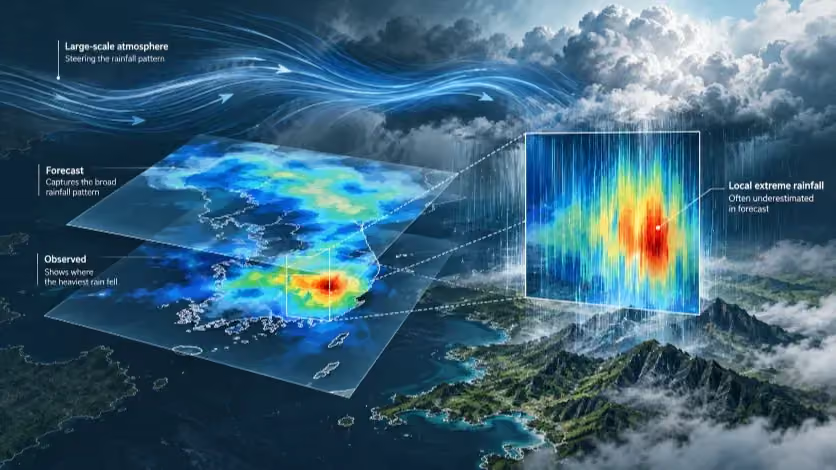 NewsOct 19, 2026
What an Accurate Rainfall Forecast Can Still Miss
AI weather forecasts can capture where rain will fall while underestimating i...
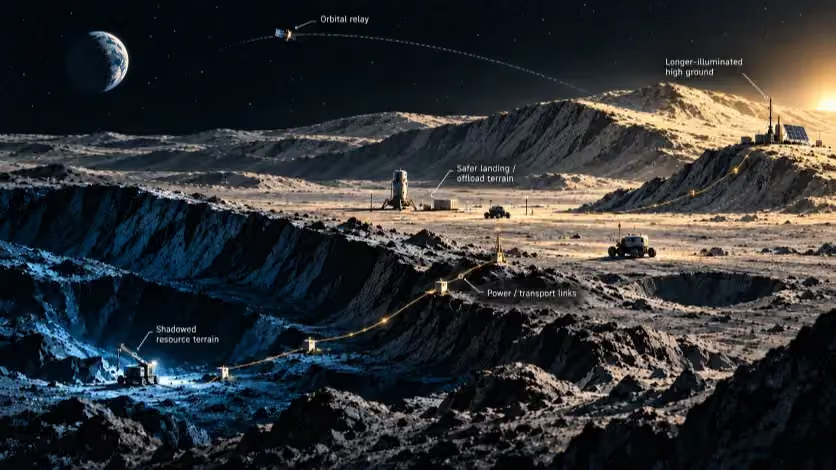 NewsOct 7, 2026
The Moon’s Industrial Future Begins With What Missions No Longer Need to Carry
Water, sunlight, safe landing terrain, communications and power do not natura...
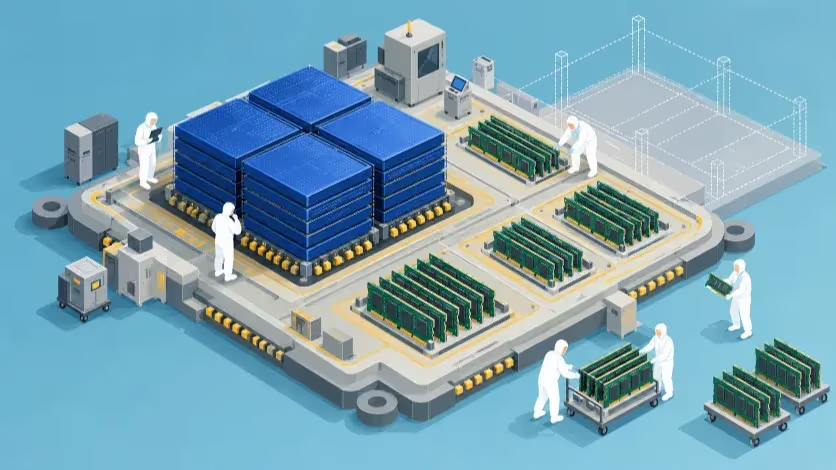 NewsOct 2, 2026
AI Is Reallocating the World’s Memory Factories
AI demand is forcing memory makers to decide how scarce DRAM capacity is divi...
More from the author
More from this byline
Stay with the same line of reporting through more work from this byline.
- NewsOct 19, 2026
What an Accurate Rainfall Forecast Can Still Miss
- NewsOct 2, 2026
AI Is Reallocating the World’s Memory Factories
Reader Signal
Community readWhat did this report leave you with?
Choose the signal that best reflects your reading. Select it again to remove it.
One response per article
No response selected
A moderated conversation about the reporting.
One-level replies and newsroom moderation keep the conversation anchored to this article.
Discussion Status
Open
Please sign in to join the discussion.
Newsletter
Weekly reporting and context from Busan and Korea.