The Unintended Consequences of US Protectionism and Diplomatic Missteps
The recently passed US Chips and Science Act, which allocates $52 billion toward domestic semiconductor manufacturing, has raised concerns for South Korean tech firms, including Samsung and SK Hynix. The legislation contains several provisions that could potentially harm the Korean tech industry, including "toxin clauses" that require the sharing of excess profits, the disclosure of confidential production facility information, and the submission of accounting records. Toxin Clauses: Sharing E


The recently passed US Chips and Science Act, which allocates $52 billion toward domestic semiconductor manufacturing, has raised concerns for South Korean tech firms, including Samsung and SK Hynix. The legislation contains several provisions that could potentially harm the Korean tech industry, including "toxin clauses" that require the sharing of excess profits, the disclosure of confidential production facility information, and the submission of accounting records.
Toxin Clauses: Sharing Excess Profits, Confidentiality Disclosure, and Accounting Records
The US Chips Act has been a source of controversy due to its "toxin clause" that requires companies to share excess profits with the US government if the cash flow or revenue significantly exceeds the projections made in the application. This clause has drawn criticism from industry leaders, who argue that it could discourage companies from investing in the US by adding additional costs and compromising the confidentiality of their financial data. It also raises concerns about how the US government will determine what qualifies as "excess" and whether it is fair to require companies to share their profits beyond what was initially projected.
In addition to the sharing of excess profits, the act also mandates that companies disclose detailed information about their production facilities. This includes products produced, production scale and capacity, and the location of the facility. This requirement poses a significant burden on tech firms who value their trade secrets and could lead to potential leaks of confidential information. Semiconductor companies invest significant resources in research and development to stay ahead of their competitors, and the disclosure of such information could put their businesses at risk.
Furthermore, the submission of accounting records, including audited consolidated financial statements, key performance indicators, and projected revenues, is another requirement that has sparked criticism from industry leaders. The bill requires companies to provide information about their finances to ensure that they have the financial stamina to withstand pressure when the semiconductor market is in a downward spiral. However, many argue that these requirements exceed the scope of the law and constitute excessive management interference, particularly for global private companies that are not US state-owned.
Diplomatic Missteps: South Korea's Misguided Approach to US Relations
South Korea's diplomatic missteps in its approach to US relations have come to the fore with the introduction of the US Chips and Science Act, which seeks to reduce dependence on foreign semiconductor manufacturing. While the Biden administration's emphasis on national security and the creation of the "Chip 4" alliance between the US, South Korea, Japan, and Taiwan may be seen as a positive step, South Korea's handling of US relations has been criticized for being misguided and shortsighted.
In particular, experts have pointed out that South Korea's failure to address the US's growing protectionist agenda has left Korean tech firms vulnerable to the new requirements imposed by the bill. While the South Korean government has prioritized economic engagement with China, it has not given adequate attention to strengthening ties with the US, which has been a key trading partner for South Korea for decades.
This diplomatic misstep could have serious consequences for South Korean tech firms, particularly Samsung and SK Hynix, as they may face significant uncertainty and additional costs as a result of the act's requirements. As the US seeks to reduce its dependence on foreign semiconductor manufacturing, South Korea may find itself at a disadvantage in the global semiconductor industry if it fails to address its diplomatic missteps with the US.
Challenges Ahead
While the US Chips and Science Act aims to strengthen the US semiconductor industry, its controversial provisions have drawn criticism and concern. The tension between progressive policies, such as the provision of affordable childcare and the promotion of unionization, and the protection of business interests will continue to be a challenge for policymakers and industry leaders alike. As the global semiconductor industry faces increasing pressure from protectionist policies, it remains to be seen how this will affect the US-Korea relationship and the future of the industry as a whole.
The US Chips and Science Act has sparked concerns for South Korean tech firms, who fear the potential harm that these new requirements could have on their industry. Moreover, the South Korean government's diplomatic missteps in handling US relations have left the Korean tech industry vulnerable to these new provisions. The need for the South Korean government to prioritize relations with the US and address its growing protectionist agenda has become crucial for the country's tech firms. As the global semiconductor industry continues to face challenges, the balance between progressive policies and the protection of business interests will be crucial for the future of the industry and the US-Korea relationship.
"Toxin clause" is a term used to refer to a clause in a law or contract that places restrictions or obligations on the parties involved. It is typically used in a negative context, suggesting that the clause imposes onerous or undesirable requirements on the parties.
Continue this reporting
Reporting on the same issue
Related coverage selected from the article's desk, topics and newsroom relationships.
 NewsSep 21, 2026
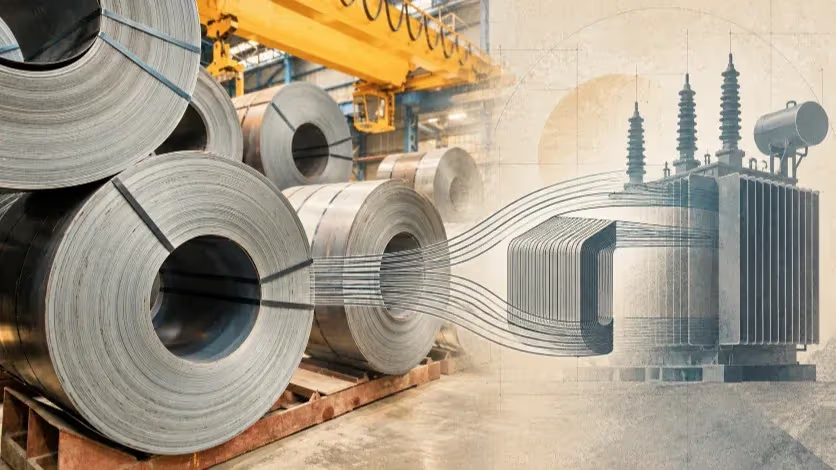
Europe’s Electrical-Steel Safeguard Now Reaches Inside the Transformer
A new EU safeguard follows electrical steel into certain finished transformer...
 NewsSep 14, 2026
Foreign Tourist Spending Is Reshaping Busan’s Nampo District
Foreign spending is making long-empty commercial space valuable again in Namp...
 NewsSep 11, 2026
Busan-Jinhae’s New Industrial Strategy Meets a Jobs Divide
As BJFEZ prepares to add AI, data and advanced energy to its industrial prior...
More from the author
More from this byline
Stay with the same line of reporting through more work from this byline.
 NewsOct 9, 2026
Why “Busan Is Good” Falls Short as a City Brand
 NewsSep 18, 2026
The Other AI Race Is for the Freedom to Change Course
Reader Signal
Community readWhat did this report leave you with?
Choose the signal that best reflects your reading. Select it again to remove it.
One response per article
No response selected
A moderated conversation about the reporting.
One-level replies and newsroom moderation keep the conversation anchored to this article.
Discussion Status
Open
Please sign in to join the discussion.
Newsletter
Weekly reporting and context from Busan and Korea.