South Korea’s UN AI Push Enters a New Phase
A March LOI with six UN agencies has given South Korea its strongest opening yet to host UN-linked AI functions. The question now is whether Seoul can match diplomatic ambition with law, funding, city strategy and institutional trust.


South Korea has not yet secured a UN AI institution. But after signing an LOI with six UN agencies in March, it has crossed into a new stage: hosting UN-linked AI functions is no longer just an ambitious idea, but a matter of state preparation. The real test now is whether Korea can turn diplomatic momentum into a credible legal, financial and institutional host package.
What had long sounded like an ambitious Korean idea — bringing UN-linked AI functions to the country — has now entered the machinery of government. Seoul returned from Geneva with a letter of intent signed alongside six UN agencies, then moved quickly to elevate the initiative into a higher-level national committee under the prime minister. Much remains unsettled. No headquarters agreement has been announced, no host city has been fixed, and no public roadmap yet defines what institutional footprint might follow. But that is no longer the whole story. For the first time, South Korea is not merely arguing that it should matter in the international politics of artificial intelligence. It is being pushed to prepare as though it might.
That is why this story should not be told as either triumph or theater. A letter of intent is not a treaty, not a headquarters agreement, and not the creation of a new UN body. It settles none of the questions that ultimately determine whether an international institution can take root in a host country: legal status, privileges and immunities, staffing, financing, administrative autonomy, or the terms under which the host state is prepared to carry the burden of residence. Yet dismissing the March agreements as symbolic would miss the deeper shift underneath them. In multilateral politics, institutions rarely begin with finality. They begin when an idea acquires enough external recognition to stop being merely aspirational and start demanding administrative preparation. That is the threshold South Korea appears to have crossed. It has not secured a UN AI institution. It has, however, reached the point at which preparing for one no longer looks premature.
The timing gives the development its weight. The United Nations is no longer treating artificial intelligence as a distant policy abstraction. The General Assembly has already launched an Independent International Scientific Panel on AI and a Global Dialogue on AI Governance, while Geneva remains the working center of the ITU-led AI for Good ecosystem, which links dozens of UN agencies and partner institutions. In other words, the map of international AI governance is no longer blank. But it is not finished either. The institutional center is visible, the outer layers are still fluid, and the geography of implementation is not yet fully settled. That is what makes Korea’s move consequential. It is not entering an empty field, and it is certainly not replacing Geneva. It is trying to secure a place in an order that is now being built in earnest.
There are reasons the bid is not fanciful. South Korea has hosted a major international institution before. The Green Climate Fund did not arrive in Songdo through rhetoric but through a formal headquarters arrangement backed by legal commitments and administrative preparation. Korea also enters this moment with a domestic AI governance framework already in force through the AI Basic Act and its enforcement decree, giving the country more institutional depth than a government merely chasing the language of technological prestige. Over the past two years, Seoul has also tried to place itself more visibly in international AI diplomacy through summitry, foreign-policy signaling, and a more deliberate vocabulary around AI, governance, security and international norms. Those are real assets. But they do not resolve the harder question now coming into view: not whether South Korea wants a place in the emerging order of AI governance, but whether it is prepared to act like the kind of host that order would require.
That question is sharper because Korea cannot rely on the language of neutrality. It is not Switzerland. It is a US ally, deeply embedded in the strategic economy of semiconductors, digital infrastructure and high-end technology. For that reason, Seoul’s case cannot be that it stands outside geopolitics. Its stronger argument is narrower and more credible: that it can function within geopolitics without reducing a multilateral platform to the extension of any single power’s agenda. The burden, then, is not to claim innocence from the pressures shaping AI, but to demonstrate institutional trustworthiness under them. This is where the story becomes more than a technology story and more than a diplomatic headline. What is now at stake is whether South Korea can translate a moment of political opening into the legal, financial, urban and diplomatic architecture required to make an international role believable. That is the real meaning of March. Korea has not yet secured a UN AI institution. What it has secured is something less final, but still consequential: the right to prepare seriously.
Why Korea’s UN AI Push Matters
The significance of South Korea’s recent push lies first in what, precisely, has changed. Until this spring, the idea of bringing UN-linked AI functions to Korea remained easy to overstate and just as easy to ignore. It had the language of strategic ambition, but not yet the marks of institutional movement. March altered that balance. The initiative was pulled into the center of government, placed under the prime minister’s office, and then tied to a Geneva signing that brought six UN agencies into the frame. That sequence matters because it did more than generate headlines. It changed the status of the proposal inside the Korean state itself. What had been an interesting diplomatic aspiration began to acquire the form of a policy question.
That may sound like a narrow distinction, but in institutional politics it is often the decisive one. Many ideas circulate around governments for years without crossing into the realm of preparation. They remain useful as rhetoric, as summit language, as evidence of national ambition. Very few reach the point at which ministries, budgets, legal frameworks and host-city considerations have to be confronted in earnest. That is what makes the March moment more consequential than a routine memorandum signing. The issue is no longer simply whether Seoul would like to play a larger role in the international politics of artificial intelligence. The issue is whether Korea is now close enough to that role that its own administrative system has to start behaving differently.
The second reason it matters is timing. The international order around AI is no longer undefined. Over the past year, the United Nations has moved from broad concern toward more formal structures: the General Assembly has created an Independent International Scientific Panel on AI and a Global Dialogue on AI Governance, while Geneva continues to function as the clearest operational center through ITU’s AI for Good platform and its wider network of UN-linked coordination. This means that the question is no longer whether AI governance will be institutionalized internationally. It already is being institutionalized. The real question is where different layers of that system will sit, how they will connect, and which countries will be trusted with which parts of the work. Korea’s recent move matters because it places the country inside that conversation while the structure is still taking shape.
This is also why the Korean effort should not be misread as a bid to replace Geneva or to create a wholly new center of gravity from scratch. That interpretation goes too far and, strategically, misses the more plausible opening. The existing core of AI governance remains anchored elsewhere. The scientific, diplomatic and convening functions already have visible institutional homes. What remains more open is the geography of implementation: where training, thematic cooperation, capacity-building, demonstration projects and cross-agency applied work might be placed as the system matures. That is the space Korea appears to be testing. The strength of its position lies not in claiming primacy, but in offering to host part of the machinery beneath the summit level — the layer where international ambition has to become institutional practice.
The composition of the March LOI makes that point clearer. Had the agreement been built around one technical agency alone, the initiative might have looked like another national attempt to attach itself to the prestige language of AI. But the six participating bodies suggest something more ambitious and more grounded. The ILO points to labor markets, reskilling and the uneven impact of automation. WHO brings health systems, regulatory assurance and responsible deployment. WFP brings operational logistics and field delivery. UNDP brings public-sector capacity and development practice. IOM brings mobility, identity and cross-border data systems. ITU brings standards, infrastructure and the connective tissue of global technical governance. Taken together, they point not toward a generic AI campus, but toward a site where AI is tied to public institutions, international coordination and practical problem-solving. That is a more serious proposition than a branding exercise. It is also much harder to fake.
That seriousness is exactly what makes the Korean opening politically important. In domestic terms, it raises the level of the discussion. Once an initiative acquires even preliminary recognition from multiple UN bodies, it can no longer be handled as a loose future-facing slogan. It begins to demand choices. Which ministry leads. Which legal model applies. Which city is being prepared. What functions are actually being sought. How much fiscal support the state is willing to commit. Whether the government intends to treat the effort as a symbolic national prize or as a disciplined multilateral hosting project. These are no longer abstract questions once the outside world has shown enough interest to make them real.
There is another reason the moment matters, and it sits slightly deeper. South Korea has spent years trying to expand the vocabulary through which it is seen internationally in advanced technology. It does not want to be understood only as a manufacturing power, a semiconductor exporter, or a fast follower in the commercial AI race. It also wants recognition as a country that can participate in the governance of new technologies. That is a more difficult status to obtain because it depends less on industrial strength than on political trust, institutional competence and legal credibility. The March agreements do not confer that status. But they do something important: they create the first real test of whether Korea can earn it.
For that reason, the push matters even if it ultimately produces something narrower than the most enthusiastic rhetoric now suggests. It may not lead to a full-fledged resident body. It may not culminate in a headline-grabbing institutional relocation. It may instead produce a hybrid arrangement: a training platform, a thematic cooperation center, a regional implementation node, or a distributed model in which different functions are placed across different sites. But even that would mark a meaningful shift. It would mean that Korea had moved beyond talking about AI governance as an external process and begun to anchor part of that process within its own institutional landscape. In international politics, that is often how larger roles begin — not with dramatic arrival, but with smaller forms of accepted responsibility.
This is why the right way to read the March developments is neither triumphalist nor dismissive. The opening is real, but narrow. The signal is significant, but incomplete. The diplomatic gain is visible, but it has value only if it forces harder preparation at home. That is what makes the story worth sustained attention. South Korea has not yet obtained the institution many domestic headlines may tempt readers to imagine. What it has obtained is something politically rarer than a slogan and more demanding than a ceremony: a credible reason to begin preparing for the possibility that part of the next international layer of AI governance might, in some form, be asked to live here.
Why Korea Could Host UN AI Functions
South Korea’s case would be much weaker if it were built on aspiration alone. It is not. One reason the current push has to be taken seriously, even at this still preliminary stage, is that Korea is not trying to enter this conversation as an institutionally untested country. It has hosted a major international body before, and under conditions that matter for the present debate. The Green Climate Fund did not arrive in Songdo as a ceremonial plaque or a symbolic diplomatic prize. It arrived through a formal headquarters arrangement, negotiated and codified in legal terms that addressed the core questions any serious host country must answer: the status of the institution, the treatment of its officials, the conditions under which it can function independently, and the obligations the host state is prepared to shoulder in return. That experience does not make South Korea an automatic destination for UN-linked AI functions. It does, however, mean that Korea is not starting from fantasy. It has at least one clear precedent for what institutional hosting looks like when it is real.
That point is more important than it may appear. Much of the public language around “global AI hubs” tends to float above the legal and administrative realities that determine whether an international organization can actually operate. Governments often speak as though attracting an international body were mostly a matter of prestige, branding, or a well-staged diplomatic campaign. It is not. The real burden begins after the announcement, when the host state has to prove that the institution will be able to live under stable legal terms, move people across borders efficiently, house international staff, maintain operational autonomy, and do so without being pulled too tightly into the rhythms of domestic politics. South Korea has not yet shown that package in the present case. But the significance of the Green Climate Fund precedent is that it gives Korea a vocabulary of seriousness that many governments simply do not have. It can point not only to desire, but to prior performance.
Korea’s domestic AI framework also matters here, though in a more limited and often overstated way. The AI Basic Act and its enforcement decree, which entered into force in January 2026, do not by themselves make Korea a natural home for an international AI institution. National legislation does not automatically translate into multilateral trust. But the law does matter in another sense. It shows that Korea is trying to move AI policy out of the realm of scattered industrial measures and into a more coherent national structure. The new framework establishes governance mechanisms, defines state responsibilities, supports research and testing infrastructure, and places AI within a more explicit policy architecture. That gives Seoul something it lacked even a few years ago: a domestic institutional basis from which it can plausibly argue that it is prepared to host more than a conference. Countries do not become credible hosts for international functions merely by saying AI is important. They become credible when they can show that AI already exists inside law, administration, and long-range state planning. Korea can now make that argument with more substance than before.
The foreign-policy record strengthens the case, though again not in a way that should be romanticized. South Korea has spent the past two years trying to build a profile in international AI governance that goes beyond industrial competitiveness. The AI Seoul Summit, the REAIM process, and the creation of a more explicit AI diplomacy function in the foreign ministry all form part of the same pattern. Seoul is trying to position itself not only as a country that develops AI technologies, but as one that can speak the language of rules, safety, norms, governance and international coordination. That matters because the UN system is unlikely to trust a host country whose only case is that it has strong companies or advanced chips. The hosting of UN-linked functions is not an industrial reward. It is a judgment about whether a country can provide political steadiness, institutional competence, and enough diplomatic discipline to support multilateral work over time. On that front, Korea is not without evidence to present.
There is also a structural reason Korea’s bid is more plausible than it may first appear. The current discussion is not really about whether South Korea can become the singular center of global AI governance. It cannot, and the existing institutional landscape does not point in that direction. The more realistic question is whether Korea can host part of the applied layer of that system: the training, coordination, field deployment, thematic cooperation and cross-border implementation that sit below summit diplomacy but above national fragmentation. In that space, Korea’s profile begins to look more relevant. It is a technologically advanced democracy with administrative capacity, a strong digital state, experience in large-scale public systems, a growing AI policy apparatus, and prior exposure to the routines of international institutional hosting. That is not a conclusive case. But it is a serious one.
The composition of the six agencies in the March LOI reinforces exactly this reading. If the initiative were centered on one technical agency alone, or on a narrow cluster of industrial bodies, Korea’s role might look more performative than substantive. But the current mix points toward a country trying to offer itself as a site for practical, cross-sectoral AI cooperation. That matters because each of the agencies involved carries a domain in which AI is no longer speculative. The ILO is dealing with labor transitions and the uneven impact of automation. WHO is dealing with public health systems, regulatory assurance and responsible deployment. WFP has moved openly into operational AI strategy in logistics and food security. UNDP is working at the level of governance, development and institutional capacity. IOM sits at the intersection of data, identity and human mobility. ITU remains one of the clearest international venues for technical coordination and standards-adjacent dialogue. This is not a random coalition. It implies that the Korean case, at least as currently framed, rests on a broader proposition: that AI should be embedded in public institutions and international problem-solving, not treated only as an industrial race.
Even so, the plausibility of Korea’s bid should not be confused with maturity. This is the point at which much of the domestic discussion is likely to lose discipline. Because Korea can now point to real assets — legal precedent, an AI law, summit diplomacy, administrative competence, prior experience with international institutions — it will be tempting for some officials and local actors to speak as though the essential case has already been made. It has not. These assets make the project legible. They do not complete it. A country can have all the right credentials on paper and still fail to convince the relevant institutions that it is prepared to host real operational work. The gap between “a plausible candidate” and “a trusted host” is exactly where most such projects either harden or collapse.
That is why the more useful way to think about Korea’s strengths is not as evidence that the job is done, but as proof that the next stage is worth taking seriously. Korea has enough institutional depth to justify preparation. It has enough prior experience to avoid looking naïve. And it has enough legal and diplomatic groundwork to argue that the idea should not be dismissed out of hand. Those are genuine advantages. But they only become politically meaningful if they are now converted into something more difficult: a concrete host-country model that can answer not just why Korea is interested, but why the UN system should believe that interest can be turned into durable capacity.
This is the point at which Korea’s candidacy becomes more than a matter of national self-perception. Every country can tell a flattering story about its own readiness. Far fewer can demonstrate, under scrutiny, that they have the institutional patience to follow through. South Korea has reached a stage at which its case can no longer be judged simply by the elegance of its diplomatic language. It will be judged by whether the country can translate precedent into policy, legal structure into trust, and ambition into a setting where an international institution could actually work. That is why Korea could host UN AI functions. It is also why the burden of proof is only just beginning.
Korea, AI and Geopolitics
At some point, any serious discussion of a Korean role in UN-linked AI governance runs into the same objection. South Korea is not Switzerland. It is not insulated from great-power rivalry, and it cannot plausibly present itself as a neutral zone standing outside the political pressures now shaping advanced technology. Korea is a treaty ally of the United States, deeply tied to American security architecture, deeply exposed to the strategic economy of semiconductors and digital infrastructure, and increasingly situated inside the wider logic through which Washington treats AI as part of geopolitical competition. That is not a marginal complication. It is the starting condition under which any Korean bid has to be assessed.
For that reason, the Korean case becomes weaker the moment it leans too heavily on the language of neutrality. That argument is seductive domestically because it flatters the idea that Korea can rise above the rivalry around it and offer itself as an untainted site of global cooperation. But the claim does not survive close scrutiny. Neither the country’s alliance structure nor its place in the political economy of high technology allows for that kind of innocence. If Seoul tries to sell itself as though it were detached from the strategic contest over AI, the argument will sound overstated and, in some quarters, disingenuous. It will invite precisely the skepticism it is meant to disarm.
But that does not mean Korea is disqualified. It means the argument has to be narrower, more disciplined, and ultimately more persuasive. The stronger claim is not that South Korea stands outside geopolitics. It is that South Korea may be able to function within geopolitics without collapsing a multilateral platform into the instrument of a single power’s agenda. That distinction is central. International institutions do not always require the host country to be neutral in the classical sense. They do, however, require the host country to be predictable, legally legible, administratively competent, and politically careful enough that the institution’s work is not constantly recast through the host’s short-term strategic interests. That is the standard that matters here. The test is not whether Korea is geopolitically pure. The test is whether it can be trusted under geopolitical pressure.
In some respects, Korea does have a case. It is not a great power trying to anchor the entire system around itself. It is not the United States, whose weight can make multilateral settings feel structurally imbalanced. It is not China, whose digital governance model and state controls would trigger a different kind of institutional mistrust in large parts of the UN community. Nor is Korea institutionally inexperienced. It is a technologically advanced middle power with a working record inside multilateral forums and with a diplomatic habit of seeking legitimacy through rules-based participation rather than unilateral reach. That profile does not erase strategic concerns. But it does create a usable position. Korea can plausibly argue not that it should become the sovereign center of AI governance, but that it can host part of its implementation layer without distorting the wider system.
This is also why Seoul’s argument works better when framed around function rather than status. The more Korea speaks as though it is trying to become the singular capital of international AI governance, the more fragile its case becomes. That kind of language invites immediate comparison with Geneva and, by extension, with an ecosystem Korea is not in a position to replace. The stronger path is more modest and more credible. Korea can present itself as a place that offers reliable institutional conditions for specific kinds of UN-linked work: training, standards dialogue, public-health applications, labor transition programs, humanitarian operations, development capacity-building, and other applied functions that sit below summit diplomacy but above fragmented national efforts. That is a claim about usefulness, not primacy. Precisely for that reason, it is a stronger one.
The March LOI points in that direction. The six-agency structure does not read like the skeleton of a prestige headquarters designed to maximize symbolic national gain. It reads more like the outline of a working platform. The mix matters. ITU brings the infrastructure of technical coordination. ILO brings the social and distributive consequences of automation. WHO brings health systems and regulatory credibility. WFP brings field operations and logistics. UNDP brings governance and development practice. IOM brings mobility, identity and cross-border data systems. Together, they imply a Korean pitch built less around singular institutional grandeur than around cross-sector execution. That is the form in which Korea’s geopolitical position becomes less of a liability. A state that cannot convincingly sell itself as neutral may still be able to sell itself as useful, stable and institutionally trustworthy.
That, however, depends on how Seoul handles the politics of its own ambition. If the initiative is packaged primarily as a national branding exercise, or as proof that Korea has “arrived” in the geopolitical contest over AI, it will undercut itself. The UN system is unlikely to be reassured by a host country that seems too eager to turn a multilateral project into a national prestige vehicle. The more the rhetoric shifts toward symbolic victory, the more outside observers will wonder whether the platform exists to serve international functions or to decorate domestic politics. Korea’s strongest case lies in the opposite direction: restraint, seriousness, technical competence, and a host-country posture that does not try to swallow the institution it seeks to attract.
This is where geopolitics stops being an abstract backdrop and becomes an institutional design problem. If South Korea wants its alignment with the United States not to become a disqualifying shadow over the project, it will have to show that the proposed hub is not a strategic annex built for one side of the technology divide. That means more than careful speeches. It means broad programmatic access, transparent legal terms, a clear multilateral mandate, and enough distance from domestic industrial promotion that partner institutions can trust the platform’s purpose. Trust, in this environment, will not come from claiming neutrality. It will come from building structures that make overreach difficult and multilateral use credible.
There is a deeper irony here. Korea’s geopolitical embeddedness is both the source of the objection and part of the source of its relevance. A country fully outside the strategic economy of AI might be easier to describe as neutral, but it would also be less central to the real political and technological pressures shaping the issue. Korea matters precisely because it is inside those pressures: as a digital state, a semiconductor power, a security ally, and an advanced economy trying to govern technological transformation in real time. The challenge is not to deny that position. It is to discipline it. If Seoul can do that, its geopolitical profile may cease to look like a simple weakness and begin to look like something more useful: evidence that a technologically serious, strategically exposed middle power can still host multilateral work without reducing it to bloc politics.
That is the bar. It is higher than the rhetoric now circulating in Seoul often suggests. But it is also more realistic than the language of neutrality. South Korea does not need to persuade the world that it exists above geopolitics. It needs to persuade institutions that it can operate responsibly within it. If it can make that argument convincingly, then its bid to host UN-linked AI functions stops sounding like an exercise in strategic vanity and starts looking like a plausible attempt to widen the geography of international AI governance without destabilizing its center.
What Korea Must Build Next
Once the discussion reaches this point, the most useful question is no longer whether South Korea’s diplomatic opening is real. It is. The more difficult question is whether the country is prepared to build the conditions under which that opening can mature into something institutional and durable. This is the point at which many national projects lose clarity. Political interest arrives first, diplomatic language follows, and public excitement quickly outruns the slower work that international institutions actually require. If Seoul wants to avoid that pattern, it now has to treat the March agreements not as proof of arrival, but as the beginning of a design problem. That design problem has several layers, and none of them can be solved by rhetoric alone. The issue is not whether Korea can continue to say the right things about AI. The issue is whether it can construct the legal, financial, administrative and urban architecture that would make a UN-linked presence believable.
The first layer is legal. International institutions do not relocate, expand or embed meaningful functions in another country on the basis of goodwill. They need legal status, predictable working conditions, protected autonomy, procurement flexibility, taxation rules, visa pathways, employment protections for international staff, and a broader framework that allows them to function without being repeatedly dragged into local administrative friction. South Korea has one important advantage here: it has already done something close to this before. The Green Climate Fund headquarters agreement offers a concrete domestic precedent for the kind of legal seriousness a host country must demonstrate. That precedent should be treated not as a talking point but as a working template. If the government is serious about a UN-linked AI role, it should already be developing, internally if not yet publicly, the rough legal scaffolding of a future host-country package: what kind of institutional status would be offered, what forms of protection would apply, how foreign officials and their families would be treated, and how operational independence would be balanced with domestic law. Until that work begins to exist in draft form, the current push remains politically interesting but institutionally light.
The second layer is financial, and this is where public discussion remains noticeably thin. Hosting an international body is not a one-off event. It is an extended fiscal commitment. Office space is the least interesting part of it. The real burden lies in startup support, administrative staffing, language and legal services, event infrastructure, information security, program funding, and the often invisible costs that come with making an international institution function smoothly over years rather than months. If the Korean government intends this initiative to survive beyond its first political cycle, it will have to produce something more disciplined than broad declarations of support. It will need a multiyear funding logic. Which ministry is paying for what. What share of the burden the central government is willing to assume. Whether local governments are expected to co-finance infrastructure and services. Whether the platform, if created, would be treated as a permanent national commitment or as a project vulnerable to annual political re-litigation. None of those questions are glamorous, but they are precisely the questions international institutions care about once the photographs are over.
The third layer is functional clarity. This may be the most urgent weakness in the current Korean discussion. The broad idea is visible: a Global AI Hub, some kind of UN-linked platform, a role for Korea inside the emerging institutional geography of AI governance. But broad ideas do not host themselves. Eventually the country will have to answer a simple, practical question: what exactly would happen in Korea that is not already happening elsewhere? That answer cannot remain generic. If it is too expansive, the proposal will sound inflated. If it is too abstract, it will sound unserious. The six agencies in the March LOI offer a workable starting point, but only a starting point. A credible proposal would need to translate them into a portfolio of actual functions. With the ILO, that might mean labor-transition programs, workforce measurement tools, and training models for reskilling under automation pressure. With WHO, it might mean applied work on AI in health systems, public-sector deployment, safety and regulatory confidence. With ITU, the path may lie in standards dialogue, technical convening, interoperability and digital-public infrastructure questions. WFP points toward logistics, disaster response and field-level operations. UNDP suggests state capacity, development policy and government adoption. IOM suggests mobility, identity and the politics of cross-border data systems. These are real domains. But they are not yet, at least publicly, a Korean program. At some point Seoul will have to stop speaking about “hosting AI functions” in the abstract and start naming the exact workstreams it wants to build.
That leads to the fourth layer: administration. One of the more revealing features of international institutional hosting is that its success often depends less on high diplomacy than on the host state’s ability to solve repetitive problems without drama. Can a foreign staff member get the right documents on time. Can a new office contract be processed without legal confusion. Can families navigate health care, schools, residence registration and daily life without the entire system becoming a maze. Can the host country provide a reliable English-language interface across multiple bureaucracies. Can a visiting delegation move through transport, meetings, security, translation and lodging without the entire burden falling on one overextended ministry desk. These questions do not make headlines, but they determine whether an institution experiences a host country as serious or exhausting. Seoul has administrative strengths, but it should not assume that those strengths automatically convert into an international-user environment. That work has to be designed.
This is also why the urban dimension deserves much more seriousness than it usually receives in domestic political debate. If some part of this initiative does move beyond the diplomatic stage, it will need a place to live. And that place will need to function at two levels at once. It must be institutionally competent and humanly livable. Institutionally, it must offer meeting facilities, digital infrastructure, transport access, secure communications and a local administrative ecosystem that can handle international operations. Humanly, it must offer housing, healthcare, education, mobility and everyday conditions under which international staff and their families can imagine remaining for years. This is the point at which slogans about “global hub cities” usually begin to thin out. Brand identity is not the same thing as host readiness. A city can be internationally ambitious and still be poorly prepared to absorb a multilateral presence.
Here the Korean discussion becomes both more difficult and more politically sensitive. Songdo and Incheon remain the strongest general-purpose candidates because they already host the Green Climate Fund and UNESCAP’s East and North-East Asia office, and because the surrounding environment was built with international organizations in mind. That is not a trivial advantage. It means the capital-region side of the debate can point not just to convenience, but to proven institutional ecology. At the same time, it would be a mistake to assume that a serious Korean strategy must therefore collapse into a single-city logic. If the country is thinking clearly, it should resist the reflex to imagine one place performing every function. Busan, for example, does not have Songdo’s existing institutional clustering, but it does have a potentially credible case in a narrower and more specialized register. If Korea wants to anchor AI to real systems rather than abstractions, Busan can make a case around maritime AI, port operations, shipping logistics, disaster-response systems and marine governance. That argument becomes persuasive only when framed as functional complementarity rather than regional grievance. The outside world is unlikely to be impressed by a domestic contest over symbolic allocation. It may, however, respond to a differentiated national model in which one location handles core institutional residence while another supports sector-specific implementation.
That is why the domestic politics of location will have to be handled with unusual discipline. The easiest route is the most familiar one: turn the question into a fight between capital concentration and provincial claim-making, then let the language of balance, fairness and national distribution dominate the conversation. But international institutions are not reward mechanisms. They are working systems. The right question is not which city “deserves” the project. It is which functions belong where, under what legal authority, with what staffing model, and supported by which ecosystem. A country that cannot ask that question clearly is unlikely to persuade the outside world that it can host the answer.
There is another layer still, and it is one Korea should not underestimate: social and linguistic openness. Hosting international functions requires more than legal accommodation. It requires a country, and often a city, to operate in a mode that feels accessible to non-Korean professionals on a daily basis. This means English-language public administration that is not merely formal but actually usable. It means international school capacity that is not theoretical. It means healthcare access, taxation guidance, legal services, relocation support, and the broader cultural competence required to absorb a long-term foreign professional community without forcing that community to build its own parallel world in self-defense. Countries often assume that once the institution has been announced, the people will adapt. In practice, people adapt only up to a point. Beyond that point, the host country is judged by whether it has truly prepared to receive them.
Then comes the question of technological infrastructure, which in this case is not incidental. A UN-linked AI platform would not be an ordinary international office. If it has any serious operational dimension, it will eventually require data environments, compute capacity, secure digital architecture, interoperability, and some way of connecting policy discussion to practical implementation. South Korea’s domestic AI strategy gives it a basis from which to think about these things. But the mere existence of national AI plans or domestic compute ambitions is not enough. The challenge is not simply to build AI infrastructure for Korea. It is to determine whether any part of that infrastructure can be made available, credibly and securely, for international multilateral use. That is a much higher bar. It requires not just technology, but trust in the governance around the technology. It requires rules, boundaries, access frameworks and political reassurance.
By this point the pattern becomes clear. Every layer of preparation points in the same direction. Korea’s problem is not whether it can produce a persuasive headline. It can. The problem is whether it can convert that headline into a host-country package robust enough to survive institutional scrutiny. The country already has some of the necessary ingredients: legal precedent, administrative capacity, a functioning AI law, diplomatic activity, and at least the beginnings of a plausible narrative. What it does not yet appear to have, at least in public view, is the integrated package that would bring those ingredients together. That is the work now in front of Seoul. Not another declaration. Not another inflated slogan. A package.
If the March opening is taken seriously, then this is what seriousness will mean. Drafting legal frameworks before they are demanded. Clarifying program portfolios before the concept begins to drift. Identifying host cities according to function rather than vanity. Building budget structures before the next round of politics begins. Designing the administrative and human environment that international staff would actually inhabit. And making all of this legible enough that outside institutions can assess the Korean offer not as an act of self-belief, but as a credible invitation. That is what Korea must build next. Anything less, and the diplomatic opening will remain exactly what it is now: promising, but unproven.
What Seoul Has Actually Secured
The easiest way to misread the March developments is to force them into one of two familiar narratives. The first is triumphalist: South Korea has won a UN AI institution, the hard part is over, and the rest is a matter of implementation detail. The second is dismissive: nothing real has happened, the government has merely wrapped itself in the language of artificial intelligence and international prestige, and the entire episode will fade once the headlines do. Both readings are wrong in ways that matter. The March agreements represent neither a settled institutional victory nor an empty diplomatic performance. What South Korea has actually secured is something narrower, but also more consequential than either cliché allows. It has secured leverage.
That word matters because leverage is precisely what Korea lacked before. Until this spring, the country could argue that it deserved a larger role in the emerging politics of AI governance, but that argument remained largely self-generated. It was an internal ambition directed outward, not yet an idea that had clearly drawn external institutional attention. The Geneva letter of intent changed that. It did not create a headquarters, define a resident structure, or settle the terms of any future institutional presence. But it did something less visible and more important: it gave South Korea the first plausible basis on which to say that preparation is no longer merely hypothetical. The Korean state is no longer building a case in the abstract. It now has enough outside interest to justify real internal design work.
That is why the March agreements should be understood as a threshold rather than a culmination. The Korean government has not obtained the institution that domestic political language may soon be tempted to imply. No public record yet shows a headquarters agreement, a designated city, an operational budget, a staff model, or a defined transfer of functions from the UN system into Korean space. In that sense, the opening remains partial. But threshold moments in institutional politics are not minor simply because they are incomplete. They matter precisely because they alter what becomes politically rational afterward. Before March, it was possible to treat the Korean idea as a useful diplomatic concept that might or might not mature. After March, that posture becomes harder to sustain. Once multiple UN bodies have attached their names to the initiative, however cautiously, the cost of failing to prepare rises sharply.
This is the real change in Korea’s position. It is not yet that the outside world has committed to Korea. It is that Korea can no longer entirely avoid committing to the implications of its own initiative. A letter of intent, especially one involving several international agencies, creates a different kind of pressure inside the host aspirant. It forces ministries to think beyond announcement. It forces local governments to test whether their claims are grounded in function or in vanity. It forces questions of legal form, administrative burden, staffing, and funding into a space where they can no longer be postponed indefinitely without undermining the credibility of the entire bid. In that sense, what Seoul has secured is not only attention from abroad. It is a new domestic obligation.
There is a paradox here that is worth stating clearly. The more preliminary the current achievement is, the more disciplined the response it requires. Had Korea actually secured a formal institutional arrangement, many of the next steps would already be structured by negotiation. But because the current stage remains open-ended, the burden on Seoul is in some ways greater. It has to define the project before the project hardens around someone else’s assumptions. It has to decide whether it is seeking a resident institutional core, a thematic platform, a regional implementation center, or some distributed model that combines more than one function. It has to decide whether the pitch is primarily diplomatic, programmatic or urban. And it has to do so before the current opening dissipates into the familiar Korean pattern of concept inflation followed by bureaucratic diffusion.
This is also why the domestic politics around the initiative matter so much. If the March agreements are treated as a symbolic national success, the initiative will likely become less serious rather than more. Success language has a way of flattening the distinction between what has been won and what is merely imaginable. Once that happens, the political incentive shifts away from building a credible host-country package and toward managing the narrative of having already arrived. That would be a mistake. Korea has not reached the stage at which celebration is the most useful response. It has reached the stage at which discipline is. The right reading of the March moment is not that the country has achieved its goal, but that it has finally entered the phase where real preparation can no longer be avoided without strategic cost.
Seen this way, the Korean government’s own rapid escalation of the issue — from task force to Geneva LOI to higher-level national committee — becomes easier to interpret. The sequence was not important because it proved that success was near. It was important because it showed that the state had begun to understand the stakes correctly. A proposal of this kind cannot remain lodged inside one ministry or survive as a loose slogan attached to AI promotion. If it is serious, it has to become cross-governmental. It has to involve law, foreign policy, finance, local administration, urban planning, and the broader question of how Korea wants to position itself inside an international institutional order that is still being assembled. In that sense, the government’s own behavior has already confirmed one part of the story: whether or not a UN-linked AI presence ultimately materializes, the issue has crossed into the category of statecraft.
That is what Seoul has actually secured. Not an institution. Not a guarantee. Not a diplomatic trophy that can be displayed as a finished result. What it has secured is a shift in political and institutional position. Korea now has enough external recognition to make internal preparation rational, and enough institutional interest to make failure of preparation more visible than before. That is not the end of the story. It is the beginning of a more demanding one.
The temptation, from here, will be to overstate the opening because overstating it feels like momentum. But momentum and credibility are not the same thing. If Seoul now turns the initiative into a vehicle for inflated national language, the March agreements may come to look, in retrospect, like the high point of a story that never acquired institutional weight. If, however, the government reads the moment correctly — as an invitation to build legal, financial, urban and diplomatic substance beneath a still-fragile opening — then March may later be understood as the moment South Korea stopped merely talking about a role in AI governance and began preparing to shoulder one.
That is the most precise way to describe what has happened. South Korea has not yet secured a UN AI institution. It has secured something less final, but still politically meaningful: the right to prepare seriously, and the obligation to prove that such preparation is worthy of the interest it has now managed to draw.
Continue this reporting
Reporting on the same issue
Related coverage selected from the article's desk, topics and newsroom relationships.
 NewsOct 4, 2026
Zelensky, South Korea and the Limits of Wartime Pressure
South Korea says Kyiv broke a confidentiality understanding when Zelensky rev...
 NewsSep 1, 2026
What Lee Jae Myung Thinks a Minister Can Fix
President Lee Jae Myung says reform should be judged by results rather than c...
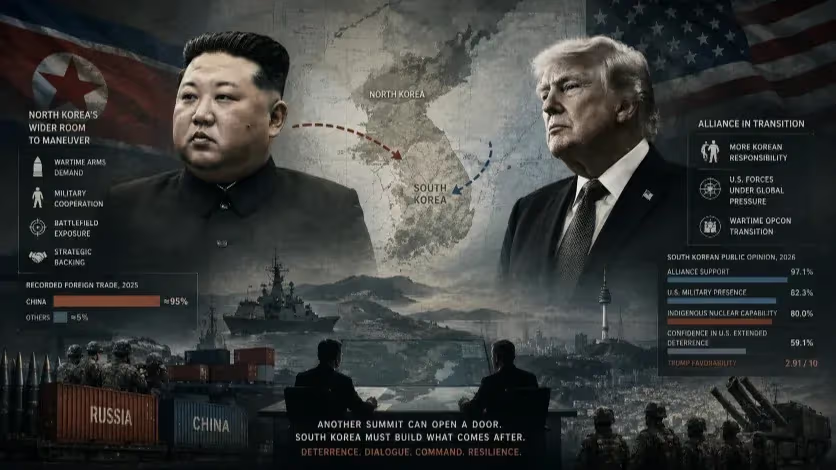 NewsAug 21, 2026
The Korean Peninsula Trump Is Returning To
Another Trump-Kim summit would unfold on a peninsula where North Korea is har...
More from the author
More from this byline
Stay with the same line of reporting through more work from this byline.
 NewsOct 21, 2026
What a Small Mackerel Is Worth

Reader Signal
Community readWhat did this report leave you with?
Choose the signal that best reflects your reading. Select it again to remove it.
One response per article
No response selected
A moderated conversation about the reporting.
One-level replies and newsroom moderation keep the conversation anchored to this article.
Discussion Status
Open
Please sign in to join the discussion.
Newsletter
Weekly reporting and context from Busan and Korea.