When Conservatism Loses Its Philosophy
A Starbucks scandal over Gwangju memory exposed a deeper crisis in South Korea’s right: a movement struggling to defend the institutions it claims to conserve.


On May 18, the anniversary of the 1980 Gwangju Uprising, Starbucks Korea promoted a “Tank Day” event with language that many South Koreans read as a collision of two wounds in the country’s democratic history: the military suppression of citizens in Gwangju and the notorious “tak” explanation associated with the 1987 torture death of student activist Park Jong-chul. The company withdrew the campaign. Its Korea chief, Sohn Jeong-hyun, was dismissed. Starbucks Global apologized, opened an internal investigation and promised tighter controls. Shinsegae’s E-Mart shares fell 5.5 percent as public anger spread beyond a consumer boycott.
The controversy was not difficult to understand. In South Korea, May 18 is not a neutral date. It marks the moment when citizens in Gwangju rose against military rule and were crushed by state violence. Nor is “tak” an innocent sound effect when placed inside the memory of South Korea’s democratic struggle. It recalls the police explanation after Park Jong-chul’s death, a phrase that became shorthand for a state trying to disguise torture as accident. A product slogan had stepped, whether by ignorance or indifference, into the vocabulary of authoritarian violence.
The first error was not the word “Tank” alone. It was the arrangement. A product line, a promotional date, a slogan and a national commemoration were placed close enough together to produce a political meaning the company either did not see or did not take seriously. In another country, the word might have passed as industrial branding. In South Korea, on May 18, it could not remain neutral.
Intent therefore became a weak defense. A company may not have meant to mock Gwangju. It may not have meant to invoke Park Jong-chul. But historical literacy in a democratic society is not measured only by intent. It is also measured by the ability to recognize which words, dates and images cannot be treated as empty commercial material. The failure was not that a marketer wrote a bad line. The failure was that a review process allowed the line to travel from concept to public campaign without anyone stopping it.
The corporate response addressed responsibility inside the company. It did not answer the larger cultural question. A brand operating in South Korea had failed to read one of the country’s most sensitive civic dates. That failure was not only a compliance problem. It suggested a gap between commercial professionalism and public memory. Modern corporations invest heavily in consumer data, seasonal timing, brand tone and digital engagement. Yet this campaign showed that a company can still lack the most basic civic intelligence: knowing when a date is not a sales hook.
When Memory Becomes Material
The Starbucks scandal might have ended as a case study in brand failure. It did not. Once the campaign touched Gwangju and Park Jong-chul, the question moved beyond Starbucks. It became a test of how South Korea’s political class handles democratic memory when that memory is inconvenient, emotionally charged or useful for partisan conflict.
The test was not passed.
The most revealing responses were not formal statements drafted after public criticism. They were the informal gestures that came before discipline arrived: social-media posts, jokes, evasive comments, boycott performances, the small theatrical acts through which politicians and party operatives signal where they stand before they are forced to explain what they mean. In contemporary politics, those gestures often matter more than official language. They show the instinct before the correction.
That kind of response is not full historical denial. It is something more common, and in some ways more corrosive: democratic trivialization. It does not openly argue that Gwangju was insignificant. It does not need to. It reduces the outrage surrounding Gwangju to something annoying, excessive or politically exploitable. It turns commemoration into culture-war bait. It invites supporters to read solemnity itself as partisan overreaction.
A society does not only remember through monuments and official ceremonies. It also remembers through restraint. Restraint is the decision not to joke at certain moments, not to weaponize certain wounds, not to treat every public controversy as another occasion for factional sport. When that restraint disappears, historical memory does not vanish. It is degraded into content.
The conservative reaction mattered more because it did not occur in isolation. South Korea’s right has long had an unsettled relationship with May 18. Party leaders have attended ceremonies, issued statements and tried to distance themselves from explicit denial. Yet the party has repeatedly struggled to make Gwangju feel like a shared democratic foundation rather than an obligation to be managed every May. The result is a politics of formal respect and informal discomfort. Leaders bow; operatives joke. Statements honor the victims; online supporters mock those who demand seriousness. The gap between ceremony and instinct remains visible.
A healthier political culture could have treated the scandal as a case for corporate accountability, historical education and institutional review. Instead, the reaction became another test of factional instinct. Some saw only a company’s mistake. Others saw proof of right-wing historical contempt. Still others treated the outrage itself as something to mock. The original question — how could this campaign happen? — became harder to hear.
The company supplied the spark, but politics supplied the oxygen.
The Right’s Missing Restraint
South Korea’s conservative crisis is often described as a rightward drift. That description is too mild. The problem is not simply that the right has moved further right. The problem is that parts of the right have abandoned the conservative disciplines that once gave the word “conservative” institutional meaning: constitutionalism, restraint, rule of law, respect for procedure and responsibility in the use of state power.
A conservative party is supposed to defend the institutions that make political conflict survivable: elections, courts, legislatures, procedures, limits on executive power and the peaceful transfer of authority. It may argue for a smaller state, stronger security, lower taxes, tougher criminal justice or slower social change. Those are ordinary disagreements inside democratic politics. What it cannot do, without hollowing out its own name, is treat constitutional limits as obstacles when its own leader loses control of the political field.
That is why former President Yoon Suk Yeol’s martial-law crisis became the central test of South Korean conservatism. The Constitutional Court’s ruling did not leave much room for ambiguity. The Court held that the declaration of emergency martial law failed to meet substantive requirements, found no actual crisis sufficient to justify martial law, and said Yoon violated both substantive and procedural requirements under the Constitution and the Martial Law Act. The Court also found that he mobilized military and police forces to interfere with the National Assembly’s exercise of power, and removed him from office in a unanimous decision.
For the conservative movement, that ruling should have created a moment of discipline. The right could have said that the impeachment decision was painful but binding, that martial law had no place in democratic competition, and that a post-Yoon conservatism would rebuild itself around institutional loyalty rather than personal loyalty. That would not have required the party to become moderate in every policy area. It would have required something more basic: the ability to distinguish conservatism from reaction, legal order from leader worship, and skepticism toward opponents from hostility toward the constitutional system itself.
Instead, the right entered a prolonged state of evasion. It did not fully collapse, but it did not reconstruct itself either. It accepted some institutional facts while leaving emotional space for those who refused them. It spoke the language of party continuity while parts of its base spoke the language of betrayal, conspiracy and restoration. Carnegie’s analysis of the post-impeachment conservative movement described far-right grassroots and online mobilization around Yoon as among the loudest and most visible conservative voices inside the People Power Party’s orbit.
The result is a form of conservatism that becomes less conservative as it becomes more militant. It claims to defend the nation but weakens confidence in national institutions. It claims to defend law and order but relativizes an attempt to use military power against political conflict. It claims to defend freedom but treats unfavorable courts, legislatures and media as captured enemies. It claims to defend history but remains unable to treat Gwangju as a democratic foundation shared across ideological lines. The contradiction is not cosmetic. It reaches the core of what the party says it is.
The crisis of the South Korean right is not that it has become too conservative. It is that it has become insufficiently conservative in the institutional sense.
The Map Has Been Moving
The crisis is not only philosophical. It is territorial.
The right has changed its name several times, reorganized its leadership, rebuilt campaign slogans and tried to present each defeat as temporary. Yet the electoral map tells a harder story. What was once a national governing force has been pushed into a narrower defensive structure, increasingly dependent on older voters, the southeast and anti-progressive consolidation rather than a broad governing coalition.
The decline did not begin with Yoon, but Yoon accelerated it. In 2012, the conservative Saenuri Party still held a parliamentary majority with 152 seats in the 300-seat National Assembly. The conservative bloc could still imagine itself as the natural party of government: presidential, parliamentary, regional and bureaucratic power were aligned closely enough to sustain that confidence.
By 2016, the confidence had cracked. The Democratic Party won 123 seats and became the largest party in the National Assembly, while Saenuri fell to 122 seats. The Council on Foreign Relations described the result as an unexpected failure of the former majority party and a sign of deep divisions inside South Korean politics.
The 2020 general election made the structural change unmistakable. The Democratic Party and its satellite party won 180 seats, while the conservative United Future Party and its satellite were reduced to 103, the worst conservative result in decades. The 2024 election confirmed the pattern: the Democratic bloc won 175 seats, while the People Power Party and its satellite won 108, leaving Yoon weakened and the opposition in control of the legislature.
The regional map is even more revealing. For decades, conservative stability rested on the southeastern wall: Busan, Ulsan, South Gyeongsang, Daegu and North Gyeongsang. That wall has not collapsed evenly, but it has weakened from the outside inward. Busan and the broader PK region are no longer simple conservative territory. They have become competitive terrain, shaped by urban voters, local economic decline, weaker party loyalty and the Democratic Party’s long effort to build local credibility.
Daegu remains culturally and organizationally conservative, and North Gyeongsang remains the deeper fortress. But the psychology of inevitability has weakened. Once voters in Busan treat the Democratic Party as a plausible governing option, and voters in Daegu are asked to compare candidates rather than simply confirm party identity, conservatism is no longer a default inheritance. It becomes a contested offer.
That is the deeper meaning of the map. South Korea has not become permanently progressive. The Democratic Party’s rise is partly earned and partly borrowed. It rests on conservative failure as much as progressive coherence. But the conservative decline is real because it is visible across time, institutions and geography. A party can survive one defeat. It can even survive several. When defeats align across Parliament, the presidency, local battlegrounds, youth politics and historical legitimacy, the issue is no longer campaign strategy. It is structural decline.
The Presidency as a Repeating Failure
The shrinking map of Korean conservatism is tied to an even deeper problem: the right has repeatedly won the presidency without proving that it can discipline presidential power.
In South Korea, conservative parties have often presented themselves as guardians of order, national security and competent administration. Yet the historical record attached to conservative rule is unusually heavy. The country’s conservative lineage includes presidents removed by impeachment, convicted of corruption, imprisoned for abuse of power or punished for the use of military force against democratic institutions. The problem is not only that individual presidents failed. It is that the conservative movement has repeatedly failed to explain why its presidents failed, what those failures reveal about its political culture and how it would prevent the next one.
The authoritarian roots of that burden run through Chun Doo-hwan and Roh Tae-woo. They do not belong to the contemporary People Power Party in a simple organizational sense, but they remain part of the historical inheritance of South Korean right-wing power: military rule, anti-communism, developmental legitimacy, state violence and the later demand for legal accountability. Roh, who became South Korea’s first directly elected president after democratization, ended his career with a conviction for treason and corruption; Reuters noted that both Chun and Roh were pardoned and freed in 1997.
The democratic-era record deepened the problem. Lee Myung-bak, who governed from 2008 to 2013, was later convicted of corruption, embezzlement and bribery and was serving a 17-year sentence before receiving a special pardon in 2022. Park Geun-hye’s fall was more politically destructive because it combined corruption, impeachment and mass civic mobilization; South Korea’s top court upheld a 20-year prison sentence for Park on graft charges in 2021 before she was later pardoned.
Yoon then turned a corruption lineage into a constitutional emergency. His case is different from Lee’s and Park’s because the core issue was not ordinary graft. It was the attempted use of emergency power against democratic institutions. A South Korean court sentenced Yoon to life in prison in February 2026 for leading an insurrection tied to his attempt to impose martial law in December 2024, according to Reuters; his lawyers have contested rulings and pursued appeals in related cases.
This is the point at which the conservative presidential problem becomes a party problem. A party can distance itself from one disgraced president. It can apologize for one scandal, change its name after one defeat, or argue that one leader betrayed its values. But when successive conservative presidents end in prison, impeachment, pardon or insurrection conviction, the explanation can no longer rest on personal weakness alone. The pattern suggests a deeper failure to discipline power once the right controls the presidency.
The repeated pardons complicate the story further. They were often justified in the language of national unity, health, reconciliation or moving beyond political revenge. Yet they also helped create a political culture in which conservative presidential crimes could be legally punished and later politically softened. Accountability arrived, but its moral lesson was blurred. The country saw convictions, but the right did not necessarily undergo ideological reconstruction. The result was a cycle: scandal, conviction, apology, pardon, party rebranding, return to power, new scandal.
The right has been better at winning executive authority than at building internal restraints around it.
The Feeling of Having Lost One’s Share
The conservative crisis cannot be explained only from the top, through party leaders, court rulings and factional calculations. It also has to be read from below, through the voters and online publics that make certain kinds of politics rewarding.
Among them, young men have become one of the most contested constituencies in South Korean democracy. They are not a single bloc, and they should not be described as if a generation or a gender had moved uniformly into extremism. But a portion of young men has become unusually receptive to political narratives that turn economic insecurity into a story of personal loss, and personal loss into resentment against feminism, redistribution, institutional liberalism or the political establishment.
The evidence does not show that young Korean men as a whole have become far-right. It shows something narrower and more politically important: a segment of young men has become more receptive to right-wing and far-right narratives when those narratives frame economic insecurity, military-service burdens, gender-equality policy and institutional distrust as a zero-sum struggle over status and opportunity. Reuters has described this as part of a wider Gen Z gender divide across democracies, with young men moving rightward while young women lean left; in South Korea, the divide has been sharpened by disputes over military service, perceived job discrimination and support for right-leaning alternatives such as the Reform Party.
The mechanism is not simple selfishness. It is defensive interest politics. Many young men entered adulthood after the older promises of South Korean development had already weakened. A stable job no longer guarantees housing. Housing no longer guarantees marriage. Marriage no longer guarantees social status. Military service is experienced by many men as a compulsory interruption at precisely the moment when competition over education, employment and income is most intense. In that environment, equality policies can be reinterpreted through a zero-sum lens. What one group calls correction, another group experiences as subtraction. What policymakers present as structural fairness can be heard by a precarious young man as another reduction in his already narrowing chances.
This is where gender backlash becomes politically useful. It does not require every young man to hold a coherent anti-feminist ideology. It only requires enough of them to feel that gender equality has stopped being a promise of fairness and has become a rival claim on scarce resources. Hanna Kim and Youngdeuk Park’s study in Asian Survey examines this connection directly, arguing that pessimistic economic perceptions among young Korean men are linked to weaker support for gender-equality policies through the logic of intergroup threat in resource-scarce conditions.
That does not mean sexism disappears from the analysis. It means sexism often travels through material anxiety rather than apart from it. A young man who believes that stable work, marriage and status are slipping out of reach may become more open to claims that feminism, women’s policies or “reverse discrimination” are part of the reason. Carnegie’s 2025 report on gender equality in South Korea identifies a “status aspiration gap” among young men — the distance between where they see themselves and where they believe they should be — as a strong predictor of resistance to gender-equity initiatives and higher levels of hostile or modern sexism.
Meritocracy gives this feeling a moral language. In South Korea, meritocracy is not merely an economic principle. It is a social ethic built through exams, credentials, ranking and competition. For many young people, it remains one of the few languages that still seems objective in a society where family wealth, housing assets and regional background quietly structure opportunity. The problem begins when meritocracy is narrowed into formal competition alone. If the exam is the same, the system is declared fair. If the starting line is unequal, that inequality is treated as background noise. Under this logic, policies designed to correct structural disadvantage appear not as repairs to unfairness, but as unfairness itself.
That is why anti-feminist politics can present itself as fairness politics. It rarely announces itself as hostility to women in its most politically effective form. It speaks instead of equal rules, equal burdens, equal competition and the unfairness of special treatment. Those words have real appeal because young men do face burdens that progressive politics has often failed to address convincingly, including military service, employment insecurity and declining expectations of family formation. But when those burdens are explained almost entirely through feminism or gender-equality policy, politics stops asking why the ladder broke and starts asking who else is standing on it.
Youth Without a Social Contract
The Reform Party sits in a different place from the openly far-right movements reshaping parts of Europe and the United States. It does not present itself as a party of racial nationalism, religious restoration or authoritarian nostalgia. Its language is more technocratic, more market-oriented and more fluent in the vocabulary of generational fairness. It attacks the old parties for hypocrisy, inefficiency and moral exhaustion. It speaks to voters who believe the People Power Party is trapped by Yoon’s legacy and that the Democratic Party has become too comfortable with its own power.
The problem is that an alternative to the old parties is not the same as an alternative political philosophy. The Reform Party’s appeal has often rested on its ability to identify what is broken rather than on its ability to define what should replace it. It is effective at naming the failures of the two-party system, the burden placed on younger generations, the unfairness felt by men who see military service and job competition as ignored by progressive politics, and the cynicism of older politicians who invoke reform while protecting their own machines. Those diagnoses can be sharp. They are not enough to build a durable party. A political project becomes serious only when it turns complaint into governing principles, and the Reform Party has not yet shown that it can consistently do so.
Its central weakness is philosophical thinness, not tactical weakness. Lee Jun-seok and the politicians around him understand media, conflict and political timing better than many older conservatives. They know how to turn a debate stage into a clip, a policy dispute into a generational contrast, and an opponent’s inconsistency into a public humiliation. That skill makes them look modern. It does not necessarily make them constructive. A politics built on exposure, ridicule and clever negation can discipline opponents, but it cannot by itself answer how a country should distribute burdens between men and women, workers and asset owners, Seoul and the regions, retirees and young taxpayers, market freedom and social protection.
The Reform Party’s youth appeal is therefore double-edged. It has helped expose the failure of older parties to speak honestly about military service, housing, labor-market dualism and the frustrations of young men who feel that progressive language recognizes every inequality except theirs. Those frustrations should not be dismissed. A democratic politics that refuses to hear them will only push more voters toward harder forms of resentment. But recognition becomes dangerous when it stops at validation. If young male anger is treated as a resource to be harvested rather than a problem to be converted into policy, youth politics becomes another version of the politics it claims to replace.
A sustainable youth party would have to do more than speak the emotional grammar of young men. Military service would have to be discussed not as a weapon against women but as a state obligation that demands compensation, career protection and institutional fairness. Housing would have to be treated not as a matter of individual failure but as an asset regime that has transferred security upward and backward to older property owners. Labor reform would have to address the divide between protected insiders and precarious outsiders without turning every worker against every other worker. Gender equality would have to be framed not as a rival claim on male opportunity, but as part of a broader reconstruction of family, work and care in a country facing demographic collapse.
The Reform Party represents both a symptom and a possibility. It is a symptom of a political system that has left many younger voters convinced that the old parties are morally exhausted. It is also a possible vehicle for generational reform if it can move beyond anti-feminist signaling, personality politics and tactical negation. The choice is not between youth and experience, or between disruption and stagnation. The real choice is between a youth politics that builds institutions and a youth politics that merely performs revolt.
The Market for Male Grievance
South Korea is not an exception to the politics of male grievance. It is one of its most compressed cases.
Across democratic societies, parties and movements on the right have learned to organize young men’s insecurity through a familiar sequence: economic uncertainty becomes status anxiety, status anxiety becomes resentment, resentment is given a cultural target, and the target is turned into a voting identity. The targets differ by country. In Europe, immigration and national identity often sit at the center. In the United States, diversity programs, feminism, universities, media and the bureaucratic state are frequent targets. In South Korea, the sharper terrain is military service, anti-feminism, compressed job competition, housing pressure, mistrust of established parties and unresolved memories of authoritarian rule.
European data points in the same direction. An analysis published by the European Consortium for Political Research found that young men’s support for far-right parties in Europe reached 21 percent in 2024, compared with 14 percent among young women, and that the gap widened rapidly after 2020. The importance of that finding lies less in the exact percentage than in the direction of travel. Younger voters were once often assumed to be naturally more progressive than older voters. That assumption is becoming less reliable when gender is added to the analysis.
The far right’s success with young voters is not only ideological. It is also technological and stylistic. Reuters reported after the 2024 European Parliament elections that far-right parties gained support among young voters in Germany, France, Poland and Spain, aided by politicians fluent in TikTok and YouTube and by a generation shaped by repeated crises.
That does not mean digital fluency causes radicalization by itself. It means political movements that already have simple enemies and emotionally satisfying explanations travel well through short-form media. A party that says housing is expensive because of asset structures, monetary policy, land use, intergenerational inequality and labor-market dualism has to ask voters to tolerate complexity. A movement that says immigrants, feminists, corrupt elites or traitorous institutions stole the future offers a cleaner story. Digital platforms reward the cleaner story because it is easier to clip, repeat, mock and personalize. The more politics becomes a competition for attention, the more resentment gains an advantage over institutional explanation.
Germany shows how quickly that advantage can move from online style to territorial power. Reuters reported in May 2026 that the AfD was gaining momentum in eastern regions such as Saxony-Anhalt, where one poll put its support as high as 41 percent despite the state branch being classified by domestic intelligence as far-right extremist. The party’s strength there is not built only on online provocation. It is also local, economic and social: dissatisfaction with prices, migration, regional decline and mistrust of mainstream parties.
The American case adds another layer: masculinity as media strategy. Recent scholarship on Donald Trump’s 2024 campaign argues that Trump increasingly bypassed mainstream media and used podcasts, sports-related platforms and “bro influencers” to reach male voters through a style built around combativeness, warrior language and strongman appeal. The point is not that every listener became radicalized. The point is that the campaign understood male grievance as a media ecosystem, not just a demographic category.
South Korea’s vulnerability lies in how many of these sequences can connect at once. The country has one of the world’s most intense education and employment competitions, a housing market that has turned adulthood into an asset test, mandatory military service for men, a severe fertility crisis, deep gender mistrust, low institutional confidence and a political right still haunted by authoritarian memory. When young male grievance enters this landscape, it can attach itself not only to anti-feminism but also to anti-communism, election denial, hostility toward courts, contempt for journalists and nostalgia for order. That is what makes the Korean case distinct. In many countries, male backlash threatens liberal equality. In South Korea, it can also become entangled with the legitimacy of democratic transition itself.
The global lesson is not that South Korea is merely importing Western culture wars. It is that democratic politics everywhere is struggling to produce a serious account of young men’s insecurity without surrendering to the politics of resentment. The far right has one answer: name an enemy, restore hierarchy, punish elites and turn anger into belonging. Technocratic centrism has another answer: adjust policy parameters and hope the anger subsides. Neither is sufficient. The first corrodes pluralism. The second underestimates the emotional depth of the problem.
What a Democratic Right Would Have to Do
There is still room for a conservative alternative in South Korea. The country has voters who want fiscal discipline, market competition, security realism, skepticism toward bureaucratic expansion, stronger local economies and checks on progressive overreach. A healthy democracy needs such a force. South Korea does not need a weaker right. It needs a democratic right.
But the existing right cannot become that force merely by surviving the next election. Its first requirement is a clean constitutional break. Martial-law apologetics, election denial, Gwangju relativization and leader-centered restoration politics must be placed outside the party’s legitimate space. Without that break, any talk of renewal will remain a slogan. A conservative party that cannot say the state must never again be used against the legislature cannot credibly call itself conservative.
The second requirement is institutional reform inside the party. Candidate selection cannot reward conspiracy politics, online cruelty or loyalty to disgraced leaders. A serious right would build a training pipeline for local candidates who understand budgets, welfare, housing, industry, education and constitutional law. It would not treat youth politics as a performance category. It would ask whether younger politicians can govern, not merely whether they can attack. It would rebuild internal dissent so that future presidents cannot turn personal grievance into state policy without resistance from within their own party.
The third requirement is policy reconstruction. The right needs a program that speaks to voters outside its shrinking base without surrendering to resentment. That means a housing agenda for young adults, a labor-market agenda that addresses dualism without demonizing organized workers, a military-service agenda that compensates burdens without turning women into enemies, a family and care agenda that responds to demographic collapse, and a regional economic agenda that treats Busan, Ulsan, South Gyeongsang, Daegu and North Gyeongsang as places with real economic futures rather than inherited voting blocs.
The fourth requirement is historical clarity. A democratic right does not have to adopt progressive historical language in full, but it must accept the constitutional meaning of Gwangju, the democratic significance of Park Jong-chul’s death and the illegitimacy of using military force to solve political conflict. These are not left-wing positions. They are the minimum conditions for democratic conservatism in South Korea. If the right cannot claim them confidently, it will remain trapped between formal democracy and emotional authoritarianism.
Before Resentment Becomes Power
The Starbucks scandal belongs at the beginning of this larger story because a democracy reveals itself not only in elections or court rulings, but in how it handles memory, defeat, resentment and generational fear. South Korea’s right is not merely choosing between moderation and radicalism. It is choosing whether conservatism will mean constitutional responsibility or grievance management. Its young politicians are not merely choosing between old and new. They are choosing whether youth politics will become a vehicle for policy, or a faster, sharper, more online version of the same politics of division.
The danger is not that young men are angry. Anger can be politically legitimate when it points to unaffordable housing, unstable work, military-service burdens and blocked mobility. The danger is that political actors are turning that anger away from structural reform and toward scapegoats. When economic anxiety becomes gender resentment, when conservatism abandons constitutional restraint, and when youth politics becomes online performance, democracy loses the language it needs to solve real problems.
South Korea’s conservative crisis is therefore not only a party crisis. It is a test of whether democratic politics can still turn grievance into policy rather than resentment into power. Until the right proves that it has learned from the presidents it produced, every promise of renewal will carry the shadow of the same question: why does conservative power in South Korea so often end in a courtroom?
Continue this reporting
Reporting on the same issue
Related coverage selected from the article's desk, topics and newsroom relationships.
 NewsOct 4, 2026
Zelensky, South Korea and the Limits of Wartime Pressure
South Korea says Kyiv broke a confidentiality understanding when Zelensky rev...
 NewsSep 1, 2026
What Lee Jae Myung Thinks a Minister Can Fix
President Lee Jae Myung says reform should be judged by results rather than c...
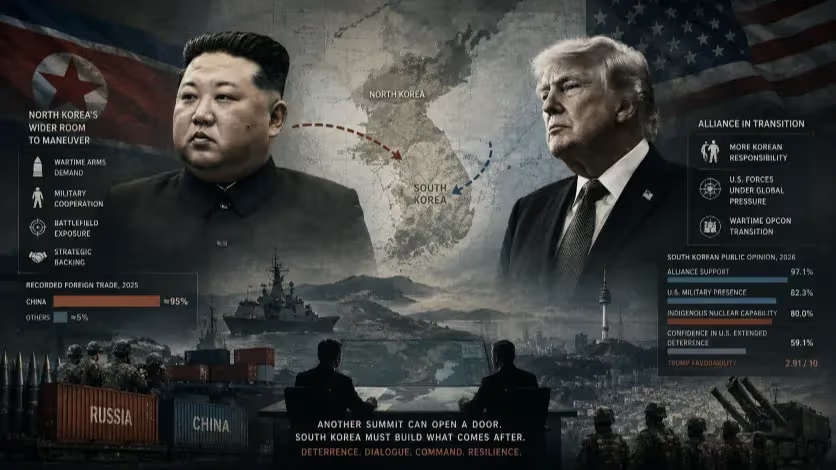 NewsAug 21, 2026
The Korean Peninsula Trump Is Returning To
Another Trump-Kim summit would unfold on a peninsula where North Korea is har...
More from the author
More from this byline
Stay with the same line of reporting through more work from this byline.
 NewsSep 16, 2026
Busan’s Young-Adult Migration Turns Sharply at 25–29

Reader Signal
Community readWhat did this report leave you with?
Choose the signal that best reflects your reading. Select it again to remove it.
One response per article
No response selected
A moderated conversation about the reporting.
One-level replies and newsroom moderation keep the conversation anchored to this article.
Discussion Status
Open
Please sign in to join the discussion.
Newsletter
Weekly reporting and context from Busan and Korea.