South Korea’s Far Right: An Opportunistic Hybrid in Global Extremism
South Korea’s far right is less an ideology than a fusion—rooted in Cold War anti-communism, evangelical networks, and borrowed narratives from the U.S. and Japan.


On a recent weekend in Myeongdong, one of Seoul’s busiest shopping districts, a crowd gathered waving Korean flags and chanting anti-China slogans. The demonstration was small compared to mass rallies of the past, but its symbolism was unmistakable: South Korea’s far right is reshaping its identity around imported narratives of election fraud, Cold War anti-communism, and, increasingly, anti-China sentiment.
Unlike the American far right, grounded in white nationalism, or Japan’s uyoku movements rooted in historical revisionism and emperor-centered nationalism, Korea’s far right has emerged as an opportunistic hybrid. Its core lies not in coherent philosophy but in the tactical fusion of evangelical Protestant mobilization, conspiracy-driven narratives, and borrowed frames from abroad. What results is a volatile movement that thrives on immediate political utility rather than long-term ideological depth.
South Korea’s far right was born out of Cold War anti-communism, reshaped by evangelical Protestant networks, and now borrows from American populism and Japanese ultranationalism — a hybrid both resilient and fragile.
Origins of a Hybrid
The origins of South Korea’s far right lie not in a coherent nationalist doctrine but in the unfinished legacies of liberation and the Cold War. When the peninsula was divided in 1945, the new South Korean state relied on anti-communism as its defining ideology. Former collaborators with Japan, many of whom had administrative or policing experience, were recast as guardians against the North. Instead of building a nationalist narrative around sovereignty or cultural pride, the conservative establishment consolidated around one pillar: anti-communism.
During the military regimes of the 1960s and 1970s, that pillar became institutional dogma. School textbooks, civic rituals, and Sunday sermons from conservative pulpits alike framed communism not simply as a rival ideology but as an existential evil. The state’s survival narrative and Christian moral language fused, creating a uniquely moralized form of political anti-communism.
Democratization in the late 1980s did not dissolve this foundation. It gave conservatives a new sense of vulnerability. For some evangelical churches, aligning with political conservatism became a strategy to preserve influence. The slogans of “anti-North” and “anti-communist” politics were recycled in religious rallies and mass vigils, blending political discourse with apocalyptic imagery.
By the 2000s, digital platforms provided a new delivery system. YouTube broadcasters and street rallies filled a vacuum left by weakened traditional conservative parties. Movements like the “Taegukgi protests” turned anti-communist rhetoric into viral content, while conspiracy theories around “rigged elections” gained traction during the 2020 general election and 2022 presidential race. In that moment, far-right rhetoric stopped being peripheral and moved into the conservative mainstream.
The trajectory reveals three enduring pillars: Cold War anti-communism, evangelical mobilization, and digital amplification. Unlike the United States, where white identity politics underpins the far right, or Japan, where ultranationalism and historical revisionism form its core, South Korea’s far right grew out of opportunistic grafting on a thin ideological base. That history explains both its adaptability and its fragility today.
Ideologies Compared
The far right is often discussed as a global trend, but its roots and ideological pillars vary sharply across countries.
United States. In America, far-right politics rests on a clear intellectual lineage. White supremacism, anti-federalism, and “America First” nationalism trace back to the aftermath of the Civil War and were reinvigorated during the 20th century. The MAGA movement and the QAnon conspiracy ecosystem added new intensity, embedding far-right ideas inside the Republican Party rather than leaving them on the margins. The unifying narrative is restorative: the belief that America has lost its greatness and must be returned to an imagined past.
Japan. The Japanese far right draws strength from the imperial legacy and post-war nationalism. Ties to the Liberal Democratic Party’s right wing, along with street organizations and the online “net-uyoku,” reinforce themes of historical revisionism, xenophobia, and hostility toward China and Korea. Here, the philosophical anchor is ethnic nationalism and cultural purity — the claim that “true Japan” must be defended against outside contamination and liberal dilution.
South Korea. In contrast, South Korea’s far right lacks a coherent philosophical base. Its central axis was Cold War anti-communism, but that single plank weakened as the decades passed. To fill the void, evangelical Protestant churches supplied mobilization power, while imported slogans supplied ideological packaging. U.S. narratives of “stolen elections” and Japanese-style anti-China sentiment were grafted onto Korea’s anti-North tradition. The result is not a consistent doctrine but an opportunistic hybrid: part religious movement, part echo of foreign rhetoric, part political faction fighting for survival.
In short, American and Japanese far-right movements operate from comparatively consistent ideological cores — racial identity in one case, ethnic nationalism in the other. Korea’s version is less a philosophy than a bricolage, assembled to meet political needs and sustained by networks of pastors, YouTubers, and activists. That divergence explains why analysts often describe South Korea’s far right as a “variant” rather than an orthodox form.
Faith as a Platform
If the United States far right draws its energy from racial nationalism, and Japan’s from an ethno-cultural narrative rooted in imperial memory, South Korea’s variant finds cohesion in the pews. Conservative Protestant churches, with sprawling congregations and centralized authority, have become not just allies but the structural backbone of extremist mobilization.
This trajectory was not predetermined. For much of the twentieth century, Korean Protestantism aligned with democratization and social activism. But as Cold War anti-communism calcified into a moral creed, pastors began to recast theology in explicitly political terms. Communism was redefined as both geopolitical enemy and spiritual evil. In sermons, the language of salvation blurred seamlessly into the language of national security. Over decades, congregations were socialized into a framework where political loyalty and Christian faith became inseparable—an example of what scholars describe as religious nationalism or even political theology in practice.
The twenty-first century has intensified this fusion. Churches provide what extremist organizers lack: disciplined networks of tens of thousands, physical venues for rallies, and steady financial flows. Pulpits serve as megaphones, amplifying slogans of “anti-communism,” “anti-China,” or “election fraud” with biblical authority. Repetition in weekly worship lends these claims a moral weight far exceeding that of online propaganda. Pastors who enter the political arena position themselves as guardians of both faith and nation, framing civic disputes as spiritual warfare.
The incentives are reciprocal. For church leaders, political engagement translates into media visibility, donations, and proximity to power. For far-right organizers, partnership with churches confers legitimacy and access to ready-made communities already habituated to collective discipline. The alliance operates as a feedback loop: pastors expand influence, while extremists gain an enduring social base.
This religious-political marriage sets South Korea apart. In the U.S., evangelical Christianity provides a vital reservoir for conservative politics, but it is not monopolized by the extremist fringe. In Japan, ultranationalism has little theological anchor, remaining a secular ethno-political project. South Korea instead has produced a hybrid: a form of religious nationalism in which theology and conspiracy, pulpit and protest, are fused so tightly that separating belief from strategy is nearly impossible.
Borrowed Scripts
South Korea’s far right has not built its identity on a singular homegrown ideology. Instead, it has absorbed and repurposed narratives that gained traction abroad—most visibly from the United States and Japan. This process has created a hybrid discourse that feels familiar to international observers but operates with distinctly Korean dynamics.
From the United States came the language of electoral conspiracy. After Donald Trump’s defeat in 2020, “Stop the Steal” became a rallying cry for his supporters, challenging the legitimacy of democratic institutions. Within months, the same vocabulary surfaced in South Korea. Conservative pastors and YouTube personalities began to insist that the 2020 and 2022 elections were manipulated, often citing American examples as proof that democratic systems everywhere are corrupt. This rhetoric offered a simple, portable frame: if a political loss occurs, blame fraud, never strategy or policy.
From Japan, the import has been more cultural than procedural. Japanese ultranationalist movements have long trafficked in anti-China sentiment, blending historical grievance with contemporary geopolitical tension. These themes have found resonance in South Korea’s far-right spaces, where suspicion of China aligns with broader Cold War–style anti-communism. The Myeongdong anti-China protests, staged under the guise of economic or security concerns, are in practice an echo of Japanese right-wing demonstrations that portray China as an existential threat to national sovereignty.
The result is a composite ideology. Fraud claims from America, anti-China street politics from Japan, and the enduring South Korean obsession with anti-communism fuse into a single, if unstable, political narrative. What makes this fusion effective is not intellectual coherence but its adaptability. Organizers can shift emphasis depending on the news cycle—election season invites American-inspired conspiracy theories, while international disputes with Beijing ignite Japanese-style street protests.
In this sense, South Korea’s far right acts less as an originator of ideas than as a consumer and amplifier. Yet, by tailoring imported slogans to local anxieties, it manages to turn borrowed rhetoric into a potent tool of mobilization.
The Yoon Factor
For South Korea’s far right, politics has always been less about a coherent philosophy than about attaching itself to figures who can amplify its influence. In recent years that figure has been President Yoon Suk-yeol.
When Yoon emerged as a conservative candidate, he was not a natural icon for the movement. A former prosecutor with little history in the nationalist or evangelical spheres, he carried none of the cultural markers that typically animate far-right mobilization. Yet the movement quickly rallied around him. What mattered was not alignment of values but utility: Yoon offered a credible path back to power after years of progressive rule.
The alliance was transactional. For Yoon’s camp, the energy of far-right activists — their capacity to stage large rallies, dominate online channels, and pressure mainstream conservatives — proved indispensable. For the activists, Yoon became a vessel through which to legitimize their narratives of election fraud, anti-communism, and anti-China grievance. By cloaking themselves in support for a sitting president, they transformed from fringe actors into stakeholders in national politics.
This embrace has not been without tension. Yoon has often presented himself as a pragmatic conservative rather than an ideologue, and his administration has sought to maintain international credibility. The far right, meanwhile, demands unflinching validation of its grievances, from street protests to conspiracy claims. The result is a delicate dance: Yoon leverages their mobilization when it is useful, but distances himself when their rhetoric threatens to alienate moderates or damage Korea’s global image.
In effect, South Korea’s far right does not require philosophical fidelity from its political standard-bearers. It requires only that they serve as vehicles for amplification. This makes the movement flexible and adaptive — but also fragile, since its loyalty is rooted in expedience rather than enduring belief.
Belief as Identity
The resilience of South Korea’s far right is less about doctrine than about the psychological alchemy that turns slogans into convictions. Political psychologists describe this as the shift from opinion to identity: once a claim becomes a marker of group belonging, its empirical accuracy becomes secondary to its symbolic power.
Motivated reasoning and identity-protective cognition are at the core of this process. Supporters do not approach information neutrally; they pre-filter it through partisan loyalty. Facts that reinforce the narrative are embraced as validation, while contrary evidence is rejected as propaganda from hostile elites. The 2022–2023 election fraud controversy demonstrates this vividly. Even after repeated legal dismissals and independent audits, rallies in Seoul insisted the vote had been “stolen,” reframing debunking itself as proof of establishment corruption.
What follows is a cycle of belief perseverance reinforced by dense social networks. Conservative Protestant congregations act as echo chambers in analog form: sermons, prayer groups, and post-service gatherings recycle political themes until dissent becomes unthinkable. Social identity theory helps explain this dynamic—once respected pastors or peers frame skepticism as disloyalty, the social costs of doubt outweigh any private misgivings. Political suspicion mutates into moral obligation, buttressed by what scholars call moral conviction, where issues are experienced not as policy disputes but as sacred imperatives.
Digital media adds another layer. Far-right YouTube channels popular among younger men operate as algorithm-driven echo chambers. Outrage is rewarded, live chats supply constant affirmation, and conspiracy theories are packaged as community rituals. This fosters identity fusion, where politics fuses with personal morality and religious faith. In this frame, defending election fraud claims or anti-China rhetoric is no longer seen as partisan argument but as a spiritual struggle.
Finally, groupthink consolidates uniformity. When movements define themselves as besieged by hostile forces—be it the progressive government, “globalists,” or foreign adversaries—internal critique becomes betrayal. Leaders who raise doubts about tactical alliances with the U.S. or Japan risk being cast out. This suppression of dissent ensures that conspiracy frames persist long after their factual shelf life has expired.
In effect, what begins as opportunistic rhetoric—anti-communism, anti-China sentiment, stolen-election claims—takes root through psychological reinforcement until it becomes an unquestionable identity. The durability of South Korea’s far right lies not in ideological coherence but in the conversion of political slogans into sacred commitments, sustained by both pews and pixels.
A Global Network
South Korea’s far right does not exist in a vacuum. It is entangled in a wider transnational web that links Seoul, Washington, and Tokyo through events, digital platforms, and rhetorical borrowing. What emerges is less a coherent alliance than a mutually reinforcing circuit of validation, where movements gain stature by appearing global.
The Conservative Political Action Conference (CPAC) has become a central hub. Its Korean offshoot, KCPAC, functions as both stage and bridge: U.S. figures tied to MAGA populism deliver speeches in Seoul, while Korean pastors and activists appear on American programs such as Steve Bannon’s War Room. These encounters rarely hinge on shared ideology. Rather, they provide symbolic capital: American conservatives project global reach, while Korean activists frame themselves as warriors in an international struggle. This is a form of what scholars of populism call transnational diffusion, where rhetoric and tactics are exported, localized, and recycled across borders.
Japan adds another layer of resonance. Ultranationalists there—long engaged in anti-China mobilization and historical revisionism—offer frames that South Korean extremists selectively adapt. The Myeongdong protests of 2025, where Korean demonstrators carried anti-China banners, closely echoed language sharpened by Japanese right-wing groups. Historical grievances between Seoul and Tokyo inhibit formal cooperation, but the circulation of “anti-China” and “anti-communism” slogans shows how ideological commodities cross borders regardless of unresolved history.
Digital infrastructure accelerates this process. YouTube’s recommendation algorithms frequently link Korean channels to American conspiracy outlets, while memes and slogans migrate through Telegram groups and Twitter re-shares within hours. Political communication scholars describe this as a networked information ecology—a space where national borders matter less than the logics of virality. For Korean extremists, this ecology supplies both ready-made narratives and a sense of belonging to something larger than their fragmented domestic politics.
Yet these global linkages do not erase local contradictions. Unlike the U.S., where white nationalism grounds the far right, or Japan, where ethnic homogeneity anchors ultranationalism, South Korea’s variant lacks a coherent philosophical base. Its distinctiveness lies in its opportunism: importing electoral conspiracies from the United States, xenophobic anti-China discourse from Japan, and religious legitimacy from conservative Protestantism. In this ecosystem, Korea becomes both borrower and amplifier—absorbing narratives while offering American and Japanese counterparts a convenient partner to showcase their “global resonance.”
Strong Yet Brittle
The durability of South Korea’s far right is not guaranteed. Its strength lies in rapid mobilization, opportunistic borrowing of narratives, and its embedment in existing infrastructures such as conservative Protestant churches and digital platforms. Yet those very traits illuminate its fragility.
Unlike the United States, where the far right can draw from deep reservoirs of white nationalism and anti-federalist traditions, or Japan, where ultranationalists mobilize around ethnically homogenous identity and historical revisionism, South Korea’s far right lacks a coherent philosophical anchor. What exists is closer to what scholars call opportunistic populism: a bricolage of frames stitched together from abroad—electoral denialism from the U.S., anti-China hostility from Japan—layered onto a residual Cold War anti-communism at home. This hybrid provides immediate mobilization but struggles to articulate a sustainable vision or institutional pathway.
The reliance on opportunism generates chronic vulnerabilities. Rivalries among pastors, YouTube entrepreneurs, and street organizers flare whenever resources or visibility are at stake, producing factionalism rather than cohesion. The absence of a unifying doctrine means that collective identity must be continuously manufactured through crises—alleged election fraud, geopolitical confrontation with China or North Korea, or moments of scandal involving domestic leadership. Without such flashpoints, cohesion dissipates, exposing what theorists of social movements describe as episodic mobilization: bursts of intensity without long-term consolidation.
Religion adds both ballast and volatility. Evangelical congregations supply durable networks, spaces, and symbolic legitimacy. Yet their participation is contingent on charismatic authority and moral narratives. When political activism eclipses spiritual leadership, legitimacy erodes within the pews. This creates a paradox: the very churches that enable sustained mobilization also constrain it by limiting appeal to a broader conservative public wary of politicized faith.
International connections further complicate sustainability. Being part of a MAGA-centered transnational ecosystem grants visibility and rhetorical ammunition, but it also risks overdependence on imported frames that may not resonate with Korean realities. Theories of transnational diffusion warn that movements borrowing scripts from abroad often face problems of local translation, and South Korea’s far right is no exception. Its survival depends on adapting these foreign narratives into domestic idioms that can be sustained beyond momentary outrage.
The result is a movement that is simultaneously resilient and brittle. Its digital and religious infrastructures ensure persistence, but its ideological incoherence and dependence on crisis-driven mobilization prevent institutionalization. The question is not whether the far right will disappear—it will endure as a latent current—but whether it can evolve from an opportunistic variant into a durable political force. That outcome will hinge less on the movement itself than on whether mainstream conservative politics chooses to contain, accommodate, or capitulate to its demands.
Opportunism Without Philosophy
South Korea’s far right stands apart from the more ideologically coherent movements in the United States and Japan. Where American extremism is grounded in white nationalism and constitutional revisionism, and Japanese ultranationalism draws on imperial memory and ethnic exclusivity, the Korean variant survives through opportunism. It mixes Cold War anti-communism with imported slogans, harnesses conservative Protestant networks for mobilization, and leans on conspiracy narratives to sustain outrage.
This hybrid has proven potent in the short term. It can turn street demonstrations into political spectacles, translate sermons into electoral demands, and import foreign frames with remarkable speed. Yet the very traits that give it agility also expose its fragility. Without a philosophical core, it risks splintering once charismatic leaders lose relevance or imported narratives lose traction. Its reliance on churches and digital platforms provides energy but also makes it vulnerable to generational shifts and regulatory pushback.
For now, the Korean far right has positioned itself as both a beneficiary and a participant in global extremism, amplifying and being amplified by its counterparts in the U.S. and Japan. But whether it consolidates into a durable political force or unravels under the weight of its contradictions will depend on more than borrowed rhetoric. It will hinge on whether it can translate opportunism into a coherent identity — or whether its hybrid character remains a symptom of a movement built more on expedience than conviction.
Opportunism Without Philosophy
South Korea’s far right occupies a peculiar place within the global landscape of extremism. Unlike the American variant, anchored in white nationalism and anti-federalist constitutionalism, or the Japanese model, rooted in imperial nostalgia and ethnic exclusivity, the Korean movement lacks a unifying philosophical core. What sustains it instead is opportunism: a tactical stitching together of Cold War anti-communism, borrowed conspiracy frames from abroad, and the mobilizing power of conservative Protestant churches.
This hybrid has proven remarkably effective in the short run. Street protests can be rapidly transformed into political theater; sermons become rallying cries with electoral implications; and foreign slogans—whether American “Stop the Steal” rhetoric or Japanese anti-China tropes—are translated into a Korean register with surprising ease. Agility is its greatest strength. Yet agility without coherence is also a liability. Without a doctrinal center, the movement is prone to splinter once charismatic leaders falter or imported narratives lose resonance.
Its reliance on churches and digital platforms illustrates both power and precarity. Religious networks provide infrastructure and legitimacy, but they also tether the movement to generational divides and internal doctrinal disputes. Digital ecosystems amplify its reach, but they remain vulnerable to regulation and to shifts in audience attention. In comparative terms, what Korea has built is not an ideological fortress but a political marketplace, where outrage is sustained by continual borrowing and tactical adaptation.
For now, the Korean far right functions as both consumer and amplifier within the wider transnational circuit of extremism. Its resonance with U.S. MAGA populism and Japanese ultranationalism gives it visibility beyond its borders, while its domestic tactics enrich the global playbook of hybrid far-right mobilization. Whether it consolidates into a durable political bloc or unravels under the weight of its contradictions will depend on more than its ability to import slogans. The decisive test lies in whether opportunism can harden into a coherent identity—or whether its hybrid character reveals a movement destined to remain brittle, reactive, and ultimately expendable.
Continue this reporting
Reporting on the same issue
Related coverage selected from the article's desk, topics and newsroom relationships.
 NewsOct 4, 2026
Zelensky, South Korea and the Limits of Wartime Pressure
South Korea says Kyiv broke a confidentiality understanding when Zelensky rev...
 NewsSep 1, 2026
What Lee Jae Myung Thinks a Minister Can Fix
President Lee Jae Myung says reform should be judged by results rather than c...
 NewsAug 21, 2026
The Korean Peninsula Trump Is Returning To
Another Trump-Kim summit would unfold on a peninsula where North Korea is har...
More from the author
More from this byline
Stay with the same line of reporting through more work from this byline.
 NewsOct 9, 2026
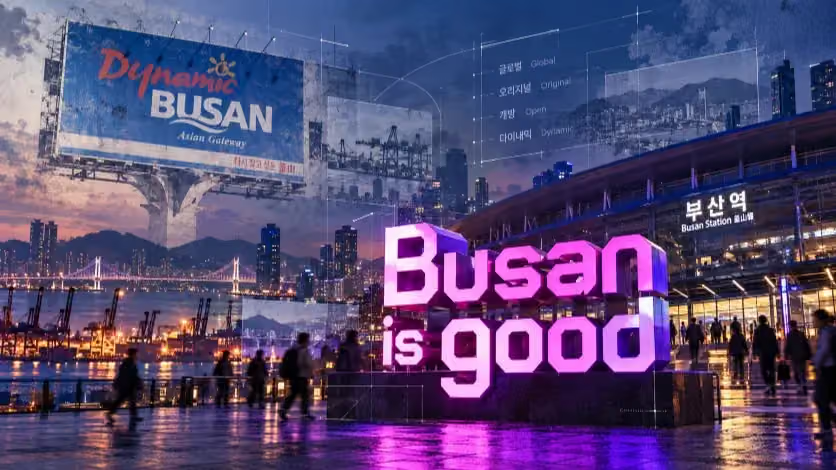
Why “Busan Is Good” Falls Short as a City Brand
 NewsSep 18, 2026
The Other AI Race Is for the Freedom to Change Course
Reader Signal
Community readWhat did this report leave you with?
Choose the signal that best reflects your reading. Select it again to remove it.
One response per article
No response selected
A moderated conversation about the reporting.
One-level replies and newsroom moderation keep the conversation anchored to this article.
Discussion Status
Open
Please sign in to join the discussion.
Newsletter
Weekly reporting and context from Busan and Korea.