Kalshi Predicts Trump Leads 2024, But Polls Show Tight Race
As the 2024 U.S. presidential election approaches, political analysts and everyday citizens alike are turning to a variety of forecasting tools to gauge the likely outcome of the race between former President Donald Trump and Vice President Kamala Harris. Among these tools is Kalshi, a U.S.-regulated prediction market where users can trade on the outcomes of real-world events, including political elections. As of October 2024, Kalshi’s markets show Donald Trump leading with a 57% chance of winni

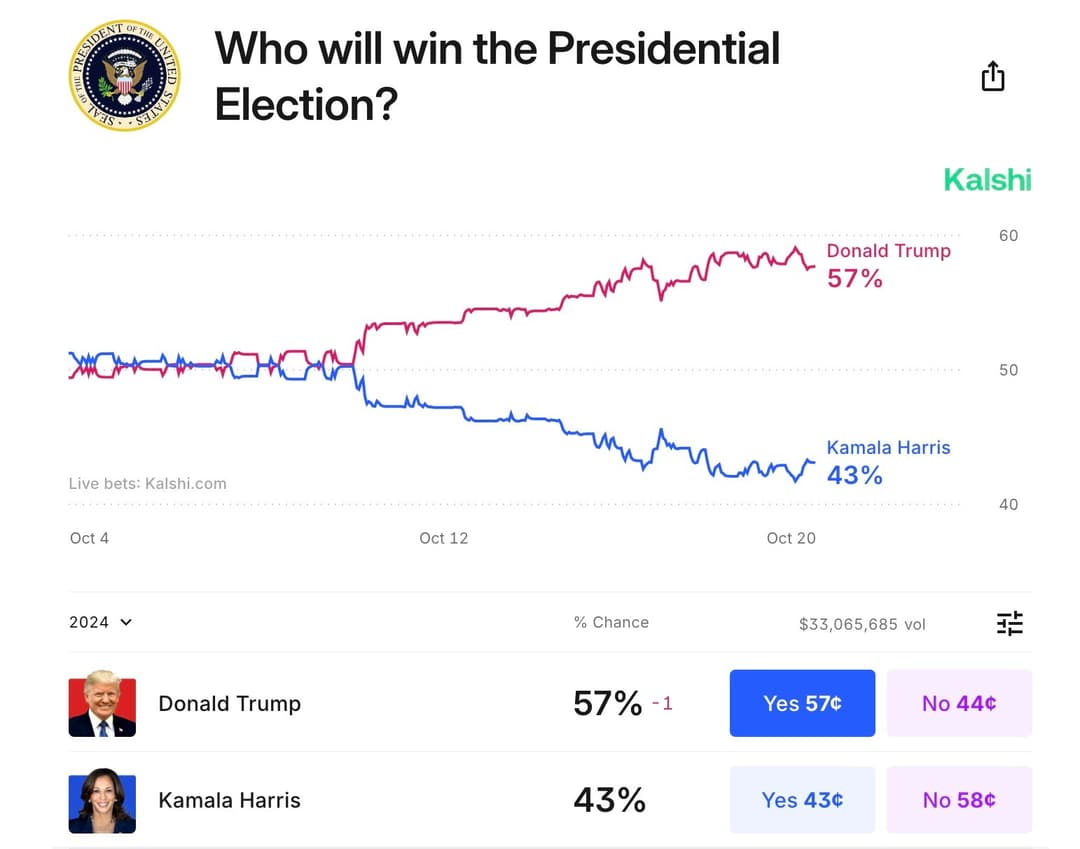
As the 2024 U.S. presidential election approaches, political analysts and everyday citizens alike are turning to a variety of forecasting tools to gauge the likely outcome of the race between former President Donald Trump and Vice President Kamala Harris. Among these tools is Kalshi, a U.S.-regulated prediction market where users can trade on the outcomes of real-world events, including political elections. As of October 2024, Kalshi’s markets show Donald Trump leading with a 57% chance of winning the presidency, compared to Harris’s 43%. While these odds suggest that traders expect Trump to prevail, they present a stark contrast to national polls, which reflect a much closer contest. This raises important questions about the accuracy and significance of prediction markets as a tool for election forecasting.
Kalshi’s Rise
Kalshi, founded in 2018 by MIT graduates Tarek Mansour and Luana Lopes Lara, was envisioned as a financial platform that allows users to hedge real-world risks by trading contracts on various outcomes. The platform quickly distinguished itself by becoming the first U.S. prediction market to receive full regulatory approval from the Commodity Futures Trading Commission (CFTC) in 2020. This approval marked a critical step for Kalshi, as it positioned the platform to legally offer real-money markets on events ranging from geopolitical developments to natural disasters.
However, Kalshi's most notable—and controversial—development came with its efforts to introduce political event contracts, including those tied to U.S. elections. In 2023, the CFTC raised objections, citing concerns about political betting crossing into the realm of gambling. Kalshi took legal action to defend its right to offer election markets, ultimately winning a major court case in September 2024 that allowed it to list election-related contracts. Despite this legal victory, the CFTC has continued its appeals, keeping the platform’s future political betting offerings in regulatory limbo.
Kalshi operates as a marketplace where users trade binary contracts based on the outcomes of real-world events. Each contract has a simple "Yes" or "No" outcome, and traders can buy or sell these contracts depending on whether they believe the event will occur. The price of a contract ranges from $0.01 to $0.99, reflecting the likelihood of the event happening based on market sentiment.
For example, if a user believes an event (such as a candidate winning the election) is highly likely, they might buy a "Yes" contract at $0.70. If the event happens, the contract settles at $1, and the trader earns $0.30 profit per contract. Conversely, if the event does not happen, the contract settles at $0, and the trader loses their stake. Users can trade contracts up until the event occurs, allowing them to react to new information or market developments.
This real-time trading environment provides dynamic insights into public sentiment, as contract prices fluctuate based on the latest news or trader expectations. By combining financial incentives with market speculation, Kalshi aims to provide a more accurate reflection of event outcomes than traditional polling methods.
Kalshi’s Current Election Odds: Trump Leads by 57%
As of October, Kalshi traders are betting heavily in favor of Donald Trump, assigning him a 57% chance of winning the 2024 election, compared to Kamala Harris’s 43%. These figures reflect the aggregated expectations of thousands of participants who buy and sell contracts based on who they believe will win the presidency. Unlike traditional polling, which gathers voter opinions, Kalshi’s markets reflect the financial stakes of individuals speculating on electoral outcomes, theoretically creating a more “invested” prediction.
It is important to note that prediction markets like Kalshi allow for real-time adjustments in probabilities. This means that the odds can shift rapidly in response to news events, campaign developments, or even debate performances. These market dynamics can sometimes lead to predictions that fluctuate significantly over short periods of time, depending on trader sentiment and external political shocks.
Comparing Kalshi’s Odds to National Polls
While Kalshi’s prediction markets currently favor Trump, the national polling data suggests a much closer race. According to aggregators like RealClearPolitics and FiveThirtyEight, the polls show Harris slightly ahead in national popular vote projections, with margins often within the margin of error. For example, Harris is polling around 49.3% nationally, compared to Trump’s 48.1%, a difference that reflects a highly competitive race. In key battleground states like Pennsylvania, Wisconsin, and Georgia, the race remains tight, with polls indicating that either candidate could come out on top.
The divergence between Kalshi’s market odds and polling data highlights the inherent differences between these two forecasting tools. Polls provide a snapshot of voter intentions based on demographic data and statistical sampling, whereas prediction markets aggregate the views of a more limited pool of financially motivated participants. As such, prediction markets may be influenced by short-term news cycles and the biases of their participants, whereas polls aim to capture broader voter sentiment.
Why Do Prediction Markets and Polls Diverge?
Prediction markets like Kalshi often diverge from polling data for several reasons. First, market participants are betting on outcomes, and their financial incentives may lead them to overreact to short-term developments. For example, a scandal or a strong debate performance could lead to a surge in bets for one candidate, even if the broader polling data doesn’t show a significant shift in voter sentiment.
Second, prediction market participants may be influenced by strategic voting patterns, such as the expectation that Trump could win the Electoral College despite losing the popular vote, as he did in 2016. This possibility is particularly relevant in a polarized election where key swing states like Arizona, Georgia, and Wisconsin could determine the final outcome. Traders on Kalshi may be factoring in Trump’s potential advantage in these battleground states, even if national polls suggest a narrow Harris lead in the popular vote.
The Role of Recent Events in Shaping Market Sentiment
The 2024 election has been shaped by a series of significant events that have influenced both public opinion and market sentiment. Economic concerns, particularly around inflation and unemployment, have been central to Trump’s campaign, which he has positioned as a referendum on the Biden-Harris administration’s handling of the economy. Meanwhile, Harris has focused on social issues and her vision for continuing the work of the current administration.
Debates and campaign strategies have also played a role in shifting market sentiment. Kalshi’s odds for Trump increased following his strong performance in the first presidential debate, where he successfully capitalized on economic concerns and national security issues. Conversely, Harris’s market odds have fluctuated based on her efforts to mobilize key voter blocs, including young voters and minority communities.
How Reliable Are Prediction Markets?
Despite the legal and ethical controversies surrounding political betting, prediction markets like Kalshi offer valuable insights into election forecasting. By aggregating real-time data from traders who have a financial stake in the outcome, prediction markets provide a unique lens into public sentiment. However, they are not without limitations. Market participants are often wealthier and more politically engaged than the average voter, which can skew market outcomes. Additionally, prediction markets can be prone to overreacting to temporary news events or campaign dynamics.
Historical evidence shows that prediction markets have had mixed success in accurately forecasting election outcomes. In 2016, prediction markets underestimated Trump’s chances of winning, while in 2020, they correctly predicted Joe Biden’s victory. The key takeaway is that prediction markets should be used alongside other tools—such as polls and demographic analysis—to provide a fuller picture of electoral dynamics.
Kalshi’s prediction markets currently suggest a clear advantage for Donald Trump in the 2024 election, but national polling data shows a much closer race. The divergence between these two forecasting tools underscores the importance of considering multiple perspectives when analyzing electoral outcomes. As the election date approaches, the race between Trump and Harris remains highly competitive, and the final outcome may hinge on voter turnout in key battleground states. Observers should continue to monitor both prediction markets and traditional polling to get a comprehensive view of this critical election.
Continue this reporting
Reporting on the same issue
Related coverage selected from the article's desk, topics and newsroom relationships.
 NewsOct 4, 2026
Zelensky, South Korea and the Limits of Wartime Pressure
South Korea says Kyiv broke a confidentiality understanding when Zelensky rev...
 NewsSep 1, 2026
What Lee Jae Myung Thinks a Minister Can Fix
President Lee Jae Myung says reform should be judged by results rather than c...
 NewsAug 21, 2026
The Korean Peninsula Trump Is Returning To
Another Trump-Kim summit would unfold on a peninsula where North Korea is har...
More from the author
More from this byline
Stay with the same line of reporting through more work from this byline.
 NewsSep 18, 2026
The Other AI Race Is for the Freedom to Change Course
 NewsSep 5, 2026
How a Political Appointment Becomes a Judgment of Character
Reader Signal
Community readWhat did this report leave you with?
Choose the signal that best reflects your reading. Select it again to remove it.
One response per article
No response selected
A moderated conversation about the reporting.
One-level replies and newsroom moderation keep the conversation anchored to this article.
Discussion Status
Open
Please sign in to join the discussion.
Newsletter
Weekly reporting and context from Busan and Korea.