Japan’s Rightward Drift and Korea’s Pragmatic Response
As Japan’s conservatism turns inward and South Korea’s diplomacy grows more self-aware, East Asia enters a fragile era where stability is measured not by peace, but by control.


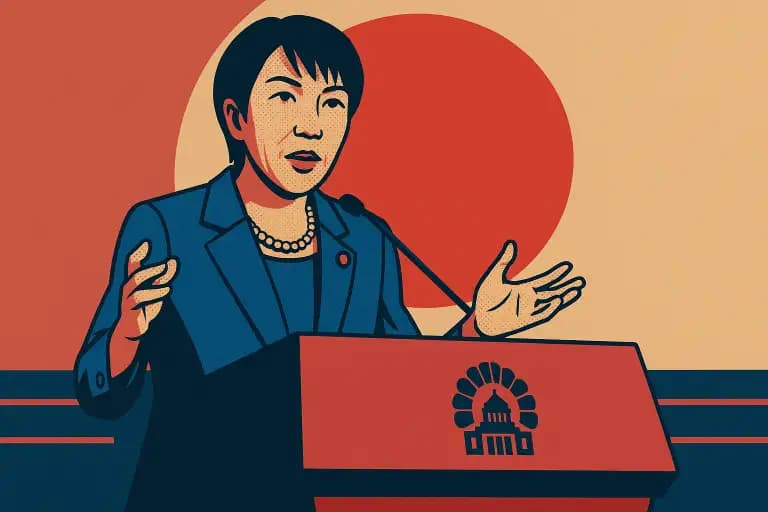
Tokyo’s autumn felt muted, as if the city itself were holding its breath. On the day Sanae Takaichi was confirmed as Japan’s new prime minister, a small edit appeared in a policy memo in Seoul. The sentence that once read “stable management of Korea–Japan relations” now carried a quiet addendum: “based on strategic autonomy.” It was a small change, but one that captured the new grammar of South Korea’s diplomacy under President Lee Jae-myung — pragmatic, self-measured, and distinctly its own.
Lee’s foreign policy speaks in the language of balance. Not neutrality, not distance, but proportion. His government maintains the alliance with Washington while reopening space with Beijing and the Association of Southeast Asian Nations. With Tokyo, the goal is not restoration but redesign: to keep cooperation functional, to prevent history from defining the future, and to build predictability where trust still wavers.
Japan, however, is moving on a different current. The Takaichi administration, buoyed by the legacy of Shinzo Abe, has pledged to “normalize strength” — accelerating constitutional revision, expanding defense budgets, and tightening security coordination with the United States. To many outside observers, it looks like the final consolidation of Japan’s conservative turn, two decades in the making. To Seoul, it is both an opportunity and a warning.
The opportunity lies in structure: the institutional memory of two economies that cannot easily decouple, the defense networks that already intersect, the growing overlap of industrial policy and technology security. The warning lies in symbolism. Every gesture in Tokyo — a visit, a word, a silence — reverberates in Seoul’s domestic politics with the force of history. Even as the two governments rebuild cooperation, public trust remains brittle, and each new Japanese leader tests that fragility anew.
As 2025 unfolds, the two capitals find themselves caught between necessity and memory. The United States wants alignment; China offers leverage; North Korea provides the perpetual urgency that keeps dialogue from drifting. Within that geometry, Lee’s administration is attempting something rare in Korean diplomacy: strategic composure. Whether it can sustain that posture while Japan redefines its own will determine not only the shape of bilateral ties but the balance of an entire region trying to remember what stability feels like.
Japan’s Rightward Turn Redux
Japan’s conservative turn did not erupt overnight. It settled, layer by layer, until it felt less like an ideology and more like a habit. Over two decades, the vocabulary of restraint — pacifism, modesty, self-containment — has been quietly replaced by the grammar of resolve. The change was not shouted; it was administered. Policy by policy, speech by speech, Japan’s postwar humility has been rewritten as strategic maturity.
The architects of this shift have been consistent. From Shinzo Abe to Fumio Kishida, and now to Sanae Takaichi, the ruling Liberal Democratic Party has cultivated a nationalism of pragmatism: forward-looking in tone, backward-anchored in sentiment. Each leader framed strength not as ambition but as obligation — the duty to safeguard prosperity in an increasingly hostile region. The message resonated. For a nation that once feared its own assertiveness, power is now seen as protection, and protection as virtue.
The machinery that sustains this narrative lies deep within the state. Party factions operate less as ideological blocs than as systems of inheritance. Bureaucrats, media networks, and corporate donors align around the same instinct for continuity. Even dissent, when it appears, tends to orbit within accepted bounds. Political renewal in Japan does not mean reorientation; it means re-legitimation of the same trajectory under a new name. Takaichi’s ascent, backed by Abe’s factional infrastructure, fits seamlessly into that pattern — not a disruption, but a declaration that the long rightward drift has become institutional gravity.
Yet what distinguishes Takaichi’s conservatism is its affect. Where Abe spoke of pride and Kishida of reform, Takaichi speaks of restoration — a word that carries both nostalgia and impatience. Her speeches invoke order, duty, and self-reliance, appealing to an electorate increasingly anxious about demographic decline and geopolitical vulnerability. Nearly a third of Japan’s population is over sixty-five, and among them, polls show overwhelming support for constitutional revision and expanded defense authority. To them, security is not an abstraction; it is a moral promise that the stability of their past will survive the uncertainty of their future.
Culturally, too, the tide has turned. Textbook revisions frame wartime history with nuance that often tilts toward justification. Television dramas and variety shows glorify innovation, discipline, and collective will — traits once associated with Japan’s economic miracle. Online, younger conservatives wield nationalism with irony, turning memes and history alike into tools of identity. It is less about ideology than belonging, less about the past than the comfort of knowing which side you are on.
For outside observers, this evolution is unsettling, yet it remains distinctly Japanese in form — incremental, procedural, cloaked in civility. The state’s tone has hardened without raising its voice. And that is what makes the transformation so difficult to contest: Japan’s right turn is not a revolt against liberalism, but its absorption. It promises freedom through discipline, peace through readiness, dignity through distance.
Whether this equilibrium endures will depend on how far Takaichi is willing to press the symbolism. Power in Tokyo rarely overreaches, but when it does, it often believes it is simply restoring balance. For now, the applause has faded, but the momentum continues — quiet, deliberate, and deeply rooted in the conviction that Japan’s restraint has run its course.
Pragmatism and Dignity: Seoul’s New Playbook
In Seoul, diplomacy has always been more than strategy; it is a form of memory management. Each government inherits a past it did not make but must answer for, and every new administration learns the same lesson: that the distance between principle and pragmatism is not a straight line but a negotiation. Under President Lee Jae-myung, that negotiation has taken on a sharper definition — one framed by the twin imperatives of sovereignty and survival.
Lee calls it strategic balance. It is less a doctrine than a stance, a choreography of movement between competing gravities. His foreign policy team describes it as “autonomy without isolation,” a concept that seeks to re-center South Korea’s diplomacy not between Washington and Beijing, but around Seoul itself. In this calculus, Japan is both neighbor and variable — a partner in technology and security, a rival in memory and politics, and a mirror reflecting the region’s unfinished history.
Since early 2025, the Lee administration has pursued what insiders call a two-track diplomacy toward Tokyo: cooperation where it counts, contention where it cannot be avoided. The shuttle diplomacy restored in the summer — a Tokyo summit in August followed by a return visit to Busan in September — signaled not reconciliation, but calibration. In official communiqués, both sides reaffirmed their “future-oriented partnership,” yet Seoul inserted a new clause: respect for “mutual dignity.” In bureaucratic prose, the word felt heavy, almost moral. It was Lee’s quiet red line — collaboration without deference.
Behind the scenes, the machinery of coordination is humming again. Defense officials have revived trilateral intelligence sharing with Japan and the United States under the GSOMIA framework, while the ministries of finance and industry have opened new “economic security dialogues” focused on semiconductors, critical minerals, and supply chain resilience. The rhetoric of alliance has given way to the grammar of necessity: talk less, coordinate more. Trade volumes between the two nations have recovered to pre-pandemic levels, with technology exports driving most of the growth.
But this is not the diplomacy of enthusiasm. It is the diplomacy of management — quiet, procedural, and intensely aware of its own fragility. Every gesture toward Tokyo must survive a domestic echo chamber that amplifies suspicion faster than facts. Public opinion remains divided: majorities support cooperation on defense and technology but reject any impression of political alignment. For Lee, the challenge is to protect engagement from its own optics.
Unlike his predecessor, Lee does not speak the language of alliance; he speaks the language of transaction tempered by ethics. “We seek peace through self-respect,” he said in a June address that was less about Japan than about Korea’s sense of agency. In that formulation lies his government’s essence — pragmatic in method, proud in tone, calibrated to the realities of a world where moral clarity is no longer a luxury.
The question, of course, is whether this composure can last. Diplomacy built on balance demands constant maintenance, and Japan’s political weather is shifting faster than Seoul’s public patience. Still, for now, the playbook holds: respect without reverence, engagement without illusion, and the belief — fragile but firm — that dignity itself can be a form of strategy.
The Faultlines of the Korea–Japan Relationship
Every alliance built on memory carries a kind of static — a charge that never fully dissipates, no matter how polished the diplomacy becomes. Between Seoul and Tokyo, that static hums beneath the machinery of cooperation, shaping the tempo of every gesture, every silence. In 2025, the two governments are closer in coordination than they have been in years, yet further apart in sentiment. It is not contradiction; it is the architecture of their coexistence.
The visible layer is efficient. Joint missile-tracking drills with the United States, synchronized export controls, and a dense web of economic-security dialogues all function with quiet precision. On paper, the alliance hums. But policy operates on two frequencies: the bureaucratic and the emotional. Every successful meeting in Tokyo must survive the reverberation that follows it in Seoul, where opposition leaders, civil groups, and media commentators parse each Japanese gesture for traces of arrogance or amnesia. A single visit to Yasukuni Shrine, a statement on wartime labor, even a commemorative photograph near disputed islands — each act can unravel weeks of technical progress.
Yet what complicates this equation is not only history itself, but the way trust has evolved on each side of the sea. In Seoul, trust remains relational — a bond that must be earned, reciprocated, repaired. In Tokyo, particularly under its conservative mainstream, trust has become something else entirely: inward, procedural, self-referential. To the Japanese right, trust is no longer a bridge between nations but a mirror of conviction. It means not faith in others, but confidence in the stability of one’s own order. When officials speak of “restoring trust,” what they often mean is restoring predictability — the assurance that Japan’s conduct will not be questioned, its authority not disturbed. In this sense, Japan’s rightward turn has not abandoned trust; it has nationalized it.
That philosophical divergence makes cooperation fragile by design. For Japan, trust is a condition of hierarchy; for Korea, it is the currency of equality. One side defends order, the other defends recognition. When Tokyo invokes “normalization,” Seoul hears revision; when Seoul demands acknowledgment, Tokyo hears reproach. The dialogue is circular, each statement shadowed by its own echo. The two nations do not mistrust each other because they remember too much — they mistrust because they remember differently.
And yet, interdependence endures. Semiconductor supply chains, battery minerals, energy routes — these are not sentimental bonds but physical ones, built into the circuitry of both economies. Even as political moods oscillate, cooperation in research and defense has grown dense, procedural, inevitable. Necessity has replaced affection as the governing logic of engagement. The phrase used by diplomats in Seoul — “conditional trust” — captures this new equilibrium: progress without illusion, civility without intimacy.
But necessity, by its nature, compresses tension rather than resolving it. The more seamless the coordination, the more visible the cracks beneath it. Diplomacy can choreograph meetings, not memories. Each side moves within its own grammar of restraint — Japan through confidence, Korea through caution — and in that asymmetry lies the essence of their relationship. Two nations speaking the same language of partnership, yet meaning entirely different things by the word trust.
Still, perhaps that is its own form of balance. Stability, in Northeast Asia, has never been a state; it is a rhythm, fragile but continuous. For Seoul and Tokyo, cooperation under memory remains an uneasy duet — one that endures not because it reconciles the past, but because it refuses to let the past dictate who leads the next note.
Regional Ripples: Japan, China, and the United States
Power in East Asia has always moved like weather — gradually, unpredictably, and according to patterns that only appear after the storm has passed. In 2025, the air is thick with rearrangement. Japan’s rightward turn, China’s assertive diplomacy, and the United States’ selective engagement have produced not a triangle of balance but a field of shifting fronts. Somewhere within that geometry, South Korea is learning to define stillness as strategy.
For Washington, the picture remains deceptively simple. A trilateral framework — the United States, Japan, and South Korea — promises coherence in deterrence and efficiency in coordination. The rhetoric is smooth: shared values, collective defense, economic resilience. But beneath the choreography lies divergence. Japan seeks normalization through power; South Korea through autonomy. The same missile exercise that reassures Washington also reminds Seoul how easily dependence can masquerade as partnership.
Beijing, meanwhile, reads the region through a different lens: not of alliances but of thresholds. Every new joint statement between Tokyo and Seoul is measured against the pace of its own encirclement. China’s diplomacy has grown more psychological, deploying uncertainty as leverage. Where Washington speaks of freedom and Tokyo of deterrence, Beijing speaks of patience — and it means endurance, not restraint. It is not the pace of confrontation that troubles Chinese strategists, but its rhythm: the quiet regularity with which cooperation among its neighbors becomes routine.
For South Korea, this environment has turned diplomacy into a form of triage. Lee Jae-myung’s administration must maintain security coordination with the United States and Japan, preserve trade corridors with China, and prevent either side from turning proximity into leverage. The result is a foreign policy defined less by alignment than by elasticity. It bends without breaking, absorbs pressure without pledging loyalty. Korean officials describe this as “strategic composure,” a term that sounds modest until one realizes how few nations can sustain it.
Japan, in this wider frame, becomes both partner and amplifier. Its growing military capacity reassures Washington but unnerves Beijing; its conservative confidence stabilizes itself but unsettles others. Every Japanese step toward “normalization” nudges the region toward an abnormal sensitivity. The paradox of strength in Asia is that it rarely feels stable to those who witness it. Power consolidates but trust disperses, and every gesture meant to restore balance generates its own shadow of imbalance.
Still, the system holds — barely. Economic gravity ties the region together even as ideology pulls it apart. Semiconductors, green energy, logistics — these are the quiet treaties that underwrite the louder ones. Yet economic interdependence no longer guarantees peace; it merely delays crisis. The United States plays conductor, but the orchestra no longer waits for cues. Each nation keeps its own tempo now, and the music — if one can still call it that — is dissonant but continuous.
For Seoul, the task is to find coherence without conformity. It must navigate between a confident Japan, a calculating China, and a distracted America — three powers certain of their own narratives but unsure of one another’s limits. In such a landscape, neutrality is not an option, and alignment is not an answer. What remains is balance — the disciplined art of remaining relevant without becoming predictable. And in that art, perhaps, lies the quiet center of East Asia’s next chapter.
Futures, Frictions & Frameworks
The future of East Asia will not arrive with a single event. It will unfold as a sequence of adjustments — small, deliberate, sometimes imperceptible — that redefine what normal feels like. Between Seoul and Tokyo, the coming years will test whether cooperation built on necessity can mature into understanding, or whether it will harden into ritual. The difference may not lie in policy but in tempo: how each side learns to breathe through tension rather than against it.
Three paths emerge from the current geometry. The first is Managed Cooperation — a continuation of the present equilibrium. Bureaucracies sustain the rhythm of engagement; summits alternate predictably; disputes flare but are contained. Under this scenario, pragmatism wins by exhaustion. History remains unresolved but quiet, and diplomacy becomes the art of routine. It is the most likely outcome, and perhaps the least inspiring, yet it offers what this region prizes most: time.
The second path is Symbolic Collision. Here, restraint falters under pressure. A visit, a remark, a policy review — one act reignites dormant grievances, and domestic politics in both nations spiral into reaction. Economic ties endure, but sentiment fractures. Washington urges calm, Beijing watches the fissure widen, and the balance collapses not from strategy but from symbolism. It is the scenario most feared by diplomats because it cannot be negotiated — only managed after it happens.
The third is Strategic Integration. It begins not with reconciliation but with alignment — a gradual recognition that regional survival requires shared infrastructure, not shared affection. Under this path, Seoul and Tokyo would institutionalize cooperation beyond politics: joint R&D in defense technology, coordinated responses to supply chain shocks, integrated crisis communication. It is ambitious, fragile, and plausible only if both sides learn to decouple memory from management. Yet if achieved, it would transform the region from a corridor of friction into a circuit of resilience.
For President Lee Jae-myung, the test will be endurance. His foreign policy of strategic composure demands constant recalibration — enough engagement to keep Japan close, enough distance to keep Korea whole. It is a demanding posture, requiring discipline without detachment. For Japan, the test is humility — whether its new confidence can coexist with the patience required for partnership. Both nations must learn to live within contradiction: to accept that stability is not peace, and progress not always visible.
Beyond them, the region itself is learning a new language of coexistence. The United States speaks of alliances as instruments of deterrence; China frames them as containment; Korea and Japan increasingly treat them as management systems. None of these are wrong, yet none are sustainable without empathy. In the end, East Asia’s stability may depend less on treaties than on imagination — the capacity of its leaders to picture a future that is neither nostalgic nor defensive.
And so the question remains, unanswered but necessary: what if the next stage of diplomacy is not about winning trust, but redefining what trust means? Perhaps that is the quiet revolution underway — not the return of old powers, but the slow emergence of a region learning to endure without illusion. In that endurance, fragile and deliberate, lies the outline of a new order that has not yet decided whether it wants to be called peace.
Continue this reporting
Reporting on the same issue
Related coverage selected from the article's desk, topics and newsroom relationships.
 NewsSep 1, 2026
What Lee Jae Myung Thinks a Minister Can Fix
President Lee Jae Myung says reform should be judged by results rather than c...
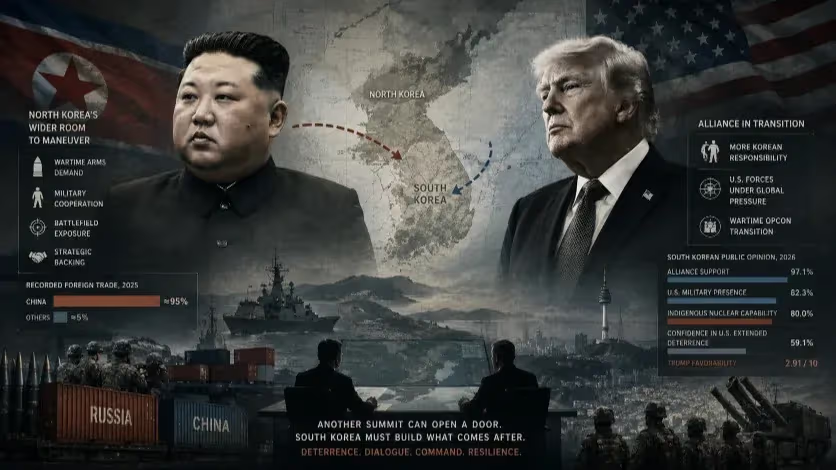 NewsAug 21, 2026
The Korean Peninsula Trump Is Returning To
Another Trump-Kim summit would unfold on a peninsula where North Korea is har...
 NewsAug 16, 2026
What Makes a North Korea Policy Survive a Change of Government?
From Kaesong to military agreements, South Korea’s history shows why some Nor...
More from the author
More from this byline
Stay with the same line of reporting through more work from this byline.
 NewsSep 18, 2026
The Other AI Race Is for the Freedom to Change Course
 NewsSep 5, 2026
How a Political Appointment Becomes a Judgment of Character
Editorial Record
Corrections, sourcing notes and newsroom disclosures remain part of the published record. View Newsroom Notes →
Reader Signal
Community readWhat did this report leave you with?
Choose the signal that best reflects your reading. Select it again to remove it.
One response per article
No response selected
A moderated conversation about the reporting.
One-level replies and newsroom moderation keep the conversation anchored to this article.
Discussion Status
Open
Please sign in to join the discussion.
Newsletter
Weekly reporting and context from Busan and Korea.