Iran War Exposes Limits of U.S. Power and China’s New Leverage
The United States proved it could still strike Iran. What it failed to prove was that force could close the nuclear file, stabilize Hormuz, command allied trust, or keep China outside the diplomatic fallout.

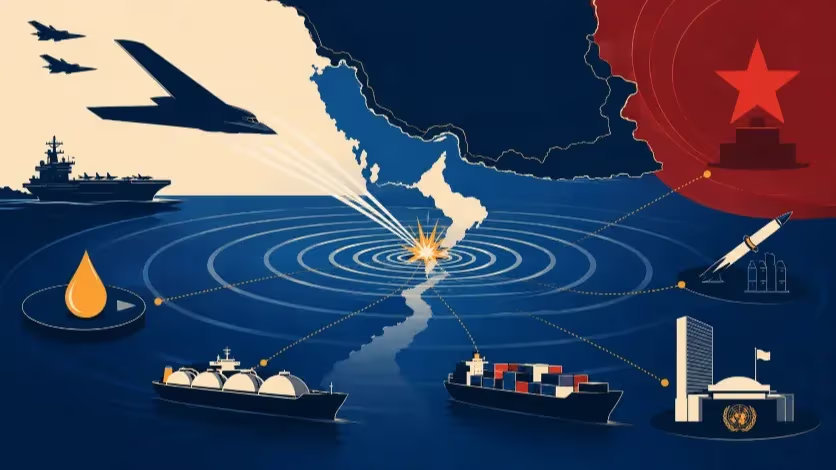
The Iran war did not reveal a powerless United States. It revealed a superpower still capable of overwhelming force, but increasingly unable to contain the military, legal, economic and diplomatic consequences of using it.
American aircraft reached Iranian targets, and U.S. warships moved into the Gulf with a speed no rival could match. The military balance was never the central mystery of the war. Washington could still punish Iran, reinforce bases, coordinate air and naval assets, and frame its campaign in the familiar language of deterrence, non-proliferation and freedom of navigation. What proved harder to control was everything that followed. Tankers slowed near the Strait of Hormuz, Asian refiners recalculated exposure, insurers repriced risk, diplomats fought over the language of a U.N. response, and Beijing found that a crisis triggered by American force still required Chinese leverage to manage.
That was the deeper test. The war did not ask whether the United States could still strike a regional adversary. It asked whether American military power could still be converted into strategic control, legal authority, allied confidence and market stability. On that broader measure, the result was far less decisive. The United States demonstrated reach; it did not demonstrate command over the consequences of that reach.
The Strait of Hormuz turned that distinction into a global fact. In 2024, about 20 million barrels of oil a day moved through the strait, roughly one-fifth of global petroleum liquids consumption, and more than four-fifths of the crude oil, condensate and LNG transiting Hormuz went to Asian markets. China, India, Japan and South Korea together accounted for a large share of those flows, which meant that a war fought in the Gulf quickly entered Asian energy accounts, factory margins and shipping schedules. Washington could choose the strike. It could not choose where the consequences stopped.
The Military Balance Was Never the Real Balance
The claim that the Iran war exposed a collapse of American military power is too crude. In several respects, the opposite is true. The conflict verified that the United States remains the only power able to project force at scale across distance, integrate air and naval operations, operate from a global base network and impose immediate pain on an adversary far from its own shores. Iran could not match American aircraft, submarines, intelligence networks, precision weapons or naval reach. China may be the pacing challenge in the Western Pacific, but it still does not reproduce the global military architecture Washington has built over decades.
The more serious finding was not about reach, but about conversion. American force could damage targets, but the damage did not automatically become political obedience. Tehran’s leverage lay in the space between military inferiority and systemic disruption. Iran did not need a navy comparable to America’s; it needed enough missiles, drones, mines, fast boats, coastal geography and political nerve to make the world price uncertainty into every voyage through Hormuz. A weaker state can lose aircraft, radars and facilities and still force Gulf monarchies, Asian refiners, maritime insurers and U.S. commanders to make their next decisions under pressure.
That is the strategic logic of Hormuz. The United States has to keep the waterway usable because its claim to maritime leadership depends on the flow of commerce. Iran does not have to close it permanently. It only has to make passage uncertain enough for markets to believe the American guarantee has limits. A drone or mine does not have to defeat a carrier group to matter; it has to change the insurance premium, delay the cargo, alter the route or force the escort. The defender must produce continuity. The disruptor needs only to puncture it.
The same imbalance appeared in the American arsenal. A global security order does not run on declarations; it runs on interceptors, standoff weapons, vertical launch cells, fuel depots, hardened shelters, satellite links, repair crews and production lines. CSIS found that seven key categories of U.S. munitions used in the Iran war fall into two groups — long-range ground attack and air and missile defense — and warned that large numbers of the same weapons would be needed in a future Western Pacific conflict, while allies and partners also compete for the same output. The issue was not that Washington had exhausted itself in Iran. The issue was that each weapon fired in one theater had to be counted against another contingency.
That makes the war more relevant to Beijing than any simple battlefield comparison would suggest. Chinese planners do not need to conclude that America is weak. They only need to see that America is finite. They can study how quickly U.S. interceptors are spent, how forward bases absorb missile pressure, how allies respond to escalation, and how long Washington can sustain domestic and diplomatic consent once the cost of enforcement becomes visible. In a Taiwan crisis, China would not need to defeat the United States everywhere at once. It would need to delay access, complicate basing, exhaust defenses, pressure allies and stretch the time between American military action and political result.
That is the military lesson of Iran: not that American firepower has vanished, but that the translation of firepower into compliance has become less reliable.
The Nuclear File Did Not Close
The strongest American case for war was also the hardest one to validate afterward. Washington argued that force was necessary to stop Iran from moving toward a nuclear weapon. That claim gave the campaign its urgency and moral vocabulary, but it also created a demanding standard for success. The question after the strike was not simply whether facilities had been damaged; it was whether the nuclear problem had become smaller, more visible and more governable.
Military force can set back a nuclear program. It can destroy centrifuge halls, collapse access tunnels, disrupt power systems, kill personnel and force engineers to work under fear. Those effects matter. But delay is not disarmament, and visible damage is not strategic closure. Nuclear programs are not single targets. They are systems of material, expertise, procurement channels, political decisions and institutional memory. A crater at an enrichment site can be photographed. The location of enriched uranium, the resilience of scientific knowledge and the future intentions of a regime are harder to verify.
Reuters reported that U.S. intelligence assessments found limited new damage to Iran’s nuclear program and that Iran’s estimated timeline to produce a nuclear weapon had not changed significantly since the previous summer. The same report noted that the U.N. nuclear watchdog could not verify the status of roughly 440 kilograms of uranium enriched to 60 percent, material that remains central to any real assessment of proliferation risk. That uncertainty cuts through any clean claim of success. If the material cannot be fully accounted for, the strategic problem does not disappear; it moves into tunnels, guarded facilities, intelligence estimates and future bargaining.
This is the weakness of preventive war against a dispersed nuclear capability. The attacker can hit what it sees, but cannot be certain it has hit what it does not know. It can damage declared facilities, but cannot erase the education system that produced the scientists, the archives that preserve technical knowledge or the political lesson Tehran may draw from being attacked. From Washington’s perspective, the war may show that nuclear defiance invites punishment. From Tehran’s perspective, it may show that only a more survivable deterrent can prevent the next strike.
Both lessons can exist at once, which is why the nuclear file did not close after the explosions. It became more opaque and more politically charged. The United States showed that it had the means to damage Iran’s program. It did not show, by force alone, that Iran’s nuclear material had been removed from play, that inspectors could verify the result, or that Tehran now viewed restraint as safer than latency. A facility can be bombed. A nuclear question has to be contained.
The Moral Premium of American Security Shrinks
American power has never rested on force alone. It has also rested on a moral premium: the belief, shared by enough allies and tolerated by enough others, that U.S. force usually serves a wider order rather than merely American preference. That belief has always been contested, and often for good reason. The American record carries protection, access and stability alongside resentment, hypocrisy and violence. Yet the premium mattered because it lowered the cost of leadership. It made coalition-building faster, basing access easier, sanctions more enforceable and legal arguments more persuasive.
The Iran war reduced that premium. Washington entered the conflict as the state that claims authority to enforce rules — to keep sea lanes open, prevent nuclear proliferation, deter aggression and defend the architecture of global commerce. But the same war that invoked those rules also strained them. The United States could say it was defending freedom of navigation, yet the conflict made navigation more dangerous. It could say it was preventing nuclear proliferation, yet the strikes left verification uncertain. It could say it was defending order, yet the legal basis, proportionality and strategic endpoint of the campaign became part of the dispute rather than the foundation beneath it.
This is not an ethical footnote; it is a strategic injury. Once American force looks less like enforcement and more like unilateral violence, allies demand more assurances, rivals find more language, and undecided states gain more reason to hedge. Chatham House warned that the attacks risked making the use of force “the new normal” while casting aside international law, creating precedents other states could cite when they seek to use force without regard for the rule of law. The critique matters not because it absolves Iran, but because it attacks the premise that American force automatically represents the rules-based order it claims to defend.
Iran was not an innocent actor. Its nuclear opacity, missile program, regional proxies and maritime threats created real security concerns. Gulf states had reason to fear Tehran, and Asian importers had reason to fear a closed Hormuz. But the existence of danger does not settle the authority to use force. A global enforcer needs more than capability. It needs a convincing chain between threat, legal basis, proportionality, outcome and postwar stability. The Iran war weakened that chain.
The damage is measurable. Gallup found that median approval of U.S. leadership fell from 39 percent in 2024 to 31 percent in 2025, while China’s approval rose from 32 percent to 36 percent; disapproval of U.S. leadership reached a record 48 percent. Those figures do not mean China has become broadly trusted. They mean the United States has become easier to doubt. That matters operationally. A trusted Washington can ask allies to absorb costs. A distrusted Washington has to bargain for them. Trust shortens the distance between decision and cooperation; mistrust lengthens it.
Moral authority is not decoration in American strategy. It is logistical grease. It helps move troops, votes, sanctions, money and public consent. When it erodes, the same military action requires more explanation, more pressure and more compensation. The Iran war did not destroy American credibility, but it made credibility more expensive.
China’s Gain Was Derivative
China was not the architect of the Iran war, not the decisive military actor and not the replacement for the United States. Its gain was narrower and more revealing: Beijing benefited from the fact that Washington could not finish the war’s political meaning by itself.
China’s position was not comfortable. It depends heavily on Gulf energy, and the disruption hurt. Reuters reported that China’s April crude imports fell 20 percent year on year to 38.5 million metric tons, the lowest since July 2022, while seaborne crude imports fell to 8.03 million barrels per day, refined fuel exports dropped to a decade low and natural gas imports declined. Beijing was not watching from a safe distance. It was exposed through the same maritime system the war had shaken.
That exposure, however, became part of its leverage. China buys Iranian oil, trades deeply with Gulf states, holds a permanent seat on the Security Council and can speak to Tehran without appearing to serve as Washington’s messenger. The crisis hurt China materially, but it made China diplomatically harder to bypass. When the United States needed pressure on Iran, language at the U.N. or reassurance that the crisis would not become a broader energy shock, Beijing’s position mattered.
The U.N. showed the pattern clearly. Washington sought international language that would place responsibility for the Hormuz crisis on Iran and support efforts to reopen the waterway, but Reuters reported that China and Russia were still expected to veto a revised U.S. resolution. That did not make China stronger than the United States militarily. It made China a gatekeeper of legitimacy after the military facts had already been created.
This is the right way to understand China’s role. Beijing did not win the war. It gained from the spaces American force could not occupy: Iranian calculations, U.N. procedure, energy diplomacy, Gulf hedging and global suspicion of unilateral military action. China does not need to become the better world policeman, and it does not want to pay for that job. It does not patrol every sea lane or underwrite every alliance. Its advantage lies in a cheaper proposition: when American force produces instability, China can offer itself as a necessary channel, a procedural obstacle, a buyer with leverage and a voice for sovereignty.
That is not moral superiority. It is strategic efficiency. China can criticize U.S. intervention without policing Hormuz, defend sovereignty without resolving proliferation, call for dialogue without carrying the burden of enforcement, and wait for Washington to spend force before moving into the diplomatic space that opens afterward.
The Taiwan lesson follows, though it should not be overstated. Iran is not Taiwan, and Hormuz is not the Western Pacific. Japan, South Korea, Australia and the Philippines would treat a Taiwan crisis differently from a Gulf war. Still, Beijing will study the friction points: munitions depletion, base vulnerability, allied hesitation, legal narratives, shipping disruption and the time it takes for Washington to turn military action into accepted authority. China does not need America to be weak. It needs America to be stretched.
For Korea, the Lesson Is Exposure
South Korea does not need to fight in the Gulf to feel a Gulf war. The pressure arrives through crude cargoes, naphtha, LNG, freight rates, insurance premiums, refinery schedules and currency risk. AP reported that South Korea imported more than 60 percent of its crude and 50 percent of its naphtha through Hormuz last year; a tanker carrying one million barrels of crude that passed through the strait was large enough to represent roughly 35 to 50 percent of South Korea’s daily crude consumption. A Middle Eastern war becomes a Korean industrial problem long before any Korean vessel is targeted.
Korea converts imported energy into refined products, petrochemicals, ships, cars, batteries, semiconductors and exports. A disruption in Hormuz first affects oil and gas, then moves into plastics, shipping costs, factory margins and consumer prices. The battlefield is far away; the invoice is not.
Busan is exposed differently. It is not South Korea’s main crude-import hub. Its strategic value lies in containers, transshipment, ship services, manufacturing networks and export logistics. Busan Port handled 24.4 million TEU in 2024, and transshipment accounted for 55.3 percent of the total, according to city data. A port built around transshipment does not need to be struck by a missile to suffer from disorder. It suffers when routes lose predictability.
A refinery suffers when crude cannot arrive. A transshipment port suffers when carriers adjust schedules, cargo owners reroute, insurance costs alter choices and delays ripple through inventory planning. In the age of weaponized chokepoints, uncertainty becomes a tax on port cities. Busan is not exposed because it is close to Iran. It is exposed because it is built into the same maritime system that Hormuz can disrupt and Taiwan could endanger.
The practical lesson is not militarization for its own sake. It is resilience. Korea needs strategic reserves of oil and gas, but it also needs strategic reserves of routing options, logistics capacity, diplomatic channels and public trust. Ports need clearer roles in national economic-security planning, better visibility across cargo flows, stronger coordination with shipping firms and insurers, and contingency planning for a world in which maritime disruption no longer remains local.
The Price of Command
The Iran war did not show that America can no longer use power. It showed that America can no longer decide alone what its power will mean.
For decades, Washington’s position rested on a rare combination of military reach, alliance networks, financial privilege, technological depth, legal influence and a claim to act for a wider order. That claim was never clean, but it gave the United States a presumption no other power enjoyed. When Washington acted, many governments objected, but few could ignore it. When Washington invoked order, many doubted the language, but few could replace it.
The Iran war showed how much of that presumption has thinned. The United States could strike, punish, defend and assemble partners. No rival can yet reproduce the full American system of long-range power projection, intelligence integration, naval reach and alliance access. But the war also showed that power is no longer measured only at the moment of impact. It is measured by what follows: whether the target stays degraded, whether the adversary changes course, whether markets stabilize, whether allies align, whether legal claims hold, whether rivals can contest the narrative, and whether the world accepts force as protection rather than escalation.
On those measures, Washington faced questions that firepower could not settle. The nuclear file remained uncertain. Hormuz remained a pressure point. Munitions use raised future-theater questions. Allies calculated exposure. China entered the diplomatic equation. Legal arguments became part of the battlefield.
That is how hegemonic power erodes: not necessarily through defeat, but through friction. Each act of enforcement requires more explanation. Each coalition requires more bargaining. Each market shock requires more reassurance. Each legal claim faces more scrutiny. Each rival finds more room to contest the meaning of events.
China’s advantage lies in that gap, but its advantage is not the same as leadership. A world without credible American authority is not automatically fairer or more stable. It may be more fragmented, more transactional and more exposed to regional coercion. Beijing can profit from American overreach, but it has not shown that it can provide a better order. It offers alternatives to American authority, not an answer to global disorder.
That is the unsettled world the Iran war revealed. The United States remains too strong to dismiss. China remains too exposed to dominate without cost. Iran remains too weak to win outright, but strong enough to make victory expensive for others. Allies remain dependent on Washington, but less willing to grant it unquestioned trust. Markets remain global, but more sensitive to local violence. Ports remain commercial machines, but increasingly sit inside the logic of security competition.
The old order promised that American power could keep those contradictions manageable. The Iran war did not prove that promise dead. It proved it is no longer cheap. The United States proved it could still strike. It did not prove it could control the fallout.
Continue this reporting
Reporting on the same issue
Related coverage selected from the article's desk, topics and newsroom relationships.
 NewsOct 4, 2026
Zelensky, South Korea and the Limits of Wartime Pressure
South Korea says Kyiv broke a confidentiality understanding when Zelensky rev...
 NewsSep 1, 2026
What Lee Jae Myung Thinks a Minister Can Fix
President Lee Jae Myung says reform should be judged by results rather than c...
 NewsAug 21, 2026
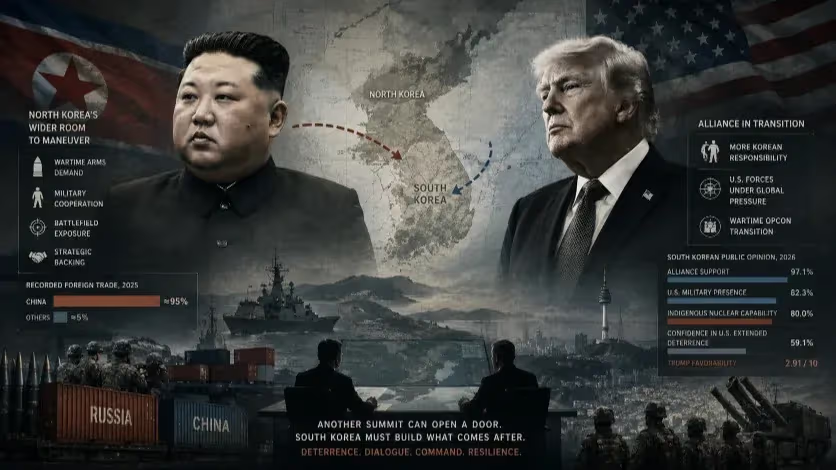
The Korean Peninsula Trump Is Returning To
Another Trump-Kim summit would unfold on a peninsula where North Korea is har...
More from the author
More from this byline
Stay with the same line of reporting through more work from this byline.
 NewsOct 21, 2026
What a Small Mackerel Is Worth
Reader Signal
Community readWhat did this report leave you with?
Choose the signal that best reflects your reading. Select it again to remove it.
One response per article
No response selected
A moderated conversation about the reporting.
One-level replies and newsroom moderation keep the conversation anchored to this article.
Discussion Status
Open
Please sign in to join the discussion.
Newsletter
Weekly reporting and context from Busan and Korea.