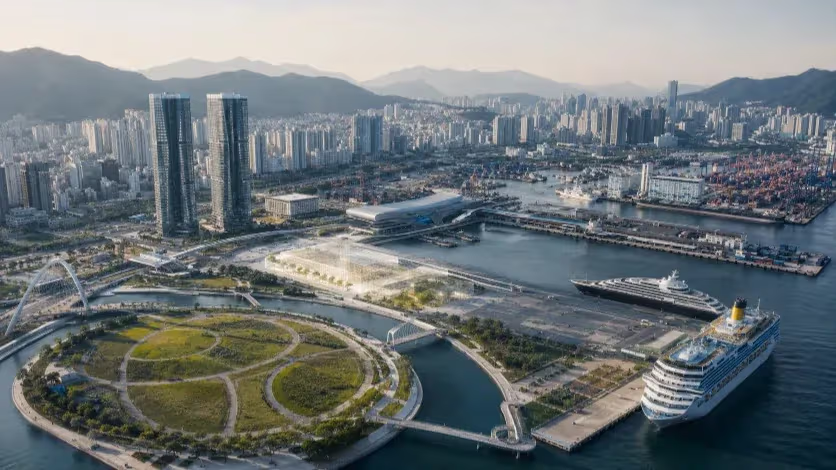
Four countries have submitted competing bids to host World Expo 2030
Five countries have submitted competing bids to host World Expo 2030: The Republic of Korea (in Busan), Italy (in Rome), Ukraine (in Odesa), and the Kingdom of Saudi Arabia (in Riyadh). Russia withdraws its bid * The Republic of Korea has applied to host a World Expo in Busan between May 1 and October 31, 2030, with the theme "Transforming Our World, Navigating Toward a Better Future." * Italy's bid is for a World Expo in Rome from April 25 to October 25, 2030, with the theme "The Horizontal


Five countries have submitted competing bids to host World Expo 2030: The Republic of Korea (in Busan), Italy (in Rome), Ukraine (in Odesa), and the Kingdom of Saudi Arabia (in Riyadh). Russia withdraws its bid
- The Republic of Korea has applied to host a World Expo in Busan between May 1 and October 31, 2030, with the theme "Transforming Our World, Navigating Toward a Better Future."
- Italy's bid is for a World Expo in Rome from April 25 to October 25, 2030, with the theme "The Horizontal City: Urban Regeneration and Civil Society."
- Ukraine's bid is for a World Expo in Odesa between May 1 and October 31, 2030, with the theme "Renaissance. Technology. Future."
- Saudi Arabia's bid is for a World Expo in Riyadh from October 1, 2030 to April 1, 2031, with the theme "The Era of Change: Leading the Planet to a Foresighted Tomorrow."
World Expos, also known as International Registered Exhibitions, are global gatherings of nations that address universal issues of the day. Through engaging and immersive activities, these unrivaled global events offer a journey inside a chosen theme. World Expos, which take place every five years and last up to six months, attract tens of millions of visitors, allow countries to build extraordinary pavilions, and transform the host city for years to come.
Russia withdraws its bid to host World Expo 2030
The Russian Federation informed the Bureau International des Expositions (BIE) of its decision to withdraw its bid to host World Expo 2030 in Moscow. In a letter to the BIE Secretary General, Dimitri S. Kerkentzes, Russian Prime Minister Mikhail Mishustin explained the reasons for withdrawing the candidature and expressed hope that the country will be a candidate to host an Expo in the near future.
Russia's bid was for a World Expo in Moscow from April 27 to October 27, 2030, with the theme "Human Progress: A Shared Vision for a World of Harmony."
The host country for World Expo 2030 will be chosen by the BIE's 170 member countries at the Organization's 173rd General Assembly in late 2023. In early 2023, the BIE will organize Enquiry Missions to assess the feasibility and viability of each candidature project submitted.
How Does the Bidding Process Work?
The government of the country wishing to host an Expo submits a letter of candidature to the BIE, outlining the proposed theme, proposed city and dates, duration of the Expo, and legal status of the organizers. The letter must guarantee the government's full support.
Following the receipt of a single candidature, the BIE initiates a six-month countdown during which all other countries wishing to organize the same Expo may notify the BIE of their interest. The BIE closes the candidature list at the end of the six-month candidature phase.
Following the six-month candidature phase, all candidates move on to the project examination phase, in which they present a detailed candidature dossier based on predefined specifications. These candidature dossiers serve as the foundation for the work of BIE Enquiry Missions in candidate countries.
In each candidate country, Enquiry Missions are organized. They are made up of one of the BIE's Vice Presidents, one or more Delegates from BIE Member States or experts, and the BIE Secretary General. These Enquiry Missions assess the project's feasibility and viability, as well as the political and social climate of the candidate country and city, as well as the support of relevant parties (government, local authorities, and citizens).
The following factors are considered:
- The proposed Expo dates and duration
- The proposed theme of the Expo, as well as its development
- The Expo's overall goals and anticipated outcomes
- The extent to which citizens, special interest groups, political parties, and businesses support the Expo.
- Relevant authorities' legislative, organizational, operational, and financial measures, including assistance to developing countries
- The Expo's promotional communications strategy
- The proposed Expo site's size and location, as well as the city and region
- The planned content of the Expo in terms of pavilions and programming
- The development and post-use plans for the Expo site
- The expected number of participants and the nature of participation
- The number of expected visits and visitor profiles
- The planned accommodation facilities for visitors and staff
- The feasibility plan including budgeting
- The estimated cost of participation
The results of the Enquiry Missions are compiled in a report that is reviewed by the BIE Executive Committee, which then recommends to the General Assembly the projects it believes are viable. Member States are asked to approve the projects under consideration, which will then be put to a vote.
Candidate countries launch international campaigns to gain support for their Expo project as soon as they submit their bid to host an Expo. Candidate countries present their Expo project to delegates from BIE Member States at each General Assembly of the BIE held between the notification of candidature and the final vote.
At the end of the project examination phase, BIE Member States elect the host country by secret ballot during the BIE General Assembly based on the principle of one country, one vote.
The findings of the Enquiry Missions, the appeal of the proposed Expo theme and whether it is relevant for their participation in the Expo, as well as their bilateral relations with the candidate countries, all influence Member States' decisions.
How World Expositions Can Benefit Host Cities
The well-known legacies of the world expos include the Eiffel Tower in Paris and the Atomium in Brussels, which have showcased technology, architecture, and culture every five years since London's inaugural Great Exhibition of the Works of Industry of All Nations in 1851.
Today, however, hosting an expo entails much more than just buildings. Bidders expect the six-month event to benefit the economy and raise their international profile. Jobs are created as large construction projects get under way, and international and local tourism increases, a boon to restaurants, hotels, car rental agencies and other businesses.
Expos are an important part of the hosts' urban development strategy because they act as catalysts for accelerating infrastructure transformations.
Is Busan well-prepared to host the World Expo?
The World Expo 2020, held in Dubai (UAE) under the theme "Connecting Minds, Creating the Future," began on October 1, 2021 and will end on March 31, 2022. The next World Expo will be held in Osaka, Kansai (Japan) between 13 April and 13 October 2025, with the theme "Designing Future Society for Our Lives."
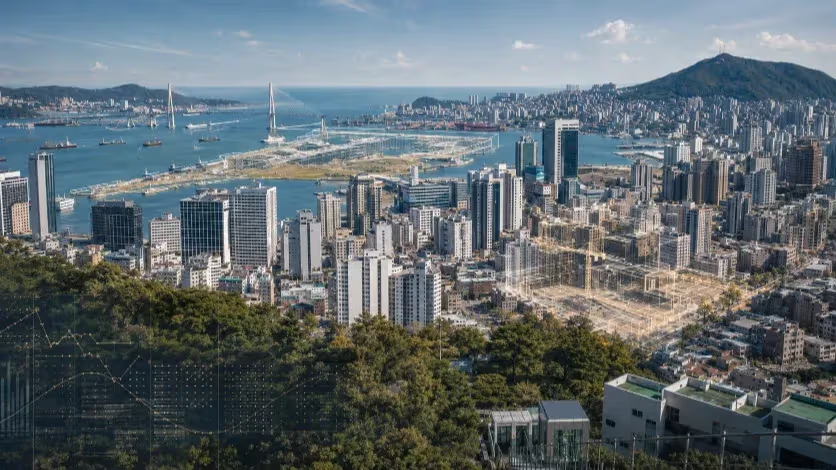
South Korea bid to host a World Expo in Busan between May 1 and October 31, 2030, with the theme "Transforming Our World, Navigating Toward a Better Future. In early September, a government delegation from Busan visited Paris and submitted the candidature dossier required to host the 2030 World Expo to the Bureau International des Expositions (BIE).
The World EXPO outline, major theme and subthemes, estimated number of visitors, venue, transportation, lodging, financing, and differentiation strategies are all included in the submitted dossier. The documents will be reviewed by the BIE member states (170 in total) as a point of reference in assessing not only the candidate's host capacity but also the candidate city's local inspection, which is scheduled for the first half of 2023.
The BIE organizes four types of Expos: World Expos, Specialized Expos, Horticultural Expos, and the Triennale di Milano. While two Korean cities, Daejeon and Yeosu, hosted 'Specialized Expos,' if Busan wins the bid, South Korea will host the World Expo for the first time. Along with the Olympics, World Cup, and World Expo, the World Expo is regarded as one of three mega international events.
According to the bidding committee, the World Expo 2030 Busan, with a budget of 6.5 trillion won, will generate 43 trillion won in economic value and 18 trillion won in added value.
Expo organizers must balance cost and legacy at the same time. According to government estimates, the Shanghai World Expo 2010 cost $4.2 billion. However, according to Chinese media, the actual cost of staging the event was more than $50 billion, far exceeding the amount spent on the 2008 Beijing Olympics.
Breaking down barriers and seeing reality
Busan's main slogan is 'Transforming Our World, Navigating Toward a Better Future,' and it is supported by three sub-themes: Sustainable Living with Nature, Technology for Humanity, and Platform for Caring and Sharing 'People.'
However, the city's vision for presenting itself as a member of the international community is ambiguous. Busan's bid for Expo 2030 is brimming with words like "metaverse," "blockchain," "humanity," "sustainability," and "better future". "It simultaneously tries to display images of nature, sustainability, future technology, K-culture, and BTS. However, it is difficult to predict what kind of picture it hopes to depict.
Riyadh, Saudi Arabia, Busan's biggest competitor, appears to be confident of winning the bid, having received public support from 57 Organization for Islamic Cooperation (OIC) members and more than 70 countries, including France.
Long-term survival necessitates diversification of a city's outputs to reduce reliance on specific industries. As a result, the city's economy becomes more robust, with greater immunity to global market changes and thus greater economic resilience.
However, the city of Busan should be considered sustainable only if it can demonstrate an indefinite capacity for high performance. Many of the concepts described in this great theme have been observed in cities that have demonstrated sustainability for 10 to 30 years, but their long-term robustness has yet to be proven.
The long-term viability of urban growth is always a challenge.
The long-term viability of city growth is always a challenge. The economic environment can shift, a rival city can thrive and compete, local residents and businesses can leave, and political support can fade.
To address this challenge, leaders should chart a clear path for local institutions to develop and lead. As a result, local governments must constantly update their strategies and pursue an environment conducive to the growth of the private sector.
Editorial Context
"Independent journalism relies on radical transparency. View our full log of editorial notes, corrections, and project dispatches in the Newsroom Transparency Log."
Reader Pulse
The report's impact signal
Be the first to provide a reading pulse. These collective signals help our newsroom understand the impact of our reporting.
Join the discussion
A more thoughtful conversation, anchored to the story
Atlantic-style discussion for this article. One-level replies, editor prompts, and moderation-first participation are now powered directly by Prisma.
Discussion Status
Open
Please sign in to join the discussion.
The Weekly Breeze
Independent reporting and analysis on Busan,
Korea, and the broader regional economy.