Busan’s real North Port fight is over the city’s civic center
North Port is being sold through stadium politics in Busan’s local election, but the site carries a heavier question. As the waterfront meets Busan Station and the edge of the old downtown, the real issue is whether Busan can build a civic center rather than another disconnected project.

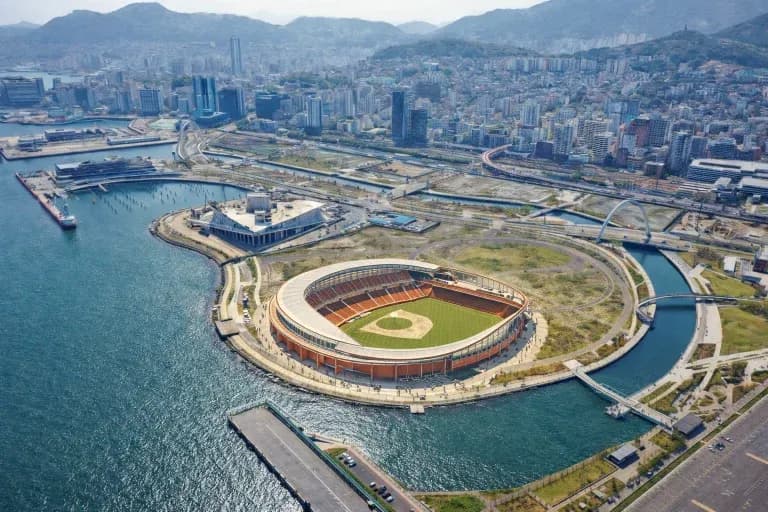
North Port has become campaign material in Busan, but the larger conflict is not about baseball. It is about whether one of the city’s most consequential pieces of land will be used to produce a civic center or absorbed into another round of facility politics. Busan’s own redevelopment framework already treats the area as more than a standalone site. Phase 1 is framed around public waterfront access, gateway status and the revitalization of the old city center, while Phase 2 extends across Busan Station, the Busanjin Station container-yard area and adjacent old-downtown districts under a single consortium-led scheme.
That is why the North Port stadium debate has grown larger than a routine election-season pledge battle. The political appeal is easy to understand. In Busan, baseball carries emotional force on its own. At North Port, that force is amplified by the site’s symbolic weight. The city’s official description places the redevelopment near Busan Station, links it to a gateway narrative and notes its proximity to central districts such as Nampo-dong, Gwangbok-dong and Jagalchi, while also acknowledging the project’s heavy political and social attention. A proposal there is therefore never only a sports promise. It is also a claim on one of the few sites in Busan where landmark politics, metropolitan access and old-downtown recovery meet on the same ground.
Why the election latched onto North Port
The North Port stadium fight escalated quickly because the site compresses too many political advantages into a single promise. In Busan, baseball already carries unusual electoral value. It speaks to civic pride, everyday sentiment and a long habit of reading the city through the fortunes of the Giants. On most sites, that would already be enough to turn a stadium pledge into a useful campaign device. At North Port, however, the emotional charge of baseball is amplified by the symbolic weight of the land itself. A candidate is not just promising a place to watch a game. He is staking a claim on one of the few sites in Busan that can be marketed at once as a waterfront destination, a metropolitan gateway and a potential new center of the city.
That is why the debate moved so quickly from sports to land use. Recent reporting shows that the main contenders are not simply arguing over whether Busan should have a better stadium. They are arguing over what North Port should become. Chun Jae-soo has proposed a seaside dome stadium as part of his mayoral bid, while rival conservative camps have countered with different combinations of Sajik reconstruction, a North Port arena or a waterfront ballpark concept. The visible campaign dispute is about facilities, but the underlying dispute is about land use: whether North Port should be defined first by baseball, by performance and events, by open waterfront access or by some negotiated mix of all three.
The electoral logic is straightforward. A North Port stadium promise gives candidates three things at once. It gives them access to the emotional language of baseball. It gives them an easily rendered visual project that can travel through campaign media. And it lets them speak in the register of city-making rather than routine administration. That combination is unusually potent in a local election, where symbolic proposals often matter as much as formal policy detail. But it also explains why the issue has generated immediate suspicion. The more functions loaded onto the promise, the more vulnerable it becomes to questions it cannot answer with a rendering alone.
Those questions are already visible in the public record. Recent coverage has highlighted the unresolved tension between new North Port proposals and the ongoing reconstruction of Sajik Baseball Stadium, which already has public funding and administrative momentum behind it. Critics have also pointed to the familiar cycle of election-season imagery that far outpaces executable planning. The skepticism is not anti-baseball. It is a learned response to how often spectacular stadium language outruns administrative reality. That makes the North Port debate heavier than an ordinary campaign pledge. Here, a stadium proposal is not just a promise to build. It is a promise to reorder priorities on one of the most contested pieces of land in the city.
What makes the politics sharper still is that North Port was already carrying too much meaning before the first campaign rendering appeared. Busan’s own planning language had long linked the site to public waterfront access, gateway status and old-downtown revitalization. Once candidates began attaching stadium and arena proposals to that ground, they were not introducing a new issue from scratch. They were entering a space that had already been marked, institutionally and symbolically, as one of the city’s future-defining corridors. That is why the election latched onto North Port so fast. The site was already waiting for a political fight. Baseball simply gave that fight a popular vocabulary.
Why North Port is politically different from every other site
North Port matters because it is not just another waterfront parcel. Busan’s own description places the redevelopment beside Busan Station, ties it to a wider gateway narrative, and notes its proximity to Nampo-dong, Gwangbok-dong and Jagalchi — districts that still carry much of the old center’s commercial and symbolic weight. The city also describes the project as an effort to recreate the heart of downtown rather than simply open new development land on the coast. That already sets North Port apart from most other large sites in Busan. It is being asked to do more than host a facility. It is being asked to stand in for a version of the city.
That changes the politics of any proposal placed there. A stadium in an inland district can remain, at least in public argument, a sports infrastructure question. A stadium at North Port cannot. Once a proposal is attached to land that sits at the edge of the waterfront, next to the city’s main rail gateway and within walking reach of old commercial Busan, it stops being read as a single-purpose project. It becomes a statement about what kind of center the city wants, what kind of image it wants to project, and which uses are being elevated above others on one of the few sites that can plausibly carry metropolitan meaning. That is why North Port proposals trigger argument at a higher temperature than comparable ideas elsewhere. The ground itself raises the stakes.
The site is politically unusual for another reason: it is central without being central in the geometric sense. Busan is too dispersed, too topographically divided and too functionally fragmented for a single point on the map to settle the question of urban centrality. North Port matters instead because it sits where several different kinds of centrality overlap. It is a point of arrival because of Busan Station. It is a point of representation because the waterfront is one of the places where Busan most visibly presents itself. And it is a point of transition because the corridor abuts districts long discussed in terms of decline, regeneration and reconnection. That overlap is what makes the site politically heavier than a park, beach or ordinary development zone. It is not simply a place in the city. It is one of the places through which the city is interpreted.
The official planning language makes that clear. Phase 1 is framed around public waterfront access, gateway status and old-city revitalization. Phase 2 then widens the argument by formally pulling Busan Station, the Busanjin Station container-yard area and adjacent old-downtown districts into a single redevelopment scheme led by a multi-agency consortium. Once the city itself defines the corridor in those terms, no proposal there can remain local in meaning. A North Port pledge is immediately judged as a proposition about Busan’s wider urban order. That is what makes the site politically different from every other candidate ground in the current campaign.
A citywide question because the corridor is a point of arrival
North Port’s role in citywide politics turns partly on accessibility, but the point needs to be made carefully. The strongest claim is not that the site is equally convenient from every part of Busan. The stronger claim is that North Port is one of the city’s most important points of arrival and transfer, and therefore one of the few places where a project is immediately read as a citywide proposition rather than a district amenity. Busan’s own English materials support that reading. The city describes the area as being near Busan Station, presents it as a focal point in a wider road-sea-air transport system, and frames the redevelopment around gateway status rather than neighborhood improvement alone.
That changes how the site is judged. A park in the interior of the city can remain a local success even if it has symbolic value. A project at North Port cannot. The station district makes that impossible. Busan Station is not just another transit node. It is the city’s main intercity rail gateway, and a site tied directly to it enters the public imagination through arrival before it enters through everyday neighborhood use. Visit Busan’s English guide to the North Port Waterfront Park makes the point in practical terms: it describes the park as a downtown waterfront site reached from Busan Station by pedestrian bridge. That is a tourism description, but politically it means more than that. It means the city is already presenting the corridor as part of Busan’s front door.
Once a site functions as part of the city’s arrival sequence, accessibility becomes representational as much as logistical. The question is no longer just how long it takes to get there. The question is who encounters the place as a first impression of Busan. Commuters, KTX passengers, tourists, business visitors and residents moving through the rail network all read the station district and adjacent waterfront before they read most other parts of the city. That gives North Port a political reach that exceeds its parcel boundaries. A proposal there does not stay local for long. It is interpreted, almost immediately, as a proposition about Busan itself. That is one reason the site carries more symbolic heat than other major public spaces.
This is also why comparisons with other prominent Busan sites can only go so far. Busan has beaches, parks and waterfront promenades. It is not short on places where people gather or spend leisure time. But those places do not generally sit at the point where metropolitan arrival, public visibility and old-downtown transition overlap. North Port does. Its importance comes not from being in the middle of the map, but from sitting at the junction where the city receives people, presents itself to them and channels them toward or away from its historical core. That is what turns accessibility into a political fact rather than a transport detail.
Where Busan arrives, remembers and tries to rebuild
North Port carries political weight not only because it is visible, but because it is layered. The waterfront beside Busan Station is not a neutral canvas awaiting the next facility. It is part of the physical sequence through which Busan became a port city, a rail city and, eventually, a city whose old commercial core grew around circulation between the harbor and the station. Busan’s own North Port framework hints at that depth in unusually direct terms. The city does not describe the redevelopment only as a marine-tourism or business project. It also assigns the area a “history function” that seeks to restore the identity of the city. That phrase matters because it turns history from a decorative motif into an obligation of planning. The city is effectively saying that North Port is not just supposed to look new. It is supposed to reconnect to an older urban logic that has been weakened but not erased.
That is one reason North Port cannot be treated like ordinary reclaimed land. The site sits where the historical infrastructure of Busan’s growth is still legible. Busan Station remains the city’s principal rail gateway. The old downtown districts near the station remain part of the city’s historical commercial fabric. The port, meanwhile, is not an abstract maritime image but the institutional and spatial foundation on which much of modern Busan was built. A March 2026 Busan city release made that point in broader historical terms, describing Busan Port as the “gateway to the Korean Peninsula” since its opening in 1876 and as a central hub in the influx and exchange of modern goods and culture. That language is promotional, but its historical premise is not trivial. The station district, the port edge and the old downtown are not adjacent by accident. They belong to the same urban formation.
That historical formation is precisely what makes the current politics heavier than it first appears. A stadium, arena or landmark proposal at North Port is not being placed on blank land. It is being placed on ground where Busan’s older urban order is still visible, even if weakened. That is why the city’s own Phase 2 language matters so much. The official purpose is not limited to new industry or waterfront development. It also includes connection and win-win development with the original downtown area and the shaping of a compact, complex city center. Those phrases make clear that the redevelopment is not meant to bypass the historical city. It is meant, at least on paper, to force a new relationship with it.
This is where much campaign language risks flattening the issue. Election rhetoric naturally prefers the future tense. It likes to imagine what could be built, how iconic it could look and how quickly it could turn into a new destination. But North Port cannot be understood only in the future tense. The political difficulty of the site comes from the fact that it is already full of inherited meaning. It carries the port’s role in the making of modern Busan, the station district’s role in arrival and circulation, and the old downtown’s unresolved status as a place that remains central in history but uncertain in the city’s current hierarchy. That inherited meaning is not a sentimental side note. It changes what counts as success. A visually impressive new district that leaves the old relationship between the waterfront, the station and the historical city fundamentally broken would not solve the political problem North Port now embodies. It would only modernize the surface of it.
North Port, in other words, matters because it is one of the few places in Busan where the city is being asked to do three things at once. It has to accommodate new development. It has to acknowledge an older urban structure. And it has to decide whether those two tasks can be made compatible. That is why the site is more than a waterfront project and more than an election issue. It is one of the rare spaces where Busan is being forced to answer a harder question: whether the city intends to build over its historical core, or whether it is finally prepared to reconnect to it.
The old downtown is not a side issue but the measure of success
The old downtown is not a secondary beneficiary of the North Port project. It is one of the project’s stated purposes. Busan’s English materials for Phase 1 say the redevelopment is meant to revitalize “the heart of the old city center and local economy” through the simultaneous development of North Port and its surrounding area. Phase 2 makes the point even more plainly. Its official purpose includes promoting connection and win-win development with the original downtown area, while the project boundary itself extends across Busan Station, the Busanjin Station container-yard area and adjacent old-downtown districts. That language matters because it removes any ambiguity about how the site should be judged. North Port is not being presented by the city as a self-contained waterfront district. It is being presented as a corridor whose legitimacy depends on whether it reconnects to the historical city beside it.
That makes success harder to claim than many campaign renderings imply. A waterfront project can look complete even when it remains functionally isolated. It can open parks, plazas and landmark facilities and still fail to repair the break between the port edge and the existing city. The official plans themselves point to that danger by making linkage part of the project’s stated purpose. Once the city says the redevelopment is supposed to revive the old center, the argument can no longer stop at the water’s edge. A successful North Port is not one that simply attracts people to a new district. It is one that changes how people move between the station district, the waterfront and the older streets of Choryang, Dong-gu and Jung-gu.
The same logic appears in Busan’s broader regeneration planning. The city has previously tied North Port integrated development to old-downtown regeneration and to Busan Station-area regeneration and knowledge-platform projects. That planning history matters because it shows the linkage question is not an after-the-fact interpretation imposed by critics. It has been built into the policy conversation for years. What the current election has done is force that underlying question into a more compressed and politically visible form. Once stadium and arena proposals began occupying the site in public debate, they also inherited the burden of proving that they would strengthen rather than weaken the old-downtown connection that official policy had already made central.
This is where many waterfront megaprojects fail their hardest test. They generate a new destination but do not generate urban repair. The public can reach the water, but the existing city does not meaningfully absorb the new movement. If that happens at North Port, the project may still look active, prosperous and photogenic. It will not have done what Busan says it is supposed to do. The old downtown does not need symbolic adjacency to the waterfront. It needs usable linkage, regular foot traffic and a corridor that allows older commercial streets to participate in the project’s daily life rather than stand beside it as historical scenery. If movement stops at the edge of the new district, then North Port may succeed as development while failing as city-making.
That is why the old downtown has to be treated not as background but as the measure of success. The relevant question is not simply what gets built at North Port. It is whether the site can send activity back into the historical city in a way that changes the lived geography of Busan. If the answer is yes, North Port can plausibly claim to be rebuilding the center. If the answer is no, then even a visually impressive waterfront will remain what many large redevelopment projects become: a new edge beside an old city that still has not been reconnected to it.
Why a stadium is unusually heavy here
A stadium proposal at North Port carries a different weight from a stadium proposal elsewhere because the site is already over-assigned. It is not being asked to do one thing. It is being asked to function, at once, as a public waterfront, a gateway district, a redevelopment engine and a bridge back into the old downtown. Once that planning framework is in place, a stadium proposal is no longer just a sports pledge. It becomes a decision about how much of the corridor’s civic burden one ticketed facility should be allowed to absorb.
That is what makes the current campaign argument unusually heavy. Recent reporting shows that the competing North Port plans are not simply variations on stadium design. They represent different claims about what the land should prioritize. A seaside dome, a North Port arena, or a baseball-first waterfront concept each implies a different answer to the same question: whether North Port should be defined first by baseball, by performance and events, by open waterfront access or by some negotiated mix of all three. The visible campaign dispute is about facilities, but the underlying dispute is about primary function.
The policy burden is heavier still because North Port is not empty ground waiting for a single flagship use. The area is already embedded in a larger redevelopment structure that includes Busan Station, the Busanjin Station container-yard area and surrounding old-downtown districts. Recent coverage has also underscored that Sajik’s reconstruction is already part of the city’s sports-infrastructure trajectory, which immediately raises the question of duplication. Once that question is asked, a North Port stadium can no longer be sold simply as an additional amenity. It has to justify why one of the city’s most symbolically charged and strategically located corridors should be occupied by another large sports facility when the city is already committed to rebuilding its traditional baseball base elsewhere.
This is where the politics of excitement collides with the politics of trade-offs. A stadium proposal is electorally efficient because it is legible at a glance. It promises scale, spectacle and civic ambition in one image. But at North Port, every large facility comes with a harder question attached to it: what does the city give up to make room for it? The answer is not abstract. It can mean less non-ticketed public space, a weaker pedestrian corridor between Busan Station and the waterfront, or a more self-contained destination model that keeps activity inside the new district rather than sending it into older streets nearby. Busan Port Authority’s materials present the redevelopment as a business-and-pleasure district and allocate substantial land to public facilities, including park-and-square space. That makes the trade-off more specific, not less.
The skepticism visible in recent coverage follows from that tension. It is not, at bottom, a rejection of baseball. It is a learned response to how often highly visual election pledges outrun administrative reality. The more emotionally attractive the North Port stadium promise becomes, the more necessary it is to ask what remains after the rendering is stripped away: who pays, who operates, what happens to Sajik, how the project fits the Phase 1 and Phase 2 plans, and whether the old downtown gains anything more than proximity to a new spectacle. At North Port, a stadium promise is not just an addition. It is a choice among competing claims on one of the few sites in Busan where symbolic ambition, citywide access and old-downtown recovery all meet on the same ground.
What kind of public space Busan actually needs there
If North Port is to function as more than a development site, the debate over a plaza or civic center has to be more precise than the usual language of open space. Busan does not simply need a large clear site on the waterfront. It needs a corridor where arrival, assembly and public visibility can operate together without being subordinated to ticketed facilities or event calendars. That is a higher threshold than the language of plazas and promenades often suggests. A civic center is not created by emptiness alone, and it is not secured by the mere presence of a park. It exists only if the space can absorb ordinary use as well as spectacle. At North Port, that means the corridor has to work not only when a crowd has been called in, but also when nothing special is happening.
That distinction matters because the existing public discussion often mistakes visual openness for civic function. A site may look generous on a rendering and still fail as public space once it is built. The relevant test is not how broad the pavement or lawn appears from above. The relevant test is whether people can reach the place easily on foot, stay there without paying for access, cross it without being funneled into a commercial program, and continue through it into the surrounding city rather than turning back along the same controlled edge. Project for Public Spaces makes the point in practical terms: successful squares depend on pedestrian access, active edges and the everyday presence of people, while spaces cut off by fast traffic lose the social life that makes them work.
For Busan, this means the real question is not whether North Port gets a plaza, but what kind of public-space logic governs the corridor as a whole. A place that empties out whenever there is no match, concert or official event is not functioning as a civic center. A place that can only be used after passing through ticketed programs or commercial bottlenecks is not functioning as a civic center. A place that delivers visitors to the water and sends them back along the same route without drawing them into the older city is not functioning as a civic center. The threshold is ordinary time. The site has to work on a weekday without spectacle, and it has to work for people who are not attending anything at all. That is especially important at North Port because the corridor already carries too many competing expectations to be judged by special occasions alone.
The physical structure of the redevelopment makes the question more concrete. The Busan Port Authority positions North Port as a major transformation of existing port facilities into a mixed business-and-pleasure district. That is not wrong, but it reveals the tension at the heart of the site. The same corridor is expected to support investment, leisure, tourism, urban branding and public accessibility at once. Those aims are not naturally aligned. Without an explicit public-space logic, the most commercially legible programs will tend to dominate. That is why the issue is not simply whether there is enough open land on the plan, but whether the open land remains primary rather than residual after larger uses are inserted. At North Port, public space will fail if it survives only as the area left over after destinations have been assigned.
This is also why Busan should not think about the site as one plaza in isolation. North Port has to be understood as part of a civic corridor running from Busan Station to the waterfront and back into the old downtown. The city’s own Phase 1 and Phase 2 language already supports that reading by tying the redevelopment to gateway status, waterfront access and connection with the original downtown area. If the city plans it instead as a sequence of parcels, it may still produce attractive buildings and broad open surfaces, but it will not produce a functioning civic center. It will produce adjacent spaces without civic continuity.
Why governance matters more than design
The hardest problem at North Port is governance, not architecture. The site is often discussed through buildings because buildings are what campaigns can render most easily. But the official structure of the project points in a different direction. Phase 2 is not being pursued by a single authority with a unified mandate. The developer is the Busan City Consortium, made up of Busan City, the Busan Port Authority, Korea Land and Housing Corporation, Busan Metropolitan Corporation and KORAIL. The project area itself spans Jaseongdae Wharf, Busan Station, the Busanjin Station container-yard area and nearby old-downtown districts. That means the corridor sits across port land, rail land, redevelopment land and existing urban fabric at the same time. Before any civic center can be built on the ground, it has to be built institutionally.
That institutional complexity matters because the different agencies are not managing the same problem from the same angle. KORAIL can read the corridor through rail operations and station access. The port authority can read it through redevelopment value, maritime branding and the reuse of former port land. Housing and municipal development bodies can read it through project delivery, financing and land assembly. City hall can try to hold the broader political narrative together, but it still has to do so across entities with different incentives and different timelines. None of those perspectives is illegitimate on its own. The difficulty is that they do not automatically add up to a public realm. They can just as easily produce a corridor of adjacent priorities, with each institution optimizing its own piece while the space between those pieces remains strategically underdefined.
That is where many large waterfront projects begin to drift. The plans look integrated because the map is contiguous, but the underlying decisions remain fragmented. A station district can be improved as transport infrastructure without being made more civic. A waterfront can become more attractive without becoming more public. An old downtown can be named as a beneficiary without being built into the actual movement logic of the site. North Port is especially vulnerable to that pattern because the city has already assigned it too many functions at once: public waterfront access, gateway identity, investment attraction, cultural programming and old-downtown revitalization. The more responsibilities a site carries, the more dangerous it becomes to leave coordination implicit.
The numbers in the redevelopment plan illustrate the problem. The Busan Port Authority’s English materials show 810,285 square meters allocated to public facilities in Phase 1, including 199,939 square meters categorized as park and square space. On paper, that looks substantial. But public land on paper is not the same thing as a functioning civic corridor. The question is not only how much land is reserved. It is how that land is governed once larger facilities, commercial programs and movement systems begin to compete around it. Open space can still be cut up by traffic, weakened by inactive edges or treated as residual area after the major uses have already been assigned. The more land a plan labels as public, the more important it becomes to ask who protects its public function in practice.
Busan Station makes that governance problem visible in operational terms. Once the city treats the station district as part of a pedestrian-centered urban strategy, it concedes the central point: the area in front of and around the station is not a leftover transport zone. It is part of the civic realm. Busan’s recent English-language materials describe station-area or pedestrian-centered improvements in exactly those terms. That matters because it provides a real test of whether Busan can govern North Port as a corridor rather than as a set of projects. If the station district is improved on one logic, the waterfront on another and the old downtown on a third, the city may still complete visible works on all three fronts. It still will not have produced a civic center.
This is why responsibility for the space between projects matters as much as responsibility for the projects themselves. The politically easy part is to announce a facility, a plaza or a signature structure. The harder part is to assign enforceable responsibility for pedestrian continuity, access rules, programming, maintenance and old-downtown spillover across the whole corridor. Without that chain of responsibility, the language of linkage will remain descriptive rather than operational. The city will be able to say that Busan Station, North Port and the old downtown belong to one redevelopment story. It will be much harder to make them function as one lived urban sequence.
That is why governance, in the end, may decide more than design. North Port does not lack plans, drawings or symbolic ambition. What it risks lacking is an institutionally durable answer to a simpler question: who is accountable if the corridor still feels broken after the landmark projects are built? Until that question is answered, North Port will remain politically valuable long before it becomes civically legible.
Beyond the campaign cycle
That is why the North Port argument has already outgrown the campaign cycle that helped inflame it. The site matters because it concentrates several unresolved questions in one corridor: what counts as Busan’s landmark, what part of the city feels most central, how the old downtown is supposed to recover, and whether the waterfront can be reconnected to the historical city rather than built over as a separate zone. Busan’s own planning language makes that reading hard to avoid. Phase 1 frames the redevelopment around public waterfront access, gateway status and the revitalization of the old city center, while Phase 2 pulls Busan Station, the Busanjin Station container-yard area and adjacent old-downtown districts into a single consortium-led scheme.
That is also why North Port should be judged by a stricter standard than the next stadium rendering or landmark proposal. The relevant test is not whether the site can absorb another crowd-pulling facility. It is whether a resident or visitor can move from Busan Station to the waterfront and then into the old downtown through a corridor that still feels public, connected and unmistakably part of the city. That is the standard implied by the city’s own gateway framing, by the marketing of North Port Waterfront Park as a downtown site reached on foot from Busan Station, and by the project’s explicit linkage to the original downtown area.
If Busan can make that corridor work in ordinary time — not only on event days, not only through ticketed destinations, and not only inside new waterfront parcels — then North Port can plausibly claim to be rebuilding the center rather than decorating the edge. If it cannot, the city may still produce attractive buildings, public-facility acreage and a more marketable skyline. But it will not have solved the harder political problem the site now embodies. It will simply have handed one of Busan’s most consequential pieces of land to another round of disconnected promises. The issue is no longer whether the ground can be developed, but whether it can still function as a civic realm once the major uses are assigned.
Continue this reporting
Reporting on the same issue
Related coverage selected from the article's desk, topics and newsroom relationships.
 NewsOct 4, 2026
Zelensky, South Korea and the Limits of Wartime Pressure
South Korea says Kyiv broke a confidentiality understanding when Zelensky rev...
 NewsSep 1, 2026
What Lee Jae Myung Thinks a Minister Can Fix
President Lee Jae Myung says reform should be judged by results rather than c...
 NewsAug 21, 2026
The Korean Peninsula Trump Is Returning To
Another Trump-Kim summit would unfold on a peninsula where North Korea is har...
More from the author
More from this byline
Stay with the same line of reporting through more work from this byline.
 NewsSep 16, 2026
Busan’s Young-Adult Migration Turns Sharply at 25–29
Reader Signal
Community readWhat did this report leave you with?
Choose the signal that best reflects your reading. Select it again to remove it.
One response per article
No response selected
A moderated conversation about the reporting.
One-level replies and newsroom moderation keep the conversation anchored to this article.
Discussion Status
Open
Please sign in to join the discussion.
Newsletter
Weekly reporting and context from Busan and Korea.