Why the Far-Right Rises from Capitalism’s Shadows
Across democracies, far-right movements are gaining ground — not despite economic dislocation and inequality, but because of them. As liberal institutions fail to offer emotional resonance and material security, the vacuum is filled by nativist myths and authoritarian certainty.


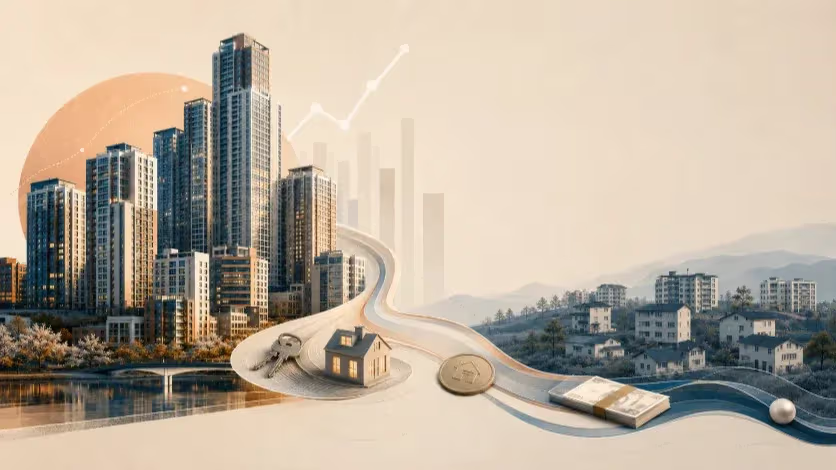
In villages turned hollow and high-rises filled with emptiness, a new political reality is emerging. The far right is no longer confined to the fringes — it is winning elections, shaping discourse, and redrawing the moral lines of democracy. From post-industrial Europe to Rust Belt America, its momentum draws not only from anger, but from a pervasive sense of abandonment. Modern capitalism, in its obsession with efficiency, has created ghost towns, fractured labor markets, and winners who speak in markets — not in morals.
Nowhere is this backlash more visible than in the return of protectionist politics. Donald Trump’s revived tariff war — aimed at China but wounding global supply chains — is less about trade than about grievance. It taps into the belief that ordinary people are being sacrificed for global elites, that national dignity has been outsourced. What begins as an economic disruption often becomes a cultural realignment.
The Structural Roots of Far-Right Expansion
The far right does not arise in a vacuum. It flourishes in the fractures of modern capitalism, where globalization, automation, and deregulation have not delivered on their promises of shared prosperity. Instead, they have hollowed out the industrial base, weakened unions, and eroded the social contracts that once stabilized democracies.
As traditional class identities fade, voters turn to cultural narratives that offer a sense of belonging — often laced with nationalism, nostalgia, and xenophobia. These narratives are not merely emotional; they respond to real material dislocation. A worker in Detroit, a farmer in rural France, or a delivery driver in South Korea may no longer see a future in the system they inhabit. Democratic institutions feel distant. Tech giants feel omnipotent. In this vacuum, far-right forces present themselves not just as rebels, but as restorers of dignity.
What’s more, austerity policies in the aftermath of financial crises have eroded public trust. Welfare systems have withered, housing is increasingly financialized, and education has become a debt trap rather than a ladder. As the state retreats, far-right leaders step in — not only to blame scapegoats, but to reclaim the language of care, protection, and sovereignty.
Even more alarmingly, the far right is increasingly intertwined with the mainstream economy. They receive funding from private interests, capitalize on media monopolies, and shape policy through legal populism. Their economic platforms may be contradictory — railing against elites while supporting billionaire tax cuts — but their political grammar is coherent: “We speak for the people that globalization forgot.”
The Psychology of Far-Right Appeal
While structural conditions create fertile ground for far-right growth, the emotional architecture of its appeal explains why it captures loyalty with such intensity. In uncertain times, people do not only vote with their wallets — they vote with their identities.
Far-right movements offer something that neoliberal democracies often neglect: a coherent moral narrative. In these spaces, citizens are not abstract “economic agents” or “consumers,” but members of a threatened community. This frame taps into deep psychological needs: for recognition, belonging, and a sense of control over one’s future.
This also helps explain the moral double standards that emerge. Voters who support far-right parties may tolerate corruption or authoritarian rhetoric from their own side, yet respond with outrage when similar behavior is perceived in progressive actors. This is not hypocrisy in the conventional sense — it reflects a tribal moral logic. The in-group must be protected; the out-group must be judged.
Moreover, far-right discourse often weaponizes grievance, reinterpreting personal disappointment or economic stagnation as the result of betrayal — not just by political elites, but by cultural outsiders, intellectuals, or immigrants. This framing is emotionally satisfying: it redirects anger toward visible targets and reaffirms a sense of righteous victimhood.
In many ways, this dynamic mirrors how religious or mythological systems once operated: offering not policy solutions, but clarity, certainty, and a cosmic sense of who is “good” and who is “evil.”
Today’s digital media ecosystem intensifies this psychology. Algorithms reward outrage, echo chambers amplify identity, and misinformation becomes the fuel of community. As a result, far-right movements do not merely gain voters — they build tribes, united less by ideology than by affective loyalty and moral certainty.
Rethinking Liberalism: What Now?
If the far-right has surged by providing clarity, community, and emotional coherence, then its opposition must respond not simply with data, but with vision. Technocratic liberalism — rooted in incrementalism, managerialism, and economic rationality — has proven insufficient in an age defined by cultural anxiety and political disillusionment.
What’s needed now is a moral counter-narrative that doesn’t shy away from emotion, identity, or belonging. This doesn’t mean mimicking the populist right’s tactics, but rather reclaiming the terrain of values: fairness, dignity, community care, and democratic courage. People must not only be told how policies work — they must be invited into a story of who they are and where they’re going.
This also demands a structural reckoning. Neoliberalism’s model of globalized markets, deregulated capital, and hollowed-out welfare systems has bred the very resentment that fuels reactionary politics. Without real investment in economic justice, labor empowerment, housing access, and climate resilience, the backlash will only grow stronger.
Finally, liberal democracies must reimagine the architecture of participation. Political institutions must become more porous, more local, and more responsive — not just representative, but generative of collective purpose.
Because the rise of the far-right is not simply a warning. It’s a mirror. And unless liberalism evolves to meet the emotional, social, and material needs of its people, the future will not be negotiated — it will be seized.
Editorial Context
"Independent journalism relies on radical transparency. View our full log of editorial notes, corrections, and project dispatches in the Newsroom Transparency Log."
Reader Pulse
The report's impact signal
Be the first to provide a reading pulse. These collective signals help our newsroom understand the impact of our reporting.
Join the discussion
A more thoughtful conversation, anchored to the story
Atlantic-style discussion for this article. One-level replies, editor prompts, and moderation-first participation are now powered directly by Prisma.
Discussion Status
Open
Please sign in to join the discussion.
The Weekly Breeze
Independent reporting and analysis on Busan,
Korea, and the broader regional economy.