South Korea Is Growing Older, Colder, and More Disconnected
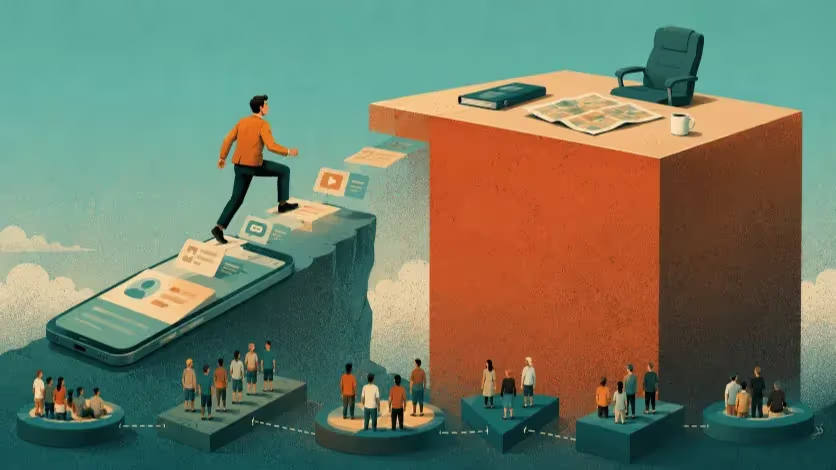
South Korea's true crisis is not low fertility, but the unraveling of institutional trust and social solidarity in a society that no longer believes in a common future.

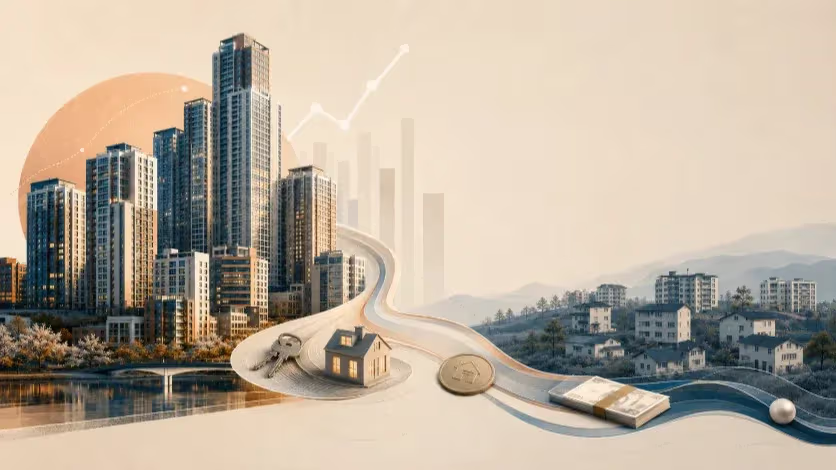
In 2024, South Korea's total fertility rate rose slightly—from 0.72 to 0.75 births per woman—marking the first increase in nine years. The number of annual births increased by approximately 8,300, a shift attributed to delayed marriages following the COVID-19 pandemic and demographic bulges in the early-30s age cohort. Some also credit expanded family support policies introduced by local governments and corporations.
However, most experts caution against interpreting this as a demographic recovery. The structural drivers of fertility decline—housing insecurity, high childcare and education costs, gendered labor inequality, and widespread distrust in institutions—remain intact. The marginal uptick appears to reflect timing effects rather than a reversal of broader trends.
This statistical rebound has not altered public sentiment. Institutional trust continues to erode, inflation persists in daily life costs, and civic disengagement deepens. The fertility rate may have ticked upward, but South Korea’s deeper crisis—the unraveling of social trust and collective vision—remains unresolved.
In 2025, South Korea offers a critical case study: a nation that excels in technology and growth, yet struggles to sustain the belief that the future is a shared project worth committing to.
Political Dysfunction: A System Without Consensus
South Korea's political institutions, once credited with managing the country's transition from dictatorship to democracy, are now facing increasing scrutiny over their responsiveness and relevance. The 2024 general election saw a nationwide turnout of 67.0%—the highest in over three decades—yet youth participation continued to lag behind older demographics. Voters in their 20s and 30s were underrepresented relative to their population size, reflecting a persistent pattern of disengagement rather than a sharp decline.
Although young voter turnout did not plummet, it remained modest despite a campaign season marked by high-profile issues affecting younger generations—including housing insecurity, public safety failures, and employment instability. This disconnect between youth concerns and political representation has amplified concerns about long-term civic disengagement.
Bipartisanship has eroded into rigid ideological alignment, with legislative gridlock becoming a routine feature of parliamentary life. Core national issues—such as fertility, housing, labor reform, and education—are increasingly absorbed into partisan disputes, preventing coherent long-term policy responses.
Political discourse has shifted away from structural analysis or policy-based negotiation toward emotive messaging, identity politics, and factional loyalty. The result is a political ecosystem that feels increasingly disconnected from the lived realities of the public, particularly those most affected by economic and social uncertainty.
Judiciary and Media: Institutions Without Credibility
Public trust in South Korea's judiciary and media has declined markedly in recent years, with 2025 continuing the trend. Once viewed as counterbalances to political power, both institutions are increasingly regarded as extensions of partisan influence or commercial interest, rather than as neutral arbiters or watchdogs.
The judiciary has come under particular scrutiny for a perceived inconsistency in high-profile rulings involving political figures, corporate leaders, and public officials. Although structurally independent, the courts are widely seen as susceptible to political pressure, especially during periods of administration change.
Media credibility has followed a similar trajectory. While South Korea maintains a robust and competitive press, the rise of algorithm-driven news consumption, the proliferation of partisan outlets, and sensationalist editorial practices have fragmented the information landscape. News content increasingly caters to ideological or demographic niches, creating echo chambers and reducing public confidence in shared facts.
Younger Koreans, in particular, express skepticism not just toward legacy media, but toward journalism as a profession. Many turn instead to social media influencers or alternative platforms for commentary and information, often with little editorial oversight. While this shift may offer diversity in perspective, it also undermines the role of verified public knowledge in democratic debate.
Fertility Collapse: A Symptom of Lost Social Faith
Despite the slight rise in fertility rate in 2024, South Korea's demographic future remains uncertain. The current total fertility rate of 0.75 is still far below the replacement level and insufficient to reverse population decline.
The causes are multifaceted: rising housing costs, insecure employment, competitive educational pressures, and gender inequality in domestic and professional spheres. Yet beyond these measurable variables lies a deeper issue: a generational retreat from the expectation that society can—or will—support personal milestones like marriage and childbearing.
For many younger Koreans, parenthood is no longer viewed as a default stage of adulthood but as a financial and emotional liability in an unsupportive system. The phrase "Why would I have a child in a society that doesn't care about me?" has become a common refrain in interviews and surveys.
The demographic crisis also reflects broader trends in relational trust. Marriage rates continue to decline, with record numbers choosing to remain single. Intergenerational tensions, job insecurity, and urban atomization have weakened the sense that raising a child is a communal effort. In this environment, reproduction is not just a personal decision, but a referendum on institutional legitimacy.
Inflation and the Perception Gap: When Growth Doesn't Feel Like Progress
Despite stable GDP growth and a rebound in exports during early 2025, most South Koreans report worsening financial pressure in daily life. The disconnect between headline economic performance and lived experience is a growing source of public frustration, particularly among younger and lower-income households.
Official inflation figures remain within the central bank's target range—hovering around 2.5%—but core expenses such as housing, childcare, transportation, and groceries have increased far more sharply. Rental prices in Seoul continue to rise, and wage growth remains flat in real terms. According to the 2025 National Economic Sentiment Survey, over 60% of respondents reported feeling poorer than the previous year, despite aggregate economic growth.
This phenomenon is not unique to Korea but is especially acute in its context. The country's high household debt levels, weak social safety nets, and reliance on private education amplify the impact of even modest price increases. For young adults burdened with student loans and precarious job prospects, the future feels economically narrow—even if macro-level indicators suggest otherwise.
The consequence is psychological as much as material. People may survive, but they don't feel like they're advancing. Consumption slows, marriage is delayed, and birth rates continue to decline—not because of temporary shocks, but because of a persistent belief that economic systems are no longer structured around human needs.
Cultural Individualism: Withdrawal as Survival
A recurring critique in South Korea's public discourse is that younger generations are increasingly selfish, disengaged, or apathetic. Yet this interpretation overlooks the broader conditions under which individualism has taken root—not as a cultural shift, but as a rational response to institutional erosion and social precarity.
The phrase “각자도생”(gak-ja-do-saeng)—"each survives on their own"—has become a defining ethos for many, particularly among youth and working-class communities. It reflects not a preference for isolation, but a perception that collective systems, from the state to the workplace to the family, can no longer be relied upon for stability or care.
South Korea's hyper-competitive education system, volatile labor market, and insufficient welfare protections have produced high-performing individuals within low-trust environments. In this context, relational commitments such as marriage, parenting, or long-term community participation are often seen not as life goals, but as potential liabilities.
This shift is not only behavioral but emotional. Many report a growing fatigue toward social expectations—what has been called "quiet quitting from society." Civic engagement, family formation, even national identity are increasingly approached with skepticism, if not indifference.
Importantly, this is not a uniquely Korean phenomenon. Across many developed societies, post-material individualism is on the rise. But in Korea, it intersects with a demographic collapse and rapid aging, making its effects more visible and more consequential. When social withdrawal becomes normalized, it accelerates the very trends—low fertility, declining political participation, economic contraction—that prompted it in the first place.
Global Parallels: South Korea as a Bellwether
South Korea's convergence of demographic collapse, institutional distrust, and civic withdrawal is not an anomaly—it is an early indicator of trends emerging across many advanced economies. From Japan's "lost decades" to falling birthrates in Southern Europe, and from rising political polarization in the United States to declining youth engagement in the United Kingdom, post-industrial democracies are increasingly marked by shared symptoms of social exhaustion.
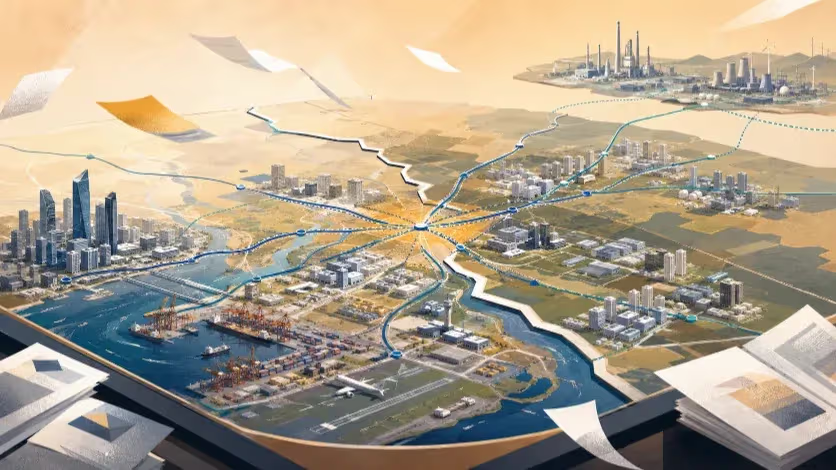
What distinguishes South Korea, however, is the speed, simultaneity, and intensity of these converging pressures. The country has reached record-low fertility faster than any other OECD member, experienced a dramatic surge in household debt, and undergone an accelerated collapse in institutional trust—all within one generation. And unlike other low-birthrate countries like France or the Nordic states, South Korea lacks a robust welfare infrastructure or deeply rooted civic culture to cushion the impact.
At the heart of the global relevance is this question: What happens when a society no longer trusts the very systems that made its success possible? South Korea's case demonstrates that growth, technology, and education—while critical—are insufficient safeguards against civic erosion. The absence of trust, not material scarcity, is proving to be the most corrosive force in modern governance.
A Future That Trust Forgot
South Korea's crisis is frequently described in statistical terms—lowest fertility rate, highest elderly poverty, rising household debt. Yet beneath these figures lies a more fundamental rupture: the breakdown of trust between individuals and the systems meant to support them. That rupture now shapes nearly every aspect of Korean life—from demographic behavior and political participation to economic sentiment and social relationships.
Public institutions—political, legal, media—are no longer seen as credible conduits of representation or accountability. Policy interventions, no matter how well-funded, fail to resonate when belief in the system's intentions has eroded. The result is not rebellion, but quiet resignation: a retreat from marriage, parenting, voting, and long-term investment in society.
If South Korea once served as a model for how rapid modernization could produce prosperity, it may now serve as a warning for what happens when prosperity outpaces cohesion. Its challenges are not uniquely Korean. Rather, they reflect the stress fractures of post-industrial democracies struggling to maintain civic solidarity in the face of economic volatility, technological acceleration, and generational disillusionment.
Reversing this course will not come from financial incentives alone. It will require a deeper reckoning—a reimagining of how institutions behave, how citizens are engaged, and how societies measure their success.
For South Korea, and others watching closely, the question is no longer whether the numbers can recover. It is whether the society can rediscover a reason—and a will—to invest in a shared future.
Editorial Context
"Independent journalism relies on radical transparency. View our full log of editorial notes, corrections, and project dispatches in the Newsroom Transparency Log."
Reader Pulse
The report's impact signal
Be the first to provide a reading pulse. These collective signals help our newsroom understand the impact of our reporting.
Join the discussion
A more thoughtful conversation, anchored to the story
Atlantic-style discussion for this article. One-level replies, editor prompts, and moderation-first participation are now powered directly by Prisma.
Discussion Status
Open
Please sign in to join the discussion.
The Weekly Breeze
Independent reporting and analysis on Busan,
Korea, and the broader regional economy.