Korea's Agricultural Land Restrictions Limit Urban Farming Opportunities
South Korea has one of the most advanced economies in Asia, with a highly urbanized population and a strong focus on technology and innovation. However, the country also faces several challenges related to food security, environmental sustainability, and climate change. One of the solutions that have been proposed to address these challenges is urban agriculture, including vertical farming. However, there are restrictions on the use of agricultural land in Korea, which limits the potential for u


South Korea has one of the most advanced economies in Asia, with a highly urbanized population and a strong focus on technology and innovation. However, the country also faces several challenges related to food security, environmental sustainability, and climate change. One of the solutions that have been proposed to address these challenges is urban agriculture, including vertical farming. However, there are restrictions on the use of agricultural land in Korea, which limits the potential for urban farming in the country.
According to the Korean government's Agricultural Land Act, agricultural land can only be used for farming activities, such as growing crops, raising livestock, or forestry. Any other use of the land, including construction or development, is strictly prohibited. This means that urban farming practices such as vertical farming, which require building structures or modifying existing buildings for farming purposes, are not allowed on agricultural land in Korea.
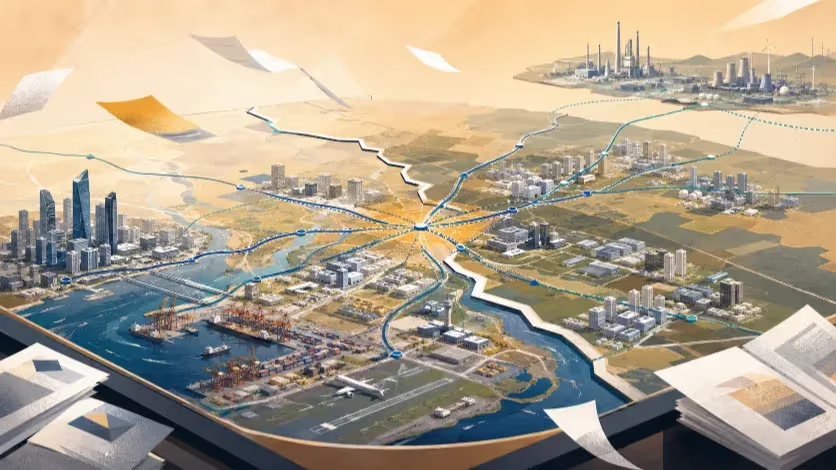
This restriction has been a barrier to the development of urban farming in Korea, especially in the densely populated urban areas where the demand for fresh, locally grown produce is high. While rooftop gardens, community gardens, and greenhouses have been used in some cities, they can only provide a limited amount of fresh produce due to the limited space and resources available.
Vertical farming, which involves growing crops indoors on multiple levels using hydroponics, aeroponics, or aquaponics, could offer a solution to this problem. By using artificial lighting, optimized temperature and humidity, and recycling water and nutrients efficiently, vertical farms can provide high yields of fresh produce year-round, using less water, fertilizer, and pesticides than outdoor farms. Moreover, they can be located in urban areas, closer to the consumers, reducing transportation costs, carbon emissions, and food waste.
However, the restrictions on agricultural land use in Korea make it challenging for urban farmers and entrepreneurs to start vertical farming operations. They would have to seek alternative land options, such as brownfields or industrial sites, which may not be suitable for farming or require costly remediation efforts. Moreover, they would face legal and bureaucratic hurdles in obtaining permits and approvals for their projects.
To promote the development of urban farming in Korea, policymakers need to consider relaxing the restrictions on agricultural land use or creating special zones for urban agriculture. They could also provide financial incentives, such as tax breaks or subsidies, for building vertical farms or repurposing vacant or underutilized buildings for farming purposes. Investing in research and development of new technologies and crops, and providing education and training for farmers and consumers on the benefits of locally grown food could also help to promote the growth of urban agriculture in Korea.
Thus, while urban farming, including vertical farming, offers a promising solution to the challenges of food security, environmental sustainability, and climate change in Korea, the restrictions on agricultural land use pose a significant obstacle to its development. By reconsidering the Agricultural Land Act and promoting the use of alternative land options and incentives, policymakers can help to create a more diverse and resilient food system, improve public health, and mitigate the impacts of climate change.
Editorial Context
"Independent journalism relies on radical transparency. View our full log of editorial notes, corrections, and project dispatches in the Newsroom Transparency Log."
Reader Pulse
The report's impact signal
Be the first to provide a reading pulse. These collective signals help our newsroom understand the impact of our reporting.
Join the discussion
A more thoughtful conversation, anchored to the story
Atlantic-style discussion for this article. One-level replies, editor prompts, and moderation-first participation are now powered directly by Prisma.
Discussion Status
Open
Please sign in to join the discussion.
The Weekly Breeze
Independent reporting and analysis on Busan,
Korea, and the broader regional economy.