What Busan’s tourism rebound does not fix
Visitors are back, but the sectors that give the city economic depth remain under pressure — leaving Busan busier on the surface and more exposed underneath.

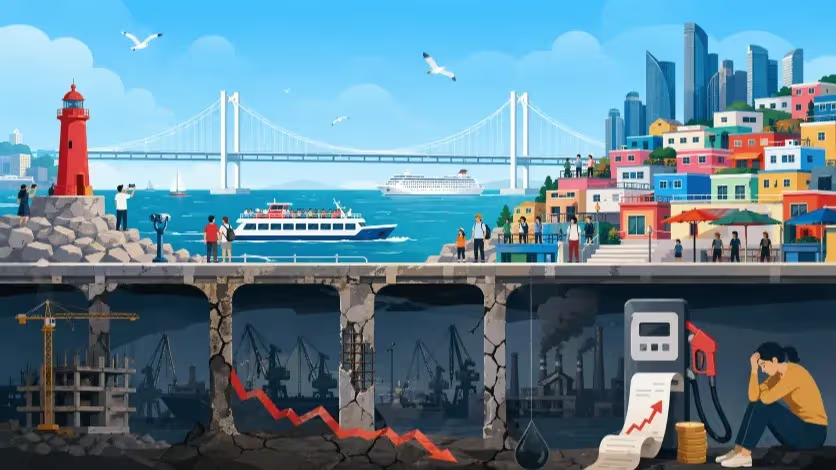
BUSAN — On recent weekends, parts of Busan can look like a city firmly back in motion. Waterfront districts are busier, hotel corridors feel fuller, and the city’s official narrative has become more confident in tone. Busan says it welcomed 3.64 million international visitors in 2025, up about 24 percent from a year earlier, and city officials have responded by pushing harder on gastronomy, longer stays and destination branding as the next stage of growth. As a visual story, it is easy to read: more people, more spending, more confidence, a city recovering its rhythm.
But a city can regain motion without regaining depth. That is the tension now running through Busan’s economy. The tourism rebound is real enough, and the city is not wrong to describe it as a success. The problem is that the success is being asked to carry more meaning than it can bear. Visitors can fill streets, restaurants and hotel rooms. They can improve sentiment. They can support a useful layer of consumption. What they cannot do on their own is answer the harder question that now matters most for Busan: whether the city is rebuilding an economic base that is broad enough to sustain stable work, absorb shocks and lower the vulnerability of the people who live there.
That question matters because Busan is not just any city with a tourism strategy. It is a city whose older economic identity was built around industry, logistics, port activity and construction-linked growth, but whose current public narrative increasingly leans on visibility, events and the visitor economy. That shift does not make tourism trivial. It makes the city’s dependence on tourism more revealing. The more Busan presents visitors as proof of recovery, the more important it becomes to ask what the rest of the economy is doing at the same time. And on that test, the picture is much less comfortable.
The weakness beneath the headline
The easiest way to miss Busan’s weakness is to stop at the headline labor figure. In March 2026, the city’s unemployment rate stood at 2.5 percent. Read in isolation, that looks reassuring. It suggests a labor market under control, perhaps even a city weathering uncertainty better than expected. But the more useful question is not how flattering that number looks. It is what the number leaves out. Total employment in Busan fell to 1.694 million, down 5,000 from a year earlier. More important still, the losses were concentrated in the sectors that have historically carried some of the city’s more stable work: manufacturing employment fell by 14,000 and construction employment by 19,000.
That is not a secondary detail. It is the core of the story. A low unemployment rate can describe the surface of a labor market while missing its underlying contraction. It can tell you that the city is not in obvious distress while saying very little about the kind of jobs that are disappearing, the kind of jobs that remain, or the city’s ability to generate employment with enough scale and durability to matter. In Busan’s case, those distinctions are no longer technical. They are central to understanding what kind of recovery this is.
The same tension appears on the production side. In February 2026, Busan’s industrial production fell 17.1 percentfrom a year earlier, while shipments fell 18.5 percent. The weakness was led by primary metals, electricity and gas, and machinery. Those are not numbers one associates with an economy quietly rebuilding its core beneath a tourism upswing. They point instead to a sharper divide between what is visible and what is foundational: more movement in the city’s consumer-facing spaces, less strength in the sectors that give an economy weight.
This is why the current moment should not be framed as a simple recovery with a few weak spots around the edges. The weakness is not sitting at the margin. It is appearing in the parts of the economy that matter most when growth needs to be translated into confidence, wages and staying power. Busan may look more active. But activity is not the same thing as resilience, and a city that feels lively can still be losing thickness where its economic foundations ought to be strongest.
A city with too few engines
Busan’s deeper problem is not tourism. It is concentration. The city has too few engines capable of carrying the economy when its core sectors weaken. When manufacturing and construction slow, there are limited alternatives that can replace their scale, wages or wider spillover effects. That is what makes the recent tourism success less straightforward than it first appears. The issue is not whether tourism is good. It is whether a city with a narrower industrial base can afford to rely so heavily on tourism and consumption to supply the language of recovery.
Tourism helps, but it helps selectively. It can lift hotels, restaurants, transport operators and some retail corridors. It can support business districts linked to festivals, waterfront traffic and short-stay consumption. It can also sharpen the city’s external image, which matters for investment and confidence. But even successful tourism-led demand is not the same as a broad labor-market substitute for weakening industrial work. A fuller hotel market is not a wider job base. Higher visitor traffic is not proof that the city has solved the problem of where stable livelihoods will come from. Busan’s recent visitor gains may therefore be doing two things at once: supporting selected service activity while also revealing how much narrower the city’s economic structure has become.
That narrowing becomes more serious when prices are brought into view. In March 2026, Busan’s consumer prices rose 2.0 percent from a year earlier. Petroleum prices jumped 10.1 percent. Industrial goods prices rose 2.6 percent, and services were up 2.3 percent. Nationally, consumer inflation was 2.2 percent in March, and the Bank of Korea has warned that oil-price shocks are pushing up producer prices and could add to broader inflation pressure. The point is not simply that prices are higher. It is that Busan’s apparent recovery is unfolding in a cost environment that makes household security harder to rebuild. A city leaning more heavily on movement, services and visitor activity is also a city more exposed to transport- and fuel-linked strain.
This is where the article’s themes stop being separate stories and begin to look like one structure. Weaker industrial employment, softer output and higher energy-linked costs are not parallel developments. They reinforce one another. If the sectors that once anchored steadier work are shrinking, and the visible gains are concentrated in sectors more exposed to seasonality and thinner margins, then the city’s recovery may become increasingly uneven in the most practical sense: Busan looks stronger from the outside just as many households become more exposed from within.
Younger workers are likely to feel that imbalance first. Nationally, the deterioration in youth labor conditions is already visible. In the first quarter of 2026, the number of underemployed young people seeking additional work rose to 123,000, while the broader youth supplementary unemployment indicator reached 10.7 percent. Youth unemployment stood at 7.4 percent. Those are national figures, not Busan-specific conclusions. But Busan is unlikely to be insulated from them. In a city with too few durable engines, younger workers tend to be channeled more quickly into narrower and less secure service-sector paths, even when the city itself appears busy and outward-looking. The danger is not simply a shortage of jobs. It is a shortage of jobs with enough stability and progression to anchor a life.
What Busan is really being tested on
Seen in this light, Busan’s fuel-price relief payments are not just an administrative add-on to the story. They are part of its meaning. The city said the first phase would begin on April 27, offering 600,000 won to basic livelihood recipients and 500,000 won to near-poverty and single-parent households, with a broader second phase to follow under a nationally designed support framework. The payments are limited and temporary. But they are revealing precisely because they are limited and temporary. They show that policymakers themselves understand that pressure on households is no longer a marginal issue. The city’s recovery narrative is visible enough; what requires cushioning is the gap between that narrative and lived economic strain.
This is the real test now facing Busan. The city no longer struggles to attract visitors, attention or events. It struggles to convert visibility into resilience. That is a harder task, and a more important one. It demands more than stronger branding or a busier hospitality sector. It requires an economy capable of generating stable work outside a narrow set of sectors, absorbing cost shocks without quickly pushing households into distress, and spreading the gains from growth more broadly than the visitor economy alone can manage.
None of this means tourism is failing, or that tourism growth is economically meaningless. That would be too simple, and wrong. The point is narrower and more serious. Tourism is proving easier to expand than the productive base beneath it. Busan can bring people in. It has not yet shown that it can turn that momentum into a more diversified, more shock-resistant economy. Until it does, the city’s central contradiction will remain intact: a place that looks increasingly dynamic from the outside, yet remains materially less secure where its foundations ought to be strongest.
That is why Busan should be read not as a city without momentum, but as a city whose momentum is arriving in the wrong places. It has movement without enough depth, visibility without enough insulation, and growth without enough confidence underneath it. The question is no longer whether Busan can sell itself. The question is whether it can rebuild an economy that does not depend so heavily on being sold.
Continue this reporting
Reporting on the same issue
Related coverage selected from the article's desk, topics and newsroom relationships.
 NewsOct 22, 2026
Busan Port’s LNG and Methanol Plan: Who Pays to Keep Fuel Ready?
Busan already supplies ships with LNG and methanol, drawing on regional and i...
 NewsOct 16, 2026
What Is Still Worth Going to See?
Busan’s biennale faces questions of artistic judgment and institutional care....
 NewsOct 14, 2026
What Became of Busan’s University Streets?
From 2015 to 2023, registered businesses grew near Pusan National University...
More from the author
More from this byline
Stay with the same line of reporting through more work from this byline.
- NewsOct 22, 2026
Busan Port’s LNG and Methanol Plan: Who Pays to Keep Fuel Ready?
 NewsOct 12, 2026
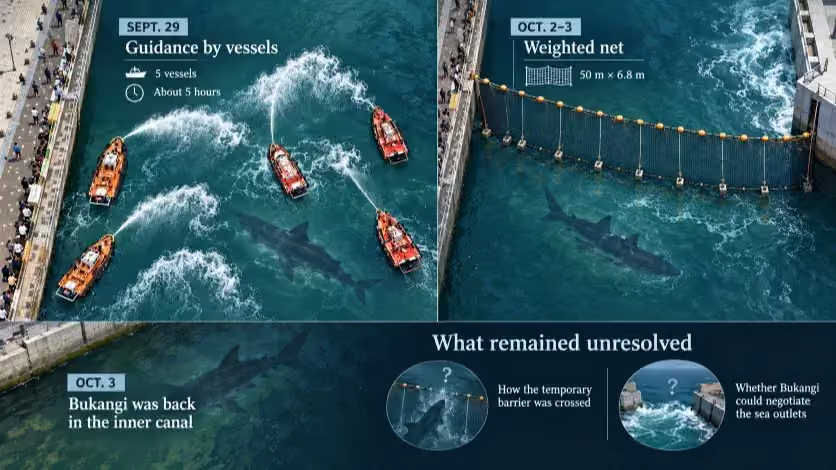
Bukangi, the Shark That Stayed in Busan’s North Port
Reader Signal
Community readWhat did this report leave you with?
Choose the signal that best reflects your reading. Select it again to remove it.
One response per article
No response selected
A moderated conversation about the reporting.
One-level replies and newsroom moderation keep the conversation anchored to this article.
Discussion Status
Open
Please sign in to join the discussion.
Newsletter
Weekly reporting and context from Busan and Korea.