Busan’s BTS Lodging Crisis Tests Urban Trust Before June Concerts
Busan’s temples can offer beds, and inspectors can check violations. But the BTS concerts now pose a harder test: whether the city can protect bookings and stop visitors from feeling like one-time targets for extraction.

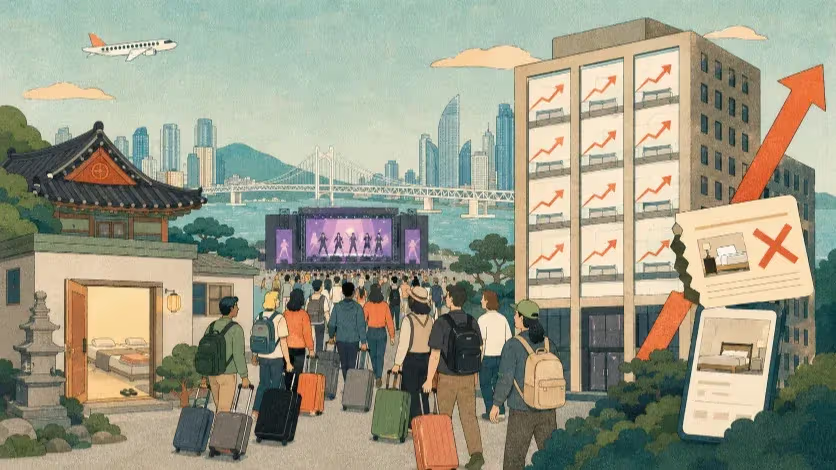
Busan City has asked Buddhist temples to help house BTS fans before the group’s June concerts.
Beomeosa, one of the city’s best-known temples, will open ten twin rooms for 20 foreign visitors from June 11 to 14 and provide meals free of charge. Seonamsa and Hongbeopsa have also joined the city’s “Fair Lodging Challenge,” offering temple rooms as Busan tries to contain anger over hotel prices before BTS performs at Busan Asiad Main Stadium on June 12 and 13. The city will take applications through Visit Busan and select guests by lottery.
The temple rooms give Busan a warmer image at a difficult moment. They also reveal how far the city has had to reach after private lodging markets became part of the story before the concerts even began. A Buddhist temple can offer hospitality. A public youth center can add low-cost beds. A city-owned facility can hold its normal rates. None of those measures can restore a canceled reservation, force an online booking platform to explain a sudden price jump, or reassure a visitor who now wonders whether a confirmed room will still exist when global demand arrives.
Busan City has not ignored the controversy. Officials have opened public accommodation, organized joint inspections and warned that lodging operators accused of abusive pricing may face tax referrals. The city says youth training centers and Naewonjeongsa temple stay facilities have already provided hundreds of beds for foreign visitors, while Busan Urban Corporation’s Arpina maintained existing prices and filled its rooms. The effort shows a city trying to protect its brand before an event that will place Busan in front of a global fandom.
Hotel markets moved faster.
By late May, Korean and English-language outlets were still finding concert-date room rates several times higher than ordinary weekends. Seoul Economic Daily reported a studio-type room normally listed at 57,000 won rising to 3 million won on the concert date. The Korea Times reported a room that usually cost 60,000 won climbing to 760,000 won during the concert period. Asia Business Daily cited official survey figures showing average lodging rates during the concert week at 2.4 times normal levels, with some accommodations showing increases of up to 7.5 times.
The price of a room has become only part of the damage. Fans have also alleged that some bookings were canceled after the concert schedule drew attention, with rooms later appearing at higher prices. A traveler can reject an expensive room before paying. A traveler who already booked a room builds a trip around that confirmation. Flights, trains, work schedules, companion plans and concert logistics all move with it. When the reservation disappears, the loss no longer fits neatly into a complaint about price.
Busan’s lodging dispute now asks a harder question than whether hotels are charging too much. The question is whether a confirmed booking means anything when a city receives sudden global demand.
The city’s current tools struggle to answer that question. Inspectors can check unregistered lodging, posted-rate violations, safety issues and tax concerns. Consumer agencies can receive complaints. Officials can ask businesses to cooperate. Temples and public facilities can absorb a limited number of visitors. Yet a hotel price can change online before an inspector arrives, and a canceled booking can push a visitor into a worse market long before mediation produces relief.
BTS brings Busan an opportunity that most cities would want. The group’s world tour carries global spending power, international media attention and fans willing to travel across borders for a few hours of performance. Reuters reported that analysts estimated the tour could generate about $5.32 billion in spending across 44 cities. For Busan, that kind of demand should translate into overnight stays, meals, shopping, taxis, beaches, markets and repeat visits.
The lodging backlash threatens to reverse that equation. Fans angered by prices have discussed same-day travel, rooms outside Busan and reduced local spending. A concert can bring visitors to a city. A lodging controversy can teach them not to stay.
Busan is not short of goodwill. Beomeosa, Seonamsa, Hongbeopsa, public facilities and some cooperating hotels have given the city visible examples of civic hospitality. The shortage lies elsewhere: enforceable trust. The June concerts will test whether Busan can protect the basic promises that make tourism work — a posted price, a confirmed reservation and a fair chance to stay — before global attention turns into local resentment.
The city built a response after the market had already moved
Busan City built its lodging response around three tools: alternative beds, inspections and public pressure.
Alternative beds came first because they were visible. The city opened public lodging facilities, promoted temple stays and used Visit Busan to take applications for free accommodation at Beomeosa. The Beomeosa program covers 20 foreign visitors in ten twin rooms from June 11 to 14, with meals provided free of charge and same-gender room sharing required. Applicants must apply online, and selected guests must present a physical passport at check-in.
Other temples added more rooms. Seonamsa offered six rooms for 15 visitors. Hongbeopsa offered 16 rooms for 48 visitors from June 12 to 13 and seven rooms for 21 visitors from June 13 to 14. Naewonjeongsa had already opened 21 temple-stay rooms at a paid public rate, and those rooms were fully booked.
The numbers matter because they define the measure more clearly than the slogan does. Beomeosa’s offer gives 20 visitors a place to sleep. Seonamsa and Hongbeopsa add dozens more. Public youth facilities and earlier temple-stay programs can absorb several hundred people. A two-night BTS stop at Busan Asiad Main Stadium creates a different scale of pressure. Fans, companions, staff, media and citywide fan events all move into the same weekend. A few hundred controlled-price or free beds can protect individual travelers from the worst market conditions. They cannot reset the market.
Busan City also moved into enforcement. The joint inspection effort includes city departments, district offices, special judicial police, the Fair Trade Commission, the Korea Consumer Agency, fire authorities and other agencies. Inspectors are looking at unregistered lodging, missing room-rate displays, prices charged differently from posted rates and fire-safety violations.
Those targets show both the value and the weakness of the response. Inspectors can catch a business that operates outside registration rules. They can act when a posted rate and a charged rate do not match. Fire officials can check safety. Tax authorities can examine suspicious revenue later. Yet many of the most visible fan complaints sit outside that clean enforcement box. A hotel can post a concert-weekend rate online before an inspector arrives. A platform can display a price several times higher than surrounding Fridays. A traveler can lose a reservation and still face a long complaint process before any agency produces relief.
The official price data already showed how quickly the market had moved. The Fair Trade Commission and the Korea Consumer Agency surveyed 135 Busan lodging businesses and found that average rates for the BTS concert period were 2.4 times higher than nearby weekends. Motel rates rose about 3.3 times, hotel rates about 2.9 times, and some individual properties reached 7.5 times normal levels. Thirteen properties, about 10 percent of the sample, raised rates by more than five times.
Late-May searches showed that city action had not cooled the market. Busan Ilbo found a Seomyeon hotel listing June 12 at 745,000 won, compared with about 160,000 won on nearby Fridays. A Yangjeong hotel listed the concert date at 557,000 won while nearby Fridays remained in the 50,000-won range. The same report noted that some fans were looking at same-day returns, Gimhae stays or reduced spending in Busan rather than paying concert-weekend hotel prices.
Busan City did not fail to act. The city opened rooms, recruited temples, organized inspections and warned lodging operators about tax scrutiny. The harder fact is that each tool works after a different kind of delay. Public rooms help only the people who win access. Inspections require a violation that fits existing law. Consumer redress begins after a traveler has already been harmed. Tax review arrives after revenue has been collected. Hotel prices, by contrast, can move instantly.
That timing gap now shapes the whole dispute. Busan can still create scenes of hospitality. Beomeosa can feed visitors. Public facilities can hold prices. Some hotels can join the Fair Lodging Challenge and protect their own reputations. But the city has not yet shown that a visitor who booked early will keep that room, or that a lodging operator who breaks that trust will face consequences before the concert weekend ends.
The deeper damage is not the price. It is the broken booking.
Hotel prices gave the controversy its first number. Canceled bookings gave it a sharper wound.
Fans can see a 700,000-won room online and decide not to buy it. They can search in Gimhae, return home after the concert, split a room with friends or give up on staying overnight. A high price forces a choice before the trip begins. A canceled reservation breaks a choice the traveler already made.
Several Korean outlets have reported complaints from fans who say lodging operators canceled earlier reservations after the BTS concert dates drew attention, sometimes citing overbooking or renovation, before similar rooms appeared again at higher prices. Asia Business Daily reported allegations of reservations being canceled and rooms relisted at higher rates, alongside examples of room prices rising from 60,000 won to 760,000 won during the concert period. The same report described fans talking about same-day trips, overnight travel without lodging and reduced spending in Busan.
A canceled room travels farther than the booking page. A fan who secured a room months earlier may have already bought train tickets, arranged flights, requested time off, planned a route from the stadium and built the trip around that address. When the room disappears, the traveler does not return to the original market. The traveler enters a worse one, closer to the concert date, after prices have risen and cheaper rooms have been taken.
That sequence explains why the lodging dispute cannot be treated only as a debate over how much a room should cost. A concert weekend allows hotels to charge more. A market can defend higher prices as scarcity. A hotel operator has a harder time defending a canceled reservation if the same room, or a comparable room, returns to the market at a higher price.
The Fair Trade Commission and the Korea Consumer Agency have already documented the price side of the market. Their survey of 135 Busan lodging properties found that the average one-night rate for the BTS concert weekend was 2.4 times higher than nearby weekends. Motel rates rose to about 3.3 times normal levels. Hotel rates reached 2.9 times. Some individual properties listed prices as much as 7.5 times higher, and 13 properties — about one in ten in the sample — raised rates by more than five times.
Those figures matter, but they do not capture the full injury. The survey can show how far prices moved. It cannot show how many visitors lost an earlier booking, how many canceled rooms were relisted, how many operators used renovation or closure notices to escape lower-rate reservations, or how many travelers abandoned Busan after deciding the city’s lodging market could not be trusted.
Busan’s enforcement system also becomes weaker at this point. Inspectors can compare posted prices with charged prices. District offices can check whether a lodging business is registered. Fire officials can inspect safety conditions. Tax authorities can examine revenue later. Consumer agencies can receive complaints and attempt mediation. None of those tools gives a traveler an immediate replacement room at the original price when a booking disappears three weeks before a global concert.
The booking platforms sit in the center of that gap. Hotels and short-term lodging operators use online platforms to change prices, close inventory, reopen rooms and communicate cancellation notices. Fans see the platform screen, not the back-office decision. A public agency that does not receive platform-level data cannot easily determine whether a canceled room returned to sale, whether the room type changed, whether a price increase followed the cancellation, or whether the operator repeated the pattern across multiple guests.
Busan City has threatened tax referrals for businesses tied to price-gouging complaints, and national agencies have monitored the market. The threat may discourage some operators. It does not automatically repair the broken transaction. A tax review examines revenue after the money has moved. A consumer complaint creates a record after the traveler has been displaced. A public statement tells the market that officials are watching. A confirmed reservation needs protection before the traveler loses the room.
That is why the BTS lodging dispute cuts deeper than the number on a hotel page. Busan is asking visitors to trust the city with time, money and movement. Fans are not only buying a concert ticket. They are buying a weekend in Busan — a train arrival, a place to sleep, food near the stadium, transit after the show, and the confidence that the plan will hold.
When lodging operators raise prices, visitors may call the city expensive. When confirmed bookings collapse, visitors may call the city unreliable. That second judgment carries more damage. A costly city can still attract visitors for a rare event. An unreliable city teaches visitors to avoid staying, to sleep elsewhere, to spend less, and to warn others before the next global event arrives.
Inspectors can find violations. They cannot rebuild trust fast enough.
The enforcement problem begins with the room-rate table.
Korean lodging regulation still carries the shape of an older market, where a traveler walked into a property, looked at a posted rate near the front desk and paid at the counter. Busan’s BTS lodging dispute belongs to another market. Prices move through online platforms. Room inventory can open and close without a public explanation. A reservation can disappear through a message, while another room appears on a screen at a higher price.
Busan inspectors can still do important work. They can check whether a lodging business is registered. They can look for missing rate displays. They can compare posted rates with charged rates. Fire officials can inspect safety conditions. District offices can follow complaints. The city can ask national agencies to examine consumer harm or tax questions. Busan began QR-code reporting and joint inspections in January, with complaints routed through the Korea Tourism Organization and relevant local authorities.
Those tools give the city a way to document misconduct. They do not give the city a clean way to stop every abusive price before a fan has to book.
The legal boundary is narrow. A lodging operator that fails to post a rate, operates without registration or violates safety rules gives inspectors a concrete violation. A lodging operator that posts a high concert-weekend rate online creates a harder case. The Korea Fair Trade Commission and the Korea Consumer Agency can monitor prices and warn consumers, but high pricing alone does not automatically become illegal unless another violation, such as collusion, false display or unfair cancellation conduct, can be shown. The agencies’ survey of 135 Busan accommodations documented a market surge — average rates 2.4 times higher than nearby weekends, motels at about 3.3 times, hotels at 2.9 times and some properties up to 7.5 times — but the numbers by themselves did not create an instant price-control power.
Busan therefore faces a practical gap between public anger and enforceable misconduct. Fans see a room price jump from tens of thousands of won to hundreds of thousands or even millions of won. Officials must ask a narrower set of questions. Was the business registered? Was the rate posted? Did the operator charge more than the posted rate? Did the operator cancel a reservation without a reasonable basis? Did several businesses coordinate prices? Did the operator hide revenue? The public sees extraction. The law asks for a violation that fits a category.
The Ministry of Health and Welfare has already moved to update part of that framework. A proposed amendment to the Enforcement Rule of the Public Health Control Act would clarify lodging operators’ duty to post and follow room rates online, not only at physical counters. The government’s own explanation says current first-stage penalties for missing or non-compliant rate displays have often been limited to warnings or improvement orders, leaving weak deterrence as online reservations became the norm.
The proposed rule also shows why Busan entered the BTS concert period exposed. Regulators are trying to close an online-market loophole while the event calendar keeps moving. A legal amendment published for consultation in March and April cannot automatically protect a traveler who needs a room in June. Busan Ilbo reported in late May that prices around Seomyeon and Yangjeong remained sharply higher for the concert dates, while legal changes needed for stronger enforcement had not yet caught up with the market.
A separate legal interpretation shows how technical the enforcement problem can become. The Ministry of Government Legislation previously held that when a lodging business charged a price different from a rate table posted at the counter, authorities could not simply treat that conduct as the same violation as failing to post a rate table. The interpretation recommended clearer legislation if regulators wanted a separate compliance duty and penalty standard.
That kind of distinction matters in a courtroom or an administrative file. It does not help a visitor standing outside a sold-out city.
Busan’s current response therefore operates on several delayed clocks. Inspections require field checks. Consumer mediation begins after a traveler files a complaint. Tax review follows the money after revenue has been collected. Legislative reform moves through notice, review and enactment. Online prices change immediately.
The delay gives lodging operators the advantage. A hotel can raise a rate before a public official opens a case. A platform can show scarcity before a city publishes a warning. A canceled booking can push a visitor back into the market after cheaper rooms have vanished. By the time an agency classifies the complaint, the concert weekend may already be over.
Busan City has reason to keep inspecting. The city also has reason to publish the results. Complaint numbers, cancellation cases, inspected properties, confirmed violations, tax referrals and consumer-agency referrals would show whether enforcement has moved beyond announcement. Without those numbers, the public sees activity but cannot measure consequence.
The city’s problem is not only weak law. It is invisible enforcement. A fan who loses a room does not know whether the operator faced a sanction. A hotel that kept fair prices does not know whether competitors gained by breaking trust. A visitor planning the next global event does not know whether Busan learned anything from the last one.
Temples can make Busan look generous. Inspectors can make Busan look alert. Only visible consequences can make Busan look reliable.
A city can lose the visitor before the concert begins
Busan wanted BTS to turn a concert weekend into a citywide tourism weekend.
The city prepared welcome centers, fan routes, food programs, night events and public hospitality. Restaurants near transit corridors expected extra tables. Cafes, taxis, convenience stores, markets, beaches and shopping districts stood to benefit from visitors who would stay overnight and move through the city before and after the concerts. A stadium show lasts a few hours. A visitor who trusts the city can spend two or three days around it.
The lodging backlash threatens that conversion.
Fans have already begun discussing ways to reduce their exposure to Busan’s accommodation market. Some plan to return home after the show. Some look for rooms in Gimhae or other nearby cities. Some talk about bringing food and water from outside Busan, avoiding local spending, or treating the city as a place to enter for the concert and leave as quickly as possible. Those choices matter because they move money away from the overnight economy that Busan hoped to capture.
A hotel room anchors a trip. Once a visitor sleeps in the city, the city gains breakfast, coffee, transit, convenience-store purchases, late-night meals, local shopping and the unplanned spending that fills the gaps between scheduled events. When a fan books outside Busan, those transactions move with the bed. Gimhae receives the room payment. Another city receives the late meal. A highway rest stop, not a Busan market, may receive the convenience purchase.
The loss does not appear only in hotel revenue. A same-day visitor moves differently. That visitor arrives later, carries more supplies, avoids unnecessary detours and leaves under time pressure. A same-day visitor may still buy a concert ticket and use the stadium. The city around the stadium receives less of the trip.
BTS gives Busan access to a kind of demand that most tourism campaigns cannot buy. Fans are not casual visitors who need to be persuaded to travel. Many have already decided to come. They search for rooms, compare transport, read city guidance, share routes and influence one another through fan networks. A city that treats them well can turn that attention into repeat travel and long-tail reputation. A city that lets the lodging market feel predatory can turn the same networks into warning systems.
That warning system has already begun to form. A fan who posts a room-price screenshot does more than complain. The screenshot becomes travel advice. A canceled reservation becomes a cautionary story. A hotel listing at several times the normal rate becomes evidence that the city cannot control its event economy. Each post teaches other visitors how to avoid risk: do not sleep in Busan, do not spend more than necessary, do not trust early bookings without backup plans.
Busan’s tourism officials have tried to frame the concerts as hospitality. Lodging operators who push prices too far create the opposite lesson. They tell visitors that the city sees them as a one-time extraction opportunity. That perception is especially dangerous for a city that has spent years trying to become more than a stop between Seoul, Jeju and Japan-bound travel.
The damage also falls unevenly. A hotel that multiplies its rate may earn more during the concert weekend. A restaurant nearby may lose customers if fans avoid overnight stays. A small cafe may gain less foot traffic if visitors arrive only for the show. A local market may miss foreign visitors who would have browsed during a longer stay. Short-term pricing gains can impose wider costs on businesses that did not create the controversy.
Busan City cannot build a global tourism brand only through events. The city must protect the ordinary transactions that make visitors comfortable enough to stay. A ticket brings a fan to the stadium. A reliable room lets that fan become a tourist.
That distinction should guide the city’s response. Public lodging and temple stays help a limited number of people. Inspection teams can catch defined violations. Fair-price hotels can show that not every operator exploited the weekend. But Busan still needs to ask where the spending is going after the backlash. How many visitors canceled overnight plans? How many shifted rooms to Gimhae, Yangsan, Ulsan or Seoul? How many decided to reduce local spending after seeing hotel prices? How many foreign fans now associate Busan with uncertainty before they have even arrived?
The city does not need those answers for public relations. It needs them because the lodging dispute has entered the tourism economy itself.
A concert can bring visitors to a city. A lodging controversy can teach them not to stay.
Busan had already seen this pattern
Busan did not meet the BTS lodging crisis without warning.
The city saw a similar pattern in 2022, when BTS held a concert tied to Busan’s campaign for the 2030 World Expo. Hotel prices rose sharply. Fans complained about canceled reservations. City officials opened a complaint channel and warned lodging operators. The same sequence returned in 2026 with different dates and a larger sense of fatigue: global attention, sudden room scarcity, online price spikes, fan anger, public inspections and a city trying to repair trust after the market had already moved.
That repetition matters more than any single hotel listing.
A city can be surprised once. Busan cannot easily claim surprise after the second BTS-linked lodging controversy. The 2022 episode gave local officials a preview of how global fandom behaves, how quickly rooms disappear, how online booking platforms spread price information, and how fast fan communities turn screenshots into public evidence. It also showed that a lodging dispute can threaten the very image a global event was meant to promote.
The lesson should have been institutional.
Busan needed more than a temporary complaint center after 2022. The city needed a standing event-lodging protocol before the next global event arrived: a pre-event rate disclosure system, platform data-sharing rules, cancellation monitoring, published complaint outcomes, fair-price participant lists, and a way to distinguish legitimate peak pricing from opportunistic reservation abuse. Without that structure, every major event sends the city back to the same emergency script.
That script has become familiar. Officials urge restraint. Inspectors visit businesses. Agencies collect complaints. Public institutions offer limited relief. A few civic actors step forward with goodwill. The city asks visitors to trust that the worst cases will be handled. By the time those steps appear, however, the visitor has already seen the price screen, read the cancellation story, or changed the travel plan.
Busan’s current Fair Lodging Challenge therefore carries two meanings at once. It shows that the city can mobilize local goodwill. It also shows that Busan still relies on ad hoc goodwill when the lodging market comes under stress. Beomeosa, Seonamsa and Hongbeopsa did not create the pricing problem. Public youth facilities did not cancel private reservations. Arpina did not cause hotel rates to rise around the concert dates. Yet those institutions now help absorb the reputational cost.
That arrangement may protect some visitors. It does not answer why the same pattern returned.
A durable system would have looked different before the concert date approached. Busan could have published a list of participating fair-price hotels earlier, with available room counts and rate ranges. The city could have asked major booking platforms to flag mass cancellations after the BTS schedule announcement. District offices could have tracked whether canceled rooms returned to sale at higher prices. The city could have released weekly complaint totals and enforcement results so fans could see consequence, not only statements. Local authorities could have explained which conduct would trigger tax review, consumer referral or administrative sanction.
Instead, the public has mostly seen fragments: extreme price examples, fan complaints, inspection announcements, public lodging offers and temple stays. Those fragments create motion. They do not yet create confidence.
The recurrence also changes the tone of accountability. A first controversy can be treated as a stress event. A repeated controversy becomes a governance record. Busan’s tourism officials have spent years promoting the city as an international destination, a port city with beaches, food, festivals, conventions and cultural reach. That ambition requires more than attractions. It requires predictable rules when demand spikes.
Global events now test cities before visitors arrive. Fans judge the city through booking screens, cancellation messages, transportation options and complaint responses long before they see the stadium. The visitor experience starts at the reservation page. By that measure, Busan’s BTS weekend began badly for many fans.
The city still has time to reduce harm. Officials can publish complaint numbers. They can disclose inspection outcomes. They can identify fair-price participants. They can pressure platforms to preserve cancellation and relisting records. They can make clear that tax referrals and consumer cases will not disappear after the concert ends. Those steps would not lower every price, but they would show that Busan intends to learn from the second warning.
Without that evidence, the 2026 controversy will look less like an unexpected market shock and more like a failure to build memory.
Busan knew what could happen when BTS brought global fans to the city. The harder question is why the city still needed temples to help rescue its lodging reputation four years later.
What Busan must prove before the next global event
Busan cannot answer the lodging controversy only with more beds, warmer slogans or another round of guidance to hotels.
The city now needs to show what happened inside the market before the concerts. How many lodging complaints did officials receive after the BTS schedule drew attention. How many involved sudden cancellations. How many businesses did inspectors visit. How many violations did they confirm. How many cases went to the National Tax Service, the Fair Trade Commission or the Korea Consumer Agency. How many operators joined the Fair Lodging Challenge, how many rooms they offered, and what prices they agreed to maintain.
Those numbers matter because they separate public activity from public consequence.
A city can announce inspections without showing whether inspections changed behavior. A city can open a complaint channel without showing whether complaints produced sanctions. A city can praise fair-price participants without telling visitors what “fair” means. A city can threaten tax referrals without disclosing whether any business actually faced one. Without that disclosure, visitors see motion but not accountability.
Busan should treat the BTS weekend as a test case for a permanent event-lodging protocol.
That protocol should begin before tickets go on sale. City officials should identify major event dates, estimate accommodation pressure and ask hotels, guesthouses and booking platforms to submit baseline price ranges for comparable weekends. The city should not set every price. It should make price movements visible early enough for visitors, regulators and fair operators to see the market before the worst listings define it.
The city also needs a cancellation watch. Booking platforms hold the data that public inspectors cannot easily see from the street: when a reservation was canceled, who initiated the cancellation, what reason was given, whether the same room type returned to sale, and whether the new price was higher. Without that data, officials chase individual complaints after the market has already reorganized itself. With that data, Busan can distinguish ordinary inventory changes from patterns that damage consumer trust.
Fair-price participation also needs a standard. A hotel should not receive public praise simply for joining a campaign. A participating operator should disclose the number of rooms offered, the rate range, the normal comparable rate and the cancellation policy. Busan does not need to shame every business that charges more during a peak weekend. But the city should be able to tell visitors which businesses made a verifiable commitment and which ones merely benefited from scarcity.
The same standard should apply to public lodging. Temples and public facilities can help during a sudden shortage, but emergency beds should not become the city’s default answer. Busan should publish the capacity, eligibility rules, application numbers and selection results for public and religious accommodation programs. A lottery can be fair only if the public understands the size of the pool and the odds of being selected.
The city also needs to report outcomes after the concert ends. The most damaging version of the BTS lodging controversy would not be high prices alone. It would be a familiar cycle: outrage before the event, inspections during the event, silence after the event, and the same market behavior before the next global gathering. Busan can break that cycle only by publishing a post-event lodging report with complaint totals, violation types, sanctions, referrals, platform cooperation and unresolved cases.
That report would serve more than public relations. It would tell fair operators that the city noticed the difference between restraint and extraction. It would tell visitors that a complaint did not disappear into an administrative file. It would tell future event organizers that Busan can protect the visitor experience beyond the stadium. It would also give the city a record to improve before the next concert, festival, convention or international sports event.
Busan’s tourism ambitions require that kind of memory.
A global event city cannot improvise trust every time demand spikes. It needs rules that activate before the booking rush, data that shows where the market moved, and consequences that remain visible after the headlines fade. Public hospitality can soften a crisis. Market memory prevents the crisis from returning in the same form.
The BTS concerts have already shown the gap. Busan can mobilize temples, public facilities and inspection teams. The city still has to prove that it can protect a reservation, track a cancellation, define a fair price and show what happened to businesses that crossed the line.
That proof will matter after BTS leaves. Another global event will come. Another booking rush will follow. Visitors will remember whether Busan learned from this one.
Hospitality cannot substitute for enforceable trust
Beomeosa, Seonamsa and Hongbeopsa have given Busan the kind of image every tourism city wants: a city willing to open its own rooms when visitors are at risk of being priced out. Public facilities and fair-price operators have also shown that not every institution treats a global event as a chance for short-term extraction.
Busan should value that goodwill. The city should not mistake it for a lodging policy.
The BTS concerts have exposed a harder standard for a global tourism city. Visitors do not judge a city only by its beaches, stadiums, food districts or slogans. They judge it through the first transactions that make travel possible: whether a posted price holds, whether a confirmed booking survives, whether a complaint produces a result, and whether a city can tell the difference between peak-season pricing and conduct that breaks trust.
Busan City has moved. Officials opened public beds, recruited temples, organized inspections, warned operators and turned to national agencies. Those steps matter. They also arrived inside a market that had already moved faster. Room prices had already jumped. Fans had already shared screenshots. Some travelers had already reconsidered staying overnight. The city’s challenge now lies beyond producing another gesture of hospitality. Busan must show consequence.
That means publishing the numbers after the concert weekend ends: complaints received, cancellation cases, inspections completed, violations confirmed, tax referrals made, consumer cases transferred and fair-price rooms actually supplied. A public report would not lower the prices that visitors already saw. It would tell the market that the city keeps memory. It would tell fair operators that restraint matters. It would tell future visitors that Busan does not let a global event pass, absorb the headlines and return to the same pattern before the next booking rush.
The temples can help Busan tell a story of welcome. Enforcement data will tell whether Busan can tell a story of governance.
BTS can bring the world to Busan for two nights. A city that wants those visitors to return must protect more than the concert experience. It must protect the ordinary promise that allows tourism to begin: a room booked in good faith should still be there when the traveler arrives.
Continue this reporting
Reporting on the same issue
Related coverage selected from the article's desk, topics and newsroom relationships.
 NewsOct 22, 2026
Busan Port’s LNG and Methanol Plan: Who Pays to Keep Fuel Ready?
Busan already supplies ships with LNG and methanol, drawing on regional and i...
 NewsOct 16, 2026
What Is Still Worth Going to See?
Busan’s biennale faces questions of artistic judgment and institutional care....
 NewsOct 14, 2026
What Became of Busan’s University Streets?
From 2015 to 2023, registered businesses grew near Pusan National University...
More from the author
More from this byline
Stay with the same line of reporting through more work from this byline.
- NewsOct 22, 2026
Busan Port’s LNG and Methanol Plan: Who Pays to Keep Fuel Ready?
 NewsOct 12, 2026
Bukangi, the Shark That Stayed in Busan’s North Port
Reader Signal
Community readWhat did this report leave you with?
Choose the signal that best reflects your reading. Select it again to remove it.
One response per article
No response selected
A moderated conversation about the reporting.
One-level replies and newsroom moderation keep the conversation anchored to this article.
Discussion Status
Open
Please sign in to join the discussion.
Newsletter
Weekly reporting and context from Busan and Korea.