Is a Subway-Centred Transport Strategy Still Right for Busan?
Busan continues to expand rail and launch autonomous bus pilots, but the city’s real transport challenge lies in uneven access, steep topography and the high cost of reaching the network. The question is no longer whether rail matters, but whether rail alone is enough.

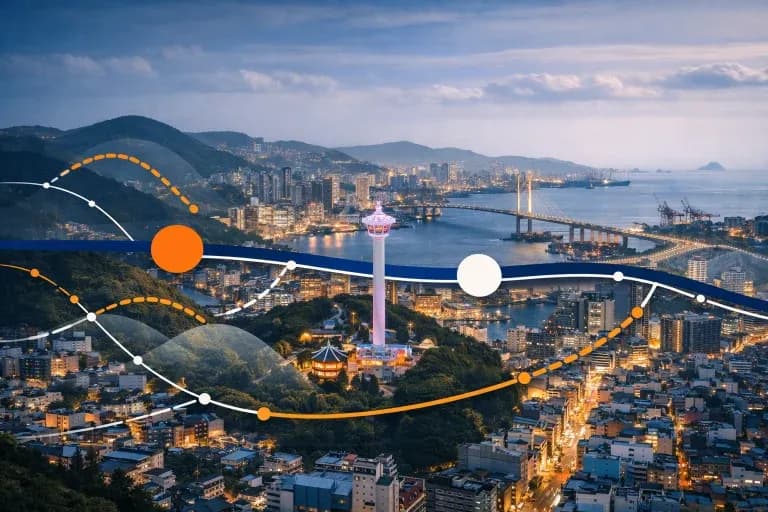
BUSAN — Busan’s new autonomous bus pilot in Eco Delta Smart City invites an easy reading: another municipal technology showcase, another launch wrapped in the language of future mobility. The city says the pilot service will begin in April on a roughly 10-kilometre round-trip route with nine stops. That is the surface fact. It is not the main story. The harder question is why a city still investing heavily in rail expansion keeps reaching for smaller, more flexible transport experiments at the margins of its network.
Busan’s own transport policy already answers part of that question. The city’s 2023 public-transport innovation plan did not stop at rail. It paired rail planning with integrated fare discounts, bus-network redesign, demand-responsive transport, MaaS and autonomous services, and tied the whole package to a 2030 goal of raising public-transport modal share to 60%. The 2026 work plan uses a similar frame, presenting public-transport-centred growth alongside Dongbaek Pass expansion, bus reform and autonomous pilots. A city that believed rail alone was enough would not be governing this way.
Busan’s Problem Is Not a Lack of Technology, but a Geography of Uneven Access.
Busan’s transport problem does not begin on the subway map. It begins before residents can reach it.
That is the point rail-centred rhetoric keeps obscuring. The city’s burden is not distributed evenly because the city itself is not arranged evenly. Busan is long, steep, coastal and broken into living zones that do not connect cleanly to one another. In that setting, the penalty of movement is often imposed before a passenger ever boards a train: the feeder bus that comes too rarely, the extra fare paid to reach the station, the uphill walk that turns nominal proximity into practical exclusion, the local trip that consumes more time and money than the corridor trip that follows. The problem is not only movement across the city. It is movement into the system. That reading is supported by the city’s own decision to treat fare policy, buses, DRT and autonomous mobility as core transport tools rather than side programs.
The Busan Metropolitan Council has been more explicit than the city’s promotional language. In January 2026, council debate described a “paradox of transport welfare” in which residents in hillside and rail-poor districts bear higher burdens simply because of where they live. The record singled out old downtown and sanbokdoro areas where buses and village buses function not as convenience but as lifelines, because the subway does not meaningfully serve the trip that residents actually need to make.
The same pattern appears in debate over student commutes. Council records for March 2025 describe the old downtown hillside area as a place where trunk-road-oriented public transport leaves students with long headways and awkward transfers even though formal bus service exists. That is not a trivial service complaint. It shows the core mismatch in Busan’s system: between fixed heavy infrastructure and steep local geography, between corridor logic and daily life.
Once that point is admitted, the shape of the problem changes. Busan does not simply have a supply problem. It has a mismatch problem: between infrastructure and terrain, between trunk speed and local reach, between metropolitan planning and the actual cost of getting to work, school, hospitals and markets. A city can keep extending its rail ambition and still leave those burdens largely intact. The right question is not whether Busan needs more rail, but which layers of Busan’s mobility problem rail is actually solving and which layers it continues to leave behind. That is an inference, but it follows directly from the council’s equity concerns and the city’s own reliance on multiple non-rail instruments.
Rail Still Matters. But Rail No Longer Answers the Whole Question.
None of that amounts to an anti-rail argument. It would be foolish to pretend Busan can function without rail. A long metropolitan corridor with major inter-district flows still needs high-capacity trunk transit. Busan’s planning establishment is right to keep rail expansion at the centre of metropolitan strategy, and the city continues to do so through its railway network planning and broader mobility agenda. Rail remains the backbone.
But backbone is not the same thing as complete answer.
That distinction is where Busan’s debate has lagged. For too long, rail expansion has doubled as a total theory of connectivity, as though enough lines on a planning map would largely solve the city’s transport problem. Busan’s own documents now quietly contradict that assumption. The same city that promotes rail planning also pushes integrated discounts, bus-network reform, DRT, MaaS and autonomous services. Administratively, Busan is already behaving like a city that knows rail is necessary but insufficient. The public narrative has been slower to catch up.
That matters because rail solves only one layer of the problem well: long-distance trunk movement. It does not automatically solve the price of reaching the station, the weakness of interchange, the poor fit between hillside neighbourhoods and fixed corridors, the service gap in new districts, or the thin frequencies that make short daily trips exhausting. A station cannot flatten a hill. A new line does not remove the penalty of a weak feeder trip. The error, then, is not subway-first planning by itself. The error is the habit of treating subway-first planning as though it resolved the entire hierarchy of urban movement. It does not.
The broader policy context points in the same direction. The OECD’s 2025 Korea report argues for a more “compact-and-connected” strategy anchored in accessibility and transit-oriented development, not merely infrastructure length. That is the more useful lens for Busan as well. A modern transport strategy is not measured only by how much network exists on paper, but by whether people can actually reach jobs, schools, services and daily destinations without paying a geography penalty. Rail can still serve as the backbone. It can no longer be treated as the whole architecture.
The Real Contest Is Not Speed, but Sustainability.
The standard changes once the argument moves from speed to sustainability.
In March 2026, the IEA described the current Middle East crisis as a major oil shock and argued that governments should look beyond supply-side responses. Among the measures it highlighted were stronger use of public transport and other demand-side actions to reduce oil exposure. Its estimate is blunt: encouraging public transport can cut national oil use for cars by about 1% to 3%, with further gains possible when short trips shift to walking and cycling. That changes what counts as a serious urban transport strategy. The issue is no longer only how fast a city moves. It is how exposed daily life remains to oil-price shocks.
That matters especially in Busan, and more broadly in Korea. Reuters reported that about 70% of South Korea’s crude imports pass through the Strait of Hormuz, which is why Seoul’s response to the current crisis has included an energy-saving campaign, car-use curbs in public institutions and broader calls for reduced fuel consumption. In that setting, transport cannot be judged only by speed, engineering ambition or political symbolism. It has to be judged by whether the city can make daily life less dependent on oil and less exposed to shocks in energy markets.
This is where Busan’s own mobility policies become more serious than they sometimes look. The city is not only trying to move people more efficiently. It is trying, sometimes awkwardly, to build a system that is cheaper to use, less dependent on private cars, and more workable across uneven terrain. That is the real meaning of putting rail planning, Dongbaek Pass, bus redesign, DRT and autonomous pilots inside the same policy frame.
Busan’s Most Important Transport Policy May Be Cheaper, More Reachable Transit.
Some of the city’s most consequential transport measures are also the least glamorous.
Busan says Dongbaek Pass had reached 790,000 subscribers by December 2025. The city also says public-transport modal share rose from 42.2% in 2022 to 44.6% in 2024. Those figures matter because they point to a basic but often neglected truth: passengers do not respond only to infrastructure supply. They respond to cost, predictability and friction. In a sustainable system, fare policy is not a welfare add-on. It is behavioural infrastructure.
The logic was present from the start. In 2023, Busan’s innovation plan proposed a first-in-the-country integrated public-transport discount system that would refund monthly spending above 45,000 won, explicitly linking lower fares to the broader goal of increasing transit use and making the city more public-transport-friendly. That was not a side issue. It was a direct attempt to reduce the cost barrier to regular use.
This is why Busan’s rhetoric about becoming a public-transport-centred city cannot be judged by rail expansion alone. If a resident can reach the system only through extra fares, weak feeder service or punitive wait times, the city has preserved the network while failing the trip. If a fare pass cuts those barriers, the policy may do more to change daily behaviour than a planning-map promise whose benefits will arrive years later. That is an inference, but it is the one most consistent with the city’s own presentation of Dongbaek Pass and integrated discounts as flagship reforms.
Busan’s Bus System Matters More Than Its Image Suggests.
In Busan, buses are not the minor instruments left behind once rail has done the serious work. They are the part of the system forced to absorb the city’s physical reality.
That is why the bus story matters so much. Busan’s recent policy agenda includes route restructuring, urban express bus logic, shorter headways in parts of Gangseo and Gijang, and demand-responsive services for weaker coverage areas. The 2026 work plan includes transport support in Eco Delta’s early settlement phase and continued DRT operations, while the 2023 innovation plan made bus-network overhaul one of its central planks. These are not random additions. They are acknowledgments that fixed heavy infrastructure cannot do everything in a city whose daily transport burden is often imposed at the neighbourhood scale.
In a city like Busan, bus reform can be more transformative than another cycle of corridor politics. It can reduce the geometry penalty paid by residents in districts outside the glamour of major infrastructure. It can shorten the wait that makes the whole system feel unusable. It can lower the cost of interchange. It can make the rail backbone actually reachable. That is not secondary work. It is the work of turning a transport network into a transport system. This is interpretive, but it follows from the city’s own prioritisation of bus redesign and from council testimony about feeder burdens in hillside districts.
Autonomous Buses Matter Only Where Rail Is Weakest.
That brings the argument back to Eco Delta.
Autonomous buses are not the future of Busan in the grand, singular sense often implied at launch events. They are not substitutes for rail. They do not solve the city’s access inequality on their own. But they are not trivial either. Their real value appears in the parts of the system rail has always handled least well: district circulation, late-night service, tourist corridors, internal movement in new developments, and first- or last-mile conditions that fall outside fixed heavy-infrastructure logic. Busan’s recent autonomous pattern makes sense only in that narrower frame. The city’s 2026 work plan highlights simultaneous autonomous pilot expansion in Osiria and the BRT corridor, while Eco Delta adds a new-town residential testbed.
That is the serious reading of the Eco Delta launch. Not that driverless vehicles look modern, but that Busan is still searching for ways to serve the parts of urban movement rail has always handled least completely. Treated honestly, the pilot is not proof that the future has arrived. It is evidence that the existing hierarchy of transport answers remains unfinished. That last sentence is an inference from the city’s decision to place autonomous pilots precisely where flexibility matters most.
Busan Does Not Need Less Rail. It Needs a More Honest Transport Hierarchy.
The strategic error would be to present the city with a false choice: rail or everything else. That is not Busan’s problem. Busan needs rail. It also needs to stop pretending rail is a complete answer.
A more honest transport hierarchy would keep rail where it belongs: as backbone infrastructure for trunk movement, metropolitan integration and long-distance demand. But it would place far more weight on the parts of the system that determine whether the backbone is usable in ordinary life. That means cheaper and more integrated fares. It means bus reform treated as structural policy, not administrative maintenance. It means village buses and feeder routes understood as core public infrastructure in hillside districts rather than peripheral services. It means DRT where fixed routes remain too blunt. It means using autonomy where local circulation and off-peak operations make flexibility more valuable than spectacle. Busan’s own policy documents already point in this direction. The city’s future depends on whether it follows that logic all the way through.
The modern transport question for Busan is no longer whether subways still matter. They do. The question is whether a subway-centred imagination still fits a city that must become less oil-dependent, less car-dependent, cheaper to navigate and more workable across steep terrain and fragmented districts. That is the argument hidden inside the Eco Delta launch. It is also the argument Busan will eventually have to answer in practice, not in slogans
Continue this reporting
Reporting on the same issue
Related coverage selected from the article's desk, topics and newsroom relationships.
 NewsOct 22, 2026
Busan Port’s LNG and Methanol Plan: Who Pays to Keep Fuel Ready?
Busan already supplies ships with LNG and methanol, drawing on regional and i...
 NewsOct 16, 2026
What Is Still Worth Going to See?
Busan’s biennale faces questions of artistic judgment and institutional care....
 NewsOct 14, 2026
What Became of Busan’s University Streets?
From 2015 to 2023, registered businesses grew near Pusan National University...
More from the author
More from this byline
Stay with the same line of reporting through more work from this byline.
- NewsOct 22, 2026
Busan Port’s LNG and Methanol Plan: Who Pays to Keep Fuel Ready?
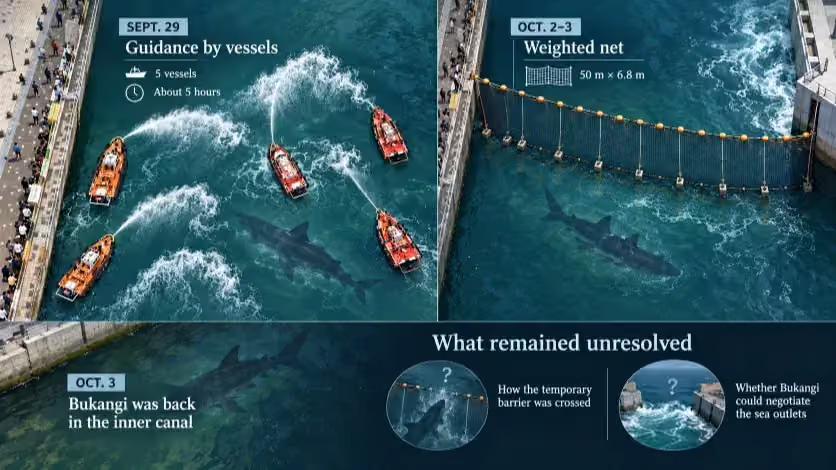 NewsOct 12, 2026
Bukangi, the Shark That Stayed in Busan’s North Port
Reader Signal
Community readWhat did this report leave you with?
Choose the signal that best reflects your reading. Select it again to remove it.
One response per article
No response selected
A moderated conversation about the reporting.
One-level replies and newsroom moderation keep the conversation anchored to this article.
Discussion Status
Open
Please sign in to join the discussion.
Newsletter
Weekly reporting and context from Busan and Korea.