In Busan, High Oil Prices Become an Urban Stress Test
The fuel shock in Busan is no longer confined to gas stations. It is appearing in household relief payments, rush-hour transit pressure, diesel logistics, export margins and the port economy — exposing how much the city depends on movement.

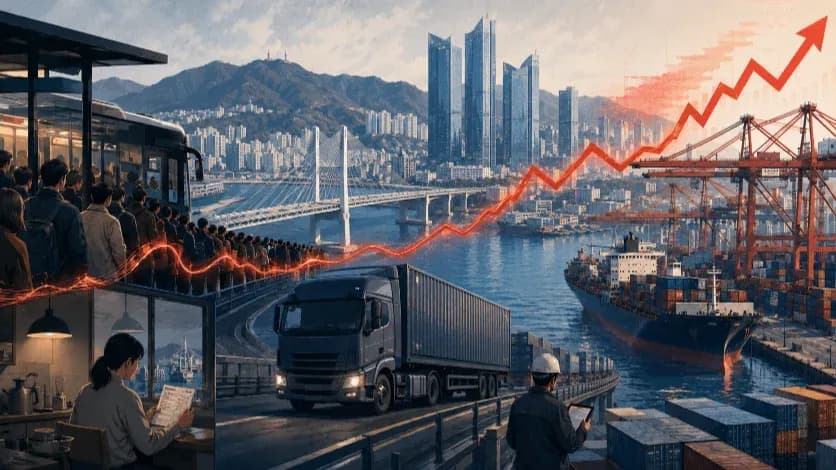
BUSAN — The first sign of an oil shock in Busan is not always the price board outside a gas station. It can be a longer line at a bus stop before 8 a.m., a truck operator recalculating diesel costs before a port run, or a small exporter waiting for a freight quote that may erase the margin on an order.
Across the city, high fuel prices are beginning to appear less as a single number and more as a chain of pressures. As of May 11, the national average retail price stood at 2,011.90 won per liter for regular gasoline and 2,006.41 won for automotive diesel, according to Korea National Oil Corp.’s Opinet system. In Busan, the pressure has already entered consumer prices: the city’s April consumer price index rose 2.3 percent from a year earlier, while diesel and gasoline prices jumped 32.5 percent and 21.7 percent, respectively.
The policy response has come in layers. The national high-oil-price relief program is moving cash into household budgets. Busan is adding buses on crowded rush-hour routes. Subway service has already been tightened during peak periods. Diesel-dependent freight trucks and village buses are receiving operating-cost support, while exporters face higher logistics bills and a more uncertain shipping environment.
Taken separately, these measures look like routine administrative responses to a price spike. Taken together, they reveal something more important: in Busan, high oil prices are not staying at the pump. They are moving through household budgets, rush-hour transit, diesel logistics, export margins and the port economy.
That makes Busan a sharper test case than many other Korean cities. It is a large metropolitan economy, but also the country’s principal port city — a place where household consumption, public transport, diesel logistics and global trade sit close together. When fuel prices rise, the burden is felt by commuters and low-income households, but also by truckers, village bus operators, manufacturers, freight forwarders and exporters whose costs are tied to shipping routes far beyond Korea.
A city’s emergency map
Busan’s current response did not arrive as one urban strategy. It came through several policy doors at once: income support, traffic demand management, public transport expansion, freight-sector aid and export assistance. Yet the pattern is difficult to miss. Each measure points to a part of the city where fuel inflation is expected to hurt first.
The relief payments show the household layer. The second application period runs from May 18 to July 3, with eligible Busan residents in most districts receiving 150,000 won. Residents in Dong, Seo and Yeongdo districts receive 200,000 won because those districts are designated as depopulation-area priority zones. Basic livelihood security recipients receive 600,000 won, while near-poor and single-parent households receive 500,000 won. The money must be used by Aug. 31.
The transport layer is being shaped by national energy-saving measures. Beginning April 8, the government strengthened public-sector vehicle restrictions from a five-day rotation to an odd-even system for public agencies, while applying a five-day system to public parking lots operated by public bodies. The measure covers about 11,000 public institutions and roughly 30,000 public parking lots.
The effect in Busan has been visible in transit planning. From May 11, the city began adding rush-hour buses on 32 crowded routes serving major corridors toward Seomyeon, Busan Station and Nampo-dong. The additional service applies from 7 a.m. to 9 a.m. and from 6 p.m. to 8 p.m. Busan said 737 buses would be used on the affected routes, raising the number of trips from 1,125 to 1,344 and shortening the average interval from nine minutes to about seven. The subway system had already added 16 peak-hour trips on lines 1, 2 and 3, reducing intervals from five minutes to between 3.5 and 4.5 minutes.
For diesel transport, the city has taken a different route. Busan is putting 9 billion won from its second supplementary budget into a support program for roughly 30,000 diesel-powered commercial freight trucks and village buses. The program covers 29,700 commercial diesel trucks and 355 village buses, offering up to 300,000 won per vehicle for engine oil, urea solution and tires.
For exporters, the response is broader. Busan is expanding support for small and medium-sized export firms affected by prolonged Middle East conflict, logistics disruptions and higher freight costs. The city has allocated 890 million won for export-import difficulty vouchers, 456 million won for overseas logistics costs and 1.284 billion won for overseas exhibition participation, while shifting from monthly screening to a batch application process. It also plans a joint purchasing support program for raw and subsidiary materials imported by local firms that manufacture finished goods for export.
Together, these measures form a pressure map. Households need relief. Drivers are being pushed toward transit. Transit systems must absorb demand. Diesel operators are exposed to daily operating costs. Exporters are paying for the same shock through freight, vessel space and delivery risk.
Where relief lands first
The relief payment is the most visible part of the response, but it is not the deepest one. A cash transfer can soften a household bill. It cannot explain why the same fuel shock lands differently across the city.
In Busan, the payment structure already carries that geography. The extra amount for Dong, Seo and Yeongdo districts is easy to read as a technical classification, another line in a government table. But the geography is not incidental. These are older parts of Busan, tied to the city’s port history, steep roads, aging neighborhoods and local economies that have not benefited equally from the city’s newer waterfront and commercial growth.
A fuel shock in such places is not only a matter of filling a tank. It can narrow daily movement, reduce small purchases, delay appointments and make already uneven access to the city feel more expensive. The payment does not erase that problem. It marks where the state expects the pressure to be felt first — among households with thinner buffers, in older districts, and in communities where income, mobility and local commerce are more vulnerable to disruption.
The limits are just as clear. Fuel inflation does not strike once and disappear. It returns through repeated expenses: a commute, a delivery charge, a taxi ride, a market trip, a utility bill, a product whose price has absorbed higher transport costs. A one-time payment can cushion that sequence. It cannot stop it.
This is where the household story becomes an urban story. Busan is not a flat map of identical consumers. It is a city of older port districts, hillside neighborhoods, dense commuting corridors, industrial zones and newer commercial centers. The same price signal moves through each of those places differently.
The risk for policymakers is to mistake relief for repair. Cash payments can buy time, and in a crisis that matters. But they do not reduce dependence on costly movement, do not expand transport access, and do not strengthen the local economies most exposed to price shocks. They answer the first question — who needs help now — but not the harder one: why some parts of the city need help faster than others.
When driving falls, buses carry the load
The next layer of Busan’s fuel shock is movement. A city can ask people to drive less, and higher fuel prices can make that choice more likely. But the need to move does not disappear. Workers still have to reach offices, students still have to cross districts, patients still have appointments, and small businesses still depend on customers arriving at the right hour.
That is the pressure behind Busan’s rush-hour transit measures. The additional buses are not merely a response to inconvenience. They are evidence that demand has shifted into the public system. When private driving becomes more expensive or more restricted, the pressure moves to bus lanes, subway platforms and transfer points.
This shift is most likely to be felt in the narrowest hours of the day. A city’s transport system is not tested evenly. It is tested between 7 and 9 in the morning, and again between 6 and 8 in the evening, when small changes in behavior can turn into crowded vehicles, longer waits and missed connections. A few more commuters choosing a bus over a car may look minor in annual statistics. At a stop near Seomyeon, Busan Station or Nampo-dong, it can decide whether someone boards or waits.
Busan’s geography makes the change sharper. The city is not built as a simple grid. Its commuting patterns run through hills, coastal roads, port corridors, older neighborhoods and dense commercial centers. Many routes are not easily replaced by walking or cycling. For residents in hillside districts or areas with weaker rail access, the bus is not a preference but the practical link to the rest of the city.
Public transport therefore becomes the solution at the same time that it becomes more burdened. The more successful the shift away from private driving, the more pressure lands on the system meant to absorb it. If service does not expand, commuters pay in time and discomfort. If service does expand, the city pays in operating cost.
That cost is less visible to passengers. A commuter notices the shorter wait or the crowded aisle. The city must calculate the additional trips, overtime, vehicle wear, energy use, scheduling pressure and public subsidy required to keep fares politically and socially acceptable. What looks like a private saving can become a public obligation.
The immediate question is whether the added buses and trains are enough to handle the current surge. The longer question is harder. If high fuel prices persist, Busan cannot treat transit expansion as an emergency adjustment alone. It will have to ask which corridors need permanent reinforcement, which neighborhoods remain poorly connected and how much public money is required to keep mobility affordable when energy costs are not.
The diesel layer
For many households, high fuel prices arrive as a choice: drive less, take the bus, combine trips, delay a purchase. For diesel-dependent operators, there is often no such flexibility. A truck still has to leave for the port. A village bus still has to climb the same road. A delivery route still has to be completed whether the fuel bill has risen or not.
This is where the oil shock becomes most direct. It appears in daily receipts, maintenance schedules and monthly cash flow. A small transport operator cannot wait for global energy markets to settle before deciding whether to take the next job. The work has to move first; the cost is calculated afterward.
In Busan, that burden is tied closely to the city’s shape. The port generates freight movement. Industrial zones require parts and materials. Hillside neighborhoods depend on small buses and local routes that are less profitable but socially necessary. Markets, warehouses, factories and residential districts are connected by vehicles that do not always appear in broader discussions of urban mobility. They are not the face of the city, but they are part of its circulation.
Freight trucks feel the shock through diesel prices, but also through time. A port run is not only the distance between a depot and a terminal. It can include waiting, congestion, empty return trips, loading delays and routes that leave little room for efficiency. When fuel costs rise, every idle minute becomes more expensive. Every delay becomes part of the bill.
The problem is sharper for smaller operators because they often have less power to pass costs on. Large logistics firms may renegotiate contracts, adjust routes or spread higher costs across a wider network. A small trucking business or individual operator may have to absorb the increase until the next contract cycle, if there is one. The fuel shock then becomes a margin shock. Work continues, but the profit inside each trip narrows.
Village buses face a different version of the same pressure. They serve routes that larger systems may not cover well, especially in older or steeper neighborhoods. Their value is measured less by passenger volume than by access. If those routes weaken, the loss is not only commercial. It affects older residents, students, workers and small shops that depend on short local connections to the wider transport network.
Support for diesel-reliant vehicles is therefore more than a narrow industry measure. It is a way of protecting the hidden links that keep the city functioning. A tire, a bottle of urea solution or an oil change may look minor beside the scale of global oil markets. For a small operator, those costs can decide whether service remains stable.
But the support also reveals a policy limit. Helping with operating supplies can ease immediate strain, but it does not change the deeper dependence on diesel. It does not solve weak bargaining power in small freight markets. It does not reduce empty runs, port waiting time or the fragile economics of low-margin local routes. It keeps vehicles moving, which is necessary. It does not make the system less exposed.
When fuel becomes freight
For Busan’s exporters, the fuel shock does not always appear as a fuel bill. It often arrives in a different form: a freight quote, a surcharge, a delayed vessel, a tighter delivery window, or a buyer asking whether the price can still hold.
That makes the pressure harder to measure from the outside. A company may not operate trucks of its own. It may not buy much diesel directly. But if it imports materials, ships finished goods, relies on container space or competes on delivery time, the cost of fuel reaches the balance sheet anyway. It moves through carriers, forwarders, ports, insurance, exchange rates and shipping schedules before it becomes a problem inside a small office or factory in Busan.
For larger companies, a rise in logistics costs can often be managed through contracts, scale and bargaining power. For smaller exporters, the room is narrower. A higher freight rate can turn a profitable order into a marginal one. A delayed shipment can weaken trust with a buyer. A sudden change in vessel space can force a company to choose between paying more, shipping late or absorbing the loss.
This is why the city’s export support measures carry more meaning than their budget lines suggest. Trade vouchers, logistics subsidies and support for overseas exhibitions do not remove the crisis. They buy time for companies whose margins are too thin to withstand repeated shocks. They also show that Busan’s exposure to high oil prices is not limited to transport operators. It extends into the city’s industrial base.
The pressure is especially difficult for firms that sit between imported materials and exported products. These companies are exposed twice. They pay more to bring in raw materials, parts or components, and then face another round of costs when finished goods leave Korea. If shipping schedules become less predictable, the damage is not only financial. Production planning becomes harder. Inventory decisions become riskier. Client relationships become more fragile.
Joint purchasing and shared logistics support matter because they acknowledge a basic weakness in small-company trade: many firms face global shipping costs alone. A larger buyer can negotiate. A major manufacturer can fill containers, diversify routes or pressure service providers. A smaller exporter may be left with whatever quote is available when the shipment has to move.
Still, subsidies cannot create bargaining power by themselves. A few million won in support can reduce the pain of one shipment or one trade cycle. It cannot guarantee vessel space, stabilize freight markets or protect exporters from another geopolitical disruption. If the crisis lasts, the question becomes whether Busan can help its smaller firms act less like isolated shippers and more like a coordinated export base.
That would require more than emergency money. It would require better information on freight trends, earlier warnings on route disruptions, shared logistics platforms, stronger links with forwarders, and practical support for companies that lack in-house trade expertise. In a port city, export resilience is not only a matter of production. It is also a matter of navigation — through prices, schedules, routes and risk.
The price of connectivity
Busan’s economy has long drawn strength from movement. Containers move through its terminals, cargo shifts between vessels, materials enter factories, finished goods leave for buyers abroad, and transport firms fill the space between the port and the rest of the country. The city’s identity as a port is not symbolic. It is built into its roads, labor markets, industrial districts, public finances and political ambitions.
That strength is also a form of exposure.
A port city does not experience global disruption from a distance. It receives it through schedules, rates, routes and volume. When fuel prices rise, when shipping lines adjust service, when freight rates move suddenly, or when geopolitical risk changes the cost of passage, the effects do not remain offshore. They enter the city through the logistics system.
Busan’s position as a major transshipment hub sharpens that relationship. Busan Port handled 24.88 million TEUs in 2025, up 2.0 percent from the previous year and a record high. But the structure matters: import-export cargo fell 1.1 percent to 10.79 million TEUs, while transshipment rose 4.4 percent to 14.10 million TEUs, accounting for about 57 percent of total container volume.
The first quarter of 2026 showed the other side of that exposure. Busan Port handled 6.14 million TEUs, down 2.0 percent from a year earlier. Import-export volume fell 4.7 percent to 2.58 million TEUs, while transshipment edged up 0.1 percent to 3.561 million TEUs. That pattern suggests a port whose global network role can hold even when direct trade weakens — but also one whose local economy may not benefit evenly from headline throughput.
This distinction matters for Busan. A port can post strong annual volume while certain exporters suffer. Transshipment can hold up even when local export-import cargo weakens. A terminal can remain busy while inland carriers struggle with fuel and waiting time. The health of a port city is therefore not captured only by total throughput. It depends on what kind of cargo is moving, who earns from it, who pays the rising cost, and how much of the value remains in the local economy.
Busan’s long-term strategy depends on becoming more than a place where containers pass through. It wants shipping companies, maritime finance, logistics technology, public agencies and port-related services to cluster around the waterfront and the wider metropolitan economy. But deeper integration into the shipping economy also raises the standard of resilience expected from the city.
If Busan becomes more central to Korea’s maritime strategy, it cannot treat oil shocks and freight volatility as external events. They become part of the city’s own risk environment. A port hub must be able to read early signs of disruption, communicate them to smaller firms, manage inland bottlenecks, support vulnerable operators and prevent global volatility from turning into local paralysis.
The current response has begun to sketch that responsibility. Export subsidies, logistics support and public transport adjustments are not port policies in the narrow sense. Yet they all touch the same system. Workers must reach factories and terminals. Trucks must move containers. Small exporters must secure freight. Local routes must connect neighborhoods to the labor market. The port cannot function apart from the city that surrounds it.
What relief cannot do
Busan’s response has been fast enough to show that the city understands the pressure. It has identified households that need immediate support, routes where buses are crowded, transport operators exposed to diesel costs, and exporters facing a more expensive logistics environment. In a crisis, that speed matters. A city that waits for perfect data often moves too late.
But speed should not be confused with strength. Relief payments, extra buses, transport support and export subsidies can reduce the first damage. They can keep households spending, commuters moving, operators working and small companies shipping. What they cannot do, by themselves, is change the structure that made those parts of the city vulnerable to the same external shock.
This is now the central question for Busan. The city is not facing one problem called high oil prices. It is facing a chain of linked pressures. A rise in fuel prices changes commuting behavior. Changed commuting behavior strains public transport. Higher diesel costs weaken transport operators. More expensive freight reduces export margins. Port volatility raises the cost of being connected to the world.
Emergency policy tends to follow the most visible pain. A crowded bus route can be expanded. A struggling household can receive a payment. A freight-cost increase can be partly subsidized. These actions are necessary, but they are partial. They answer where the city hurts today. They do not fully answer why the same hurt travels so quickly from one layer of the city to another.
That is where resilience begins. It is not a slogan about sustainability or future planning. It is the practical ability to absorb pressure without letting one disruption become many. For Busan, that means knowing which neighborhoods are least able to handle rising mobility costs, which bus corridors fail first under demand shifts, which local transport operators lack bargaining power, which exporters are most exposed to freight volatility, and where port congestion or inland logistics can turn a global problem into a local bottleneck.
The present fuel shock will eventually pass, or at least change form. Prices may fall. Relief programs may expire. Bus schedules may return to normal, or some of the added service may remain. Exporters may find new routes, renegotiate freight, delay orders or absorb losses until the market settles. The immediate pressure will not stay exactly as it is.
But what matters is not only the price level at a particular moment. It is what the shock has revealed about the city underneath it.
Busan is a city built on movement. Its workers move across a landscape shaped by hills, ports, old neighborhoods and newer commercial centers. Its buses and subways carry the daily functioning of households that cannot easily substitute private transport. Its trucks and local operators connect terminals, factories, warehouses, markets and residential districts. Its exporters depend on routes, rates and schedules negotiated far beyond the city’s borders. Its port gives Busan reach, but also gives external disruption a direct path into the local economy.
The easiest response is to wait for the market to ease and call the episode over. The harder response is to keep the map the crisis has drawn: which districts needed support first, which routes crowded fastest, which operators had no room to pass on costs, which exporters were most exposed to freight volatility, and which parts of the port economy stayed strong while other parts quietly carried the cost.
Those questions matter because the next shock may not look like this one. It may come through oil again, or through exchange rates, shipping alliances, geopolitical conflict, labor shortages, climate damage, port congestion or another disruption that starts outside the city and arrives through the systems that keep Busan moving. A resilient city is not one that guesses the next crisis correctly. It is one that understands its own pressure points before they fail.
For now, the signs are scattered across the city: a busier morning route, a relief payment, a freight quote, a diesel receipt, a port schedule adjusted by conditions elsewhere. Each is small on its own. Together they show the same thing. The fuel shock has not only raised costs. It has made visible the machinery of a city that depends on movement.
The task is not to stop that movement. It is to make sure Busan can keep moving without passing every new cost to the people and firms least able to carry it. That is the measure of resilience the city now faces.
Continue this reporting
Reporting on the same issue
Related coverage selected from the article's desk, topics and newsroom relationships.
 NewsOct 22, 2026
Busan Port’s LNG and Methanol Plan: Who Pays to Keep Fuel Ready?
Busan already supplies ships with LNG and methanol, drawing on regional and i...
 NewsOct 16, 2026
What Is Still Worth Going to See?
Busan’s biennale faces questions of artistic judgment and institutional care....
 NewsOct 14, 2026
What Became of Busan’s University Streets?
From 2015 to 2023, registered businesses grew near Pusan National University...
More from the author
More from this byline
Stay with the same line of reporting through more work from this byline.
- NewsOct 22, 2026
Busan Port’s LNG and Methanol Plan: Who Pays to Keep Fuel Ready?
 NewsOct 12, 2026
Bukangi, the Shark That Stayed in Busan’s North Port
Reader Signal
Community readWhat did this report leave you with?
Choose the signal that best reflects your reading. Select it again to remove it.
One response per article
No response selected
A moderated conversation about the reporting.
One-level replies and newsroom moderation keep the conversation anchored to this article.
Discussion Status
Open
Please sign in to join the discussion.
Newsletter
Weekly reporting and context from Busan and Korea.