Busan’s West Busan Administrative Complex in Sasang Tests a New Center of Gravity
The planned second city hall in Sasang is designed to relocate public functions, strengthen Busan’s western administrative base and anchor the wider redevelopment of an aging industrial district.

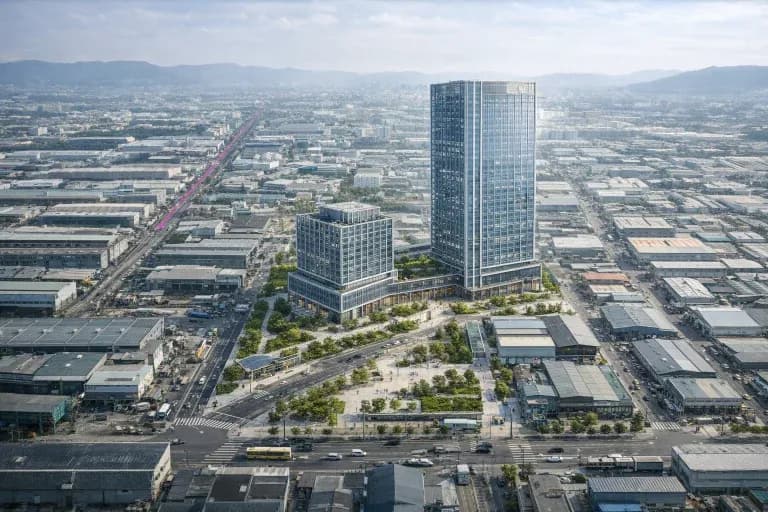
BUSAN — Busan’s planned western administrative complex in Sasang is often described as a second city hall. The label is useful, but incomplete. The project is designed not only to relocate part of the city’s administrative apparatus to western Busan, but also to concentrate public offices, business-support functions and service infrastructure in Sasang, one of the city’s older industrial districts. In public planning materials, Busan has placed the complex at the center of the wider Sasang Dream Smart City program, linking it to a broader effort to narrow the long-standing imbalance between the eastern and western parts of the city.
That gives the project a meaning that goes beyond the construction of another government building. Sasang is not an empty redevelopment site. It is part of the industrial belt that helped drive Busan’s growth, but it has not carried the same weight in the city’s administrative geography. By moving a cluster of public functions there, Busan is trying to do more than ease pressure on its existing city hall. It is trying to establish a western administrative base in a district the city also wants to recast as a new urban and economic node.
The scale of the plan is already clear in official documents: a major public complex in Hakjang-dong, Sasang-gu, with five basement levels, towers rising as high as 31 stories, and a total project cost of about 506 billion won. Public descriptions also tie the site to adjacent support facilities and an underground connection to the planned Smart City station on the Sasang-Hadan line. The larger question is whether those elements will work together strongly enough to change how western Busan functions within the city as a whole.
Why Sasang Matters
That question begins with the site itself. Sasang was not chosen simply because land was available. It sits inside one of Busan’s long-established industrial zones, an area with deep economic history but weaker standing in the city’s administrative order. Busan’s planning documents make clear that the western administrative complex is meant to anchor the larger Sasang Dream Smart City program, which aims to reorganize this part of the city rather than leave it to gradual decline or piecemeal improvement.
The city’s approach is notable for what it does not rely on. This is not a prestige commercial redevelopment led by private capital and followed later by public investment. Busan is moving in the opposite direction. It is using public institutions to give Sasang a different role in the city, tying the complex to surrounding facilities that include a digital business support complex, blood-service facilities, park space and direct rail access. The logic is straightforward: if western Busan is to function differently, then the institutions that shape daily public life must be placed there in a concentrated form.
That makes Sasang more than a receiving point for relocated offices. It makes the district a test case. For years, western Busan has carried industrial and logistical weight without commanding equal institutional weight. The western administrative complex is meant to narrow that gap by placing routine administrative activity in a part of the city more often defined by factories, transport corridors and old industrial land than by governance.
This also helps explain why the project matters beyond Sasang itself. Busan’s western half is no longer shaped by a single development story. Sasang’s industrial regeneration sits alongside Eco Delta City, expansion plans in Gangseo and the longer arc of airport- and port-linked growth farther west and south. Within that wider map, Sasang is unlikely to become the sole center of western Busan. What the city appears to be trying to create there instead is a different kind of weight: not dominance over every western corridor, but a stable administrative center in a part of Busan that has long lacked one.
Beyond a Second City Hall
Calling the Sasang complex a second city hall captures only part of what Busan is trying to build. Public descriptions of the project point to a broader concentration of functions: municipal departments, affiliated agencies, business-support facilities, blood-service infrastructure, park space and a direct underground link to the planned Smart City station. The result is not simply a backup administrative site. It is a public complex designed to gather different kinds of routine access in one place.
That matters because cities are not governed only through formal decisions. They are also governed through repetition: permit reviews, inter-agency consultations, site management, data handling, transport access, service delivery and the daily movement of officials, contractors, residents and businesses through the same institutional terrain. The significance of the Sasang complex lies in the possibility that some of those routines will begin to accumulate in western Busan rather than remain concentrated elsewhere.
The mix of functions attached to the project makes that clearer. Busan has described the wider site not only through administrative relocation but also through the digital business support complex and adjacent blood-service facilities. That combination suggests a district intended to do more than house offices. It suggests a place where public administration, business support and everyday service infrastructure are meant to reinforce one another. In that respect, the project is less an annex than an attempt to create a working public node with enough institutional range to alter the district around it.
The transportation link is central to that effort. Official materials describe the complex as being connected underground to the planned Smart City station on the Sasang-Hadan line. That feature does more than improve convenience. It is part of the argument for the project itself. A western administrative base can matter only if it is easy to reach, easy to use and folded into the movement patterns of the wider city. The rail connection is meant to give the complex that kind of practical reach.
At the same time, the reliance on that connection exposes one of the project’s vulnerabilities. The complex is being presented as an accessible administrative center, but the strength of that claim depends on a transit line that remains unfinished. That does not weaken the logic of the project. It does, however, mean that the project’s promise is tied not only to the completion of the building itself, but also to the wider transport system meant to support it.
For that reason, the Sasang complex should be read less as a property development and more as an effort to alter Busan’s administrative habits. If the city succeeds, Sasang will not simply host relocated offices. It will become a place where public authority is exercised, accessed and encountered on a recurring basis. If it does not, the complex risks remaining what the phrase “second city hall” implies at its weakest: a large satellite facility whose symbolic value exceeds its effect on how the city actually works.
An Anchor, Not Yet a Center
That is also where the limits of the project come into view. Busan’s western half is no longer defined by a single development corridor. Sasang’s industrial regeneration sits alongside the smart-city buildout in Eco Delta City, expansion plans in Gangseo, and the longer arc of airport- and port-linked growth tied to Gadeokdo New Airport and the logistics networks farther west and south. Public materials from the city present these as parts of a broader western Busan transformation, but they do not amount to a single, unified center. They describe a western half of the city that is growing through several large projects at once, each with a different function and a different scale.
That makes Sasang important, but not sufficient. The administrative complex may give Sasang a kind of institutional weight that western Busan has long lacked. It does not follow that Sasang will also command the economic weight of the airport corridor, the logistics weight of the port-linked west, or the speculative pull of newer smart-city and new-town development. Those forces are distributed unevenly across the western side of the city. Sasang’s role appears to be different. It is being positioned as an administrative and urban-management center within a western geography whose future growth remains spread across multiple nodes.
The transport question reinforces that point. Busan has tied the Sasang complex to the planned Smart City station on the Sasang-Hadan line, presenting the underground connection as part of the project’s case for accessibility. But western Busan’s larger spatial problem cannot be solved by one station-linked site alone. The districts and corridors now being grouped under the label of western Busan — Sasang, Gangseo, Myeongji, Eco Delta City and the airport-facing south and west — do not yet function as a single, seamless daily urban field. The city’s own infrastructure plans, including new rail and road links tied to the broader Gangseo and Eco Delta buildout, underscore that unfinished condition.
That is why the Sasang complex should be read as an anchor rather than an apex. It can fix a significant share of public authority in western Busan. It can help give one part of the city a different administrative role. It can even begin to change how Sasang is perceived and used. What it cannot do on its own is settle the internal hierarchy of western Busan, where industrial land, smart-city development, airport expansion and port-linked logistics are all producing their own centers of gravity at the same time.
The burden on the city is therefore larger than completing a complex or relocating a group of departments. Busan has to show that the public functions concentrated in Sasang will do more than create a visible western outpost. They have to become part of a wider pattern of access, movement and institutional dependence strong enough to connect Sasang to the rest of the west on terms more durable than symbolism. Until that happens, the complex will remain a powerful statement of intent — but not yet proof that western Busan has found a single center around which the rest can be organized.
What Busan Must Prove in Sasang
What Busan has set in motion in Sasang is not simply the construction of a major public complex. It is an attempt to test whether administrative relocation can do real urban work. For decades, the city’s western side has carried industrial functions, logistics routes and development promises, while much of the city’s institutional weight remained concentrated elsewhere. The western administrative complex is meant to change that arrangement by giving one part of western Busan a durable public role rather than leaving it as a corridor of production, transit and deferred redevelopment.
That is why the stakes are higher than the language of a second city hall suggests. A satellite office can relieve pressure on an existing headquarters. It can redistribute staff. It can improve convenience at the margins. But Busan is claiming something larger for Sasang. It is claiming that the concentration of public offices, support functions and transport access can begin to alter the city’s internal order. That claim will not be proved by completion alone. It will be proved only if Sasang begins to matter differently in the daily life of the city — as a place where decisions are made, services are sought, institutions are encountered and movement patterns are reorganized.
The deeper question is whether public authority, once moved, can still generate enough force to reshape the ground around it. That is no longer guaranteed in a western Busan defined by multiple large-scale projects, from industrial regeneration in Sasang to smart-city expansion in Eco Delta City and the airport- and port-linked ambitions farther west and south. In that landscape, Sasang does not need to eclipse every other corridor to matter. But it does need to become more than a symbolic western outpost. It needs to function as a true administrative center whose presence changes how the rest of western Busan is connected, governed and understood.
If that happens, the Sasang complex will mark more than the redistribution of municipal offices. It will stand as evidence that Busan was able to convert public investment into a new urban hierarchy. If it does not, the city will still have built a large and expensive complex in western Busan — but not necessarily a new center.
Continue this reporting
Reporting on the same issue
Related coverage selected from the article's desk, topics and newsroom relationships.
 NewsOct 22, 2026
Busan Port’s LNG and Methanol Plan: Who Pays to Keep Fuel Ready?
Busan already supplies ships with LNG and methanol, drawing on regional and i...
 NewsOct 16, 2026
What Is Still Worth Going to See?
Busan’s biennale faces questions of artistic judgment and institutional care....
 NewsOct 14, 2026
What Became of Busan’s University Streets?
From 2015 to 2023, registered businesses grew near Pusan National University...
More from the author
More from this byline
Stay with the same line of reporting through more work from this byline.
- NewsOct 22, 2026
Busan Port’s LNG and Methanol Plan: Who Pays to Keep Fuel Ready?
 NewsOct 12, 2026
Bukangi, the Shark That Stayed in Busan’s North Port
Reader Signal
Community readWhat did this report leave you with?
Choose the signal that best reflects your reading. Select it again to remove it.
One response per article
No response selected
A moderated conversation about the reporting.
One-level replies and newsroom moderation keep the conversation anchored to this article.
Discussion Status
Open
Please sign in to join the discussion.
Newsletter
Weekly reporting and context from Busan and Korea.