Busan’s Sanbokdoro Plan Is Ambitious, but Delivery Will Be Hard
Busan has recast its old hillside districts as a problem of urban access rather than symbolic regeneration. But steep terrain, land acquisition, financing and resident trust will determine whether the plan reshapes the old downtown or remains a compelling idea.

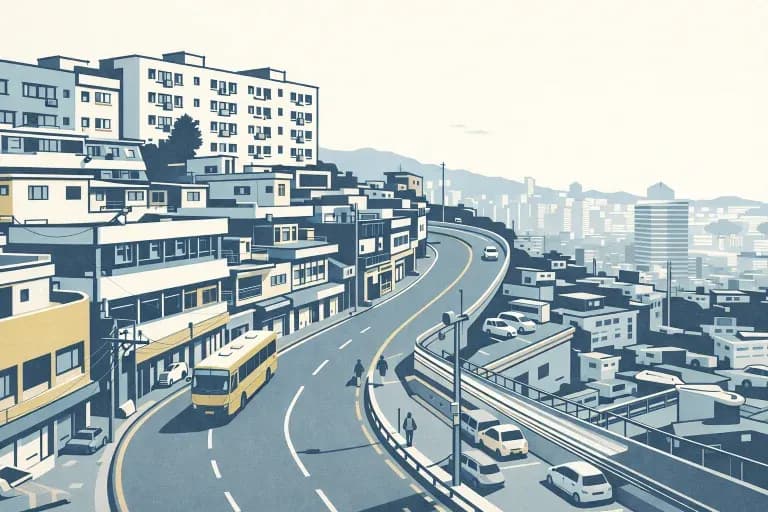
Busan’s latest sanbokdoro initiative is being presented as a transport-and-housing breakthrough for the city’s old hillside districts. That is only partly true. What the city has done, more consequentially, is recast one of old Busan’s most persistent urban problems not as a matter of scenery, nostalgia or piecemeal regeneration, but as a question of access: access to transit, to stable housing and, in the most basic sense, to the city below.
That reframing matters because it is closer to the lived reality of these neighborhoods. For years, policy around sanbokdoro has moved between small-scale physical improvement, symbolic renewal and selective place-making. Some of that work mattered. Much of it, however, left the central condition untouched. The problem was never simply that these districts were old, steep or visually neglected. It was that they remained structurally cut off — from efficient movement, from convenient services, and from the flatter, faster city that developed beneath them. The steep slopes and narrow internal roads are only the visible expression of that deeper separation.
This is why the April 2 briefing deserves to be taken seriously, but not at face value. The seriousness lies in the diagnosis. Busan is no longer speaking of sanbokdoro chiefly as a cultural landscape or a regeneration brand. It is speaking of it, at least implicitly, as an urban-access crisis embedded in the old downtown. That is a more mature reading of the problem. It is also a more dangerous one for the city to make, because once the issue is defined in structural terms, symbolic politics becomes far harder to hide behind.
At that point, the standard changes. The relevant questions are no longer whether the rhetoric is ambitious or whether the vision looks compelling on a briefing stage. They are whether routes can actually be secured through dense hillside fabric, whether acquisition and compensation can be managed without paralysis, whether financing can survive beyond the launch moment, and whether housing intervention will stabilize daily life for existing residents rather than simply prepare the ground for displacement. This is not fundamentally a story about whether Busan can promise reconnection. It is a story about whether the city can deliver it under conditions that have defeated simpler promises for decades.
What Has Changed — and What Has Not
That makes it important to distinguish between what is genuinely new in the current initiative and what is not. Busan has not suddenly discovered its hillside districts, nor has it begun, for the first time, to speak of their decline. Sanbokdoro has been a policy subject for years, approached through regeneration programs, community-based improvement, pedestrian infrastructure and smaller interventions meant to ease the physical hardship of hillside living. Elevators, stairway upgrades, neighborhood renewal schemes and housing concepts have all appeared, in one form or another, within the city’s broader effort to manage the old downtown.
That history places clear limits on any claim of rupture. Busan is not starting from zero, and the current initiative should not be mistaken for an entirely new urban agenda. Much of what is now being presented under the language of transport and housing innovation has roots in earlier, more fragmented programs that sought to improve daily conditions without fundamentally altering the structure of disconnection. The city has, in other words, been addressing the symptoms for some time. What it has struggled to confront is the system that produces them.
This is where the current plan marks a more meaningful departure. Its real novelty lies in consolidation. Rather than treating mobility, housing, walkability and neighborhood repair as adjacent but separate policy questions, the city is attempting to fold them into a single spatial argument. The hillside districts are no longer being framed chiefly as sites of managed decline, cultural memory or selective improvement. They are being repositioned as a part of the city whose relationship to the urban core has become structurally distorted. That shift may sound conceptual, but in policy terms it is substantial. It changes the problem from one of local inconvenience to one of metropolitan form.
Seen from that perspective, the city’s current approach is best understood not as a fresh start but as an escalation. Busan is trying to move from piecemeal mitigation to structural reconnection. That is a more serious ambition than the city has often articulated in the past, and it deserves to be read as such. But it should not be confused with proof of delivery. A stronger diagnosis and a broader policy frame do not, by themselves, overcome the physical and political constraints that limited earlier efforts. They simply make those constraints harder to ignore.
Where Vision Meets the Hillside
If the first question is what has changed in the city’s thinking, the second is what remains stubbornly resistant to change on the ground. The central misunderstanding surrounding Busan’s latest sanbokdoro initiative is the assumption that the city is simply trying to widen difficult roads in difficult places. That reading is too shallow. In most hillside districts, blanket internal road expansion is neither technically straightforward nor politically neutral. The problem is not just that the roads are narrow. It is that they are embedded in an urban fabric formed by steep gradients, compressed parcels, improvised settlement patterns and decades of adaptation to terrain rather than mastery over it. What appears, on paper, as a question of circulation quickly becomes a question of demolition, acquisition, slope stabilization and reconstruction.
This is why the city’s more plausible strategy appears to lie elsewhere. The operative logic is not likely to be comprehensive widening within the hillside neighborhoods themselves, but selective reconnection between the upper residential slopes and the lower transport grid. That distinction matters. It suggests that the project is less about remaking the entire internal fabric of sanbokdoro than about establishing a limited number of stronger vertical corridors capable of altering the broader pattern of access. In engineering terms, that is more realistic. In political and financial terms, however, it remains formidable.
Terrain is the first constraint, but not the only one. These are not empty slopes awaiting rational intervention. They are inhabited neighborhoods, layered with existing homes, retaining walls, stairways, side alleys and a built form that evolved under pressure rather than design. Any serious attempt to cut through that fabric carries costs that extend far beyond construction itself. It means deciding which homes and parcels are expendable, which alignments are feasible, how to absorb the consequences of land assembly, and how to build through places where everyday life has long depended on compromise with difficult geography. The rhetoric of reconnection can make such intervention sound clean and civic-minded. The underlying process is neither.
This is where the financial dimension becomes inseparable from the physical one. Large hillside infrastructure projects in dense urban areas are rarely defined by engineering alone. They are defined by compensation, by the pace and terms of acquisition, by the friction between public purpose and private loss, and by the cumulative cost of trying to impose coherent infrastructure on ground that was never built for it. Once that is understood, the latest sanbokdoro initiative reads less like a conventional mobility upgrade than like a long-horizon urban restructuring project with unusually high exposure to delay, dilution and conflict.
That exposure is sharpened by time. Plans of this scale acquire symbolic power quickly because they compress a city’s frustrations into the promise of decisive action. But they also unfold slowly, and slowness changes everything. Election cycles intrude. Budget priorities shift. Administrative coalitions weaken. Initial language hardens into expectations before routes, compensation frameworks and financing structures are fully secured. By the time the work becomes real, the political moment that launched it may already have passed. In that sense, the vulnerability of the current plan lies not only in the steepness of the hills, but in the duration of the state required to govern them.
None of this makes the initiative meaningless. It does, however, alter the standard by which it should be read. The issue is not whether Busan can produce a persuasive story about reconnecting the old hillside city. It plainly can. The issue is whether that story can survive contact with the material demands of terrain, land and money. That is the threshold at which many ambitious urban projects cease to be visionary and begin to reveal whether they are actually governable.
The Tests That Will Matter Most
That, in turn, leads to the more practical question: what will actually determine whether this initiative succeeds. If the city wants the plan to be judged as more than an ambitious reframing of an old problem, it will have to prove itself where residents feel change most directly and where policy language is least able to obscure failure. The first meaningful tests will not be found in the grandeur of the announcement, but in the quality of delivery. The question is not simply whether Busan can design major corridors on a map. It is whether it can produce visible gains in everyday mobility, establish housing credibility in terrain-bound neighborhoods, and build enough public trust to sustain a long project through inevitable friction.
The first of those tests is daily movement. For all the attention drawn by larger corridor construction, the more immediate measure of seriousness may lie in transport service rather than monumental infrastructure. Residents experience disconnection not in abstract planning language but in missed transfers, steep climbs, long detours, infrequent buses and the constant tax that topography imposes on time. That is why the proposed circulator bus system may matter more, at least initially, than the headline promise of new connections. If the city can shorten access times, improve reliability and make movement between hillside neighborhoods and transit nodes materially easier, it will have established something more valuable than a concept: proof that the problem is being addressed at the scale of ordinary life.
The second test is housing, and here the burden is heavier. A hillside housing model can sound progressive, even inventive, while remaining vague about the social terms on which renewal is meant to occur. Yet no serious housing intervention in these districts can avoid the central question: whether improvement will secure the place of existing residents or merely prepare the ground for their replacement. This is where urban policy often loses moral and political credibility. A city speaks of innovation, livability and renewal, while residents hear the possibility of rising land values, prolonged uncertainty and eventual displacement. Unless Busan can show that its housing strategy is tied to continuity as well as redesign, the project will struggle to persuade those most directly asked to live through it.
The third test is governability, which in practice means specificity. Vision can mobilize attention, but it cannot carry a project through dense and difficult neighborhoods on its own. At some point, the city will need to show which routes are truly feasible, how phases will be sequenced, what compensation principles will govern acquisition, how funding will be secured across political cycles, and what standards will be used to judge success beyond the ceremonial language of revitalization. In places like sanbokdoro, trust is not built through aspiration alone. It is built through predictability — through the sense that residents are not being asked to invest faith in a shifting idea, but to assess a plan whose implications are concrete enough to be argued with honestly.
This is why the initiative’s real challenge is not only spatial but institutional. Busan is attempting to govern one of its most difficult urban conditions by raising the scale of the conversation. That is a legitimate move, and perhaps a necessary one. But a larger frame also creates larger obligations. Once the city claims that sanbokdoro is a structural problem of access, mobility and housing, it can no longer retreat into symbolic gestures without exposing the gap between what it has diagnosed and what it is prepared to do. In the short term, the bus may matter more than the boulevard. In the long term, housing credibility may matter more than either. Across both, however, the decisive factor will be whether the city can translate a persuasive urban argument into durable resident-level confidence.
A More Honest Diagnosis, Still an Unproven Claim
What Busan has put forward is, in one sense, overdue. The city is finally treating its hillside districts not as an awkward leftover from an earlier phase of urbanization, nor as a sentimental landscape to be selectively improved, but as a spatial condition that continues to produce unequal access to movement, housing and urban convenience. That is a more honest reading of sanbokdoro than much of the language that has surrounded it in the past. It acknowledges, however indirectly, that the old hillside city is not simply poor in infrastructure. It is governed by a persistent mismatch between where people live and how the city actually works.
That is precisely why the initiative is both promising and vulnerable. Projects of this kind become politically powerful because they give form to a frustration the city has long lived with but rarely confronted in structural terms. They offer the appeal of coherence in places where policy has often been fragmented, incremental and too modest for the scale of the problem. But the more completely a city names a problem, the harder it becomes to conceal the limits of its own capacity. Once Busan claims that sanbokdoro can be reconnected to the urban core through new mobility, new housing logic and a different physical relationship to the city below, it is no longer making a symbolic promise. It is making a governing claim.
That distinction matters. A symbolic promise can survive ambiguity. A governing claim cannot. It must withstand route-level scrutiny, budgetary strain, administrative turnover, property conflict and the lived skepticism of residents who have seen versions of urban improvement come and go before. In that sense, the deepest challenge facing the current plan is not whether Busan can imagine a better future for its hillside neighborhoods. It is whether the city can sustain enough institutional discipline to move from diagnosis to sequence, from sequence to implementation, and from implementation to a form of change that residents experience not as abstraction, but as daily relief.
The larger significance of the sanbokdoro initiative, then, lies beyond the project itself. It is a test of whether Busan can govern topography rather than merely narrate it. For decades, the city’s hillsides have been treated as sites of exception — difficult, picturesque, burdensome and culturally resonant, yet somehow always just outside the reach of ordinary urban integration. The current plan matters because it challenges that habit of thought. Yet it will only become consequential if it also breaks the habit of substituting ambitious framing for durable execution. Until then, the initiative remains what many of Busan’s most compelling urban ideas have been at the moment of their unveiling: necessary in diagnosis, impressive in language, and still unproven where it matters most.
Continue this reporting
Reporting on the same issue
Related coverage selected from the article's desk, topics and newsroom relationships.
 NewsOct 22, 2026
Busan Port’s LNG and Methanol Plan: Who Pays to Keep Fuel Ready?
Busan already supplies ships with LNG and methanol, drawing on regional and i...
 NewsOct 16, 2026
What Is Still Worth Going to See?
Busan’s biennale faces questions of artistic judgment and institutional care....
 NewsOct 14, 2026
What Became of Busan’s University Streets?
From 2015 to 2023, registered businesses grew near Pusan National University...
More from the author
More from this byline
Stay with the same line of reporting through more work from this byline.
- NewsOct 22, 2026
Busan Port’s LNG and Methanol Plan: Who Pays to Keep Fuel Ready?
 NewsOct 12, 2026
Bukangi, the Shark That Stayed in Busan’s North Port
Reader Signal
Community readWhat did this report leave you with?
Choose the signal that best reflects your reading. Select it again to remove it.
One response per article
No response selected
A moderated conversation about the reporting.
One-level replies and newsroom moderation keep the conversation anchored to this article.
Discussion Status
Open
Please sign in to join the discussion.
Newsletter
Weekly reporting and context from Busan and Korea.