Busan Was Left Off Korea’s AI Map. Its Port May Be the Way Back.
South Korea’s new AI strategy is being built around semiconductor fabs, data centers and robot-production hubs. Busan lacks a corporate anchor in that map, but its port could offer something different: a real-world testbed for maritime physical AI.

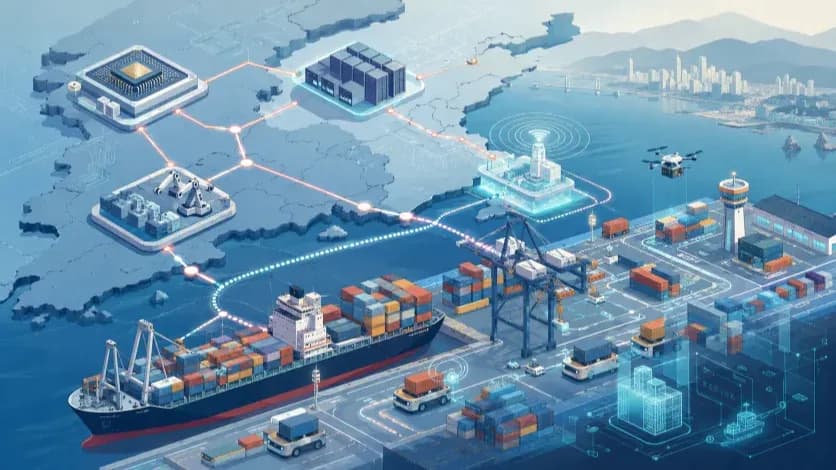
South Korea’s latest AI industrial strategy is beginning to turn artificial intelligence into geography. Semiconductor fabs are being tied to land, water, power and permitting speed; AI data centers to electricity, cooling, network infrastructure and corporate balance sheets; physical AI to robot production, manufacturing data and industrial sites where algorithms can be tested against machines. The result is a national industrial map built around places where large companies, infrastructure and state support can converge.
Busan is difficult to place on that map. The country’s largest port city has one of the world’s major container gateways, a maritime logistics system that runs around the clock, industrial zones in Gangseo, shipbuilding and marine-equipment suppliers, an emerging power-semiconductor cluster and a port authority now pursuing AI transformation. Those assets give Busan a serious industrial base, yet they have not been organized into the kind of national role that the government’s new AI strategy appears to reward: a memory fab, a hyperscale AI data-center campus or a robot-production hub backed by a major corporate investment.
The distinction matters because the June 29 mega-project did more than announce support for artificial intelligence. It framed AI as a physical industrial system. Chips provide the computing base. Data centers supply the infrastructure for training and inference. Physical AI moves machine intelligence into factories, vehicles, robots, logistics sites and industrial equipment. Regions that can attach those layers to large-scale capital become visible in the national plan. Places with diffuse assets, even substantial ones, remain harder to name.
Busan’s problem is therefore more precise than regional exclusion. The city has not been assigned a clear function in Korea’s emerging AI stack. It has physical infrastructure, industrial history and a globally significant port, but its strongest assets are distributed across public agencies, terminal operators, shipping lines, logistics firms, marine-equipment suppliers, industrial estates and labor systems. The port generates valuable operational data every day, yet those data are fragmented. The city has a maritime economy, yet the economy has not been translated into the language now shaping national AI policy: data factories, physical-AI testbeds, manufacturing AI clusters, robot deployment, foundation models, power infrastructure and anchor investment.
For Busan, the question is no longer whether the city can call itself an AI hub. Many cities can make that claim. The sharper question is whether Busan can turn the port from a logistics asset into AI infrastructure, with the governance, test sites, procurement demand and corporate participation needed to make maritime physical AI a national project rather than another local slogan.
Korea’s AI map now has a geography
The government’s latest industrial plan places AI inside a wider physical supply chain. Policy discussions around artificial intelligence often begin with models, chips and software talent, but the June 29 strategy gave equal weight to the infrastructure that allows AI to operate at national scale. A semiconductor fab requires large sites, reliable power, industrial water, wastewater treatment, suppliers and permitting speed. A data center requires electricity, cooling, fiber networks, land, grid access and companies willing to invest before demand is fully visible. Physical AI adds another layer: robots, sensors, actuators, machine tools, industrial vehicles and production lines need real sites where algorithms can be trained, tested and deployed under operating pressure.
The geography that follows from those requirements is uneven because the underlying industrial objects are uneven. A fab gives policymakers a production site around which land, water, suppliers and tax incentives can be assembled. A data-center campus gives government a power-and-compute project that can be matched with grid upgrades, cooling systems and corporate energy plans. A robot foundry or component cluster gives physical AI a manufacturing symbol, making it easier to connect national ambition to local investment. Regions with those objects become strategic nodes because they give the state and large companies something concrete to build around.
Busan’s difficulty begins with the absence of such an object. The city is not the obvious site for a memory megafab, where the decisive conditions are large contiguous land, water, power and a semiconductor supply chain organized around mass production. Its semiconductor route is narrower and more specialized, centered on compound and power devices rather than the scale logic of memory production. Busan is also less clearly positioned than energy-rich industrial sites in the race for hyperscale AI data centers, where power supply, cooling and large corporate commitments define the first tier of competition. Physical AI presents another challenge: the government’s initial language has gravitated toward robot production, component conversion and manufacturing AI, areas where Saemangeum, the Daegu-Gyeongbuk industrial base and other manufacturing regions have been given more explicit roles.
The city’s strongest remaining claim lies in a different layer of the physical-AI stack. Busan is not primarily a place where robots would be mass-produced. It is a place where machines, cargo, workers, vehicles and schedules already interact inside one of the country’s most complex operating environments. Ships enter and leave port, cranes lift containers, yard trucks cross terminals, refrigerated cargo requires monitoring, workers manage safety risks, trucking firms wait for slots and shipping schedules shift with weather, congestion and global trade flows. Those movements are the kind of real-world conditions that robots, sensors, digital twins and industrial algorithms must eventually learn to handle.
A container port offers what demonstration halls and laboratory pilots cannot easily reproduce: density, regulation, safety constraints, equipment diversity, unpredictable demand and continuous operation. Physical AI will have to move beyond scripted environments, and Busan Port is one of the few places in Korea where maritime machines and logistics algorithms can be exposed to those pressures at scale. The challenge is that the port has not yet been packaged as a national AI proposition. For years, Busan has spoken in the familiar language of maritime hub, logistics gateway and smart port. Korea’s new AI strategy speaks in the language of data factories, testbeds, manufacturing AI clusters, robot deployment and anchor capital. Busan’s next industrial task is translation.
Translation, in this context, means more than branding. The city would need institutions capable of turning port operations into shared data, simulation environments, test protocols and procurement demand. It would need a framework for connecting the Busan Port Authority, terminal operators, shipping lines, logistics companies, equipment makers, cloud providers, robotics firms and local research institutions without reducing the city to a passive test site. A port can become AI infrastructure only when the city can govern the data, define the test environment and ensure that the resulting systems create local capability rather than simply passing through.
Assets without an anchor
The government’s AI mega-project shows how industrial policy now works in Korea’s high-technology sectors. Regions become strategic when a large corporate commitment gives the state something concrete to support. A semiconductor fab can justify land preparation, transmission lines, water systems, supplier parks and permitting reform. A hyperscale AI data center can justify grid upgrades, cooling infrastructure and energy policy. A robot-production hub can justify component supply chains, workforce programs and manufacturing subsidies. Capital arrives first, or at least appears credible enough to be treated as if it will arrive, and public policy gathers around it.
Busan entered the announcement without that kind of object. Its port is nationally significant, its maritime economy is real, and its industrial zones still contain manufacturers tied to shipbuilding, machinery, mobility components and logistics equipment. The city also has a power-semiconductor route in Gijang and an AI-transformation agenda at the port. Each of those pieces matters. None has yet become the equivalent of a fab, a data-center campus or a robot foundry in the eyes of national industrial planning.
The difference is not only scale. A large corporate investment simplifies policy. It gives officials a site, an investor, a timeline, a headline number and a set of infrastructure demands. Busan’s assets are harder to convert into that format because they are spread across an operating system rather than concentrated in a single project. The port involves the Busan Port Authority, terminal operators, shipping lines, logistics firms, trucking networks, customs and quarantine systems, equipment suppliers, labor arrangements and central-government regulation. Its value lies in coordination, data and operating complexity. Those qualities are essential for physical AI, yet they do not produce the same immediate political clarity as a pledged factory or data-center project.
That gap helps explain why Busan’s AI claim remains less visible than the claims made by other regions. Honam can point to the language of memory fabs, even if the full build-out will require years of power, water and permitting work. Ulsan can point to a major AI data-center project connected to energy infrastructure and industrial land. Saemangeum can point to robot production and a planned manufacturing cluster. Daegu-Gyeongbuk can point to component conversion around existing manufacturing firms. Busan can point to the port, but the port has not yet been recast as an AI asset with a defined investment structure.
For the city, the absence of a corporate anchor creates a double problem. It weakens Busan’s position in the first round of national allocation, where ministries and large companies prefer projects that can be described through investment size, location and corporate name. It also exposes the risk of policy fragmentation inside the city. Port AI, maritime AI, power semiconductors, Gangseo manufacturing, logistics automation and energy infrastructure can all be discussed separately while failing to become a single proposition. A national strategy rewards a package. Busan is still presenting a collection.
The answer cannot be a simple demand for another conglomerate project. Busan’s industrial history gives the city reason to be cautious about anchoring its future to one outside investor. A factory can employ workers and raise output without leaving the region with control over technology, suppliers or investment decisions. Production can be local while the industrial command system remains elsewhere. Physical AI would repeat that pattern if Busan offered the port only as a place for outside firms to test equipment and extract data.
A stronger strategy would begin with the public asset Busan already has. The Busan Port Authority, together with the city, the Ministry of Oceans and Fisheries, terminal operators and research institutions, could function as the first anchor for a maritime physical-AI platform. The role of private companies would still be essential, especially cloud providers, robotics firms, sensor companies, shipping lines and equipment manufacturers. Their participation would need to be organized around shared test protocols, data governance, procurement pathways and local capability-building rather than one-off demonstrations.
A plant is not an industrial axis
Busan’s anxiety over the new AI map is shaped by an older manufacturing lesson. The city has seen large industrial promises arrive before, only to discover that production alone does not give a region control over technology, suppliers or future investment. A plant can raise output, employ workers and become a symbol of local industry while the decisions that matter most — product allocation, research priorities, sourcing, capital spending and long-term strategy — remain outside the city.
The automotive story still carries that warning. Busan once treated car manufacturing as a route into a new industrial era, and the city did gain a major production base. Yet the trajectory of the sector also showed the limits of a model built around an external corporate anchor. Ownership changed, global strategies shifted, model cycles depended on decisions made elsewhere, and the local economy learned that a factory floor is not the same thing as an industrial command center. The city kept an important manufacturing asset, but it did not become the headquarters of a self-directed automotive ecosystem.
That distinction matters for physical AI. If Busan responds to the latest national strategy by waiting for another large company to arrive with a single transformative project, it risks repeating the same pattern under a new technological label. A robotics company, cloud provider or global logistics technology firm could use Busan’s port as a test site without leaving the city with control over the data, the models, the equipment standards or the procurement pipeline. The location would be local. The value chain could still be governed elsewhere.
The lesson should not lead Busan to reject corporate capital. No serious physical-AI platform can be built without private firms that make sensors, robots, cloud systems, industrial software, port equipment, autonomous vehicles and digital-twin platforms. The issue is the order of control. If private capital defines the project first and Busan only provides the site, the city becomes an operating surface for other companies’ systems. If Busan defines the data environment, test rules, safety standards, procurement demand and local participation structure first, corporate capital enters a platform the city has helped design.
A port-based physical-AI strategy would therefore have to avoid two failures at once. It cannot remain a public-sector planning exercise with no private investment, because national industrial policy rewards projects with capital behind them. It also cannot become another case in which the city offers land, labor or operating data while strategic control flows outward. The narrow path between those risks is institutional design: a framework that gives companies enough reason to test and invest in Busan, while ensuring that the resulting knowledge, supplier opportunities and operational standards strengthen the region’s own industrial base.
Busan Port gives the city a stronger starting point than an empty industrial site would. The port is already a working system with public authority, terminal contracts, shipping traffic, equipment demand, safety obligations and measurable operating problems. Physical AI could be introduced through concrete needs rather than abstract ambition: reducing truck waiting times, predicting vessel arrival, automating dangerous lashing work, monitoring refrigerated containers, coordinating yard equipment, detecting safety risks and building simulation models for terminal operations. Each of those problems can become a test case. Taken together, they could become a platform.
The risk is that Busan treats those use cases as isolated smart-port upgrades. A camera system here, an AI prediction model there, a robot pilot in one terminal and a data dashboard in another would improve operations, but it would not create a new industrial axis. The city would need to connect those projects into a common architecture: shared data standards, repeatable test procedures, procurement rules that favor deployable systems, local maintenance and engineering capacity, and pathways for marine-equipment suppliers to move into AI-enabled hardware and software.
The port as a physical-AI data factory
Physical AI is often described through robots, and the government’s first round of industrial language has reinforced that association. Robot foundries, humanoid systems, actuators, sensors, component clusters and manufacturing AI are easier to visualize than the less visible systems that allow machines to operate in complex environments. For Busan, following that production-centered definition too closely would lead to a weak claim. The city is not positioned to compete with regions being organized around robot manufacturing or component conversion. Its route into physical AI has to begin elsewhere, with the environments where intelligent machines must prove that they can function outside controlled settings.
A port is one of those environments. Unlike a factory line, where processes can be enclosed, standardized and repeated inside a single corporate system, a major container port is a dense operating field shaped by many actors at once. Vessel arrival times depend on weather, global shipping schedules and berth availability. Crane operations depend on yard conditions, labor allocation, equipment reliability and cargo priority. Yard trucks, trailers and terminal vehicles move through constrained spaces where safety margins matter. Refrigerated containers require continuous monitoring. Dangerous cargo, customs procedures, trucking queues and real-time congestion introduce further variables. Physical AI systems designed for logistics cannot mature without exposure to that kind of friction.
Busan’s strongest claim therefore lies in operational complexity. Physical AI needs more than robotic arms or mobile platforms. It needs environments where perception, prediction, planning and control can be tested against moving equipment, shifting demand, safety rules and human work. A port produces those conditions every day. The machines are already there. The sensors are increasingly there. The operating problems are measurable. The missing layer is a coordinated AI architecture that turns port activity into training data, simulation models, test protocols and procurement demand.
That distinction matters because a smart-port agenda and a physical-AI agenda are not the same thing. A smart-port project can digitize forms, connect logistics data, install cameras, automate gates or build dashboards. Those improvements may raise efficiency without creating a deeper industrial platform. A physical-AI agenda would ask a different set of questions: which port tasks can be performed or assisted by machines, which operating conditions must be simulated before deployment, which safety thresholds define acceptable autonomy, which data are needed to train models, which suppliers can build deployable systems, and which public or private buyer will purchase the technology once it works.
Under that definition, Busan Port becomes more than a logistics gateway. It becomes a potential maritime physical-AI data factory. The term matters because it shifts attention from the port as a place where goods move to the port as a place where machines can learn. Vessel arrivals, crane cycles, yard congestion, equipment faults, refrigerated cargo alerts, worker-safety incidents, truck reservations and berth scheduling all produce traces of physical operations. If those traces remain locked inside separate systems, they will support narrow efficiency tools. If they are governed, standardized and connected, they can support broader models for port automation, safety prediction and maritime logistics control.
The same logic could extend from the port into Busan’s surrounding industrial base. Marine-equipment suppliers, logistics-equipment makers, shipbuilding-related firms and power-semiconductor companies would not have to become global AI giants to participate. They could move into AI-enabled hardware, sensing modules, control systems, maintenance tools, electric port equipment and safety devices designed for maritime environments. Gangseo and Mieum would matter less as generic industrial zones and more as the manufacturing layer behind a port-based testbed. The city’s semiconductor route, centered on power devices rather than memory scale, would also fit this pattern if it is tied to electric ships, port equipment, energy storage, data-center power systems and industrial mobility.
Busan’s opportunity is narrower than the rhetoric of becoming an AI hub, but more concrete. The city does not need to claim every part of the AI stack. It needs to claim the layer where maritime operations, industrial equipment, power systems and logistics data meet. That layer has value precisely because it is difficult, regulated and physical. A port that never stops moving is a harsher test environment than a demonstration hall, and physical AI will eventually need harsh environments.
The risk of becoming a test site without control
A testbed is not automatically an industrial strategy. Many cities have learned that hosting pilots can create visibility without creating durable local capability. Technology companies bring equipment, run demonstrations, collect performance data, refine their products and move on to larger markets. The host city receives a press release, a temporary project and perhaps a small operational improvement, while the intellectual property, software architecture, supplier relationships and commercial upside remain elsewhere.
Busan faces that risk if it presents the port only as a place where outside firms can test maritime AI systems. The port’s complexity is valuable precisely because it exposes robots, sensors, software and logistics algorithms to conditions that cannot be reproduced easily in a laboratory. That value could attract cloud companies, robotics firms, autonomous-vehicle developers, industrial software vendors and global logistics platforms. Yet the same value can be extracted if the city does not define rules for data access, model development, procurement and local participation before the testbed grows.
The danger is not hypothetical. Port operations generate commercially sensitive and safety-sensitive information: vessel schedules, cargo flows, yard congestion, equipment faults, gate movements, worker locations, trucking patterns, refrigerated-container alerts and incident records. If those data are handed over case by case to private vendors, Busan may help train systems that are later sold back to the port sector without building a local industry around them. The city would provide the operating environment while other companies capture the models, standards and markets.
Data governance therefore becomes an industrial question, not only a privacy or security issue. A maritime physical-AI platform would need to decide which data can be used for training, which must remain restricted, how commercially sensitive information is anonymized, who can access shared datasets, whether models trained on port data must return value to the port system, and how local firms and universities can participate in development. Without those rules, Busan’s most valuable AI asset — the operational reality of the port — could become a raw material extracted by others.
Procurement poses a second risk. Even well-designed pilots lose industrial meaning if no buyer exists after the demonstration stage. A lashing robot, autonomous yard truck, AI safety system or cold-chain monitoring tool can prove technically promising and still fail to become part of the port economy if terminals, public agencies or logistics firms have no budget, standard or incentive to purchase it. Demonstration funding alone creates projects. Procurement creates markets. Busan’s physical-AI strategy would need to connect test results to buying decisions, maintenance contracts, certification rules and operating standards.
Labor is the third pressure point. Physical AI in a port is inseparable from work. Automation may reduce dangerous tasks, improve safety and help manage labor shortages, but it can also intensify surveillance, change job classifications and shift bargaining power inside terminals. A port that introduces AI safety systems, autonomous vehicles and robotic equipment without a negotiated labor framework could face resistance even if the technology works. Busan cannot build a credible maritime AI platform by treating workers as an afterthought. Their knowledge of risk, workflow and equipment behavior is part of the operating intelligence that physical AI needs to learn.
A fourth risk lies in fragmentation. Busan already has many pieces that can be described as relevant to AI: port AX, K-Maritime AI planning, Gangseo industrial zones, power semiconductors, logistics platforms, smart-city infrastructure and university research. If each piece develops under a separate budget, ministry, agency or corporate partnership, the city may accumulate projects without creating a platform. Fragmentation would allow every actor to claim progress while leaving Busan without the unified industrial proposition that national policy rewards.
Avoiding these risks requires Busan to define the testbed before the market defines it for the city. The port authority, the city government, terminal operators, shipping lines, logistics firms, labor representatives and research institutions need a shared framework for what kinds of systems will be tested, how data will be governed, how safety will be certified, how successful technologies will be purchased, and how local companies will be included in deployment and maintenance. The framework does not have to exclude large technology companies. It has to prevent them from being the only actors that learn from the port.
What Busan should build now
Busan’s next move should not be another broad declaration that the city wants to become an AI hub. The national strategy has already made that language too generic to matter. A more credible response would identify the part of the AI stack where Busan has a defensible claim, then build the institutions, data rules and procurement channels around it. For Busan, that claim begins with maritime physical AI.
The first step would be to seek designation for Busan Port, the new port and the wider maritime logistics zone as a national maritime physical-AI testbed. Such a designation would have to mean more than permitting a few demonstrations inside terminals. It should define the port as a national site for testing AI systems that interact with ships, cranes, yard vehicles, containers, safety zones, cold-chain cargo, energy systems and human workers. The testbed would need access to live operational conditions, controlled simulation environments and safety protocols that allow new systems to be evaluated before they are deployed at scale.
The second step would be to build a Busan Port Data Factory. The phrase should not refer to a single warehouse of port data, because the port’s information is distributed across many owners and systems. It should refer instead to a governed structure for collecting, standardizing and using operational data in repeated industrial test cases. Vessel-arrival records, berth schedules, crane cycles, yard congestion, gate movements, truck reservations, refrigerated-container alerts, equipment maintenance logs, safety incidents and energy-use patterns could become the raw material for maritime AI models if they are organized under clear rules. Without those rules, the data remain fragmented operational records rather than an industrial asset.
The third step would be to connect the port to the city’s manufacturing base through a Gangseo maritime-manufacturing M.AX cluster. Korea’s manufacturing AI strategy is already moving toward data factories, industrial testbeds and AI-enabled production clusters. Busan should not try to enter that agenda as a generic manufacturing city. It should define Gangseo, Mieum, Noksan and nearby industrial zones as the manufacturing layer behind the port: a place for marine-equipment firms, logistics-equipment makers, power-device companies, control-system developers and maintenance providers to build systems required by maritime physical AI. The port would generate the operating problems. The industrial zones would help produce the hardware, software and service capacity to solve them.
The fourth step would be a port AI regulatory sandbox. Maritime physical AI cannot be built only through research funding because many of the most important systems require permission to operate in constrained and safety-sensitive environments. Autonomous yard trucks, lashing robots, drone-based inspections, AI-assisted safety monitoring, remote equipment diagnostics, electric port vehicles and digital-twin-based terminal planning all raise questions about liability, labor rules, safety certification, cybersecurity and data sharing. A sandbox would allow Busan to test those systems under defined conditions rather than waiting for national regulations to catch up case by case.
The fifth step would be a corporate testbed consortium designed around participation rather than dependency. Busan needs large firms, but it should not repeat a model in which outside companies define the project and the city supplies only land, labor or data. A consortium led by the Busan Port Authority and supported by the city, the Ministry of Oceans and Fisheries, terminal operators, shipping lines, logistics firms, cloud providers, robotics companies, equipment manufacturers and local universities could give private firms a reason to test in Busan while keeping the platform’s rules public. The consortium should make clear what data can be used, what local partners must be included, how successful systems can be procured and how intellectual property or operational standards will return value to the port economy.
The sixth step would be to tie Busan’s power-semiconductor and energy assets to the same strategy. The city’s semiconductor path is not a memory megafab path. Its more plausible role lies in compound and power devices used in electric ships, port equipment, energy storage, data-center power systems, industrial mobility and robotics. Those applications fit a maritime physical-AI strategy better than a broad attempt to compete with regions now positioned for memory fabs or hyperscale data centers. If Busan can link power semiconductors to electric port equipment, autonomous logistics vehicles, cold-chain systems and distributed-energy infrastructure, the city’s semiconductor policy would gain a clearer demand base.
The final step is institutional ownership. Busan cannot build a maritime physical-AI platform if each project remains inside a separate administrative silo. Port AX, the K-Maritime AI Belt, Gangseo manufacturing, power semiconductors, distributed energy, smart logistics and university research need one coordinating table with authority over project selection, data standards, testbed access, procurement design and national funding requests. Without such coordination, the city will produce many AI-related programs and no AI axis.
The port as Busan’s second chance
Busan missed the first draft of Korea’s new AI industrial map. The city was not named as a semiconductor megafab base, did not emerge as a first-tier hyperscale AI data-center anchor, and was not given the production language now attached to robot foundries and component clusters. That absence should not be softened into a story about untapped potential. It reveals a structural weakness: Busan has major industrial assets, yet those assets have not been assembled into a form that national AI policy can recognize as an axis.
The next response will determine whether the city remains on the margin of the strategy or enters it through a different route. Busan can spend the next few years chasing labels already claimed elsewhere, or it can define the missing layer in Korea’s physical-AI agenda. Robot production will be built where companies place factories. AI data centers will grow where electricity, cooling and corporate capital are already aligned. Busan’s strongest claim sits in the operating world those systems eventually have to serve: ports, ships, cargo, logistics equipment, workers, energy systems and maritime supply chains.
That claim has to be made with precision. A port is not automatically AI infrastructure because it is large, busy or globally connected. It becomes AI infrastructure only when its operations are converted into governed data, repeatable test environments, procurement demand, safety standards and local industrial capability. Busan Port already produces the physical complexity that AI systems need to confront. The city still has to build the institutional machinery that allows those conditions to become a national platform.
The stakes go beyond one regional development debate. Korea’s AI strategy is moving from software ambition into physical systems: fabs, grids, data centers, robots, factories and industrial data. In such a strategy, cities are valued for the functions they can perform inside the stack. Busan has not yet been assigned one. The port gives the city a credible answer, provided that the answer is framed as more than logistics modernization. Maritime physical AI would treat Busan Port as a place where machines learn, safety systems are verified, autonomous equipment is tested, power devices find industrial demand and marine suppliers move into AI-enabled products.
The old manufacturing lesson remains close. A region can host production without controlling the industrial future that production creates. Busan should not repeat that pattern by offering its port as an open testing ground for outside technology firms while data, models, standards and commercial value move elsewhere. The city’s task is to make participation possible without surrendering the platform. Public authority, private technology and port operations have to meet under rules that leave capability in the region.
The path is narrower than the language of an AI hub, and more demanding. It requires Busan to coordinate the Busan Port Authority, terminal operators, shipping lines, logistics companies, labor groups, marine-equipment suppliers, power-semiconductor firms, universities and national ministries around one proposition: the port as Korea’s maritime physical-AI testbed. That proposition needs budget, governance, test rights and buyers. It also needs a political decision to treat port data and port operations as strategic industrial assets rather than administrative byproducts of logistics.
Busan may not receive a single dramatic announcement comparable to a fab, a data-center campus or a robot foundry. Its anchor, if it builds one, will be less visible at first: a governed operating environment where ships, machines, cargo and workers generate the conditions physical AI needs to master. That kind of anchor is harder to explain than a factory. It is also harder for another city to copy.
The first AI map left Busan without a clear role. The second will not be handed to the city. Busan will have to make its port too important to leave out.
Continue this reporting
Reporting on the same issue
Related coverage selected from the article's desk, topics and newsroom relationships.
 NewsOct 25, 2026
The Long Bill for Busan’s Apartment City
Busan has about 958,000 apartments even as its population declines. Elevators...
 NewsOct 23, 2026
Busan’s Twelve-Year School Account Faces a Test Beyond Access
Busan’s PENZ promises one school account for 12 years, while BeAT brings AI t...
 NewsOct 22, 2026
Busan Port’s LNG and Methanol Plan: Who Pays to Keep Fuel Ready?
Busan already supplies ships with LNG and methanol, drawing on regional and i...
More from the author
More from this byline
Stay with the same line of reporting through more work from this byline.
 NewsOct 21, 2026
What a Small Mackerel Is Worth
Reader Signal
Community readWhat did this report leave you with?
Choose the signal that best reflects your reading. Select it again to remove it.
One response per article
No response selected
A moderated conversation about the reporting.
One-level replies and newsroom moderation keep the conversation anchored to this article.
Discussion Status
Open
Please sign in to join the discussion.
Newsletter
Weekly reporting and context from Busan and Korea.