Busan Reviews What Dadaepo Should Receive for a 3,000-Home Rezoning
Seongchang’s Dadaepo proposal matches the provisional increase in land value with KRW 90.95 billion in public contributions. Nearly 88 percent, however, is the appraised value of a civic parcel whose final institution, construction budget and operating plan have yet to be settled.

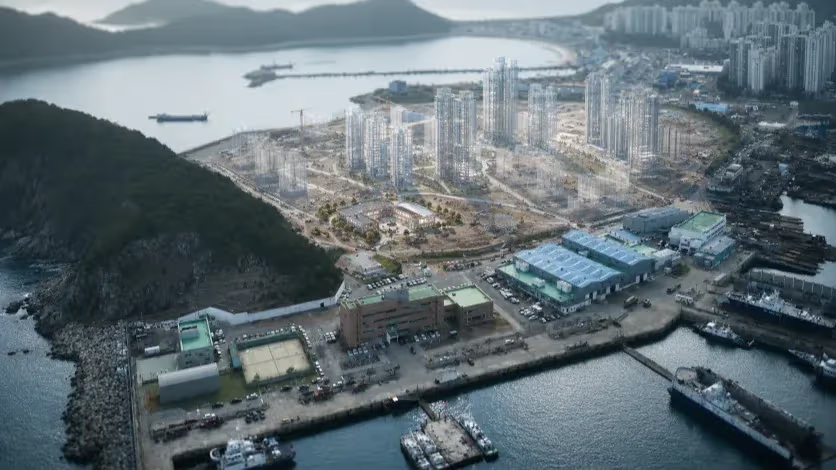
Nearly 88 percent of the proposed KRW 90.95 billion public contribution is the value of a civic site whose construction, operator and long-term funding remain unresolved.
Busan Mayor Jeon Jae-soo has ordered officials to reconsider the public-benefit package attached to a proposed 3,000-home redevelopment on Dadaepo’s industrial waterfront, opening an early test of how his administration will handle the city’s large negotiated-development projects.
The proposal covers 151,689 square metres occupied by Seongchang Enterprise in Dadae-dong. Almost all of the site is currently designated for industrial use. Seongchang is seeking to replace that zoning with 132,038 square metres of semi-residential land and 16,947 square metres of general commercial land, allowing 13 apartment towers of between 35 and 48 storeys alongside business, healthcare, leisure and cultural uses. Busan invited public comment in December 2025, and the City Council examined the negotiated contribution package in March 2026. The package was still being reviewed when Jeon ordered officials to reconsider its terms on July 13.
Jeon said Busan’s public-contribution agreements had too often produced apartment developments accompanied by parks, parking facilities and limited cash payments without clearly strengthening local industry, residential conditions or the wider urban economy. He instructed the planning bureau to revisit the Seongchang proposal and examine whether earlier agreements could be changed where legally and practically possible. His order begins an administrative and policy review; it does not itself amend Seongchang’s plan or give the city an unrestricted right to rewrite projects that have already moved through planning, financing or construction.
The immediate dispute concerns a provisional contribution valued at KRW 90.95 billion. Seongchang’s submission estimates that the land would rise from KRW 402.26 billion under the existing planning conditions to KRW 493.21 billion after rezoning, attributing the entire KRW 90.95 billion difference to the new development rights. The proposed contribution matches that provisional increase, so the published figures do not support a simple claim that Busan has waived the appraised gain from rezoning. The unresolved issue is the form in which the value would reach the public.
Most of the contribution is a site, rather than a completed facility
Seongchang assigns KRW 79.65 billion of the package to a 16,947-square-metre public-facility parcel. A 100-space underground public car park is valued at KRW 6 billion, the cash payment at KRW 4.84 billion and a 366-square-metre park parcel at KRW 457 million. The public-facility land therefore represents 87.6 percent of the proposed contribution, while cash accounts for slightly more than 5 percent.
The proposal illustrates one possible use for the civic parcel: a three-storey residential and cultural complex containing galleries, a bookstore, a live-performance space, a cultural centre, children’s facilities and commercial areas. The planning framework also allows cultural, assembly, education and research uses, leaving Busan and the developer room to alter the programme during negotiations. The released material does not identify a final institution, construction budget, operator or recurring source of money for staffing and maintenance. The KRW 79.65 billion figure measures the land beneath the proposed facility; it is not the estimated cost or value of a completed public institution.
Some of the project’s most prominent amenities belong to a different part of the site. An 8,070-square-metre privately developed mixed-use parcel is intended for a senior-healthcare complex and a marine centre, and the submission depicts medical services, hydrotherapy, fitness facilities, an infinity pool, restaurants, cafés and marine-leisure retail. Those businesses could attract visitors and create employment if Seongchang secures operators and investment, but city officials confirmed during the council hearing that the business and mixed-use parcels would be developed by the private project company. They are not the civic land that accounts for most of the KRW 90.95 billion package.
The distinction became a central point of dispute in the City Council. Councillor Bae Young-sook argued that facilities located beside 3,000 apartments would inevitably provide their largest benefit to the incoming residents and increase the attractiveness of the private development. Planning Director Baek Myung-gi replied that the facilities would remain open to the public and said Seongchang’s civic parcel could eventually be combined with public land from the neighbouring former Hanjin Heavy Industries project, creating a site of roughly 24,000 to 25,000 square metres for a larger destination under the Dadaepo redevelopment strategy. No final institution, funding arrangement or construction timetable for that combined site was presented during the hearing.
The council adopted an opinion calling for benefits that would serve Busan residents generally rather than function primarily as amenities for the new apartment population. Meeting that standard requires more than transferring legal ownership of a valuable parcel. Busan would need to decide what will be built, who will pay for it, when it must open and which institution can operate it over time; otherwise, the city could acquire waterfront land while inheriting an unfunded obligation to turn the site into a usable public facility.
Receiving the land may still prove to be the best bargain. A site of this scale could become more valuable and useful as Dadaepo develops, and fixing every operational detail before the planning decision may constrain future choices. The public debate should nevertheless distinguish between the asset Seongchang is offering now and the service Busan may have to finance later. The published contribution figure resolves the appraisal; it does not complete the institution.
Dadaepo already has residential density
The proposed towers would rise in a district already dominated by large apartment estates. Saha’s housing inventory lists Dadae Hyundai with 2,181 homes, a public rental estate with 2,107, Molundae Apartments with 2,960 and Lotte Castle Molundae with 3,462, alongside several other complexes containing more than 1,000 units. Seongchang’s 3,000 apartments would resemble another major residential district rather than the first substantial housing project on an underbuilt waterfront.
Dadae 1 and Dadae 2 contained 28,260 households at the end of 2025. The Seongchang proposal is equivalent to about 10.6 percent of that existing total. Of those households, 11,520 consisted of one person, producing a combined single-person household share of approximately 40.8 percent. These figures do not determine demand for a waterfront project, but they show why an apartment count alone cannot establish the number, age structure or spending power of the residents a development would add.
The wider Saha district has lost people even as its household count remained comparatively resilient. Its registered population fell from 371,909 in 2005 to 286,222 in 2025, while households increased from 126,389 to 139,728. Smaller household sizes allow demand for individual homes to persist while fewer residents support schools, shops, transport and other public infrastructure. Saha’s district-wide trajectory does not decide the future of the Seongchang site, but it makes the origins of the project’s buyers and tenants central to any claim that the development will reverse local decline.
Waterfront housing could draw working-age residents and families who might otherwise choose another part of Busan. It could also be filled by households moving from older apartments in Dadaepo or elsewhere in Saha. Both outcomes can support sales and improve individual housing conditions, although their effect on the district would differ sharply: one expands the local population and consumer base, while the other redistributes residents and spending within a shrinking area.
Busan has published the number, height and location of the apartments without releasing an estimate of how many occupants are expected to move from outside Saha, how many might transfer from nearby estates or what age and employment profile the project is designed to attract. No district-level assessment in the public record reviewed for this article measures the likely effect on older apartment centres. The absence of those projections does not demonstrate weak housing demand; it prevents apartment occupancy from being treated as evidence of net population growth.
Dadaepo has visitors and productive activity, but the connections are unclear
Dadaepo already draws substantial seasonal traffic. Saha recorded 525,000 uses of the eastern beach and 2.059 million of the western beach during the 2025 opening period, for a combined total of 2.584 million. These are cumulative usage counts rather than 2.584 million individual tourists, but they establish that the waterfront does not suffer from an absolute lack of visitors.
The figures do not show how long visitors remain, what proportion enters local businesses or how much spending reaches the existing streets around Dadaepo Beach Station, Dadaepo Port and the older apartment estates. A beach, ecological trail, public park and sunset can draw large crowds without requiring overnight stays or significant private consumption. Seongchang’s healthcare and marine-leisure programme could lengthen visits and create year-round activity, although the public proposal provides no operators, investment commitments or spending forecasts that would allow those effects to be assessed.
The waterfront also supports production. Dadaepo Port is a national fishing harbour with 310 locally registered vessels, annual fisheries output of 32,081 tonnes and production valued at KRW 38.55 billion, supported by a live-fish auction facility and fuel, water and wastewater infrastructure. Saha more broadly describes 23 percent of its land as industrial and records 1,555 companies in those areas. These figures do not require the existing Seongchang factory to remain in its present form, but they show that the development would replace part of a working waterfront rather than create value on economically empty land.
The opportunity is real. Better housing, accessible public space, healthcare, culture and marine tourism could connect Dadaepo’s residents, visitors and productive waterfront more effectively than the current arrangement. The physical mixture of apartments and commercial buildings does not establish that connection by itself. Residents may work and spend elsewhere, visitors may leave after using free public spaces, and new businesses may draw customers from older streets rather than enlarge the district economy.
Myeongji shows why occupied apartments do not guarantee occupied shops
Busan’s experience in Myeongji provides the closest local warning against using residential growth as a proxy for commercial demand. In the second quarter of 2025, vacancy among individually owned retail units reached 25.46 percent in Myeongji International City and 21.98 percent in Myeongji Ocean City, compared with a Busan average of 8.96 percent. A Busan Ilbo inspection found 37 vacant ground-floor units in one apartment complex that had begun receiving residents in 2019.
Myeongji and Dadaepo differ in household structure, transport, geography and development history, so those vacancy rates cannot predict the outcome at Seongchang. The comparison establishes a narrower point: apartment occupancy and commercial viability require separate evidence. The two Myeongji districts were initially allocated more than 290,000 square metres of commercial land, while delayed transport infrastructure and additional supply in nearby Eco Delta City placed more premises in competition for a market that remained heavily dependent on local households.
Seongchang’s private medical, wellness and marine-leisure uses may generate stronger destination demand than conventional apartment retail. That case would be more convincing with committed operators, projected visitor numbers, expected sales and an assessment of the effect on businesses already operating in Dadaepo. The released plan identifies possible uses and building capacity, but it does not disclose a district-level commercial-demand study.
The missing analysis matters because development can change where consumption occurs without increasing its overall volume. A lively new cluster inside Seongchang could draw customers from older apartment centres, the port and existing shopping streets. Such a result may still produce a successful private development; it would offer weaker evidence of recovery across Dadaepo.
The project next door exposes the risk of execution
The former Hanjin Heavy Industries site beside Seongchang reveals a different weakness. HSD advanced a plan for 3,095 apartments in 11 towers of up to 48 storeys, along with a school, park, underground parking, commercial uses, marine-cultural facilities and hotel accommodation on 178,757 square metres. The project moved through major planning and approval stages, including approval of its housing programme and a permit for the marine-cultural parcel.
Construction did not follow. HSD had financed the land through approximately KRW 380 billion in bridge loans, but interest arrears, difficulty securing a contractor and the failure to convert the debt into full project financing eventually pushed the property into an official auction process. The latest detailed account located for this article, published in May 2026, reported that all 13 rounds had failed and that the site remained available for a negotiated sale; its appraised value was about KRW 431.15 billion, while the minimum price in the thirteenth round had fallen to roughly KRW 201.53 billion.
Those auction results are not direct evidence that buyers have no interest in new housing in Dadaepo. A purchaser would acquire a complicated package containing apartment land, a school, roads, parkland, commercial and cultural sites, public obligations, construction costs and substantial financing requirements. The process tested the feasibility of the entire development structure at the offered terms rather than the value of unrestricted residential land.
Hanjin remains relevant because it had a large waterfront site, planning approvals, thousands of proposed homes, a hotel concept and an extensive package of public and private amenities. Those components never became a financeable sequence connecting the land, contractor, full construction funding, apartment sales and delivery of the non-residential facilities. Planning created development value before the promised district could be built.
Busan officials have suggested combining the public parcels from Hanjin and Seongchang to create a stronger civic destination. That ambition links part of Seongchang’s public-benefit narrative to a neighbouring project whose ownership, financing and construction timetable remain unresolved. Hanjin’s 3,095 homes cannot be treated as certain future supply, yet they remain relevant to any assessment of the housing, school, transport and commercial demand that Dadaepo may eventually have to absorb.
The replacement factory remains a company projection
Seongchang’s property differs from Hanjin’s because production continues on part of the site. City officials told the council that approximately 20 percent of the existing factory remained active, largely in plywood manufacturing. The company proposes to relocate from roughly 147,000 square metres in Dadaepo to a 33,000-square-metre site in Gijang, while increasing employment from about 100 workers to approximately 250.
A smaller plant does not necessarily mean lower output or fewer jobs. Modern machinery, more efficient storage and a changed production process could allow Seongchang to operate more productively on a much smaller site. The council record provides no investment amount, production forecast, construction schedule, job classification or evidence of committed financing that would allow the projection to be tested.
Councillor Lee Seung-yeon asked whether Busan could compel the company to complete the Gijang factory and deliver the employment increase after receiving the rezoning benefit in Dadaepo. The planning director acknowledged the concern and said the city would examine it, but no enforcement mechanism was identified during the hearing.
The order of events gives the issue its significance. Rezoning would create a valuable development opportunity on the Dadaepo property, while construction of the replacement factory, transfer of production and additional employment would follow through separate corporate decisions. Unless the final agreement ties those stages together, the residential rights can become fixed before the industrial replacement cited in support of the project is secured.
The same caution applies to the privately proposed healthcare, hospitality and marine-leisure uses. They could bring employment and outside revenue into Dadaepo, producing a stronger local economy than the partly used factory now supports. They remain proposals until operators, capital and opening dates are attached to them. Comparing the existing and future economies requires evidence about production, wages, employment and external spending alongside the value of the new property.
Jeon’s review must define what will be delivered
Busan has quantified the physical transaction with considerable precision. Seongchang’s proposal states how much land would change use, how many apartments could be built, how high they could rise and how much the planning decision is expected to add to the land’s appraised value. The city has not released an equivalent model for net population growth, daytime employment, visitor spending, demand for new commercial space, effects on existing businesses or the full cost of opening and operating the proposed public facility.
No forecast can guarantee where every buyer will come from, how much each visitor will spend or which business will survive. Busan can require the assumptions behind the development to be disclosed and separate broad expectations from obligations the developer can control.
For the civic parcel, the final bargain should identify the facility, construction payer, operator, opening deadline and long-term source of funding. If the selected institution cannot be financed, the agreement needs an alternative contribution rather than an indefinite undeveloped site. A valuable parcel is a legitimate public asset; presenting it as a complete public benefit before the building and operating structure are secured creates a different impression.
The factory relocation requires a comparable sequence. Control of the Gijang site, financing, construction milestones, transfer of production and the method used to count the promised employment should be settled before Busan loses practical leverage over the residential development rights. Private non-residential facilities used to support the economic case can also be tied to housing phases, reducing the risk that the apartments advance while the employment- and visitor-generating programme remains optional.
Commercial supply must be assessed across Dadaepo, including the unresolved Hanjin development, rather than calculated from Seongchang’s future residents alone. Roads, pedestrian routes and public spaces should connect the development with the subway, beach, port and existing business districts so that activity can circulate through Dadaepo rather than end inside a self-contained waterfront complex.
Jeon’s review cannot make one private development reverse two decades of population loss. A planning agreement cannot ensure that every visitor becomes a customer or that every shop succeeds. It can prevent uncertain outcomes from being counted as public benefits before funding, deadlines and enforceable responsibilities have been attached to them.
Rezoning is likely to increase the value of Seongchang’s land, and the proposed towers would transform the physical appearance of the waterfront. Those are the clearest outcomes in the plan. A functioning civic institution, a verifiable industrial investment, sustainable commercial demand and economic activity extending into the surrounding neighbourhood require a more deliberate agreement.
Busan has calculated what its planning decision could add to the land. The unfinished negotiation is about what Dadaepo will receive in return.
Continue this reporting
Reporting on the same issue
Related coverage selected from the article's desk, topics and newsroom relationships.
 NewsOct 22, 2026
Busan Port’s LNG and Methanol Plan: Who Pays to Keep Fuel Ready?
Busan already supplies ships with LNG and methanol, drawing on regional and i...
 NewsOct 16, 2026
What Is Still Worth Going to See?
Busan’s biennale faces questions of artistic judgment and institutional care....
 NewsOct 14, 2026
What Became of Busan’s University Streets?
From 2015 to 2023, registered businesses grew near Pusan National University...
More from the author
More from this byline
Stay with the same line of reporting through more work from this byline.
- NewsOct 22, 2026
Busan Port’s LNG and Methanol Plan: Who Pays to Keep Fuel Ready?
 NewsOct 12, 2026
Bukangi, the Shark That Stayed in Busan’s North Port
Reader Signal
Community readWhat did this report leave you with?
Choose the signal that best reflects your reading. Select it again to remove it.
One response per article
No response selected
A moderated conversation about the reporting.
One-level replies and newsroom moderation keep the conversation anchored to this article.
Discussion Status
Open
Please sign in to join the discussion.
Newsletter
Weekly reporting and context from Busan and Korea.