Busan-Jinhae Free Economic Zone at 22: Built Out, Still Not Working as One
The Busan-Jinhae Free Economic Zone has scale, logistics strength and industrial weight. What remains less settled is whether 22 years of development produced a durable regional system — or simply a large zone with strong parts and weak links.

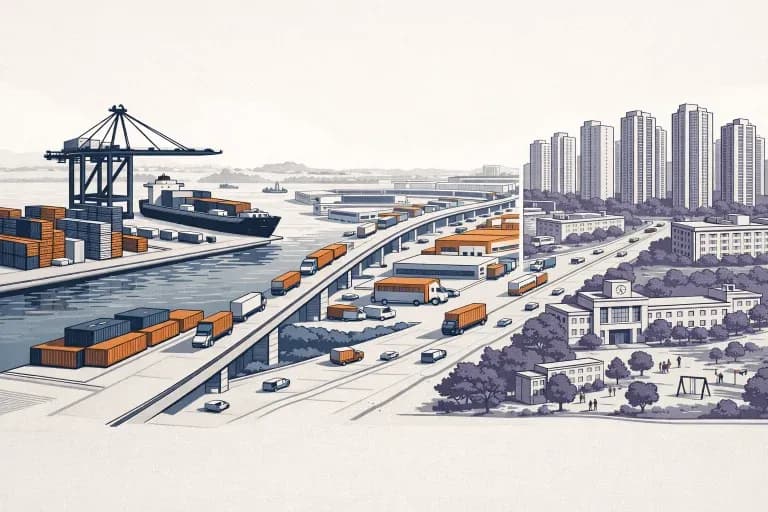
BUSAN — With its current development timetable running to 2027 and its reported development rate at 98.7 percent, the Busan-Jinhae Free Economic Zone has reached the point where construction no longer explains enough. After two decades of land development, port expansion and housing growth, the harder question is whether BJFEZ has become a functioning free economic zone — or simply a large one.
The Build-Out Case Is Closed
For more than two decades, the Busan-Jinhae Free Economic Zone has been presented as one of South Korea’s major regional development projects: a port-centered zone meant to link logistics, manufacturing, foreign investment and new urban districts across Busan and Jinhae. By now, the physical scope of that effort is not really in dispute. BJFEZ’s official development outline places the zone at roughly 49.9 square kilometers, divided into 22 districts, with a development period running from 2003 to 2027. It is organized across five large areas — New Port, Myeongji, Jisa, Ungdong and Dudong — each assigned a different mix of logistics, industry, international business and residential support.
That matters because it removes both the easiest criticism and the easiest defense. BJFEZ is not an empty designation. Too much land has been opened, too much infrastructure laid, and too much industrial and logistics value has accumulated for that. But once a zone reaches this stage, physical expansion stops being a sufficient answer to every question about it. In the early phase of a free economic zone, land supply and infrastructure are not side metrics; they are the project itself. Once that phase nears completion, the same metrics begin to lose explanatory power. Roads do not tell you whether firms are staying. Housing supply does not tell you whether settlement is stable. Industrial plots do not tell you whether districts have begun to reinforce one another.
BJFEZ itself is now speaking in those terms. In March 2026, it said the zone had reached a 98.7 percent development rate and framed its next phase around Jinhae New Port, Gadeokdo airport, strategic industries, better one-stop support and stronger settlement conditions. In other words, the authority is no longer describing its future mainly through additional build-out. It is describing it through reorientation. That shift is revealing. Institutions speak this way when the first story has reached its limit.
This is also why BJFEZ deserves to be judged against the wider Korean FEZ system rather than only against its own past. Korea now operates nine free economic zones, all formally intended to improve both the business environment and living conditions for foreign-invested firms. That national frame matters because BJFEZ is no longer young, no longer small, and no longer short on physical assets. Some zones developed cleaner metropolitan identities. Others built sharper sectoral stories around bio, AI, batteries or advanced manufacturing. Busan-Jinhae built one of the country’s most practical port-and-industry zones. Its problem is not irrelevance. Its problem is that, after 22 years, it is still easier to explain what the zone was built around than what it has fully become.
Myeongji and the Gap Between Name and Use
If one district best exposes the limits of the BJFEZ story, it is Myeongji. Officially, Myeongji was never meant to be just a large housing area on Busan’s western edge. Within BJFEZ’s development structure, it was assigned international business, housing, logistics and advanced-industry functions. That makes the district more than a local planning case. It makes Myeongji the clearest test of whether BJFEZ’s broader promises translated into lived urban form.
But that is not the order in which the district took shape. Housing arrived first and defined the place fastest. The functions that were supposed to make Myeongji feel less like a large residential district and more like an internationally oriented urban node came more slowly. That remains visible now. In February 2026, Busan announced that the Royal Russell Busan Campus had completed major permit procedures, with construction planned for September 2026 and opening targeted for August 2028. The city described the project as part of the educational and residential base needed to attract foreign investment and overseas talent. That may help the district later. It also shows how late some of the district’s most basic international-settlement functions are arriving.
That timing changes how the last two decades should be read. If a district’s most visible growth comes first through apartment supply, while educational, medical and broader settlement institutions are still being assembled in year twenty-two, then residential growth has already done most of the work of defining the place. A name can promise internationalism. A district still has to live like one. In Myeongji, the sequence ran the other way. The result is not that the district became meaningless. It is that it became narrower than it was supposed to be.
This is where comparison matters. Housing exists in every free economic zone. That is not the issue. What makes Myeongji more revealing is that housing appears to have outpaced the very functions it was supposed to support. In more clearly structured FEZ districts, residential areas tend to follow or reinforce a recognizable industrial, research or international-business role. In Myeongji, the social meaning of the district appears to have formed before that broader role became institutionally persuasive. Residential life was not just part of the district. It became the district’s strongest fact.
That is why the criticism of Myeongji should not be reduced to aesthetics. The problem is not simply that there are too many apartment towers, or that the district feels repetitive. The deeper issue is that residential absorption became the district’s dominant urban fact before the institutions that were supposed to justify its broader role had taken shape. Once schools, family retail, commuter life and apartment turnover begin to define a place at scale, they do more than fill land. They fix the social meaning of the district. By the time later projects arrive — international schooling, medical complexes, upgraded branding — they are no longer founding elements. They are attempts at correction.
When Growth Comes in Too Narrow a Form
The newer population data makes that narrowing easier to see. Based on the user’s compiled data for March 2024 to February 2026, Myeongji International New Town’s population barely moved, slipping from 54,433 to 54,176, a decline of 257 people or 0.47 percent. That is not the profile of a rapidly expanding frontier district. It is the profile of a large residential area that has already entered a mature, stabilized phase.
The age structure tells the more important story. In Myeongji International New Town, 0–19 accounts for 26.6 percent of the population, 20–39 for 25.7 percent, 40–59 for 34.0 percent, and 60+ for 13.7 percent. In other words, the district still looks relatively young in aggregate, but its center of gravity has already moved upward into established family and middle-age cohorts. It is no longer best described as a fast-growing new town driven mainly by incoming young households. It is better understood as a large family district whose first generation of growth is now aging in place.
That becomes even clearer in Ocean City, one of the district’s key living areas. There, population fell from 30,035 to 29,447 over the same period, a decline of 588 people or 1.96 percent. Ocean City still has a high child share at 27.9 percent, but its 20–39 population is only 18.3 percent, while 40–59 accounts for 38.0 percent and 60+ for 15.8 percent. Its ageing index is 0.56. More telling than the headline figures are the internal shifts: the biggest declines came in the 0–9, 30–39 and 40–49 groups, while gains appeared in 50–59, 10–19 and 70–79. That is not a collapse. It is something more structurally revealing. It suggests a district where the first generation of family-oriented growth is moving upward in age while replenishment from younger households has weakened.
This is what makes the current phase of Myeongji more significant than the older shorthand about a “young new town.” The district still looks young in aggregate, but that youth increasingly has the character of a maturing first-generation family district rather than a socially mixed urban center. Ocean City, in particular, suggests what happens when a housing-led new town is no longer replenished strongly enough by younger households: it does not fail dramatically, but it begins to age in place.
That distinction matters because it points to the real weakness of this kind of new-town growth. A district shaped too heavily by one household type can look lively for years. Schools fill quickly. Family retail follows. Streets and services settle into a predictable pattern. But what appears to be vitality can turn into dependence on one demographic base and one consumption structure. A place built this way may remain orderly, populated and functional in a narrow sense while becoming less varied and less resilient over time. The problem is not that Myeongji is aging. The problem is that it may be aging without enough social replenishment and without enough functional diversity to offset that aging.
The 2018 Busan Metropolitan Council materials hinted at this earlier phase of concentration, noting that residents in their thirties and forties accounted for 41.3 percent of Myeongji-dong at the time, compared with 29 percent for Busan overall and 37 percent for Gangseo District. That figure should not be used as a current snapshot. But it does help frame the longer arc: Myeongji was already weighted toward a narrow life-stage profile, and the recent data suggests that the first generation of that structure is now simply moving upward in age rather than being replaced by a more varied social mix.
A Zone with Strong Parts, Still Not Working as One
Myeongji matters because it points back to the larger problem inside BJFEZ. The zone was designed as a set of complementary districts, not isolated enclaves. New Port was supposed to anchor logistics. Jisa was supposed to carry advanced production. Myeongji was supposed to support business and settlement. Ungdong and Dudong were supposed to add support functions, leisure capacity and room for growth. The model only works if those functions deepen their links over time.
The difficulty is that large zones rarely develop at one pace. Port infrastructure moves on national logistics strategy. Industrial districts move with corporate cycles. Housing moves with developer logic, finance and household demand. Education and medical facilities often arrive later. Investment promotion runs on another clock again. When those rhythms separate, a zone can become highly legible in pieces while remaining incomplete as a whole. That is the central problem now facing BJFEZ. Its strengths are real. Its port base is strong. Its industrial relevance is clear. But it is still hard to say that the zone works as one. Too often, it reads as a port here, a factory cluster there, a housing district elsewhere, and a strategic narrative trying to stitch them together afterward.
It is tempting to turn that outcome into a simple blame story. That would miss the point. What happened in Myeongji, and what remains unresolved in BJFEZ more broadly, is better understood as the product of different pressures moving at different speeds than of one institution suddenly abandoning the plan. Land development rewards supply and absorption. Housing markets reward predictability and immediate demand. Strategic planning rewards long horizons and mixed-use ambition. International settlement takes time, institutions and sustained coordination. In that setting, the faster logic usually wins unless the slower one is protected early and deliberately. That is the deeper structural problem. The system rewarded what was easiest to build and fill while underproducing what was slower, harder and more central to the district’s original promise.
That does not absolve BJFEZ or local government. It sharpens the question they now face. BJFEZ’s own stated purpose is to provide a business and living environment for foreign-invested firms. Busan, in turn, is still trying to deepen Myeongji through international-school and settlement infrastructure. Those moves matter, but they also underline the same point: functions that should have helped define the district much earlier are still arriving after the district’s social character has largely been set. The issue is not whether those additions are welcome. It is whether they arrived early enough to shape the first model rather than patch the limits of it.
Placed within the wider Korean FEZ system, BJFEZ is clearly not marginal. Korea’s FEZ framework still presents these zones as places designed to improve both business conditions and living environments, and Busan-Jinhae remains one of the system’s more consequential zones in strategic terms. It has more logistical and industrial weight than many peers. Its relevance does not need to be invented. But relevance is not the same as resolution. Compared with more legible FEZ models, Busan-Jinhae is still harder to sum up in mature form than the construction story would suggest. It is not a clean metropolitan platform in the Incheon mold. Nor does it lean on a single sharply defined sectoral identity. Its strength is practical. Its weakness is definitional. It is easier to explain what BJFEZ was built around than what it has fully become.
That ambiguity may be tolerable in the early years of a development zone, when future potential can cover for present unevenness. It becomes more costly as build-out nears completion. A mature zone is eventually judged not by what it might still attract, but by the sort of place it has already produced. On that score, BJFEZ is hard to dismiss and harder to defend. It has scale. It has strategic weight. It has institutional continuity. What it still does not fully have is a convincing answer to the question that matters most once construction recedes: why these districts, in this form, amount to more than a large and important collection of separate functions.
That is why BJFEZ’s turn toward a second-phase agenda matters. In March 2026, it framed its next chapter around FEZ expansion tied to Jinhae New Port and Gadeokdo airport, strategic industries, stronger execution, and better settlement conditions. In parallel, it has pushed more explicit “Phase 2” language around higher-value logistics and a tri-port strategy. Those are not the terms of an institution content with its first form. They are the terms of an authority trying to explain what comes after the build-out story runs out. The next phase cannot be carried by land supply alone. It will be judged by whether the zone can deepen the parts of the original promise that remained thin: settlement depth, stronger links between industry and ordinary life, and a clearer logic for the districts it already has.
It is too lazy to call BJFEZ a failure. Too much has been built, and too much of it matters. It is also too easy to call it a success simply because the map is now full. Build-out is not the same as resolution. Size is not the same as balance. After 22 years, BJFEZ has largely finished the physical work. What it has not yet finished is the argument for what all that work added up to. The next phase will not be judged by how much more land it opens. It will be judged by whether the zone can make its districts work together as more than neighboring functions. Until then, BJFEZ remains what it now plainly is: built, strategic, and still not working as one.
Continue this reporting
Reporting on the same issue
Related coverage selected from the article's desk, topics and newsroom relationships.
 NewsOct 22, 2026
Busan Port’s LNG and Methanol Plan: Who Pays to Keep Fuel Ready?
Busan already supplies ships with LNG and methanol, drawing on regional and i...
 NewsOct 16, 2026
What Is Still Worth Going to See?
Busan’s biennale faces questions of artistic judgment and institutional care....
 NewsOct 14, 2026
What Became of Busan’s University Streets?
From 2015 to 2023, registered businesses grew near Pusan National University...
More from the author
More from this byline
Stay with the same line of reporting through more work from this byline.
- NewsOct 22, 2026
Busan Port’s LNG and Methanol Plan: Who Pays to Keep Fuel Ready?
 NewsOct 12, 2026
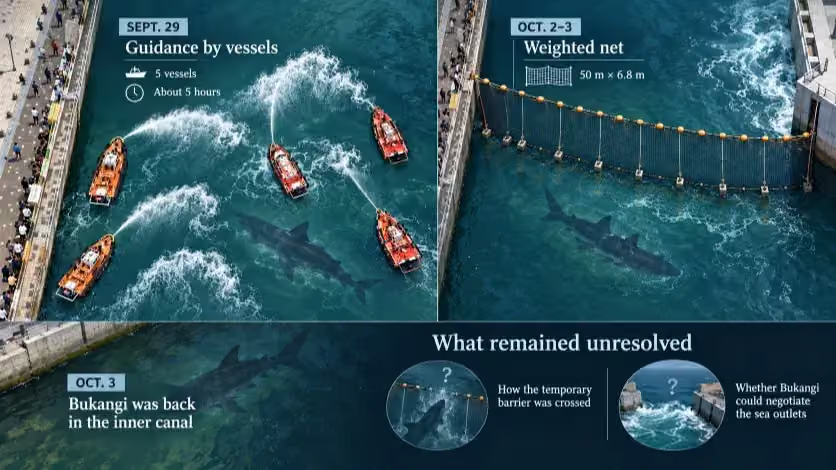
Bukangi, the Shark That Stayed in Busan’s North Port
Reader Signal
Community readWhat did this report leave you with?
Choose the signal that best reflects your reading. Select it again to remove it.
One response per article
No response selected
A moderated conversation about the reporting.
One-level replies and newsroom moderation keep the conversation anchored to this article.
Discussion Status
Open
Please sign in to join the discussion.
Newsletter
Weekly reporting and context from Busan and Korea.