Analyzing Busan: A Comprehensive Examination of Demographics and Crime Rates
As South Korea's second most populous city after Seoul, Busan's dynamism stretches beyond its well-known reputation as a bustling port and holiday destination. Comprised of 15 'Gu' (districts) and 1 'Gun' (county), Busan presents a diverse and multifaceted sociocultural tableau, housing over 3.36 million citizens according to the latest statistics. Based on data from 2022 The demographic profile of Busan is dispersed unevenly across its administrative regions. At the helm is the thriving distr


As South Korea's second most populous city after Seoul, Busan's dynamism stretches beyond its well-known reputation as a bustling port and holiday destination. Comprised of 15 'Gu' (districts) and 1 'Gun' (county), Busan presents a diverse and multifaceted sociocultural tableau, housing over 3.36 million citizens according to the latest statistics.
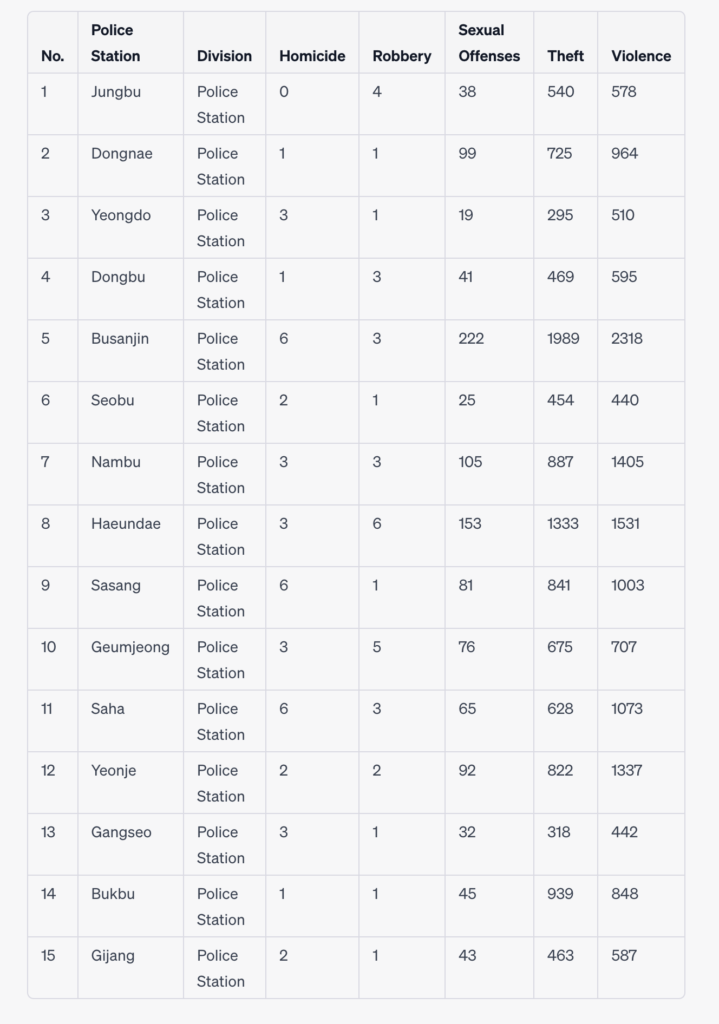
Based on data from 2022
The demographic profile of Busan is dispersed unevenly across its administrative regions. At the helm is the thriving district of Haeundae-gu, renowned globally for its spectacular beaches and dynamic nightlife. With 391,279 residents, it is the most populous district. Not far behind is Busanjin-gu, a district known for its buzzing shopping scene and vital transportation network, with a population of around 359,061.
Other districts such as Buk-gu and Dongnae-gu, boast populations of 280,662 and 274,400 respectively, each offering unique societal and cultural experiences. The spectrum ranges from Jung-gu, the historical nucleus of Busan, with the smallest population of 41,913, to the commercial and residential landscapes of Saha-gu, Geumjeong-gu, and Yeonje-gu, each adding a distinct piece to the city's rich mosaic.
However, a comprehensive understanding of Busan's crime rates necessitates more than a superficial glance at raw numbers. The real insights lie at the intersection of population statistics and crime rates. For instance, while Busanjin-gu district reports the highest absolute number of crimes, its per capita crime rate stands at around 0.88%, which can be attributed to its large population. Meanwhile, Haeundae-gu, with fewer reported crimes but a higher population, shows a marginally higher per capita crime rate of 0.91%.
Similarly, Jung-gu, with the smallest population, shows a higher per capita crime rate, indicating that crime rates can be misleading if population densities and sizes aren't considered.
The types of crimes also vary greatly among the districts. In Busanjin-gu, the district with the highest number of reported crimes, the most common offenses are theft and violent crimes, followed by sexual offenses. Haeundae-gu, a tourist hotspot, also records a significant number of thefts. Districts like Dongnae-gu and Buk-gu most commonly face theft and violent crimes.
On the other hand, Jung-gu, with the smallest population, presents a different picture, with violent crimes and sexual offenses being more common than thefts. This crime pattern highlights how each district's unique social, economic, and demographic characteristics play a role in the types of crimes committed.
Saha-gu, with a population of 306,473, reports a total of 1,775 incidents of the five major crime categories (murder, robbery, sexual crimes, theft, and violence). This district experiences a moderate level of criminal activity compared to other districts in Busan. The most prevalent crime type is theft, similar to many other districts. Violent crimes follow closely behind, underscoring the need for strategies to ensure public safety. However, when considering the total population of Saha-gu, the per capita crime rate is approximately 0.58%, which is lower than some of the other larger districts.
On the other hand, Sasang-gu, with a smaller population of 208,500, reports a total of 1,932 incidents across the five major crime categories. While the total number of crimes is higher than Saha-gu, the most common crimes are still theft and violent crimes. With a higher per capita crime rate of approximately 0.93% compared to Saha-gu, it's evident that Sasang-gu faces a more significant challenge regarding crime despite having a smaller population.
Seo-gu, with a population of 107,255 residents, reported a total of 922 major crimes, including murder, robbery, sexual offenses, theft, and violence. The primary form of crime in Seo-gu, much like in other districts, is theft, followed by instances of violence. However, it's worth noting that compared to some other districts of similar or larger population sizes, such as Saha-gu or Sasang-gu, the total number of crimes reported in Seo-gu is lower. When calculating the per capita crime rate, Seo-gu presents a rate of approximately 0.86%, which is lower than that of Sasang-gu (0.93%) but higher than that of Saha-gu (0.58%). Despite having a lower total population, Seo-gu's per capita crime rate underscores the need for public safety measures in the district.
Gangseo-gu district exhibits a unique crime profile. With a population of 148,217, the district reported a total of 796 serious crimes, which include murder, robbery, sexual offenses, theft, and violence. The dominant form of crime in Gangseo-gu, similar to most districts, is theft, followed closely by acts of violence. However, when compared to other districts with similar or larger populations, Gangseo-gu presents a slightly lower total crime count. The per capita crime rate for Gangseo-gu is approximately 0.54%, which is lower than in many other districts of Busan. For example, Seo-gu and Sasang-gu have higher per capita crime rates of 0.86% and 0.93%, respectively.
These statistics highlight that despite being a mid-sized district in terms of population, Gangseo-gu maintains a relatively low crime rate. This suggests that factors other than population size - perhaps socio-economic conditions, community cohesion, or effective local law enforcement strategies - may be contributing to the lower levels of crime in the district.
These variations in crime types across different districts make it clear that a one-size-fits-all approach may not be the most effective strategy for crime prevention in Busan. Therefore, it's crucial for policymakers and law enforcement agencies to adopt a more nuanced and localized approach to crime prevention and control. By understanding the specific crime patterns in each district and the underlying contributing factors, they can develop more effective and tailored strategies to ensure the safety and security of all Busan's residents.
The Weekly Breeze
Keep pace with Busan's deep narratives.
Delivered every Monday morning.